TLDR
RTA (ready-to-assemble) cabinets are worth it when your kitchen layout fits standard sizes, the cabinet specs are solid, and someone competent has time to assemble them correctly. They can save 15% to 50% compared to pre-assembled or semi-custom options. They are not worth it when you need custom sizing, lack assembly space, or choose a low-grade product just because the price is low.
Quick Take: Are RTA Cabinets Worth Buying?
If you want the short answer, yes—RTA cabinets are worth buying when you choose a high-quality cabinet line and your kitchen uses standard cabinet sizes.
Choose RTA cabinets if:
– You want to save 15% to 50% compared to assembled cabinets.
– Your kitchen has a standard layout.
– You or your installer can assemble cabinets properly.
– The cabinets use plywood boxes, quality hardware, and KCMA-certified construction.
Avoid RTA cabinets if:
– You need custom sizes.
– Your project has unusual layouts.
– Labor costs eliminate the savings.
– The supplier has poor warranty or replacement support.
The biggest mistake buyers make is assuming every RTA cabinet is low quality. In reality, RTA only describes how the cabinet ships—not how well it is built.
The Short Answer
Yes, RTA cabinets can absolutely be worth it. But “RTA” tells you how the cabinet ships, not whether it is any good. That distinction matters more than anything else in this article.
RTA cabinets arrive flat-packed with pre-cut parts, hardware, pre-drilled holes, and instructions. The buyer or installer builds the boxes before they go on the wall. Because the manufacturer skips factory assembly and ships compact boxes instead of bulky built cabinets, the price drops. According to Fine Homebuilding, RTA cabinets can cost 30% to 50% less than comparable assembled cabinets.
That savings is real. But it comes with conditions. You are trading money for time, skill, and risk. Whether RTA cabinets are worth it depends on three things: whether standard cabinet sizes fit your layout, whether the cabinet construction is actually good, and whether the supplier’s support holds up when something goes wrong.
If you are comparing cabinet options for an upcoming project, contact Krafter’s Land for free design consultations, 3D renderings, and professional guidance on what cabinet type fits your needs.
What Does RTA Mean in Cabinets?
RTA stands for ready to assemble. These are cabinet kits where every part (sides, top, bottom, back, shelves, doors, hinges, drawer slides) ships in a flat box. The pieces are factory-cut, factory-drilled, and factory-finished. You just put them together.
A few things RTA does not mean:
RTA does not mean cheap. Some RTA lines use plywood boxes, dovetail drawers, soft-close hardware, and durable finishes. Others use particleboard and stapled joints. The format is neutral.
RTA does not mean frameless. RTA cabinets can be framed or frameless depending on the product line.
RTA does not mean DIY-only. Contractors, remodelers, and professional installers use RTA cabinets regularly.
The opposite of RTA is fully assembled or pre-assembled. Those cabinets arrive built and ready to install. You pay more for shipping and factory labor, but you skip the assembly step.
Why RTA Cabinets Cost Less
The price difference comes from a straightforward trade. Manufacturers save on three things when they ship RTA:
Factory assembly labor. Nobody at the plant is building your boxes.
Shipping volume. Flat packs take up far less truck space than assembled cabinets.
Freight damage risk. Compact, wrapped panels survive shipping better than hollow assembled boxes (though damage still happens).
Those savings get passed to the buyer. Kitchen Cabinet Kings estimates a 10×10 RTA kitchen in the range of $1,200 to $4,400, with pre-assembled versions of the same cabinets costing $300 to $1,000 more. Fine Homebuilding puts the gap wider at 30% to 50% depending on the line.
But buyers may pay back some of that gap through assembly time, tools, design help, staging space, and the hassle of dealing with damaged or incorrect parts. The real question is whether the savings survive after those costs.
RTA Cabinet Pros and Cons at a Glance
Pros | Cons |
|---|---|
Costs 15–50% less than assembled cabinets | Requires assembly |
Lower shipping costs | Takes time to build |
Faster delivery | Needs assembly space |
Many use plywood construction | Damage claims can delay projects |
Available with premium hardware | Limited standard sizes |
Good choice for rentals and remodels | Not ideal for unusual layouts |
RTA vs Assembled vs Semi-Custom vs Custom Cabinets
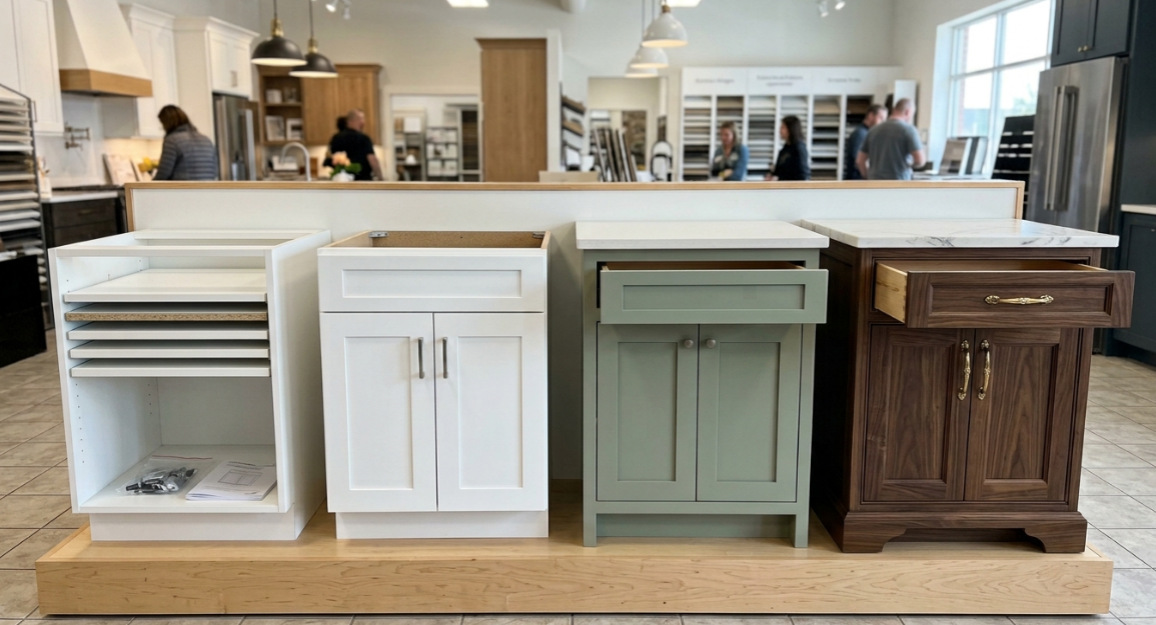
One reason people ask whether RTA cabinets are worth it is confusion about what their alternatives actually are. Here is a plain comparison.
Cabinet type | How it works | Best for | Typical lead time | Main tradeoff |
|---|---|---|---|---|
RTA | Ships flat, assembled on site | Standard layouts, budget projects, fast timelines | Days to 2 weeks when in stock | Assembly labor, limited sizing |
Fully assembled stock | Factory-built standard cabinets | Buyers who want ready-to-install boxes | 1 to 3 weeks | Higher shipping cost, still limited sizing |
Semi-custom | Standard platform with more size, finish, and modification options | Most mid-range remodels | 4 to 8 weeks | Higher cost, longer wait |
Custom | Built to exact specs | Unusual spaces, high-end projects | 6 to 12+ weeks | Highest cost, longest timeline |
An important note from CliqStudios: “custom,” “semi-custom,” and “stock” describe manufacturing processes, not automatic quality levels. A well-built stock or RTA cabinet can outperform a poorly made “semi-custom” one.
RTA cabinets typically come in fixed 3-inch width increments. Semi-custom cabinets may offer smaller increments and more modifications. Custom can be any size. As one kitchen designer noted on LinkedIn, wall spaces like 17.5 inches or 25 inches simply do not fit standard catalog sizing, which is where custom cabinetry earns its price.
You can explore cabinet categories to compare framed, frameless, and other construction styles side by side.
How Much Time Does RTA Assembly Take?
Assembly time is the variable most buyers underestimate. According to Lowe’s, an experienced DIYer might finish a basic cabinet in about 15 minutes, while a beginner should plan on at least 45 minutes per cabinet. Kitchen Cabinet Kings puts a novice’s first cabinet at 35 to 45 minutes, with speed improving after that.
For a typical 10×10 kitchen with roughly 12 cabinets, that means:
Experienced assembler: 3 to 4 hours
First-timer: 9 or more hours
Complex layouts with drawer bases, pantry cabinets, crown molding, and fillers: Add more time
And assembly is separate from installation. You still need to hang the wall cabinets, level the bases, attach filler strips, install toe kicks, add trim, and handle doors and drawers.
Practitioners on Reddit report that RTA assembly is “more time-consuming than expected but worth it for the money saved,” with multiple users recommending brands that include clear instructions and video walkthroughs. The consensus: budget twice the time you think you need for your first project.
Who Should Buy RTA Cabinets?
Different buyers benefit from RTA cabinets for different reasons.
Homeowners
Best for kitchen remodels where reducing costs is more important than reducing labor.
House Flippers
One of the biggest savings comes from keeping cabinet costs low while maintaining attractive finishes.
Rental Property Owners
RTA cabinets provide durable cabinetry without paying for custom work that tenants may never appreciate.
Contractors
Ideal for standardized projects where crews can assemble cabinets efficiently.
DIY Remodelers
Perfect for experienced DIY homeowners with enough workspace and time.
When RTA Cabinets Are Worth It
RTA cabinets make strong financial sense in specific situations.
Standard layouts. If your kitchen, bathroom, laundry room, or basement bar uses common cabinet widths (12, 15, 18, 21, 24, 27, 30, 33, 36 inches) and standard depths, RTA fits without excessive filler strips or awkward gaps.
Budget-driven projects. Rental properties, investment flips, ADUs, secondary kitchens, and starter-home remodels often benefit most. One Reddit user described ordering cabinets for a 12.5 x 10.5 basement kitchen at about $3,500 before shipping because they kept the layout simple with few specialty units.
Fast timelines. RTA cabinets in stock can ship in days. Semi-custom and custom cabinets may take four to twelve weeks. When a project cannot wait, RTA availability becomes a real advantage.
Skilled assembly. A JLC field article described a builder who used RTA cabinets with plywood boxes, solid wood doors, and dovetailed drawers on budget-conscious projects with consistently good results. The cabinets arrived on pallets within about 10 days, and the builder used RTA on multiple projects afterward.
Trade buyers managing volume. Contractors handling multi-unit jobs, property portfolios, or builder-grade spec homes often find RTA attractive for cost control and standardization.
When RTA Cabinets Are Not Worth It
Being honest about RTA’s limits is just as important as knowing its strengths. RTA cabinets are often not worth the trouble in these cases.
Unusual layouts. Sloped ceilings, non-square walls, historic trim constraints, and odd dimensions all fight against fixed 3-inch cabinet increments. Forcing standard cabinets into nonstandard spaces creates ugly filler situations or functional compromises.
High-end custom details. Inset doors, custom appliance panels, integrated hood surrounds, specialized storage inserts, and flush-to-ceiling precision require semi-custom or custom work.
No assembly capacity. If you lack tools, indoor staging space, patience, or physical ability to assemble cabinets, you are setting yourself up for frustration. A Houzz user described spending about $6,000 on RTA instead of $16,000 locally, liking the quality, but calling the delivery a “crazy nightmare” and spending weeks assembling and installing.
Professional crew labor erases savings. Fine Homebuilding quotes builder Mike Guertin saying assembly time “kills it” for professionals. When a contractor pays crew members $40 to $60 per hour to assemble cabinet boxes, those hours eat directly into whatever the RTA discount provided.
Weak supplier support. If the supplier has unclear replacement policies, poor customer service, or long turnaround on damaged parts, one bad shipment can stall your entire project. Countertop templating, appliance installation, and everything downstream gets delayed.
What Makes an RTA Cabinet Good Quality?
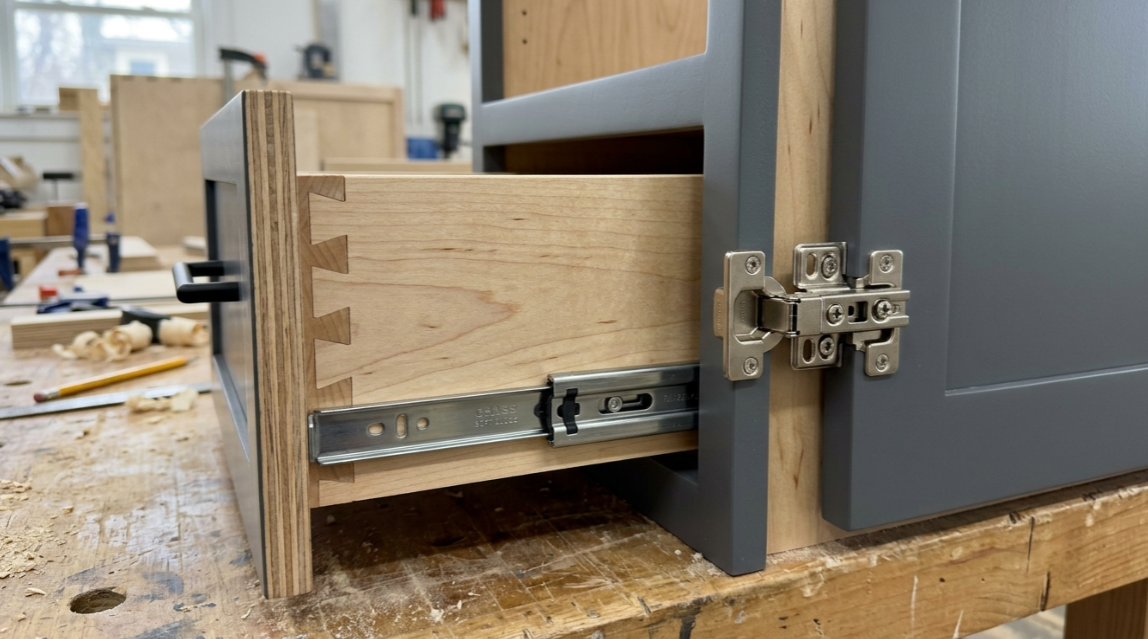
This is the most important section. Whether RTA cabinets are worth buying depends almost entirely on what is inside the box.
Box Construction
Good RTA cabinets use plywood or high-quality engineered panels for the box sides, top, bottom, and shelves. Published thickness matters. Look for 1/2-inch sides minimum and 3/4-inch shelves.
Avoid products with vague “all wood” marketing language but no actual specs. Cheap particleboard boxes in high-moisture kitchens are a reliability problem, especially when edge sealing is poor.
One nuance worth noting: MDF is not automatically bad. Practitioners on Reddit’s r/cabinetry discuss how MDF and HDF are often preferred for painted door panels because they provide a smoother, more stable surface than solid wood. The concern with MDF is not the material itself but how it is used. MDF boxes in wet areas without proper sealing are trouble. MDF door panels in a painted shaker cabinet are standard practice.
Joinery
The way parts connect determines whether a cabinet stays square and solid over years of use. Look for dados, rabbets, screws with glue, or proven locking systems. One installer on Reddit’s r/cabinetry reported assembling 25+ RTA kitchens with no structural complaints once installed, as long as the joinery was sound.
Avoid stapled-only construction or loose cam-lock systems with poor tolerances. Cabinets that rack or go out of square during assembly create cascading problems during installation.
Drawers and Hardware
The Spruce recommends looking for solid wood drawers with dovetail joinery, full-extension drawer guides, and soft-close hinges. These are the components you will touch thousands of times. Cheap drawer glides and flimsy hardware make a kitchen feel cheap regardless of how the doors look.
Finish Durability
Box strength and finish quality are two separate things. The same Reddit installer who praised RTA box construction flagged finish wear as the recurring weakness. Ask for sample doors before ordering. Check for touch-up kit availability. Read reviews specifically about chipping, peeling, and color consistency.
Certifications
Two certifications worth asking about:
KCMA certification. The Kitchen Cabinet Manufacturers Association tests cabinets against 14 performance criteria, including a 600-pound load and stress test. KCMA notes that 40% to 50% of manufacturers fail their first certification attempt. If a cabinet line carries ANSI/KCMA A161.1 certification, it has passed real testing.
TSCA Title VI / CARB Phase 2. Composite wood products (plywood, MDF, particleboard) in cabinets must meet formaldehyde emission standards. The EPA requires TSCA Title VI compliance for composite wood products manufactured or imported into the U.S. Look for documented compliance, not just claims.
Check out Krafter’s Land’s cabinet and closet warranty information to understand what proper warranty coverage looks like.
What Is the Lifespan of RTA Cabinets?
Many buyers assume RTA cabinets wear out quickly, but lifespan depends far more on construction quality than shipping format. Typical expectations:
Cabinet Quality | Expected Lifespan |
|---|---|
Low-grade particleboard | 5–10 years |
Mid-grade engineered wood | 15–20 years |
Plywood construction with quality hardware | 20–30+ years |
Proper installation, humidity control, and hardware maintenance can significantly extend cabinet life.
Hidden Costs Most RTA Buyers Miss
The sticker price on RTA cabinets is seductive. But the total installed cost includes expenses that many buyers forget to count.
Assembly labor. Even if you do it yourself, your time has value. If you hire a handyman or installer, that is a real line item. A general contractor on Reddit’s r/kitchenremodel made the point that materials and hardware matter more than the RTA label, but also acknowledged that factoring in assembly labor changes the math significantly.
Tools and supplies. Clamps, a rubber mallet, drill bits, a brad nailer, wood glue, levels, and shims add up if you do not already own them.
Staging space. You need a clean, dry, indoor area to unbox, inspect, and assemble 10 to 20 cabinet boxes before installation. A garage in winter or a cramped apartment hallway is not ideal.
Shipping and freight. Some RTA vendors include shipping. Others charge hundreds for freight, especially for large orders. Confirm this before comparing prices.
Replacement delays. Damaged doors, wrong-size drawer fronts, and missing parts are common complaints across Houzz and Reddit. One Houzz user warned that damaged cabinets and replacement delays held up their granite measurement and appliance installation for weeks. A cabinet-industry professional on LinkedIn described a contractor who chose the cheapest supplier, then lost weeks dealing with wrong-size and damaged cabinets.
Accessories. Fillers, end panels, toe kicks, crown molding, light rail, and decorative panels are often sold separately. Make sure your quote includes everything.
Warranty gaps. Some manufacturers void warranties if assembly was done incorrectly. Read the fine print on what “correct assembly” means and who determines that. Review warranty policy details carefully before committing to any cabinet purchase.
Common Mistakes People Make When Buying RTA Cabinets
Many negative reviews come from purchasing mistakes rather than problems with RTA cabinets themselves.
Common mistakes include:
Buying based on price alone
Ignoring cabinet specifications
Not ordering sample doors
Underestimating assembly time
Forgetting fillers, trim, toe kicks, and end panels
Scheduling countertops before inspecting deliveries
Choosing suppliers with poor replacement policies
Avoiding these mistakes often has a bigger impact than choosing between RTA and assembled cabinets.
The RTA Worth-It Scorecard
Before ordering, score your project honestly.
Question | Points |
|---|---|
Standard cabinet sizes fit my layout without excessive fillers | +2 |
I (or my installer) have time and experience assembling cabinets | +2 |
The cabinet specs show plywood boxes, good drawers, and quality hardware | +2 |
The supplier has a clear damage and replacement policy | +1 |
I can get sample doors and feel confident in the finish | +1 |
My project timeline can absorb a 1 to 2 week replacement delay | +1 |
I do not need custom sizes or premium custom features | +1 |
8 to 10 points: RTA is probably worth it for your project.
5 to 7 points: Compare total installed cost against assembled or semi-custom options before deciding.
0 to 4 points: RTA is risky unless budget is your only consideration.
Before You Sign for Delivery: A Checklist
Shipping damage is the number one complaint in RTA buyer forums. Protect yourself.
Photograph pallets and boxes before opening anything.
Count all boxes against the packing list immediately.
Inspect for visible damage on every package.
Open and check doors, drawer fronts, and finished panels quickly.
Report any damage within the supplier’s required claim window (usually 24 to 72 hours).
Do not schedule countertop templating until all cabinets are confirmed correct and installed. If you are also planning countertops, understanding your options for materials like quartz vs marble helps coordinate timelines.
Keep all packaging materials until the claim window closes.
RTA Cabinets for Contractors, Remodelers, and Trade Buyers
For trade professionals, the question of whether RTA cabinets are worth it comes down to different math than homeowner DIY.
Contractors care about margin, schedule, and callback risk. RTA cabinets can work well for rental properties, multi-unit projects, spec homes, ADUs, laundry rooms, wet bars, and budget kitchen remodels where standard layouts dominate. The lower material cost creates room in the bid.
But if crew labor runs $40 to $60 per hour and each cabinet takes 20 to 30 minutes to assemble, a 12-cabinet kitchen adds $160 to $360 in labor before a single cabinet touches the wall. At that point, locally sourced assembled cabinets with professional delivery might cost the same or less.
The smarter approach for trade buyers is evaluating total project cost: cabinet price plus assembly labor plus shipping plus design support plus replacement risk plus installation. A general contractor in Reddit’s r/kitchenremodel put it simply: focus on plywood boxes, real wood fronts, quality hinges, drawer slides, and joinery rather than getting hung up on the RTA versus assembled label.
Trade professionals, retailers, and builders looking for cabinet supply partnerships can register as vendors to access trade pricing and project support.
Good RTA vs Risky RTA at a Glance
Feature | Good RTA | Risky RTA |
|---|---|---|
Box material | Plywood or high-quality engineered panels with published thickness | Vague “wood construction” with no specs |
Back panel | Strong, especially on wall cabinets | Thin, weak hanging system |
Drawers | Dovetail or engineered box, full-extension slides | Stapled boxes, integrated rail glides |
Hardware | Soft-close, adjustable, name-brand when possible | Unnamed basic hardware |
Finish | Sample available, durable, touch-up support | No samples, reviews mention chipping |
Certifications | KCMA, TSCA Title VI, CARB Phase 2 documented | No documentation |
Supplier support | Clear replacement and damage process | Unclear return or replacement policy |
Final Verdict
RTA cabinets are worth it when you control the variables. They save real money on standard layouts, common styles, and projects where someone skilled can handle assembly. They are not worth it when the low price is the only thing you have verified.
The safest way to evaluate any RTA purchase: compare total installed cost. That means cabinet boxes plus assembly labor plus delivery plus installation plus trim, hardware, damage handling, and schedule impact. Not just the cabinet quote.
RTA describes how a cabinet ships. It does not tell you whether the cabinet is good. Plywood boxes, strong joinery, quality hardware, reliable finishes, proper certifications, and responsive supplier support are what separate a cabinet you will love from one you will regret.
Browse completed project examples to see what quality cabinetry looks like when properly selected, assembled, and installed. For retailers, contractors, remodelers, designers, and builders comparing cabinet options for upcoming projects, reach out to Krafter’s Land for free design consultations, 3D renderings, delivery, assembly, and installation support through showrooms in Tukwila, Tacoma, Lynnwood, and Spokane.
Frequently Asked Questions
Are RTA cabinets good quality?
They can be. RTA is a shipping format, not a quality grade. Good RTA lines use plywood boxes, dovetail drawers, full-extension slides, and soft-close hardware. Poor RTA lines use particleboard, stapled joints, and weak drawer glides. The Spruce recommends checking for solid wood drawers with dovetail joinery, full-extension drawer guides, and solid wood door frames as quality markers.
How much money do RTA cabinets actually save?
Published estimates range from 15% to 50% less than comparable assembled cabinets. Kitchen Cabinet Kings puts the savings at roughly $300 to $1,000 on a 10×10 kitchen compared to the same cabinets pre-assembled. The actual number depends on shipping costs, assembly labor, and whether parts arrive correct and undamaged.
Are RTA cabinets hard to assemble?
Basic wall and base cabinets are manageable for careful DIYers. Lowe’s estimates about 15 minutes per cabinet for experienced assemblers and 45 minutes for beginners. Drawer bases, pantry cabinets, and trim details take longer. For a 12-cabinet kitchen, plan on 3 to 9+ hours of assembly alone, not counting installation.
Are RTA cabinets better than pre-assembled cabinets?
Not automatically. Pre-assembled cabinets save time and provide factory-consistent construction. RTA cabinets save money and often ship faster. The final quality depends on the specs and who assembled the boxes. A well-built RTA cabinet, properly assembled, can perform identically to a factory-assembled version of the same product.
Should contractors use RTA cabinets?
It depends on the project. RTA works for budget-conscious jobs, rentals, flips, and standard layouts where speed and cost matter most. It does not work well when crew labor rates make assembly expensive or when the project needs custom sizing and design support.
What certifications should I look for in RTA cabinets?
KCMA certification (ANSI/KCMA A161.1) means the cabinet line passed 14 performance tests including a 600-pound stress test. TSCA Title VI and CARB Phase 2 compliance means composite wood components meet federal and California formaldehyde emission standards. Ask for documentation on the specific cabinet line, not just the brand overall.
What goes wrong with RTA cabinet orders?
The most common problems reported by buyers on forums like Reddit and Houzz are shipping damage, wrong-size parts, missing components, replacement delays, and finish inconsistencies. These issues can delay countertop templating, appliance installation, and the entire project timeline. A clear damage policy and responsive supplier support are critical.
When should I avoid RTA cabinets entirely?
Avoid RTA when your layout has unusual dimensions, sloped ceilings, or tight appliance clearances that require custom widths. Also avoid RTA if you have no assembly space, no assembly experience, a tight project schedule with no room for delays, or if the only option available uses low-grade materials with unclear specs.
Are RTA cabinets made in the USA?
Some RTA cabinets are manufactured in the United States, while others are imported from countries such as Vietnam, Malaysia, Mexico, or China. Country of origin does not automatically determine quality. Focus instead on cabinet construction, certifications, hardware, finish quality, and warranty support.
Are plywood RTA cabinets better than particleboard?
Generally yes. Plywood is lighter, stronger, and more resistant to moisture than particleboard. However, high-density engineered wood can also perform well when properly manufactured. The quality of the joinery, hardware, and finish often matters just as much as the box material.
Can RTA cabinets increase home value?
Quality RTA cabinets can improve a home’s value when professionally installed and paired with durable countertops and modern finishes. Buyers typically evaluate appearance, functionality, and condition rather than whether the cabinets were shipped assembled or flat-packed.