
TLDR
RTA (ready-to-assemble) cabinets ship flat-packed and are built on-site, while custom cabinets are designed and manufactured for a specific space. RTA typically costs 30% to 50% less and works well for standard kitchen layouts. Custom cabinets earn their premium when unusual dimensions, specialty finishes, or unique storage needs make standard sizes a poor fit. The right choice depends on your layout, budget, timeline, and who is handling installation.
RTA cabinets vs custom cabinets is the central question behind most kitchen remodeling budgets. The answer is not about which one is “better.” It is about which one fits the project.
This guide explains what both terms actually mean, breaks down the real cost differences (not just sticker prices), covers quality and installation trade-offs, and gives a clear framework for deciding. If you have ever wondered whether cheaper cabinets are “good enough” or whether custom is worth the price, this is the comparison that will help you decide with confidence.
Request a free design quote to compare cabinet options before committing to either direction.
Quick Answer
If your kitchen has a standard layout and your goal is maximizing value, RTA cabinets are usually the better choice because they cost 30%–50% less while still offering excellent quality when built with plywood boxes, dovetail drawers, and soft-close hardware. Custom cabinets are worth the extra investment when your kitchen has unusual dimensions, specialty storage requirements, premium finishes, or architectural details that standard cabinet sizes cannot accommodate.
RTA Cabinets vs Custom Cabinets at a Glance
Category | RTA Cabinets | Custom Cabinets |
|---|---|---|
Average Cost | $$ | $$$$ |
Custom Sizes | Limited | Unlimited |
Installation | Assemble then install | Usually installed by cabinet shop |
Lead Time | Days to weeks | Weeks to months |
Best For | Standard kitchens | Unique layouts |
DIY Friendly | Yes | No |
Resale Value | Good | Excellent in luxury homes |
Lifetime | 15–30 years (quality dependent) | 25–50+ years |
Typical Warranty | 5 years–Lifetime | Depends on cabinetmaker |
ROI | Higher on budget remodels | Better for forever homes |
What Are RTA Cabinets?
RTA stands for ready-to-assemble. These are cabinet components that are manufactured, finished, and packed flat, then assembled on-site by the homeowner, a contractor, or an installer. The U.S. International Trade Commission describes RTA cabinets as unassembled products packaged with wooden components plus parts like drawer faces, doors, screws, dowels, hinges, and adhesive needed for assembly.
In plain language: RTA cabinets arrive in boxes. You (or someone you hire) build them before they get installed.
The “ready-to-assemble” label tells you how the cabinet ships. It does not tell you whether the box is plywood or particleboard, whether the drawers are dovetailed, or whether the hinges are soft-close. That distinction matters, and most comparison articles skip it entirely.
What Are Custom Cabinets?
Custom cabinets are measured, designed, and built for a specific kitchen, bathroom, or built-in application. They can be made in exact dimensions with custom materials, finishes, door styles, and storage configurations. The USITC describes custom wooden cabinets as measured and designed to fit a specific kitchen, with more available styles and usually higher pricing than stock cabinets.
In plain language: custom cabinets are built for your exact space, not selected from a catalog of standard sizes.
Custom cabinetry gives you maximum design control, but it also comes with a longer timeline and a higher price. That extra cost is not always justified, and it is not always wasted. Everything depends on what the project actually needs.
Why RTA and Custom Are Not Exact Opposites
This is the most common misunderstanding in the RTA cabinets vs custom cabinets conversation. Most people assume RTA means cheap and custom means expensive. That framing is too simple.
RTA describes the delivery and assembly format. Custom describes the design and manufacturing flexibility. A cabinet can be stock RTA, semi-custom, custom RTA, factory-assembled stock, or fully custom. Here is the spectrum:
Cabinet Category | What It Means |
|---|---|
Stock RTA | Standard sizes and styles, shipped flat-packed. Lowest cost, fastest, least flexible. |
Pre-assembled stock | Standard sizes, assembled before delivery. Easier install, higher shipping cost. |
Semi-custom | Standard platform with more size, finish, and configuration options. A middle ground. |
Custom RTA | Customized components shipped flat-packed. More flexibility, still assembled on-site. |
Fully custom | Designed and built for exact dimensions and specifications. Maximum freedom, highest cost. |
Understanding this spectrum prevents the most expensive mistake in cabinet shopping: comparing a $2,000 online RTA cart to a $25,000 fully custom installed quote and thinking you are looking at the same thing.
Frame style is another decision that applies across this entire spectrum. Learn more about framed cabinet construction or explore how frameless cabinets create a different look regardless of whether you go RTA or custom.
RTA vs Semi-Custom vs Custom: Which One Fits Most Kitchens?
Many homeowners assume there are only two choices: inexpensive RTA cabinets or expensive custom cabinetry. In reality, most kitchens fall into the middle category.
Semi-custom cabinets allow homeowners to adjust cabinet widths, heights, depths, finishes, accessories, and storage options while still using standardized manufacturing. This often delivers the best balance of cost, flexibility, and lead time.
For many remodeling projects, semi-custom provides nearly all the customization homeowners actually need without paying for completely bespoke cabinetry.
Cabinet Type | Flexibility | Cost | Best For |
|---|---|---|---|
Stock RTA | Low | Lowest | Budget remodels |
Semi-Custom | Medium | Moderate | Most kitchens |
Fully Custom | Unlimited | Highest | Luxury remodels |
RTA vs Custom Cabinets: Side-by-Side Comparison
Factor | RTA Cabinets | Custom Cabinets |
|---|---|---|
How they arrive | Flat-packed in boxes | Built, or built and installed by the shop |
Cost per linear foot (installed) | $100 to $400 | $500 to $1,200 |
Lead time | Days to weeks for stock; longer for made-to-order | Weeks to months |
Assembly | Required before installation | Usually done at the factory or shop |
Customization | Limited to available sizes, styles, finishes | Full control over dimensions, materials, details |
Quality range | Varies widely by supplier and line | Varies by shop and craftsperson |
Design help | Sometimes included, often limited | Usually part of the process |
Best for | Standard layouts, budget control, rentals, flips | Unusual spaces, high-end remodels, exact fit |
Main risk | Assembly quality, measurement errors, limited support | Higher cost, longer timeline, shop variability |
Cost ranges sourced from HomeGuide’s cabinet cost data and HomeAdvisor’s cabinet pricing.
Cost: What You Actually Pay

The sticker price of RTA cabinets is almost always lower. This Old House reports that RTA cabinets are typically priced 30% to 50% lower than traditional counterparts. That gap is real. But it narrows once you account for everything else that goes into a finished kitchen.
Installed cost ranges
Stock and RTA cabinets run $100 to $400 per linear foot installed. Semi-custom cabinets fall between $150 and $700 per linear foot installed. Custom cabinets range from $500 to $1,200 per linear foot installed, including installation labor.
A 10×10 kitchen example
For a basic 10-by-10-foot L-shaped kitchen with roughly 12 cabinets:
Stock RTA units alone: approximately $1,200 to $4,400
Custom RTA units: starting around $7,000
Custom cabinets (including installation): $10,000 to $26,500
Those numbers look like a massive gap. They can be. But the fair comparison is not “RTA cart price vs custom installed quote.” The fair comparison uses what might be called the landed installed cost:
Real cabinet cost = cabinet boxes + doors + fillers + panels + toe kicks + trim + hardware + delivery + assembly + installation + design help + damage and replacement risk
RTA saves on cabinet boxes and shipping. It does not eliminate installation labor, fillers, panels, crown molding, toe kicks, or mistake correction. When homeowners skip these line items in their mental math, they end up surprised by the total.
Cabinet savings can be redirected to other surfaces, too. If you are planning countertops alongside cabinets, understanding the countertop material trade-offs helps allocate budget more effectively across the entire project.
Hidden Costs Most Cabinet Quotes Don’t Include
The cabinet quote is rarely the final project cost.
Before comparing estimates, ask whether these items are included:
Crown molding
Light rail molding
Toe kicks
Finished end panels
Filler strips
Pulls and knobs
Delivery fees
Sales tax
Installation
Removal of old cabinets
Wall repair
Disposal fees
A quote that appears thousands of dollars cheaper may simply exclude several of these items.
Quality: RTA Is Not Automatically Low Quality
This point deserves emphasis because it is the biggest misconception in the RTA cabinets vs custom cabinets debate. RTA is a shipping and assembly format. It is not a quality grade.
A well-built RTA cabinet line can include plywood boxes (1/2-inch to 3/4-inch), dovetail drawer construction, full-extension glides, soft-close hinges, and durable factory finishes. Meanwhile, a poorly executed custom cabinet can disappoint if the shop cuts corners on materials or finishing.
Practitioners on the Ask a Cabinetmaker blog warn specifically about low-end cam-lock and particleboard construction, noting that cheap cam locks can lose structural integrity once hardware loosens. But they also acknowledge that quality RTA lines with plywood boxes and strong joinery are a different product entirely.
The USITC notes that features like soft-close doors and roll-out shelves, once associated primarily with custom and semi-custom tiers, are now frequently found in current stock cabinets.
Quality checklist for any cabinet
Whether you are shopping RTA or custom, check these details:
Box material: Plywood holds up better than particleboard in kitchens. Ask about thickness (1/2-inch minimum, 3/4-inch for premium).
Joinery: Dado joints, dovetails, glue, and screws are stronger than cam-lock-only construction.
Drawers: Dovetail drawer boxes with full-extension glides handle daily use far better than stapled boxes.
Hinges: Soft-close is standard even outside custom lines. Confirm it is included, not extra.
Finish: Request door samples. Check consistency across doors, drawers, fillers, and panels. Screen colors are unreliable.
Warranty: Check coverage length, exclusions, damage reporting windows, and replacement lead times. Always review warranty terms before purchasing from any supplier.
How Long Do RTA and Custom Cabinets Last?
Cabinet lifespan depends far more on construction quality than whether the cabinets arrive assembled. Typical lifespan:
Cabinet Type | Expected Lifespan |
|---|---|
Budget particleboard RTA | 10–15 years |
Quality plywood RTA | 20–30 years |
Semi-custom | 20–35 years |
Custom hardwood cabinets | 30–50+ years |
Proper installation, moisture control, and hardware maintenance have a greater impact on longevity than cabinet category alone.
Expert Tip
A plywood cabinet with dovetail drawers and premium soft-close hardware will usually outperform a poorly built custom cabinet made with inferior materials. Always evaluate construction quality before deciding based on cabinet category alone.
Installation: The Part Most Comparisons Understate
Here is where the conversation about RTA vs custom cabinets gets practical. Assembly is only one piece of the labor. Installation is the rest, and it is the harder part.
Assembly time
This Old House suggests about 20 to 30 minutes per cabinet for assembly. Lowe’s RTA buying guide notes that expert DIYers might manage 15 minutes per cabinet while beginners should plan for 45 minutes or more. For a 12-cabinet kitchen, that is roughly 4 to 9 hours just building boxes.
A contractor profiled in JLC’s case study reported that an RTA kitchen arrived about 10 days after ordering, fit on a couple of pallets, and took “a little over a day” to assemble and install. That contractor was experienced, though. First-timers should not expect the same pace.
Installation is the real work
Building the box is the straightforward part. Installation includes layout, leveling, blocking, securing to walls, filler strips, toe kicks, door and drawer adjustment, crown molding, scribing to uneven walls, appliance clearances, and taking responsibility when something does not line up.
Practitioners on Reddit make this point clearly. In one thread about cabinet installation costs, a commenter defended a $4,800 install quote by listing everything the job includes: layout, blocking, leveling, fillers, drawer and door adjustment, crown scribing, toe kicks, pulls, touch-up, caulk, and liability for mistakes. Another homeowner in the same thread reported being quoted $4,700 for 20 RTA cabinets assembled and installed.
In a separate r/cabinetry discussion, installers reported a wide range of pricing models, from $100 to $200 per linear foot to per-cabinet rates, with significant regional variation.
The takeaway: RTA reduces the cabinet cost, not the installation complexity. Budget for professional installation unless you have real experience with cabinet layout and leveling.
See completed cabinet projects to understand what professional installation looks like when done right.
DIY vs Professional Installation
Many homeowners buy RTA cabinets planning to install them themselves.
DIY installation can save thousands of dollars, but mistakes are expensive.
Professional installation is usually recommended when:
Walls are not perfectly square
Ceiling heights vary
Crown molding is involved
Large pantry cabinets are used
Appliance openings require exact measurements
Quartz or stone countertops will be installed afterward
DIY installation is best suited for experienced homeowners comfortable with cabinet leveling, fastening, and trim work.
Design Flexibility: Where Custom Earns Its Price
Choosing between RTA cabinets and custom cabinets often comes down to how far standard sizes can stretch. RTA cabinets work well when your kitchen layout can be solved with standard cabinet widths, typically available in 3-inch increments. For many kitchens, especially those keeping the same basic footprint, standard sizes handle the job just fine.
Custom cabinets become worth the money when standard modules create awkward compromises. Practitioners on Reddit consistently make this case with specific examples, not abstract claims about luxury.
One homeowner who chose custom for a small galley kitchen explained that RTA options could not deliver a lighted glass-front display area above the cabinets, the preferred blonde wood tone, or consistent grain matching. The custom cabinetmaker delivered the desired result for about $18,000. In another discussion, a remodeler noted that custom cabinetry avoids fillers and allows small dimensional changes that matter in complex kitchens, adding “it all just comes at a premium.”
Custom is most valuable when you need:
Exact-width cabinets that eliminate filler strips
Inset doors or furniture-grade detailing
Unusual wood species, stain matching, or custom paint colors
Specialty storage (appliance garages, pull-out pantry systems, oversized island configurations)
Panels and trim that integrate with older or historic woodwork
Cabinets for angled walls, bowed walls, or non-standard ceiling heights
Semi-custom and custom RTA sit in the middle. They offer more size and finish options than stock RTA while keeping some standardization and flat-pack shipping savings.
LinkedIn practitioners in the cabinet industry emphasize that proper layout review prevents appliance conflicts, clearance issues, and budget overruns, making design support a critical variable regardless of which cabinet tier you choose.
Browse remodeling product categories to see what is available across framed, frameless, and accessory options before finalizing your design direction.
Lead Time and Scheduling
Stock RTA cabinets can ship within days if the line is in stock. Made-to-order RTA and custom RTA take longer, often several weeks. Fully custom cabinets require design approval, production, finishing, and delivery scheduling, which can stretch into months.
For contractors managing project timelines, predictable cabinet sourcing protects the entire schedule. A kitchen cannot be tiled, countered, or finished until cabinets are set. Choosing between RTA and custom cabinets means weighing speed against precision, and both carry scheduling risk if suppliers miss their estimated dates.
When to Choose RTA Cabinets
RTA is the stronger choice when:
Your kitchen works with standard cabinet widths and depths
You want a popular style (shaker, slim shaker, slab, white, gray, navy, natural wood)
Budget control is a primary goal
You are remodeling a rental, flip, basement kitchen, laundry room, or bathroom
You can assemble cabinets yourself or hire someone to do it
You need cabinets faster than a custom shop can deliver
You have space to stage, inventory, and inspect boxes on arrival
One important warning: RTA delivery means many boxes. This Old House specifically advises buyers to open every box within the manufacturer’s damage-claim window (sometimes as short as five days) and photograph any damage or missing parts immediately.
A 2026 r/HomeImprovement thread shows how polarized RTA experiences can be. One user reported being happy with 18 cabinets at around $8,000 (1/2-inch plywood boxes, solid wood face frames and doors). Others recommended IKEA for long-term hardware quality and replaceability. And one user bluntly warned against certain online RTA websites. The lesson: evaluate the specific cabinet line, not just the RTA label.
When to Choose Custom Cabinets
Custom is the stronger choice when:
The walls, ceiling, or corners are irregular
You need exact dimensions with minimal or no filler strips
The design calls for inset doors, furniture-grade details, or period-correct styling
Specialty storage or appliance integration cannot be solved by standard modules
The home’s value and the owner’s timeline justify the premium
You want one accountable cabinetmaker or designer to own the result from measurement through installation
A 2026 homeowner on Reddit described receiving custom cabinet quotes around $50,000 for a large project and asked for alternatives. The thread illustrates a common pattern: sticker shock drives people toward RTA, but the underlying question is whether the project actually needs full custom or if a quality semi-custom line could bridge the gap.
The Hybrid Strategy Most Articles Miss
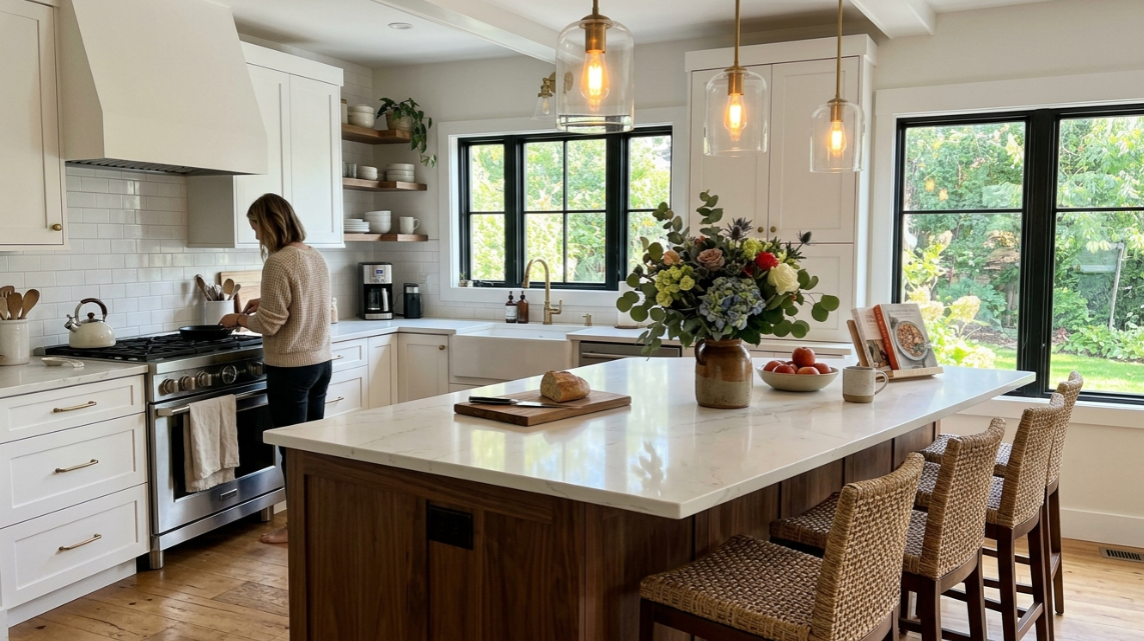
Competitor articles rarely mention this, but using both RTA and custom in the same kitchen is a practical option:
RTA for standard perimeter runs where stock sizes fit cleanly
Custom for the island, hood surround, pantry built-in, or angled wall where precision matters most
Custom fronts or panels on modular boxes to achieve a custom look at a semi-custom price
This hybrid approach lets you spend more where it counts and save where standardization works. It also gives your installer a predictable system for most of the kitchen while reserving custom work for the elements that truly need it.
Common Mistakes When Comparing RTA and Custom Cabinets
Comparing an online RTA cart to a custom installed quote. Different scope, different number.
Forgetting fillers, panels, toe kicks, crown, and trim. These add cost to both options.
Assuming plywood automatically means high quality. Plywood is better than particleboard for boxes, but drawer construction, joinery, hardware, and finish matter just as much.
Ignoring drawer and hinge hardware. Cheap slides and hinges fail before the box does.
Ordering without door samples. Screen colors lie.
Measuring before floors and walls are finalized. Cabinet measurements should happen on finished surfaces.
Not checking boxes immediately after delivery. Damage claims have tight windows.
Underestimating staging space. A 12-cabinet kitchen arrives in dozens of boxes and generates significant packaging waste.
Hiring an installer unfamiliar with the cabinet system. Each system has quirks in assembly, adjustment, and hardware.
Paying custom prices for a layout that RTA could handle. Not every kitchen needs custom.
Resale Value and ROI
If you plan to sell the home soon, the math changes. Zillow’s summary of JLC’s Cost vs. Value data shows that a minor kitchen remodel had 113% ROI nationally, while a midrange major remodel returned 51% and an upscale major remodel returned just 36%.
The pattern is clear: spending less to achieve a clean, functional, modern kitchen tends to perform better financially than overbuilding. Custom cabinetry may help in high-end markets where buyers expect it, but in most neighborhoods, buyers respond to the total kitchen feel (layout, condition, finishes) more than to the cabinet pedigree.
For long-term owners, the calculation is different. If you plan to cook in this kitchen for 15 years, daily-use satisfaction may matter more than resale percentages. Custom cabinets that solve real friction points (bad storage, awkward spacing, dated function) can be worth the investment when the payoff is measured in daily life rather than listing price.
Glossary of Related Cabinet Terms
Understanding these terms helps when comparing RTA cabinets vs custom cabinets across different suppliers and product lines.
Stock cabinets: Made in fixed sizes and finishes, available off the shelf or with short lead times.
Semi-custom cabinets: Built on a standard platform with more size, finish, and configuration options than stock.
Flat-pack cabinets: Another term for RTA. Shipped disassembled in flat packaging.
Framed cabinets: Have a face frame (solid wood border) attached to the front of the box. Traditional look, slightly narrower drawer openings.
Frameless cabinets: No face frame. The door covers the full front of the box. Modern, European-influenced look with wider drawer access.
Full overlay: Doors and drawers cover most or all of the face frame. Clean, contemporary appearance.
Partial overlay: Doors reveal some face frame between them. More traditional.
Inset doors: Doors sit flush inside the face frame. Precision fit, usually custom or high-end semi-custom.
Plywood box: Cabinet body made from plywood layers. Stronger and more moisture-resistant than particleboard.
MDF (medium-density fiberboard): Engineered wood panel. Smooth surface, good for painted doors. Less moisture-resistant than plywood.
HDF (high-density fiberboard): Denser than MDF, sometimes used for thermofoil substrates or door panels.
Particleboard: Lowest-cost engineered panel. Common in budget cabinets. Weakest when exposed to moisture.
Dovetail drawer: Drawer box joined with interlocking dovetail cuts. Stronger than stapled or cam-lock construction.
Dado joint: A groove cut into one board to receive the edge of another. Used in quality box construction.
Cam lock: A mechanical fastener used in some RTA assembly. Quick but less durable than glued or screwed joints over time.
Soft-close hinges: Hinges with a damping mechanism that prevents doors from slamming.
Full-extension glides: Drawer slides that let the drawer pull out completely for full access.
Toe kick: The recessed base panel at the bottom of floor cabinets.
Filler strip: A narrow piece used to fill gaps between cabinets and walls, corners, or appliances.
Finished end panel: A decorative panel applied to exposed cabinet sides.
Crown molding: Trim installed at the top of wall cabinets where they meet the ceiling or soffit.
Scribe molding: Flexible trim used to cover gaps between cabinets and uneven walls.
Appliance panel: A cabinet-matching panel applied to the front of a dishwasher, refrigerator, or other built-in appliance.
3D cabinet rendering: A digital visualization of how cabinets will look in your specific space, used during the design phase.
Frequently Asked Questions
Are RTA cabinets lower quality than custom cabinets?
Not automatically. RTA describes how cabinets ship and assemble, not the material or construction quality. A quality RTA line can use plywood boxes, dovetail drawers, full-extension glides, and soft-close hinges. Quality depends on the cabinet line, materials, hardware, finish, and installation, not the label alone.
How much cheaper are RTA cabinets than custom?
RTA cabinets typically cost 30% to 50% less than traditional cabinetry before installation. Installed, stock and RTA cabinets run $100 to $400 per linear foot, while custom cabinets run $500 to $1,200 per linear foot. The final gap depends on assembly, installation, trim, delivery, and design support costs that get added back.
Can RTA cabinets look custom?
Yes, with good planning and clean installation. Tall panels, proper fillers, aligned reveals, matching toe kicks, upgraded hardware, and professional installation can make RTA cabinets look much more polished. But when exact dimensions, unusual finishes, inset construction, or one-off built-ins are required, custom cabinets still win.
How long does it take to assemble RTA cabinets?
Expect about 20 to 30 minutes per cabinet with moderate experience. Beginners should plan for 45 minutes or more per cabinet. A 12-cabinet kitchen could take 4 to 9 hours of assembly time before installation even begins.
Should I hire a professional to install RTA cabinets?
In most cases, yes. Building the boxes is manageable. Installation requires layout planning, leveling, blocking, filler placement, door and drawer adjustment, crown molding, and scribing to uneven walls. Experienced installers catch problems that first-timers miss, and they take accountability for the final result.
When are custom cabinets actually worth the extra cost?
Custom cabinets are worth it when they solve problems standard cabinets cannot: odd dimensions, crooked walls, exact wood or finish requirements, inset doors, unique storage configurations, or appliance integration. They are also worth it when the homeowner plans to stay long-term and values daily function over lowest upfront cost.
What is custom RTA?
Custom RTA refers to cabinets that offer more customization than stock RTA (additional sizes, finishes, and configurations) while still shipping flat-packed for on-site assembly. It sits between stock RTA and fully custom cabinetry in both flexibility and price.
Can I use both RTA and custom cabinets in the same kitchen?
Yes. A hybrid approach uses RTA for standard perimeter runs and custom for problem areas like islands, hood surrounds, angled walls, or built-in pantries. This saves money where standardization works while getting precision where it matters most.
Choosing between RTA cabinets vs custom cabinets is really a question about where your project falls on the standardization-to-precision spectrum. RTA wins when standard sizes work and you can control assembly and installation quality. Custom wins when exact fit, unique design, or specialty storage justifies the added cost and time. The best cabinet choice is not about a label. It is about matching the right system, design plan, and installer to your specific project.
Ready to compare options for your next remodel? Contact Krafter’s Land for a free design consultation with 3D renderings at showrooms in Tukwila, Tacoma, Lynnwood, and Spokane.
Contractors, retailers, and trade professionals looking for cabinet sourcing can register as authorized vendors to access Krafter’s Land’s full product lines.