TLDR
Kitchen cabinet cost in Washington ranges from about $100 per linear foot for stock cabinets to $1,200 or more per linear foot for custom work, installed. The final price depends on cabinet tier, construction style, accessories, assembly, installation scope, and Washington’s combined sales tax (which can exceed 10% in cities like Tukwila, Tacoma, and Lynnwood). The fastest way to compare cabinet quotes is to understand the terms inside them. This guide breaks down every pricing term, explains what “installed” actually means, and shows how to read a Washington cabinet bid without guessing.
Kitchen cabinet cost in Washington is not one number. It is a stack of line items, and two quotes for what sounds like the same kitchen can land thousands of dollars apart because they include different things. One bid covers cabinets only. Another bundles delivery, assembly, crown molding, and tax. A third excludes tear-out, plumbing, and countertop coordination entirely.
The problem is not that contractors are hiding fees. The problem is that cabinet pricing uses terms most homeowners have never encountered, and national cost guides rarely account for Washington’s local sales tax, higher-than-average labor costs, and permit rules.
This glossary explains what those terms mean, what they cost, and how to use them when comparing quotes. Krafter’s Land Cabinetry Inc., a Washington-based cabinet supplier and showroom with locations in Tukwila, Tacoma, Lynnwood, and Spokane, offers free design consultations and 3D renderings to help homeowners, contractors, and designers start with accurate measurements rather than rough guesses.
Request a free design and quote to get project-specific numbers for your kitchen.
Quick Answer: Kitchen Cabinet Cost in Washington
Kitchen cabinet installation in Washington typically costs between $2,000 and $24,000 for a standard 20-linear-foot kitchen, depending on whether you choose stock, semi-custom, or custom cabinetry.
Most homeowners spend:
Cabinet Type | Typical Installed Cost |
|---|---|
Stock / RTA | $2,000–$6,000 |
Semi-Custom | $3,000–$13,000 |
Custom | $10,000–$24,000+ |
Washington homeowners should also budget for:
Sales tax (9–11%)
Delivery
Cabinet assembly
Installation labor
Tear-out and disposal
Plumbing or electrical changes if the layout changes
Always compare cabinet quotes line by line instead of comparing only the total price.
Average Kitchen Cabinet Cost by Kitchen Size
Kitchen Size | Linear Feet | Estimated Installed Cost |
|---|---|---|
Small Apartment | 10–15 LF | $1,000–$9,000 |
Small Kitchen | 15–20 LF | $2,000–$18,000 |
Medium Kitchen | 20–25 LF | $3,000–$24,000 |
Large Kitchen | 25–35 LF | $5,000–$40,000+ |
How Much Do Kitchen Cabinets Cost in Washington?
Here is the fast answer. These are market benchmarks from national sources, adjusted with Washington-specific context.
Cabinet Tier | Installed Cost per Linear Foot | Typical 20 LF Kitchen | Notes |
|---|---|---|---|
Stock / RTA | $100 to $300 | $2,000 to $6,000 | Standard sizes and finishes; fastest lead times |
Semi-custom | $150 to $650 | $3,000 to $13,000 | More sizes, finishes, and storage options |
Custom | $500 to $1,200 | $10,000 to $24,000 | Built for specific kitchens; premium materials |
Sources: HomeAdvisor 2026 cabinet cost data, HomeLight installed cabinet guide.
For Seattle specifically, local cabinet suppliers cite fully customized kitchen installations often landing between $13,000 and $30,000, with large or high-end projects exceeding that range.
These numbers do not include Washington sales tax, which can add 9% to nearly 11% depending on the city. They also assume typical installation scope. Unusual layouts, old homes with uneven walls, islands, ceiling-height uppers, and appliance panels all push costs higher.
What Is the Biggest Factor Affecting Cabinet Cost?
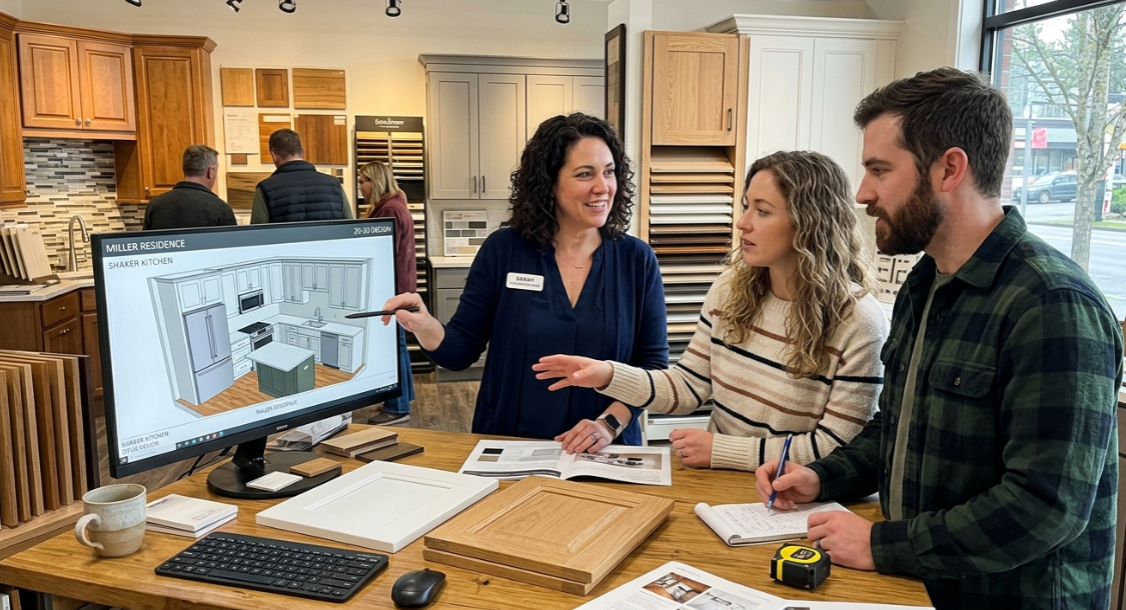
The biggest factor affecting kitchen cabinet cost is cabinet type.
Custom cabinets can cost five to ten times more than stock cabinets because they require custom manufacturing, more labor, and premium materials.
After cabinet type, the biggest price drivers are:
Kitchen size
Cabinet construction
Door style
Cabinet materials
Storage accessories
Installation complexity
Washington labor rates
Local sales tax
Why Cabinet Quotes in Washington Vary So Much
A cabinet quote is not one number. It is a stack. The fastest way to compare bids is to ask each company to separate cabinets, assembly, delivery, installation, tear-out, trim, tax, and non-cabinet trades.
Here is what makes up that stack:
Design and measurement. Layout planning, 3D renderings, appliance clearances, door swing planning, and site measurements. Some suppliers include this for free. Others charge a design fee that may or may not be credited toward the purchase.
Cabinet package. Boxes, doors, drawer fronts, shelves, drawer boxes, hinges, glides, end panels, fillers, toe kicks, and molding. This is the core product cost.
Cabinet tier. Stock, semi-custom, or custom. Each tier carries different material, sizing, and finish options.
Construction and finish. Framed vs. frameless, overlay style, door profile, wood species or engineered materials, paint vs. stain vs. laminate. Learn more about framed cabinet construction or explore frameless cabinet options to understand how construction style affects both look and budget.
Accessories. Pull-outs, lazy Susans, drawer organizers, trash pull-outs, spice racks, soft-close upgrades, and under-cabinet lighting coordination. Each adds cost.
Assembly and delivery. RTA cabinets need assembly before installation. Pre-assembled cabinets cost more upfront but save labor on site. Delivery fees depend on distance, access, stairs, and staging.
Installation labor. Leveling, shimming, fastening to studs, door and drawer alignment, filler and panel placement, crown molding, toe kick, and hardware installation. Practitioners on Reddit report that a simple per-box installation price can be misleading because stacked cabinets, crown, light rail, scribe molding, decorative doors, skins, panels, hardware, and floating shelves all deserve separate pricing.
Other trades. Tear-out, haul-away, drywall repair, flooring patching, plumbing, electrical, ventilation, and painting. These are not cabinet costs, but they often appear on the same invoice.
Washington additions. Local sales tax, permits if scope expands beyond cabinet replacement, contractor overhead, and contingency.
Seattle-Area Labor Costs Are Part of the Story
Cabinet installation in Western Washington costs more partly because labor costs more. BLS data from May 2025 shows the Seattle-Tacoma-Bellevue metro had an average hourly wage of $44.13 across all occupations, compared with $33.54 nationally. Construction and extraction occupations averaged $42.11 per hour in the Seattle area, versus $31.42 nationally.
That gap does not mean installers are overcharging. It means the installed price has to cover wages, overhead, insurance, truck time, scheduling, callbacks, warranty risk, tools, and business margin in one of the country’s most expensive labor markets.
Typical Cabinet Cost Breakdown
Cost Category | Typical Share |
|---|---|
Cabinets | 45–60% |
Installation | 20–30% |
Hardware & Accessories | 5–15% |
Delivery & Assembly | 5–10% |
Sales Tax | 8–11% |
Miscellaneous | 5–10% |
Glossary: Cabinet Cost Terms
Every term below shows up in cabinet quotes. Understanding them is the difference between comparing apples to apples and comparing a cabinet box to a finished kitchen.
Kitchen Cabinet Cost
The total price to plan, supply, deliver, assemble, and install cabinets in a kitchen. It may or may not include tear-out, countertops, plumbing, electrical, flooring, hardware, trim, sales tax, and permits. Always ask whether a quoted kitchen cabinet cost in Washington is materials only, install only, or fully installed.
Installed Cabinet Cost
A price that includes cabinets plus labor to install them. But “installed” is not standardized. Some installed quotes still exclude tear-out, haul-away, plumbing, electrical, countertops, backsplash, drywall, painting, and permits. One national cabinet guide explains that basic installation generally covers leveling, fastening, and alignment, while many related tasks are excluded.
Materials-Only Cost
The cabinet product price without installation labor. It can include boxes, doors, shelves, drawers, and sometimes hardware or trim, depending on the supplier. A materials-only quote is not the final kitchen cabinet cost unless you plan to assemble and install everything yourself.
Installation-Only Cost
Labor for placing and securing cabinets, usually after cabinets have been purchased separately. One installer on Reddit broke down how they price each component: stacked cabinets, crown, light rail, divider moldings, scribe, toekick, decorative doors, skins, panels, hardware, floating shelves, and farmhouse sink cabinets all get charged separately. Assembly for flat-pack cabinets can add 30% to 50% to the install total.
Linear Foot
A one-foot length of cabinet run. Cabinet cost guides often price by linear foot to compare kitchens of different sizes. But linear foot pricing is only a rough benchmark. Twenty feet of simple base and wall cabinets is not the same as twenty feet with tall pantry cabinets, crown molding, appliance panels, pull-outs, and inset doors.
A cabinetry practitioner on LinkedIn specifically framed per-linear-foot pricing as rough modeling rather than contract pricing, explaining that even when a general contractor asks for a per-linear-foot number, the real estimate still requires a detailed takeoff.
If a quote says $300 per linear foot, ask whether that includes upper and lower cabinets, delivery, assembly, fillers, panels, installation, and tax.
10×10 Kitchen
A standard showroom comparison layout, not necessarily your kitchen. It typically represents 20 to 25 linear feet of cabinetry and can range from $2,000 to $24,000 depending on cabinet type and materials. Use this as a budgeting benchmark, not a promise.
Cost Per Box
A labor or product price based on each cabinet unit rather than linear footage. This can understate cost when the job includes many panels, fillers, stacked uppers, crown, toe kick, appliance panels, or specialty cabinets.
Full-Scope Bid
A bid that bundles the cabinet package, delivery, assembly, installation, and defined accessories into one price. Full-scope bids reduce surprises, but demand line-item clarity so you can see what is included.
Glossary: Cabinet Tiers
Stock Cabinets
Pre-made cabinets in standard sizes, styles, and finishes. They cost roughly $100 to $300 per linear foot installed and work well for budget projects, rentals, and standard layouts. The trade-off: less sizing flexibility, which means older or uneven Washington homes may need more fillers.
RTA Cabinets
“Ready-to-assemble” cabinets shipped flat-packed and assembled before installation. RTA can reduce product and shipping cost, but assembly still costs time and money. Practitioners on Reddit note that assembly charges can materially increase labor, and $100 to $200 per linear foot install ranges are common starting points before trim, hardware, and site conditions are factored in.
Semi-Custom Cabinets
Cabinets based on manufacturer lines with more sizes, finishes, door styles, and storage upgrades than stock. The installed range is roughly $150 to $650 per linear foot. This tier fits most mid-range Washington remodels where the homeowner wants better fit and finish without full custom pricing.
Custom Cabinets
Cabinets designed and built for a specific kitchen, often with custom dimensions, finishes, interiors, panels, and details. Installed cost runs roughly $500 to $1,200 per linear foot. Custom is the right choice for non-standard layouts, luxury remodels, historic homes, high ceilings, inset doors, and exact design requirements.
High-End Custom and Inset Cabinetry
Custom cabinetry with premium materials, inset doors, detailed trim, custom panels, appliance integration, and high-touch finishing. Costs can exceed typical custom ranges when labor-intensive details are involved.
Browse product categories to see the range of framed and frameless cabinet styles available through Krafter’s Land Cabinetry.
Glossary: Construction and Style
Framed Cabinets
Cabinets with a front face frame attached to the cabinet box. This is the most common construction in traditional American cabinetry. The face frame adds structural rigidity and allows partial-overlay or full-overlay door mounting.
Frameless Cabinets
Cabinets without a front face frame, often called European-style cabinets. They use thicker box construction and provide slightly more interior access. HomeAdvisor notes that frameless cabinets average about 15% more than framed styles, depending on materials, construction, and size. Krafter’s Land Cabinetry offers both framed and frameless construction across its Washington showrooms.
Inset Cabinets
Cabinet doors and drawers sit flush inside the face frame rather than overlaying it. This requires tighter tolerances and more precise installation. Inset cabinets can cost about 20% more than similar traditional designs because of those precision requirements.
Overlay
How much the cabinet door covers the face frame or box opening. Full overlay gives a more modern, seamless appearance. Partial overlay shows more of the face frame.
Shaker Cabinets
A door style with a recessed center panel and simple frame. Shaker is a style, not a material grade. A stock shaker door and a custom shaker door can differ by hundreds of dollars per linear foot.
Glossary: Materials and Hardware
Cabinet Box
The structural body of the cabinet. It supports shelves, drawers, doors, counters, and everything you store. Ask what the box is made from, how thick it is, and what the back panel material is.
Plywood
Engineered wood made from layered veneers. Commonly used in higher-end cabinet boxes. Plywood is valued for its screw-holding strength and moisture tolerance, but quality grades vary. Not all plywood is equal.
MDF
Medium-density fiberboard, an engineered panel often used for painted doors and some cabinet components. MDF machines cleanly and paints well, but exposed or poorly sealed MDF is more vulnerable to moisture than better-protected materials.
Particleboard
An engineered panel often used in budget and mass-produced cabinetry. Do not dismiss it automatically. Ask about grade, thickness, surface treatment, edge banding, and moisture resistance. Stock and lower-end semi-custom cabinets often use particleboard with veneer, while higher-end semi-custom and custom lines typically use plywood or solid wood combinations.
Reddit discussions show a common consumer belief that plywood boxes are always better, but tradespeople point out that quality, edge treatment, cabinet grade, hardware, and installation matter just as much as the panel material.
Drawer Box
The box behind a drawer front. Dovetail joinery, plywood or solid wood construction, and undermount soft-close glides typically increase cost but also increase longevity.
Soft-Close Hinges and Glides
Hardware that slows doors and drawers before closing. Expected in most mid-range and premium projects. Often standard on semi-custom and custom cabinets, but sometimes an upgrade on stock lines.
Pulls and Knobs
Decorative and functional hardware. May be excluded from cabinet quotes or priced separately. Hardware costs range widely, from a few dollars per pull to $20 or more for premium options.
KCMA Certification
The Kitchen Cabinet Manufacturers Association’s A161.1 certification tests cabinets against accelerated kitchen-use conditions. KCMA-certified cabinets pass 14 third-party tests, including a 600-pound load test designed to simulate a lifetime of use. Ask whether a cabinet line carries KCMA certification when comparing quality claims.
For questions about warranty coverage on cabinets, review cabinet and closet warranty details before finalizing a purchase.
Cabinet Materials Compared
Material | Cost | Durability | Moisture Resistance | Best For |
|---|---|---|---|---|
Particleboard | Low | Fair | Fair | Budget kitchens |
MDF | Medium | Good | Moderate | Painted cabinets |
Plywood | Higher | Excellent | Excellent | Long-term durability |
Solid Wood | Premium | Excellent | Good | Luxury cabinetry |
Glossary: Installation and Jobsite Terms
Filler
A strip used to close gaps between cabinets, walls, or appliances. Fillers are necessary in almost every kitchen, but they are sometimes excluded from quotes.
Scribe
Cutting or shaping cabinet trim and panels to fit uneven walls, floors, or ceilings. Older Washington homes often require more scribing, shimming, and adjustment, which adds labor hours.
Shim
A small wedge used to level or align cabinets during installation. Shimming is standard practice, not a sign of a problem.
Crown Molding
Decorative trim between upper cabinets and the ceiling or soffit. Crown is often extra labor. Reddit installers specifically call out crown, light rail, panels, and trim as items that should be charged and quoted separately from base cabinet installation.
Toe Kick
The recessed space at the bottom of base cabinets that allows a person to stand close to the counter. Toe kick boards or skins are sometimes priced separately.
End Panel / Skin
Finished panels added to exposed cabinet sides, typically at the end of a run, next to a refrigerator, or on an island. These panels match the cabinet doors and are an additional cost.
Tear-Out / Demo
Removing existing cabinets before installation. Demo can reveal wall damage, plumbing issues, mold, bad framing, or flooring gaps that add to the project scope.
Haul-Away / Disposal
Removing old cabinets and debris from the property. Some installers include this. Many do not. Ask.
Countertop Templating
Measuring for countertops after cabinets are installed and leveled. Cabinet delays push back countertop templating and installation. If you are comparing quartz and marble options, understanding countertop material differences is worth doing before the cabinet install is finished.
Appliance Panel
A cabinet-matching panel attached to a refrigerator, dishwasher, or other appliance. Requires precise planning, custom sizing, and often higher labor costs.
Washington-Specific Terms That Affect Cabinet Cost
Sales Tax
Washington charges a 6.5% state sales tax plus a local rate. Installation services are taxed based on where the work is performed, according to the Washington Department of Revenue.
Here is what that looks like in Krafter’s Land Cabinetry showroom markets as of Q3 2026:
City | Combined Sales Tax Rate |
|---|---|
Tukwila | 10.4% |
Tacoma | 10.5% |
Lynnwood | 10.7% |
Spokane City | 9.1% |
On a $20,000 taxable cabinet package, the tax difference between Spokane City and Lynnwood is roughly $320. Not huge on its own, but combined with higher labor costs in Western Washington, the gap between kitchen cabinet cost in Washington’s east side versus west side becomes meaningful.
Use Tax
A tax on products or services used in Washington when sales tax has not been paid. If you buy cabinets from an out-of-state supplier that does not collect Washington sales tax, use tax applies.
Permits
Cabinet-only installation may not require a permit in many Washington jurisdictions. Seattle’s SDCI lists installing kitchen cabinets under work that usually does not need one. But moving walls, plumbing, electrical, gas, ventilation, or structural supports can trigger permits and inspections. Check your city or county before assuming the project is permit-free.
Registered Contractor
A contractor that appears active in Washington’s Department of Labor and Industries records. L&I recommends verifying contractor registration, bond, insurance, workers’ comp status, safety citations, and lawsuits against a contractor’s bond before signing a contract.
Registration is a baseline risk check, not a craftsmanship guarantee. It means the contractor has a surety bond and liability insurance on file with the state.
Licensed Trades
Certain work, particularly electrical and plumbing, may require properly licensed or certified tradespeople in Washington. If your cabinet project involves moving a sink, adding outlets, or rerouting gas lines, confirm that the people doing that work hold the right credentials.
How to Compare Two Kitchen Cabinet Quotes
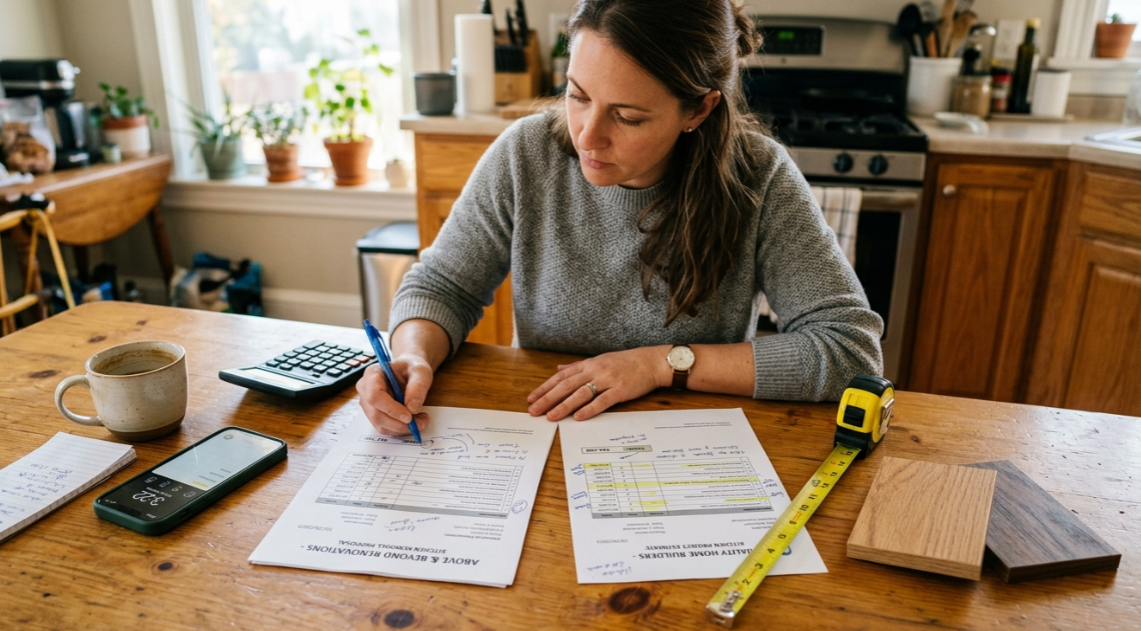
Most of the confusion around kitchen cabinet cost in Washington comes from comparing quotes that include different things. Use this checklist when reviewing bids.
Ask every cabinet provider:
Is this materials only, installation only, or fully installed?
Does the price include design and 3D renderings?
Are site measurements included?
Are cabinets pre-assembled or RTA?
Is delivery and jobsite staging included?
What is the cabinet box material?
What are the doors and drawer fronts made from?
What hardware is included (hinges, glides, pulls)?
Are fillers, panels, skins, toe kicks, and crown included?
Is old cabinet removal included?
Is haul-away included?
Does the price include Washington sales tax?
Are plumbing and electrical changes excluded?
Who coordinates countertop templating?
What is the lead time?
What warranty applies?
How are change orders handled?
What Makes a Quote Suspiciously Cheap
A cabinet quote may be artificially low if it excludes delivery, sales tax, assembly, fillers, panels, crown molding, toe kicks, hardware installation, tear-out, haul-away, wall repair, electrical or plumbing changes, countertop coordination, or change order pricing.
Reddit practitioners stress this repeatedly: the cheapest-looking quote often excludes the detail work that makes cabinets look finished. A higher quote may actually be fair when it includes design, better materials, full assembly, complete installation, and clear exclusions.
Quote Decoder: What Each Line Item Means
Quote Line Item | What It Means | Why It Changes Cost | Question to Ask |
|---|---|---|---|
Cabinets | Boxes, doors, drawers, shelves | Material, finish, construction type | What exactly is included in “cabinets”? |
Assembly | Building RTA or flat-pack cabinets | Adds labor before installation begins | Is assembly included or separate? |
Delivery | Getting cabinets to the jobsite | Distance, stairs, staging area | Is delivery inside the home included? |
Installation | Level, shim, fasten, align | Wall and floor conditions, layout complexity | Are fillers, panels, and crown included? |
Trim | Crown, light rail, toe kick, skins | High-detail labor | Is this a separate line item? |
Demo | Removing existing cabinets | Can reveal hidden damage | Is haul-away included? |
Trades | Plumbing, electrical, venting | May require permits and licensed pros | Who handles trade work? |
Tax | Washington state plus local sales tax | City-specific rate | What tax rate is being used? |
Cabinet Cost vs. Full Kitchen Remodel Cost
A cabinet quote is not a kitchen remodel quote. If the project includes structural changes, flooring, electrical, plumbing, countertops, appliances, backsplash, and painting, the total can be many times higher than the cabinet package alone.
One Seattle-area homeowner shared on Reddit receiving quotes from $60,000 to $150,000 for a kitchen remodel that included structural wall removal, 700 square feet of flooring, new cabinets, a large island, gas and water relocation, recessed lighting, painting, design, engineering stamps, and permit applications. That homeowner negotiated a price around $70,000, excluding quartz countertop materials and appliances.
That is not a cabinet cost. That is a remodel cost. When researching kitchen cabinet cost in Washington, separate the cabinet line items from everything else. It is the only way to know whether $15,000 or $50,000 is reasonable for your specific project.
See completed project examples to get a visual sense of different cabinet styles and scope before requesting a quote.
When Replacing Cabinets Is Worth It
InterNACHI’s life expectancy chart lists kitchen cabinets at roughly 50 years under normal conditions, though that is a guideline and not a guarantee. Cabinets that are structurally sound but cosmetically dated might benefit from refacing rather than full replacement. Cabinets with water damage, failing joints, or layouts that no longer work usually justify replacement.
From a resale perspective, the 2025 JLC Cost vs. Value report for Seattle shows a minor midrange kitchen remodel costing $32,271 with an estimated resale value of $38,098, recouping 118.1% of the investment. That is one of the stronger returns among remodeling projects, though it assumes the work aligns with neighborhood expectations and buyer preferences.
Good cabinets can be one of the longest-lived components in a home. Whether replacement makes financial sense depends on home value, neighborhood standards, design needs, and whether the existing layout actually works for how you cook and live.
What to Bring to a Washington Cabinet Showroom
If you plan to visit a showroom or request a design consultation, come prepared. The more information you bring, the more accurate your estimate will be.
Kitchen measurements (wall lengths, ceiling height, window and door locations)
Photos of your current kitchen from multiple angles
Appliance sizes and spec sheets
Sink and faucet preferences
Desired cabinet style: framed or frameless
Door style and color inspiration images
Storage pain points (what is not working now)
Countertop plans or questions
Budget range
Timeline
Contractor, retailer, or designer contact info if applicable
Krafter’s Land Cabinetry offers free design consultations, 3D renderings, and quotes across its Tukwila, Tacoma, Lynnwood, and Spokane showrooms.
Frequently Asked Questions
How much do kitchen cabinets cost in Washington state?
Kitchen cabinet cost in Washington ranges from about $100 per linear foot installed for stock cabinets to $1,200 or more per linear foot for custom cabinetry. A typical 20 to 25 linear foot kitchen might run $2,000 to $24,000 depending on tier, materials, accessories, and installation scope. Washington’s combined sales tax (9% to nearly 11% in many cities) and higher-than-average labor costs push totals above national averages.
What is the difference between materials-only and installed cabinet cost?
Materials-only cost covers the cabinet product: boxes, doors, drawers, shelves, and sometimes hardware. Installed cost adds labor for leveling, fastening, alignment, and basic trim. But “installed” does not always include tear-out, haul-away, plumbing, electrical, countertops, crown molding, or tax. Always ask what is and is not included.
Are RTA cabinets really cheaper than pre-assembled cabinets?
RTA cabinets often cost less to manufacture and ship. But they still need assembly before installation, and that assembly adds labor. Practitioners report assembly can add 30% to 50% to the installation total depending on complexity. RTA saves on the product side, not necessarily on the finished project.
Do I need a permit to replace kitchen cabinets in Washington?
In many Washington jurisdictions, cabinet-only replacement in the same footprint does not require a permit. Seattle SDCI lists installing kitchen cabinets under work that usually does not need a permit. However, moving walls, plumbing, electrical, gas lines, or structural supports triggers permit and inspection requirements. Always check with your local building department.
How do I verify a cabinet installer in Washington?
Washington’s Department of Labor and Industries maintains a verification tool where you can check a contractor’s active registration, bond, insurance, workers’ comp status, safety citations, and lawsuits. Registration is required for construction contractors in Washington and is a baseline risk check before hiring.
Why is one cabinet quote half the price of another?
Usually because the quotes include different things. The lower quote may exclude delivery, assembly, fillers, panels, crown molding, hardware installation, tear-out, haul-away, tax, or coordination with plumbing and electrical. The higher quote may be fair if it covers more of those items. Compare line by line, not bottom line to bottom line.
What is KCMA certification and does it matter?
KCMA certification means a cabinet line has passed 14 third-party tests simulating accelerated kitchen use, including a 600-pound load test. It is a quality benchmark worth asking about, especially when comparing unfamiliar brands. Certified cabinets are not guaranteed to last forever, but they have been tested under conditions that approximate years of daily use.
How does Washington sales tax affect cabinet cost?
Washington combines a 6.5% state rate with a local rate that varies by city. In Western Washington metros, combined rates often exceed 10%. On a $20,000 cabinet project, that means $1,800 to $2,140 in tax alone. Installation services are taxed based on where the work is performed, so the tax rate follows the project location, not the supplier’s location.
Ready to plan a cabinet project in Washington? Krafter’s Land Cabinetry Inc. supports contractors, retailers, remodelers, designers, and builders with cabinet design, free quotes, 3D renderings, delivery, assembly, and installation services across four Washington showrooms.
Contact the team to start your project, or register as an authorized partner for trade pricing and project support.