TL;DR
Quartz is an engineered stone (90–95% natural quartz bound with resins) that requires zero sealing and offers consistent color patterns. Granite is a 100% natural stone with unmatched heat resistance (up to 1,200°F) and one-of-a-kind veining. Quartz costs slightly more to fabricate, while granite demands yearly resealing. For outdoor kitchens, granite is your only real option because UV light degrades quartz resin over time.
The quartz vs granite countertops debate comes down to a simple distinction: engineered versus natural. Everything else, from maintenance schedules to heat tolerance to price, flows from that core difference. Both materials are premium choices that hold resale value and outperform laminate or butcher block by a wide margin. But they serve different lifestyles, design preferences, and use cases.
This guide breaks down exactly where each material excels and where it falls short, with specific numbers and real-world gotchas that most comparison articles skip. Whether you’re a contractor advising a client or a retailer stocking your showroom, the goal is to give you an honest framework you can actually use.
Browse countertop and cabinet options to see what’s available for your next project.
Quartz vs Granite Countertops: Quick Answer
If you want the simplest answer:
– Choose quartz if you want a low-maintenance countertop that never needs sealing and offers consistent colors and patterns.
– Choose granite if you want maximum heat resistance, natural beauty, and a countertop suitable for outdoor kitchens.
– For most indoor family kitchens, quartz is usually the better everyday choice.
– For heavy cooks, outdoor kitchens, or homeowners who prefer natural stone, granite is often the better investment.
The best countertop depends more on your lifestyle than on the material itself.
What Is Quartz?
Quartz countertops are engineered surfaces made by combining roughly 90–95% crushed natural quartz with 5–10% polymer resins and pigments. The manufacturing process creates a non-porous, uniform material that never needs sealing.
Because the color and pattern are controlled during production, quartz slabs look consistent from one piece to the next. This makes it easy to match large kitchen layouts or multi-bathroom projects without worrying about slab variation. Brands like Caesarstone, Silestone, Cambria, and MSI offer hundreds of colors and finishes, including designs that convincingly mimic marble and concrete.
Quartz is best suited for modern and contemporary kitchens where homeowners want minimal upkeep and a clean, uniform aesthetic. If you’re weighing quartz against another popular stone, our comparison of quartz countertops vs. marble covers that matchup in detail.
What Is Granite?
Granite is a 100% natural igneous stone, formed deep within the Earth’s crust through the slow cooling of molten rock. Each slab is quarried, cut, and polished, meaning no two granite countertops are ever identical. The natural veining, speckling, and mineral deposits create patterns that engineered materials can approximate but never truly replicate.
Because granite is porous, it requires periodic sealing to prevent stains from penetrating the surface. That’s the trade-off for its outstanding heat resistance and organic beauty.
Granite fits traditional, farmhouse, and rustic kitchen designs particularly well, though exotic slabs with bold movement can anchor a modern space too. It’s also the clear winner for outdoor kitchens, a point most comparison articles overlook entirely.
Side-by-Side Comparison Table
Feature | Quartz | Granite |
|---|---|---|
Composition | 90–95% crushed quartz + resin binders | 100% natural stone |
Appearance | Uniform, consistent patterns | Unique veining per slab |
Heat Resistance | Up to ~300°F | Up to ~1,200°F |
Stain Resistance | High (non-porous), but resin can absorb strong pigments | Moderate (requires sealing) |
Maintenance | Soap and water, no sealing | Reseal every 1–2 years |
Cost (installed/sqft) | $50–$150 | $40–$200 |
Lifespan | 25–50+ years | 100+ years with proper care |
Outdoor Suitability | Not recommended (UV degrades resin) | Fully suitable |
Resale Value | Strong (68% of buyers prefer it) | Strong (classic, timeless appeal) |
Quartz vs Granite at a Glance
If You Want… | Choose |
|---|---|
No sealing | Quartz |
Natural stone | Granite |
Outdoor kitchen | Granite |
Uniform appearance | Quartz |
One-of-a-kind slab | Granite |
Easier cleaning | Quartz |
Better heat resistance | Granite |
Lowest maintenance | Quartz |
Modern designs | Quartz |
Rustic or traditional look | Granite |
Durability and Heat Resistance
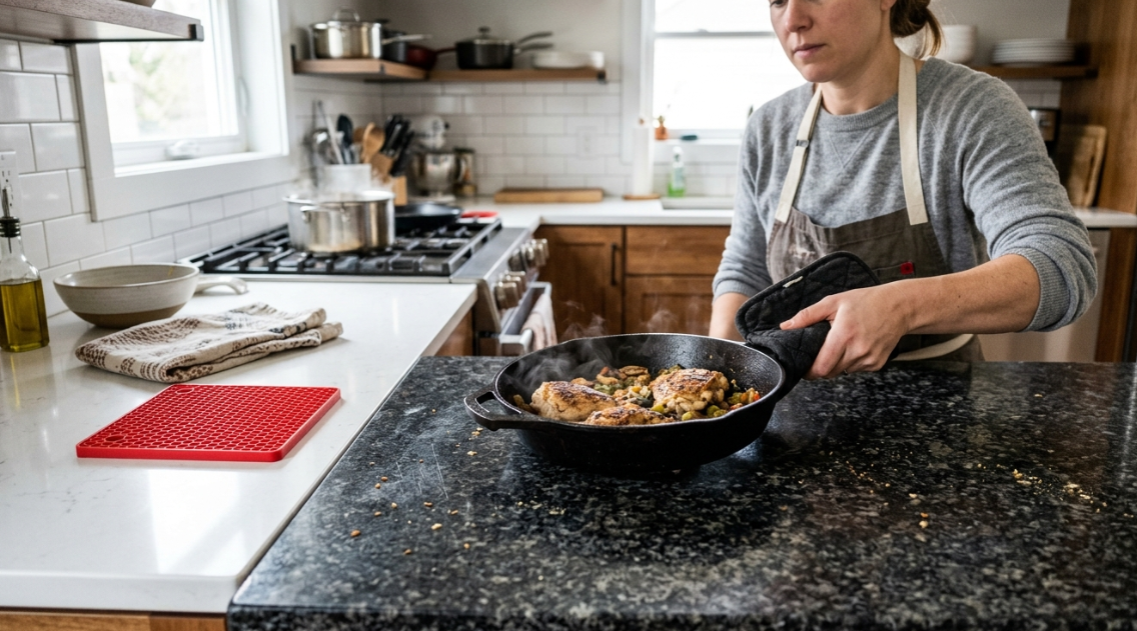
This is where quartz vs granite countertops show their starkest difference. Granite handles temperatures up to approximately 1,200°F. You can set a hot pan directly on granite and the stone won’t flinch. Quartz, by contrast, is safe only to around 300°F before problems start.
The critical detail: it’s not the quartz crystals that fail under heat. Natural quartz is extremely heat-resistant on its own. The polymer resins that bind the surface together are the weak point. When exposed to sudden or sustained high temperatures, those resins can discolor, warp, or burn. The damage is permanent. Some homeowners mistake the whitened mark for a stain, but no cleaning product will fix resin burn.
Here’s something almost no comparison article mentions: nearly every major quartz manufacturer, including Caesarstone, Silestone, Cambria, and MSI, explicitly excludes heat damage from warranty coverage. Their standard language states that placing a hot pan on the counter is considered misuse, not a manufacturing defect. Practitioners on Reddit regularly report discovering this exclusion only after the damage has already occurred.
Bottom line: If you cook with high heat and don’t want to think about trivets, granite is the safer choice. If you choose quartz, trivets and hot pads are non-negotiable.
Maintenance and Care
Quartz wins the low-maintenance category decisively. Its non-porous surface resists most spills and stains with nothing more than soap and water. You never need to seal it, and daily cleaning takes seconds.
Granite requires resealing every one to two years using a penetrating impregnator. Products like Tenax Hydrex or StoneTech BulletProof cost $15–$25 per bottle and treat 100 to 200 square feet. The application takes about 20 minutes, so it’s not a major ordeal, but it is a recurring task.
The quartz gotcha that gets overlooked: although the surface is non-porous, the resin component can absorb strongly pigmented liquids like red wine, turmeric, coffee, and soy sauce if they sit too long. White quartz is particularly susceptible to permanent yellowing from heat exposure or prolonged UV contact. The granite gotcha is simpler: acidic liquids like lemon juice or vinegar can etch unsealed surfaces, so prompt cleanup matters.
Daily Use Comparison: Which Countertop Fits Your Lifestyle?
Different households place different demands on a countertop.
Busy Families
Quartz is often the better option because spills wipe away easily and there is no need to remember periodic sealing.
Serious Home Cooks
Granite offers greater peace of mind if you frequently move hot cookware directly from the stove or oven.
Luxury Kitchens
Both materials work well, but the choice usually comes down to whether you prefer engineered consistency or natural variation.
Rental Properties
Quartz generally reduces long-term maintenance since tenants are less likely to reseal granite correctly.
Cost Comparison
Pricing for quartz vs granite countertops varies significantly by region, color selection, and edge profile. Here are consolidated ranges from multiple industry sources:
Material | Installed Cost Per Square Foot | Typical L-Shaped Kitchen (30–40 sqft) |
|---|---|---|
Quartz | $50–$150 | $1,800–$4,500 |
Granite | $40–$200 | $1,500–$4,000 |
Mid-range projects tend to cluster around $70–$100 per square foot for both materials. The spread widens at the high end because rare granite colors (blue bahia, for example) can push well past $200 per square foot, while premium quartz lines from Cambria or Caesarstone typically top out around $150.
One cost factor that rarely gets discussed: quartz is harder on fabrication tools. The resin binders generate more heat during cutting and accelerate blade wear. Some fabricators charge a $5–$10 per square foot premium for quartz fabrication over granite. Always ask about this when getting quotes.
Get a free design quote from Krafter’s Land if you’re planning a kitchen project in the Washington area.
Hidden Costs Most Buyers Don’t Consider
The purchase price is only part of the overall cost.
Cost Factor | Quartz | Granite |
|---|---|---|
Initial Installation | Medium-High | Medium-High |
Sealing | None | Every 1–2 years |
Special Cleaners | Usually unnecessary | Sometimes recommended |
Heat Damage Risk | Higher | Very low |
Repair Costs | Moderate | Moderate |
Long-Term Maintenance | Low | Medium |
Aesthetics and Design Fit
Granite countertops deliver organic movement, depth, and character that comes from millions of years of geological formation. The natural mineral composition creates rich veining, speckling, and color variation that works beautifully in traditional, farmhouse, and transitional kitchens. If your client values a one-of-a-kind look, granite delivers that by default.
Quartz countertops lean modern and versatile. Because colors and patterns are engineered, manufacturers can produce convincing marble looks, concrete-inspired finishes, and subtle solid tones without the maintenance burden of the natural materials they imitate. For minimalist or contemporary designs, quartz often pairs better with clean cabinet lines.
Pairing countertops with the right cabinetry matters just as much as the stone selection. Modern quartz designs pair well with frameless cabinets, while granite’s organic patterns complement the structured lines of high-quality framed cabinets.
From a resale perspective, neutral tones (white, gray, taupe) hold value longest in both materials. Bold colors can date a kitchen within a few years.
Outdoor and UV Suitability
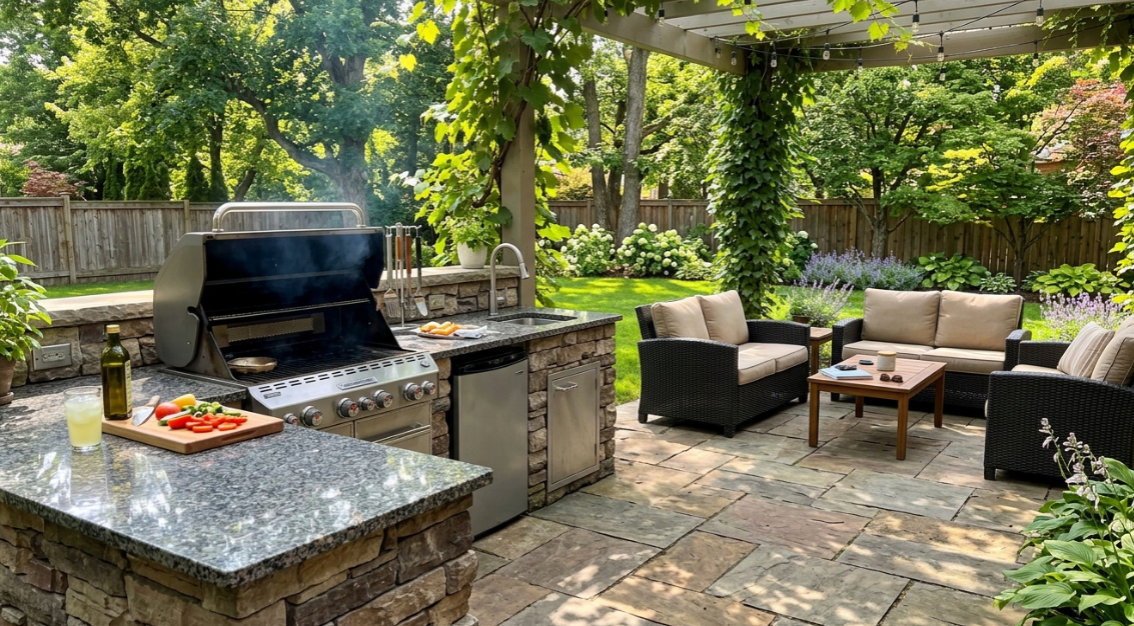
This is the section most comparison articles skip, and it’s a clear win for granite.
Quartz is not suitable for outdoor use. The resins and polymers that bind the surface break down when exposed to direct sunlight over extended periods. UV exposure causes colors to fade and the surface to lose its luster. White quartz, in particular, yellows permanently from UV degradation. This yellowing penetrates below the surface and cannot be repaired.
Granite, by contrast, is fully suitable for outdoor kitchens, patios, and poolside bars. It handles UV exposure, temperature swings, and weather without degrading. If your project involves any outdoor countertop surface, granite is the only practical choice between these two materials.
Scratch Resistance Comparison
Both materials resist scratches well, but they perform differently.
Granite ranks between 6 and 7 on the Mohs hardness scale, while quartz crystals themselves rank at 7. Because engineered quartz also contains resin binders, the finished countertop can scratch slightly more easily than solid granite under certain conditions.
Neither surface should be used as a cutting board because knives dull faster than the countertop.
Resale Value Impact
Both quartz and granite add strong resale value compared to laminate or butcher block alternatives. According to Remodeling Magazine’s 2024 Cost vs. Value Report, a minor kitchen remodel with new countertops returns an average of 96.1% of its cost nationwide.
Market data suggests that 68% of homebuyers specifically seek quartz countertops, which gives quartz a slight edge in buyer appeal. But the practical difference is minimal. Either material signals an updated, well-finished kitchen. A contractor or retailer advising a client purely on resale should focus more on color selection (neutral tones) than on the quartz vs granite countertops debate itself.
See real installations in our projects gallery for examples of how different countertop and cabinet combinations look in finished kitchens.
Lifespan: How Long Each Material Lasts
Granite has the edge on raw longevity. The National Association of Home Builders estimates that granite countertops last over 100 years with proper care. Since “proper care” means resealing every year or two and avoiding harsh acidic cleaners, that’s a reasonable expectation for most households.
Quartz lifespans range from 25 to 50 years in most real-world conditions, with some manufacturers claiming up to 100 years. The practical lifespan depends heavily on how the countertop is treated. Consistent heat exposure, UV contact (near large windows), and harsh chemical cleaners all shorten quartz’s life by degrading the resin binder.
For most kitchen remodels, both materials will outlast the next renovation cycle by a wide margin. The lifespan difference matters more in commercial settings or multi-generational homes where the countertop truly needs to last decades without replacement.
Which Should You Choose?
Choose quartz if:
Zero maintenance is a top priority
You want consistent color and pattern across a large layout
Your design direction is modern, minimalist, or contemporary
The countertop will only be used indoors
Choose granite if:
You cook with high heat and want to set hot pans down without worry
You value one-of-a-kind natural patterns
You need countertops for an outdoor kitchen or patio
You prefer a traditional, rustic, or farmhouse aesthetic
Choose either if:
Resale value is the main driver (both perform well)
Your budget is mid-range ($70–$100 per square foot installed)
You want a premium look that outperforms laminate and solid surface alternatives
The decision is about lifestyle and use case, not about one material being objectively better. The best contractors and designers match the material to the client’s actual habits, not the other way around.
Krafter’s Land operates showrooms across Washington where contractors and retailers can compare quartz countertops, cabinetry, and other remodeling products in person. Learn more about Krafter’s Land or reach out for a consultation.
Frequently Asked Questions
Is quartz more expensive than granite?
At the mid-range, quartz and granite cost roughly the same ($70–$100 per square foot installed). Quartz fabrication costs slightly more because the resin binders are harder on cutting tools, adding $5–$10 per square foot. Rare granite colors can exceed $200 per square foot, making the high end of granite more expensive than the high end of quartz.
Can you put hot pans on quartz?
Technically, no. Quartz is safe only to about 300°F. Above that, the resin binder can discolor, warp, or burn permanently. Every major quartz manufacturer excludes heat damage from their warranty. Always use trivets or hot pads on quartz surfaces.
Does granite need to be sealed?
Yes. Most granite should be resealed every one to two years using a penetrating sealer. The process takes about 20 minutes and costs $15–$25 per bottle. Some high-quality sealants can extend the interval to 3–5 years, but annual sealing is the safe default.
Can quartz be used outdoors?
No. UV light breaks down the polymer resins in quartz, causing fading, discoloration, and permanent yellowing. Granite is the appropriate choice for outdoor kitchens, bars, and patio countertops.
Which lasts longer, quartz or granite?
Granite lasts longer. The National Association of Home Builders estimates granite countertops last 100+ years with proper maintenance. Quartz typically lasts 25–50 years under normal household conditions, though some manufacturers claim longer.
Do quartz countertops stain?
Quartz is highly stain-resistant but not stain-proof. Strongly pigmented liquids like red wine, turmeric, and coffee can stain the resin if left on the surface too long. Wiping spills promptly prevents most issues.
Which material is better for resale value?
Both add strong resale value. However, 68% of homebuyers specifically seek quartz, giving it a slight advantage in buyer preference. Neutral colors in either material hold resale value the longest.
Is granite outdated?
Not at all. Granite remains a premium countertop material with timeless appeal, particularly in traditional and transitional kitchen designs. Exotic granite slabs with dramatic veining are used in high-end contemporary projects too. The “granite is outdated” perception is largely a marketing narrative pushed by engineered stone manufacturers.