
TL;DR
Trade-only cabinet lines protect dealer margins and ensure professional-grade service throughout the supply chain. To order trade-only cabinets through a dealer or distributor, you need a trade account backed by your business credentials (EIN, resale certificate, contractor or business license). This guide covers every step of that process, from qualifying for an account to managing delivery logistics and damage claims, so contractors, remodelers, designers, and retailers can run tighter projects with fewer surprises.
You found the right cabinet line for your next project. The door style fits the client brief, the finish works, the price point leaves room for margin. But the brand doesn’t sell direct. It routes everything through an authorized dealer network, with pricing hidden behind a login wall.
This is standard operating procedure across semi-custom and premium cabinet manufacturing. Brands like those under MasterBrand, Fabuwood, and similar umbrellas distribute exclusively through dealer channels. If you want access to those lines (and the margin protection that comes with them), you work within the channel.
Direct Answer: How Do You Order Trade-Only Cabinets Through a Dealer?
To order trade-only cabinets through a dealer, first find an authorized cabinet supplier that carries the manufacturer or product line you want. Apply for a trade account using your business information, EIN (if applicable), resale certificate (if required), and business license or contractor credentials. Once approved, request a cabinet design and itemized quote, review the specifications, confirm pricing and lead times, and submit the dealer’s official purchase order. After receiving the order confirmation, arrange delivery or warehouse pickup and inspect the cabinets for damage before installation.
This guide explains how to order trade-only cabinets through a dealer from start to finish. It covers the terminology, account qualification requirements, the design-to-order workflow, pricing structures, and delivery logistics. Whether you’re a contractor setting up your first trade account, a remodeler evaluating a new supplier, or an established dealer onboarding a new line, every step is here.
Evaluating supplier options? Check out contractor cabinet pricing for a breakdown of what trade pros actually pay across different tiers.
Who Can Buy Trade-Only Cabinets?
Trade-only cabinets are generally available to approved business customers rather than individual retail consumers. However, eligibility depends on the manufacturer’s distribution policy and the dealer’s account requirements.
You may qualify for a cabinet trade account if you operate a business in one of the following categories:
Business type | Typical eligibility | Common requirements |
|---|---|---|
General contractors | Usually eligible | Business registration and tax information |
Kitchen and bath remodelers | Usually eligible | Business credentials |
Interior designers | Often eligible | Business registration or professional credentials |
Cabinet installers | Often eligible | Business information and applicable licensing |
Home builders | Usually eligible | Business registration and project information |
Cabinet retailers | Usually eligible | Resale documentation |
Property developers | Supplier-dependent | Business and project credentials |
Homeowners | Usually restricted | May need to purchase through an authorized dealer |
Do you need a contractor license to buy trade-only cabinets?
Not necessarily. Many cabinet suppliers accept registered businesses, interior designers, remodelers, and retailers without requiring a specific contractor license. However, some manufacturers and dealers impose stricter eligibility requirements.
If you’re a homeowner, you may still be able to purchase the same cabinet lines by working with an authorized dealer or contractor.
What “Trade-Only” Means in the Cabinet Industry
“Trade only” (also called “to the trade”) means products are not available for purchase directly by consumers. Sales are restricted to industry professionals: contractors, designers, builders, and authorized retailers.
Why do cabinet brands operate this way? Trade-only distribution protects dealer margins, ensures professional measurement and installation (which reduces warranty claims and callbacks), and allows manufacturers to offer confidential pricing that varies by volume and relationship. It also means the dealer or contractor handles customer service, design, and problem resolution rather than a distant factory, keeping the trade partner at the center of the client relationship.
For trade professionals, this channel structure is an advantage. It prevents direct-to-consumer price undercutting, gives you control over the client experience, and positions you as the essential link between manufacturer and end user. Suppliers that maintain strict trade-only policies are actively protecting your business.
How to Find an Authorized Cabinet Dealer

The first step in ordering trade-only cabinets is finding a dealer authorized to sell the cabinet brand or product line you want. Not every cabinet showroom or distributor carries every manufacturer, and some brands restrict sales to approved dealers within specific territories.
Use these methods to identify a qualified supplier:
1. Check the Manufacturer’s Dealer Locator
Start with the manufacturer’s official website. Many cabinet manufacturers provide dealer locator tools that allow you to search by ZIP code, city, or state.
A manufacturer-listed dealer is generally a safer starting point than an unfamiliar reseller because you can verify its relationship with the brand.
2. Contact Cabinet Showrooms
Visit local cabinet showrooms and ask which manufacturers they represent. A showroom may carry multiple cabinet lines, allowing you to compare construction, finishes, door styles, and pricing through one supplier.
Ask whether the showroom works directly with contractors, remodelers, builders, or interior designers.
3. Search for Wholesale Cabinet Distributors
Cabinet distributors can be useful when you need multiple product lines, competitive trade pricing, warehouse inventory, or recurring supply for renovation projects.
However, confirm whether the distributor is authorized to sell the specific brand you want.
4. Request Proof of Dealer Authorization
Before placing an order, ask the supplier to confirm its authorized dealer status. You can also verify the business directly with the manufacturer.
This matters particularly for special-order cabinets, where warranty coverage, replacement parts, and manufacturer support may depend on purchasing through an approved distribution channel.
What to Check Before Choosing a Dealer
Evaluation factor | What to ask |
|---|---|
Brand authorization | Are you an authorized dealer for this cabinet manufacturer? |
Product selection | Which cabinet lines and finishes do you carry? |
Trade pricing | Do you offer account-based contractor pricing? |
Design support | Can you provide kitchen layouts and 3D renderings? |
Inventory | Which products are stocked locally? |
Lead times | What are the current production and delivery estimates? |
Warranty | Who handles manufacturer warranty claims? |
Delivery | Do you offer jobsite delivery or warehouse pickup? |
Replacement support | How are damaged or missing cabinets replaced? |
Pro tip: Don’t choose a dealer based on cabinet pricing alone. A supplier with reliable inventory, accurate order processing, and responsive replacement support can save more money over the life of a project than a slightly cheaper supplier with poor fulfillment.
Channel and Business-Model Terms Every Trade Pro Should Know
Dealer (Cabinet Showroom / Kitchen Dealer)
A dealer or showroom sells to end users, typically with retail markup built into the price. Dealers maintain direct relationships with manufacturers and are authorized to sell specific cabinet lines. They usually offer design services, handle ordering, and manage delivery logistics.
When trade professionals talk about ordering trade-only cabinets through a dealer, this is the entity at the center of the supply chain. If you’re a contractor partnering with a dealer, or a dealer evaluating new cabinet lines, visiting a cabinet showroom lets you assess product quality and range firsthand.
Distributor vs. Dealer vs. Retailer
These terms get used interchangeably, but they describe different roles in the channel:
Retailer sells products directly to end consumers. Think Home Depot or Lowe’s.
Dealer sells through a showroom or trade relationship, often to one client at a time, with design consultation included.
Distributor works at scale, connecting professionals directly to manufacturer pricing across multiple cabinet lines through a single trade relationship.
Some businesses blend these roles. A cabinet distributor might also operate showrooms. A retailer might have a pro desk that functions like a dealer. The distinction matters because pricing, service level, and accountability differ significantly depending on which channel you use, and choosing the wrong one can erode your margins or create service gaps your clients will notice.
Authorized Dealer / Authorized Retailer
“Authorized” means the manufacturer has formally approved this business to sell its products. An authorized dealer receives manufacturer training, has access to the full product catalog, and can process warranty claims directly. Sourcing from unauthorized channels (gray-market resellers, for instance) can void manufacturer warranties and create liability exposure on your projects.
Trade Program / Trade Account
A trade program is the formal framework a manufacturer or distributor establishes to serve professional buyers. It includes the application process, pricing tiers, ordering portal, and support infrastructure. Your trade account is your individual membership within that program, and your purchasing volume within it determines your discount tier.
For a detailed comparison of what to evaluate when choosing a trade supplier, this guide for trade pros covers the critical factors.
Login-Gated Pricing / Confidential Pricing
If you’ve visited a trade-only supplier’s website and couldn’t find a single price, that’s login-gated pricing. Trade pricing is visible only after you log into an approved account. This protects dealer margins by preventing consumers from comparison-shopping against your quotes.
This is a feature, not a bug. Login-gated pricing means your clients aren’t comparing your service-inclusive quote against a raw wholesale number they found online. It preserves the value of what you bring to the project.
Account and Qualification Terms
Trade Account Application
It starts with a trade account, not a purchase order. Before you can see pricing or place an order, you apply. The application asks for your business details, and most suppliers review applications within one to two business days.
Registration typically costs nothing. The application itself is straightforward, usually a short form asking for your company information, licensing, and tax details.
EIN (Employer Identification Number)
Your EIN is a federal number assigned by the IRS. It identifies your business for payroll and income tax purposes. Nearly every trade account application requires it.
Resale Certificate / Sales Tax Permit
A resale certificate (sometimes called a sales tax permit or resale license) is a state-level document. It proves you’re buying products for resale rather than personal use, which exempts the transaction from sales tax at the wholesale level.
Here’s where confusion commonly crops up: your EIN is federal, from the IRS. A resale certificate is state-level and covers sales tax. Some states use your EIN as your state tax ID, which is where the mixup comes from, but they’re separate documents serving separate purposes. Practitioners on Reddit and trade forums flag this confusion regularly, and getting it wrong can delay your account approval by days.
Business License / Contractor License
Most suppliers require a registered business entity and a valid business license. A contractor license is not necessarily required just to open a trade account, although licensing requirements vary by state and by the type of work you perform. Some suppliers accept interior designers and retail business owners alongside licensed contractors. Know your state’s requirements before applying.
Account Approval
Once you submit your application with the required documentation (EIN, resale certificate, business license, business address), the supplier reviews and approves it. Typical turnaround is one to two business days. After approval, you gain access to wholesale trade pricing and the ordering portal.
Design and Quoting Terms
2020 Design / Design Flex (.KIT File)
This is one of the most operationally important tools in the dealer ordering process. 2020 Design is industry-standard kitchen and bath design software. A “2020 design packet” is a branded deliverable that includes floor plans, elevations, 3D renderings, a cabinet spec list, a price-ready quote, and the native .KIT file.
Why does it matter? The .KIT file allows you to import an exact kitchen layout directly into your ordering system. This increases accuracy and saves time. Without it, someone has to manually re-enter every cabinet specification, which introduces errors that lead to reorders, delays, and margin erosion.
Many suppliers generate 2020 Design files as part of their free design service. If your supplier offers downloadable 2020 design packages, use them. They compress quoting cycles and reduce costly spec mistakes.
Cabinet Spec List / Bill of Materials
The spec list (or bill of materials) is the complete inventory of every cabinet, filler, molding, and accessory in your project. Each item includes its SKU, dimensions, finish, and sometimes its individual price. This is the document you and your client review before signing off on an order.
Understanding how to read specification sheets can save your projects from costly ordering mistakes and reduce support tickets.
3D Rendering / Project Preview
A 3D rendering shows the client what their finished kitchen or bathroom will look like before they commit. Most trade-only suppliers offer this as part of the quoting process, either through 2020 Design output or a proprietary preview tool. For trade professionals, renderings are a closing tool: they accelerate client approvals and reduce mid-project change orders.
Free Design and Quote
Many dealer-channel suppliers offer complimentary design work: you provide kitchen measurements, and the supplier produces a layout, rendering, and itemized quote at no cost. This lowers your pre-sales investment and gives you a polished deliverable to present to the client without eating into your margins before the job is sold.
SKU / Cabinet Code
Every individual cabinet has a unique identifier, its SKU or cabinet code. A typical code encodes the cabinet type (base, wall, tall), width, door style, and finish. For example, “W3630-SS-WH” might indicate a 36×30 wall cabinet in Slim Shaker style, white finish. When reviewing your spec list, these codes are how you verify that every piece is correct before submitting the order.
Questions to Ask a Cabinet Dealer Before Placing an Order
Before purchasing trade-only cabinets, confirm the supplier’s pricing structure, product specifications, payment conditions, fulfillment process, and replacement policies.
Getting these details in writing helps prevent unexpected expenses and scheduling problems.
1. Are You an Authorized Dealer for This Cabinet Brand?
Confirm that the supplier is authorized to sell the manufacturer and product line you’re considering. Ask whether manufacturer warranties and replacement services are available through the dealer.
2. What Is Included in the Quoted Price?
Determine whether the quote covers cabinets only or also includes accessories, moldings, fillers, delivery, assembly, and design services.
A low cabinet price can become substantially more expensive when additional components and delivery charges are added.
3. Are the Cabinets In Stock or Special Order?
Ask which products are available in the warehouse and which must be manufactured after ordering.
Request an estimated fulfillment date rather than relying on a general lead-time range.
4. What Happens If a Cabinet Arrives Damaged?
Ask how long you have to report damage, what documentation is required, and whether replacements are shipped at no additional cost when the manufacturer is responsible.
5. Can I Modify or Cancel an Order?
Determine when an order becomes non-cancellable and whether changes after production approval incur additional charges.
6. What Are Your Delivery and Payment Terms?
Confirm the deposit, remaining balance, accepted payment methods, delivery charges, and whether credit terms are available.
Ordering and Fulfillment Terms
Order Form (Official / Branded)
Most trade-only suppliers require orders to be submitted on their official order form. Orders submitted in other formats (a casual email list, a text message) are typically not processed. The order form standardizes the information and reduces errors. If you’re onboarding with a new supplier, confirm their required format upfront.
Order Confirmation / Acknowledgment
After you submit your order, the supplier sends back a confirmation document. This lists every item, the pricing, estimated lead time, and delivery details. The order usually stays in “pending” status until you or your client signs the confirmation and returns it. Until that signature comes back, production does not begin. Build this approval step into your project timeline.
RTA (Ready-to-Assemble) vs. Assembled
RTA cabinets ship flat-packed and are assembled on site. Assembled cabinets arrive fully built. The choice affects cost, lead time, and jobsite labor requirements.
Some suppliers offer both options: next-day pickup for RTA, or a one-week assembly turnaround if you want them pre-built. For contractors managing tight jobsite schedules, the tradeoff between assembly time and lead time is a real operational decision. For a detailed comparison of RTA vs. assembled cabinets, including cost and quality tradeoffs, that’s worth reviewing before you commit.
Lead Time (Stock vs. Semi-Custom vs. Custom)
Lead time is how long it takes from order confirmation to cabinets being ready. The range is enormous:
Stock cabinets: Available immediately or within days
Semi-custom: Typically 3 to 8 weeks
Custom: 8 to 16+ weeks
Choosing a trade-only brand often means semi-custom lead times, though suppliers with large regional warehouses can dramatically shorten this. A supplier maintaining 100,000+ square feet of local warehouse space, for instance, can keep popular SKUs in stock and eliminate the wait that kills project timelines. For a full breakdown, see this guide on cabinet lead times by type.
MOQ (Minimum Order Quantity)
Some suppliers require a minimum order, whether expressed as a dollar amount or a number of units. Others have no minimum at all. Clarify this upfront, especially if your pipeline includes smaller jobs like single-bathroom vanity installs or laundry room refreshes.
Note that “wholesale” doesn’t automatically mean a minimum order exists. More on that below.
Will-Call / Pickup
Will-call means you or your crew pick up the cabinets at the supplier’s warehouse rather than having them delivered. This is often faster and cheaper. For RTA cabinets, next-day will-call is common and can keep a project moving when the schedule is tight.
Delivery Terms (First-Floor Drop / Garage Drop)
This is a critical detail for GC scheduling. “First-floor drop” or “garage drop” means the delivery team brings cabinets to the garage or the first floor of the jobsite. They do not carry boxes upstairs, distribute them to individual rooms, or unpack them.
If the kitchen is on the second floor or cabinets need to be staged in specific rooms, plan your own labor for that. Communicating these delivery terms clearly to your client prevents day-of confusion and sets realistic expectations for what happens on delivery day. Build the internal distribution labor into your project scope.
Pricing and Payment Terms
Trade Pricing / Wholesale Pricing
Trade pricing is the discounted rate offered to approved trade account holders. It’s lower than what a consumer would pay through a retail channel. The gap between trade and retail pricing on the same product typically sits 30 to 50% apart, and that spread is your margin opportunity.
MSRP / List Price
MSRP (Manufacturer’s Suggested Retail Price) is the published reference price. Trade discounts are calculated as a percentage off MSRP. Since many trade-only brands don’t publish MSRP publicly, your supplier provides this number as part of the quoting process.
Trade Discount / Volume Tiers
Not all trade accounts get the same discount. The structure typically works in tiers:
Tier | Annual Volume | Typical Discount |
|---|---|---|
Standard Trade | Under $25,000 | 30–35% off MSRP |
Bronze Dealer | $25K–$75K | 35–40% off MSRP |
Silver Dealer | $75K–$200K | 40–45% off MSRP |
Gold Dealer | $200K–$500K | 45–50% off MSRP |
First-time and small orders might start at 10–20% off. As your volume grows, so does your discount. The margin difference is significant: the spread between a 12% trade discount and a 45% wholesale discount on a $40,000 kitchen package works out to roughly $13,200 in recoverable margin. Consolidating your purchasing with fewer suppliers is one of the fastest ways to move up the tier ladder.
Looking for specific pricing? Compare contractor cabinet pricing and lead times from various supplier tiers.
Dealer Markup (Pricing to Your Client)
When you price cabinets for your client, your quote includes your markup on top of what you paid at trade pricing. Contractors typically mark up cabinet prices 10–20%, though some charge as much as 50% depending on the scope of service included (design, project management, installation, warranty handling).
Practitioners on Reddit put the typical markup around 20% on large orders. The markup isn’t pure profit. It covers your design work, measurement, project management, warranty coordination, and the risk you absorb on the order. Pricing it too low undercuts your profitability; pricing it too high makes you uncompetitive. Knowing your true cost of service delivery matters.
Per-Linear-Foot Pricing
Some suppliers quote by the linear foot rather than by individual cabinet. Entry-level trade pricing runs roughly $80–$140 per linear foot, with mid-range at $140–$260 per linear foot. This is a useful budgeting benchmark when scoping projects, but actual cost depends on door style, finish, box construction, and accessories.
Net Terms (Net 15, Net 30)
Net terms define when payment is due after invoicing. “Net 30” means you have 30 days to pay. These terms are common for established trade accounts and significantly improve your cash flow on multi-phase projects. New accounts often start with prepayment or credit card before graduating to net terms based on payment history and volume.
Restocking Fee
If cabinets need to be returned (wrong size ordered, client changed their mind on a finish), expect a restocking fee. This typically ranges from 15–25% of the item cost. Custom or special-order pieces may not be returnable at all. Double-checking your spec list before order submission is the cheapest insurance against restocking charges.
Post-Order Terms
Warranty (Limited Cabinet Warranty)
Most trade-only cabinet brands offer a limited warranty covering manufacturing defects in materials and workmanship. The coverage period varies. Warranties typically do not cover damage from improper installation, water exposure, or normal wear.
Materials compliance matters here too. CARB Phase 2 and EPA TSCA Title VI are federal standards governing formaldehyde emissions from composite wood products. Cabinets meeting these standards support indoor air quality requirements and building code compliance. If your project requires documentation for permitting or IAQ verification, confirm compliance in writing from your supplier and keep it in your project file.
Damage Claim / Replacement Process
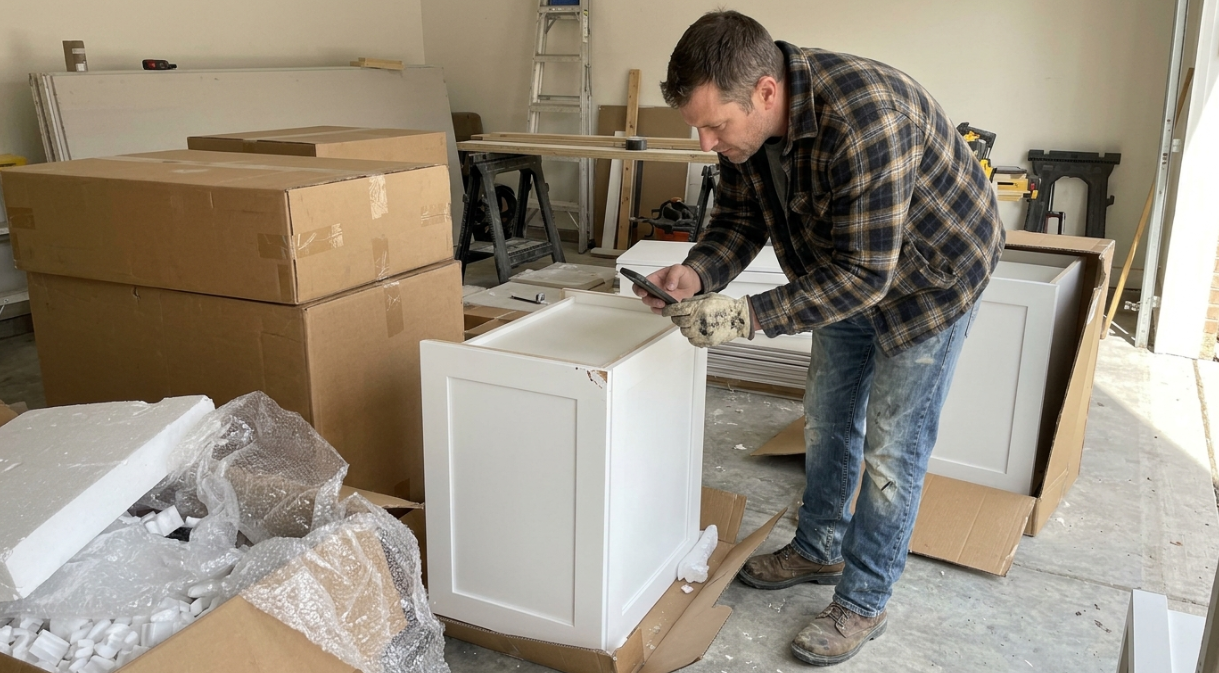
Inspect every cabinet at delivery. If something arrives damaged, document it immediately (photos, written notes on the delivery receipt) and notify your supplier within the claim window specified in your purchase agreement. Most suppliers have a defined process for replacements, but the timeline depends on whether the item is in stock or needs to be reordered.
This is where the dealer channel proves its operational value. Practitioners on Reddit consistently report that damage claims handled through independent dealers and trade-focused suppliers get resolved faster and with less friction than claims through big-box stores. One project manager described ordering thirty cabinets through a big-box retailer, receiving roughly half of them damaged, and then spending sixteen weeks stuck in replacement loops, blowing out the project timeline and destroying the client relationship. A different contractor working with a small, trade-focused dealer had a blemished piece replaced without even needing to escalate.
The same manufacturer often gets very different reviews depending on whether the purchase went through a dealer or a big-box store. The channel matters as much as the brand when it comes to protecting your project timelines.
For a detailed walkthrough of what to check, see this cabinet delivery checklist.
Punch List / Final Walkthrough
After installation, you and the client walk through the completed project and note anything that needs correction: a door that’s slightly off-alignment, a drawer that sticks, a missing piece of trim. This list is the “punch list.” Closing it out promptly, before you leave the jobsite, protects your reputation and avoids callback costs.
The Full Ordering Sequence: From Supplier Selection to Delivery
Now that the terminology is clear, here’s how the process of ordering trade-only cabinets through a dealer actually flows, step by step.
Step 1: Identify the Right Trade Supplier.
Evaluate suppliers based on product range (do they carry both frameless and framed lines?), inventory depth (in-stock vs. special order), lead times, geographic proximity, and support infrastructure (design services, 2020 files, measurement resources). Consolidating POs across cabinets, countertops, flooring, and accessories with a single multi-category supplier reduces vendor management overhead.
Step 2: Open Your Trade Account.
Submit the dealer application with your business details, EIN, resale certificate, and any required licensing. Wait for approval (typically one to two business days). Once approved, you gain access to trade pricing and the ordering portal.
Step 3: Get a Design and Quote.
Provide kitchen or bathroom measurements. The supplier creates a layout using 2020 Design or similar software, generating floor plans, 3D renderings, and an itemized spec list. Many suppliers offer this at no cost, which means you can present a polished, professional proposal to your client without absorbing pre-sales design expenses.
Step 4: Review the Spec List and Pricing.
Go through every line item. Verify cabinet codes, dimensions, finishes, and quantities. Cross-reference against field measurements. This is where mistakes are cheapest to fix.
Step 5: Approve and Sign the Order.
Submit your order on the official order form and receive an order confirmation. Review it, sign it, and return it. Production or warehouse pull begins only after this step.
Step 6: Manage Lead Time.
Lead times depend on whether you’re ordering stock, semi-custom, or custom cabinets. Build realistic lead times into your project schedule from the start. Suppliers with large regional warehouse operations can often fulfill stock and popular semi-custom SKUs within days rather than weeks.
Step 7: Schedule Delivery or Pickup.
Coordinate with the supplier and your jobsite schedule. Confirm delivery terms (first-floor drop, garage drop, or will-call). Make sure the jobsite is ready to receive the cabinets and that you have labor planned for internal distribution if needed.
Step 8: Inspect at Delivery.
Open boxes, check for damage, compare delivered items against your spec list. Report any issues immediately. Document everything with photos.
Step 9: Install.
Handle installation according to manufacturer specifications. If fit or finish issues arise during install, contact your supplier promptly. Having measurement and assembly video resources from your supplier reduces installer errors and cuts support requests.
Step 10: Final Walkthrough and Punch List.
Review the completed work with the client, document anything that needs correction, and close out the punch list before leaving the jobsite.
The “Wholesale” Misnomer
One final concept worth addressing directly: the word “wholesale” causes confusion in the cabinet industry.
“Wholesale” describes a selling approach, not a cabinet’s construction quality. A “wholesale cabinet” is not inherently better or worse than a “retail cabinet.” The term simply means the pricing structure is oriented toward trade buyers rather than consumers.
Wholesale also doesn’t automatically mean a minimum order, trade-only access, or services like design and installation. Some businesses use “wholesale” as a marketing label while selling directly to consumers at retail prices. If a supplier’s website advertises “wholesale cabinets” but doesn’t require a trade account or any business credentials, you’re probably looking at retail pricing with a wholesale label. True trade-only suppliers gate access and protect the pricing that makes your margins viable.
Why the Trade-Only Channel Protects Your Business
The most consistently positive purchasing experiences reported across Reddit and trade forums involve independent, trade-focused dealers and distributors. Contractors describe better service, faster problem resolution, and more predictable project timelines compared to big-box alternatives.
One contractor found a trade-focused supplier that delivered cabinets for about 20% less than Home Depot’s pro desk. The supplier offered the same computer-aided design service, but with faster turnaround on issues and a single point of contact who actually knew the project.
The consensus across practitioner communities is clear: trade-focused suppliers are the best choice for full kitchen and bath projects. Big-box pro desks work for stock cabinets on tight deadlines, but they fall apart on thirty-box special orders where damage claims, replacement logistics, and accountability matter.
Suppliers that maintain strict trade-only policies, login-gated pricing, and defined dealer territories are investing in channel integrity. That investment directly benefits trade professionals by preventing price transparency erosion and keeping the professional at the center of the transaction.
Evaluating your options? This comparison of cabinet suppliers vs. Home Depot lays out the practical differences from a trade professional’s perspective.
Frequently Asked Questions
What documents do I need to open a trade account?
The standard requirements are a registered business entity, a federal EIN, a state resale certificate (or sales tax exemption certificate), and a business address. Some suppliers also request a business license or contractor license, though this varies by state and supplier. Having all documentation ready before you apply speeds up approval.
How long does trade account approval take?
Most applications are reviewed and approved within one to two business days. Some suppliers approve accounts the same day. The timeline depends on whether your documentation is complete and whether the supplier needs to verify any credentials.
What is the typical trade discount on cabinets?
It ranges widely. Small or first-time orders might receive 10–20% off MSRP. Established accounts typically see 25–35% off. Volume builders and high-annual-spend dealers can negotiate 40–50% off or more. Your specific discount depends on the supplier’s tier structure and your purchasing history. Consolidating volume with fewer suppliers is the most direct path to better pricing.
What is a 2020 Design file and why should I use it?
2020 Design is the standard software used in kitchen and bath design. The file (often a .KIT file) contains the complete kitchen layout, including floor plans, elevations, cabinet specifications, and a price-ready quote. Importing it directly into your ordering system reduces manual entry errors and compresses the quoting cycle. If your supplier offers downloadable 2020 design packages, use them.
Why can’t I see prices on the supplier’s website?
Trade-only suppliers use login-gated pricing. Prices are visible only to approved trade account holders. This protects your margins by preventing consumers from comparison-shopping against your quotes. It’s a channel integrity measure that benefits every trade partner in the network.
How should I price cabinets for my clients?
The typical dealer or contractor markup is 10–20% on top of trade cost, though it can reach 50% depending on scope of service. The markup should reflect your actual cost of service delivery: design time, measurement, project management, delivery coordination, warranty handling, and the risk you carry on the order. Choosing the right supplier can help you keep your cost basis competitive while still delivering margin.
What happens if cabinets arrive damaged?
Document the damage immediately with photos and notes on the delivery receipt. Contact your supplier within the specified claim window. Replacement timelines depend on whether the item is in stock. Working through a trade-focused supplier rather than a big-box store generally results in faster resolution and less disruption to your project timeline.
Can my clients visit a supplier showroom directly?
Many trade-only suppliers operate showrooms where you can bring your clients for product selection. This lets clients see and touch finishes, door styles, and hardware in person, which accelerates approvals and reduces change orders. Contact the supplier to confirm their showroom policy and whether appointments are needed.