TL;DR
Cabinet box construction refers to the structural shell behind the doors and drawer fronts, often called the carcass or case. It determines how long your cabinets last, how much weight they hold, and whether they survive moisture exposure. The key variables are material (plywood vs. particleboard vs. MDF), panel thickness, joinery method, and whether the box is framed or frameless. If the box fails, everything attached to it fails too.
Cabinet Box Construction: Quick Answer
Cabinet box construction is the way the structural shell of a cabinet is designed and assembled. The most important quality factors are the box material, panel thickness, back-panel construction, joinery, and whether the cabinet is framed or frameless. For most higher-durability applications, 3/4-inch plywood sides, a rigid or captured back, and mechanically interlocking joints provide a strong cabinet box, but construction quality matters as much as the material itself.
The cabinet box is the part of a kitchen you never see but always depend on. It supports your countertop, holds your hinges, carries your drawers, and anchors the whole assembly to the wall. When homeowners compare quotes or contractors evaluate supplier specs, the door style and finish get most of the attention. That’s understandable. But behind every door panel and color scheme, the cabinet is essentially a box. Understanding how that box is built explains most of the variation in cost and quality across cabinet lines.
This guide breaks down every element of cabinet box construction, from materials and panel thickness to joinery, compliance standards, and how to inspect quality in a showroom or on a jobsite.
Comparing cabinet options for an upcoming project? Get contractor cabinet pricing with lead times and reviews to speed up your selection.
What Is a Cabinet Box?
The cabinet box (also called the carcass, carcase, or case) is the structural shell of any cabinet, whether it’s a kitchen base unit, wall cabinet, bathroom vanity, or pantry. Box or case construction is the foundational design behind dressers, buffets, desks, and kitchen or bath cabinetry alike.
Think of it as the skeleton. The box holds everything together: countertops press down on it, wall screws pass through it, hinges mount to it, and drawer slides attach inside it. If the box warps, racks, or delaminates, every component it supports goes with it.
The term “cabinet box construction” covers the full set of decisions that define this shell: what material the panels are made from, how thick those panels are, how they’re joined at the corners, and whether the front opening has a face frame or not.
What Makes a Cabinet Box High Quality?
A high-quality cabinet box is defined by more than the word “plywood” on a specification sheet. Look at five factors together: material, thickness, back-panel construction, joinery, and structural design.
Quality factor | Stronger construction | Lower-cost construction |
|---|---|---|
Box material | Plywood or appropriately engineered composite panels | Lower-grade particleboard |
Side thickness | Typically 3/4-inch for frameless construction | Thin panels with limited reinforcement |
Back panel | Thick or rigid panel captured in dadoes/rabbets | Thin plant-on hardboard |
Joinery | Dado, rabbet, lock-rabbet, dowel, or other mechanically reinforced joint | Fasteners-only butt joints |
Structural design | Properly engineered framed or frameless construction | Thin panels with minimal reinforcement |
Moisture protection | Sealed edges and appropriate material selection | Exposed or poorly protected particleboard edges |
The important point is that no single specification determines cabinet quality. A well-engineered cabinet made from particleboard can outperform a poorly constructed plywood cabinet. Evaluate the entire box construction rather than relying on the material name alone.
Which Cabinet Box Material Is Best for Different Applications?
The best cabinet-box material depends on where the cabinet will be installed and what performance matters most.
Application | Preferred material | Why |
|---|---|---|
High-end kitchen cabinetry | Plywood | Strong screw retention, good dimensional stability, and relatively good moisture resistance |
Under-sink cabinet | Plywood or moisture-resistant engineered panel | Greater protection against occasional water exposure |
Painted cabinet doors | MDF | Smooth, uniform surface that is well suited to paint |
Budget kitchen | Quality particleboard | Lower cost while providing adequate performance when properly protected from moisture |
Frameless cabinet construction | 3/4-inch plywood or engineered panel | Thicker sides compensate for the lack of a face frame |
Custom woodworking | Plywood, with material selected by application | Allows the builder to optimize strength, weight, appearance, and cost |
Bottom line: Plywood is often the preferred choice when structural strength and moisture tolerance are priorities, but MDF and particleboard can be appropriate when their specific strengths and limitations match the application.
Components of a Cabinet Box
Every cabinet box shares the same basic anatomy, regardless of size or style.
Side panels (gables): The left and right vertical walls of the box. These carry vertical loads and provide the surface for hinge mounting in frameless cabinets.
Top panel: In wall cabinets, this is a full structural panel. In base cabinets, it’s often replaced by stretcher rails or a nailer strip.
Bottom panel (deck): Supports the contents sitting inside the cabinet. In base units, it sits above the toe kick.
Back panel: Squares the entire box and prevents racking (the side-to-side wobble that loosens joints over time). For wall cabinets, the back panel is critical because it’s the primary surface through which screws reach the wall studs.
Face frame (framed cabinets only): A hardwood frame, typically 1.5 inches wide, attached to the front opening of the box. More on this in the framed vs. frameless section below.
Toe kick/base: A recessed platform, typically 4.5 inches tall, that lets you stand close to the countertop without stubbing your toes.
Understanding these components matters because quality differences show up at the component level. Two cabinets can look identical from the outside yet have completely different back panels, side thicknesses, and joinery holding them together.
Cabinet Box Materials: Plywood vs. Particleboard vs. MDF
Cabinet boxes are typically made from plywood, particleboard, or MDF. The material choice is the single biggest factor in durability, moisture resistance, and cost.
Plywood
Plywood cabinet boxes are made from layers of real wood veneer glued together with alternating grain directions. This cross-grain layering provides superior strength and screw-holding power, which matters for wall mounting and supporting heavy countertops. Plywood resists swelling and warping when exposed to humidity, a serious advantage under sinks and near dishwashers.
Plywood cabinets typically cost 30% to 50% more than particleboard options. But that premium buys longevity. Plywood boxes can last 30 years or more under normal use.
Particleboard
Particleboard is made from wood chips, sawdust, and resin compressed into sheets. It’s affordable and provides a smooth surface for laminate or painted finishes, making it a common choice in budget and mid-range cabinet lines.
The downsides are real, though. Particleboard has weak screw retention, meaning if you disassemble and reassemble a particleboard cabinet box, the fastener holes may not hold a second time. It’s also vulnerable to moisture. Even minor water exposure can cause the material to swell and lose structural integrity.
MDF (Medium-Density Fiberboard)
MDF is an engineered wood product with a very fine, uniform texture. That makes it excellent for painted finishes where smoothness matters. It’s denser than particleboard and holds fasteners somewhat better, but it shares particleboard’s vulnerability to moisture.
The Practitioner Consensus
On woodworking forums and cabinetry subreddits, experienced cabinetmakers frequently recommend a hybrid approach: plywood for the box, MDF for the doors. This combination uses each material where it performs best. The plywood box handles structural loads and moisture exposure, while the MDF doors provide a smooth, paint-ready surface without the wood movement issues of solid lumber.
Practitioners on Reddit have also noted that since COVID, some higher-end lines have slipped in material quality while value brands have closed the gap. The brand name on the door matters less than what’s actually inside the box.
For a deeper look at what separates good cabinets from mediocre ones, see our guide on spotting quality kitchen cabinets.
Quick Material Comparison
Factor | Plywood | Particleboard | MDF |
|---|---|---|---|
Strength | High | Low | Moderate |
Screw retention | Excellent | Poor | Moderate |
Moisture resistance | Good | Poor | Poor |
Surface smoothness | Moderate | Good | Excellent |
Cost | Highest | Lowest | Mid-range |
Typical lifespan | 25-30+ years | 10-15 years | 15-20 years |
Panel Thickness: Why Fractions of an Inch Matter
Material type tells you what the panels are made of. Thickness tells you how much of it is there. Both matter.
Side Panels: 1/2″ vs. 3/4″
This is one of the most debated topics among cabinetmakers. On the LumberJocks forum, professionals point out a practical distinction that most buyers miss: framed cabinets can get away with 1/2-inch plywood sides because the face frame adds structural rigidity. Frameless cabinets, which lack that face frame, essentially require 3/4-inch sides to maintain the same stability.
So when you see a frameless cabinet with 1/2-inch sides, that’s a red flag. When you see a framed cabinet with 1/2-inch plywood sides, that’s a reasonable engineering decision.
The Back Panel Debate
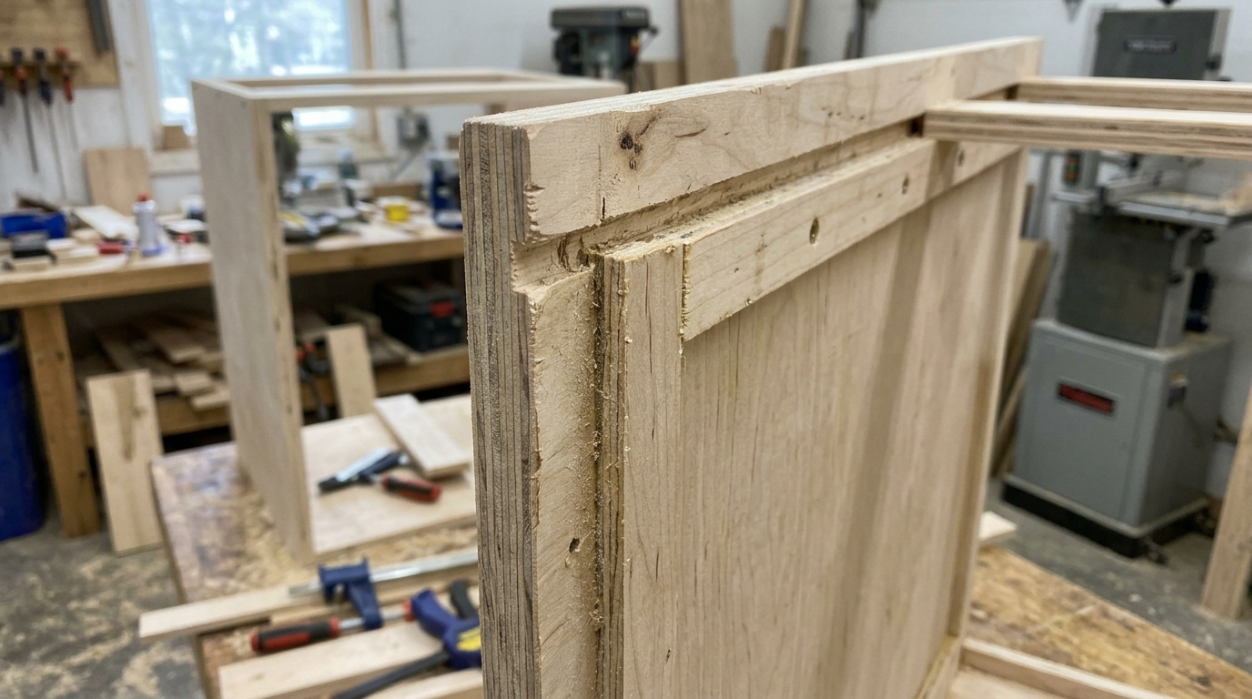
This is a major quality indicator that almost no buying guide covers well, yet it’s one of the most discussed topics on professional woodworking forums like WoodWeb.
Back panels come in several configurations:
1/8″ hardboard (budget): Thin, flexible, and prone to bowing. Provides minimal racking resistance.
1/4″ plywood, plant-on (standard): Nailed or stapled to the back of the box. Better than hardboard, but still relies on fasteners rather than joinery.
1/4″ plywood, captured in dadoes (better): The back panel slides into grooves cut into the side panels. This is stronger because the panel is mechanically held in place.
1/2″ plywood, captured (premium): Many professional cabinet shops have moved to 1/2-inch backs because modern 1/4-inch plywood often measures only 5mm, thinner than its nominal size. That inconsistency makes it unreliable for dado joinery. The thicker back also eliminates the need for separate nailer strips and stretchers, which some shops report saves more time than the extra material costs.
Cabinet Box Thickness: Quick Guide
There is no single thickness that defines a high-quality cabinet, but 3/4-inch side panels are common in frameless construction because the box does not have a face frame providing additional rigidity. Framed cabinets can use thinner side panels because the face frame contributes structural support. Always evaluate panel thickness together with material, back construction, and joinery.
Thickness Reference by Quality Tier
Component | Budget | Standard | Premium |
|---|---|---|---|
Side panels | 3/8″ particleboard | 1/2″ plywood | 3/4″ plywood |
Back panel | 1/8″ hardboard | 1/4″ plywood + nailer | 1/2″ plywood (captured) |
Shelves | 1/2″ particleboard | 5/8″ plywood | 3/4″ plywood |
Bottom | 1/2″ particleboard | 1/2″ plywood | 3/4″ plywood |
Cabinet Joinery Methods, Ranked by Strength
The joints holding a cabinet box together determine how it performs under daily stress: slamming doors, loaded shelves, and the inevitable bump from a vacuum cleaner. The general principle is simple. Joints where parts interlock or where one piece is captured inside another are the strongest. Joints that rely only on fasteners are the weakest.
1. Dovetail Joints (Strongest)
The interlocking pins and tails create a mechanical connection that resists pulling apart under repeated use. Dovetails are most common in drawer boxes, where the pulling force is constant. You’ll occasionally find them in cabinet box corners on high-end custom work, but that’s rare because the cost-to-benefit ratio is better in drawers.
2. Lock-Rabbet Joints
These balance strength and speed. The joint has a stepped profile that interlocks the two pieces before fasteners are added. Common in quality production cabinets.
3. Dado and Rabbet Joints
Panels slide into grooves (dadoes) or step-cut edges (rabbets). This is the standard for quality cabinet box construction because it’s reliable, efficient, and strong enough for decades of service.
4. Dowel Joints
A protruding dowel fits into matching holes drilled in the mating piece. Dowels provide decent alignment and shear resistance but lack the mechanical interlock of dadoes or dovetails.
5. Butt Joints with Screws or Staples
Two panels meet flat, held together by fasteners alone. Common in budget lines. These aren’t true wood joinery, and they make for less sturdy construction, especially if the material is particleboard.
6. Cam-Lock Connectors (Weakest)
Standard in RTA (ready-to-assemble) and flat-pack cabinets. Cam locks are often made of plastic, providing only two or three points of support per joint. They bend and break under stress. That said, cam-lock RTA cabinets serve a real purpose for budget projects and rental properties where replacement cost matters more than longevity. To understand the trade-offs, read about what RTA cabinets are and how they compare to assembled options.
A Note on Execution
One woodworking instructor who has taught over 400 beginners put it bluntly on WoodworkStarter: “Ugly doesn’t mean weak. A properly executed butt joint can outlast a poorly cut dovetail.” The method matters, but execution matters more at the extremes. A beautifully marketed dovetail joint in soft particleboard won’t outperform a clean dado joint in birch plywood.
Framed vs. Frameless Cabinet Box Construction
The two dominant approaches to cabinet box construction are framed (traditional American) and frameless (European). The difference is structural, not just cosmetic.
Framed Cabinets
A framed cabinet starts with the rectangular box, then adds a separately constructed face frame (typically solid hardwood) to the front opening. The face frame’s edges project slightly beyond the box sides, giving the installer room to accommodate walls and ceilings that aren’t perfectly square. This tolerance is the main practical advantage during installation.
The face frame also adds rigidity, which is why framed cabinets can use thinner side panels (1/2 inch) without sacrificing structural integrity.
Frameless Cabinets
A frameless cabinet is just the box, with no face frame. The sides and top are flush with their front edges, and doors mount directly to the box sides using concealed hinges. This design gives you wider drawer openings and slightly more accessible interior space because there’s no frame narrowing the opening.
The trade-off: frameless boxes need thicker material, typically 3/4-inch sides, to compensate for the missing face frame. They also demand more precise installation because there’s no face frame overlap to hide wall irregularities.
Both styles have their place. For a detailed comparison covering aesthetics, storage access, and cost, see the full guide on framed vs. frameless cabinets.
Looking for frameless or framed lines with fast lead times? Compare cabinet lead times for stock, semi-custom, and custom options.
Cabinet Box Quality vs. Cabinet Door Quality
Cabinet box construction and door construction should be evaluated separately. A cabinet can have an expensive-looking door and a low-cost structural box, or a simple door paired with a heavily engineered cabinet box.
Component | What to evaluate |
|---|---|
Cabinet box | Material, thickness, back panel, joinery, rigidity |
Door | Material, construction, finish, hinges, adjustment |
Drawer box | Material, joint construction, bottom support, slides |
Hardware | Hinge quality, drawer-slide capacity, adjustment, cycle durability |
Finish | Surface durability, moisture resistance, chemical resistance |
When comparing cabinet quotes, don’t assume a premium door automatically means premium construction throughout the cabinet. Ask for the specifications of the box, drawer boxes, and hardware separately.
Standard Cabinet Box Dimensions
Knowing standard dimensions helps during planning and makes it easier to spot non-standard units that might need modifications.
Cabinet Type | Height | Depth | Common Widths |
|---|---|---|---|
Base cabinet | 34.5″ (36″ with countertop) | 24″ | 9″ to 48″ |
Wall cabinet | 30″, 36″, or 42″ | 12″ | 9″ to 36″ |
Tall/pantry cabinet | 84″, 90″, or 96″ | 24″ | 18″ to 36″ |
Bathroom vanity | 34.5″ | 21″ | 24″ to 72″ |
The 34.5-inch base cabinet height includes the 4.5-inch toe kick. Paired with a standard 1.5-inch countertop, the finished working surface lands at 36 inches, the industry standard for kitchen ergonomics.
For bathroom vanities, the shallower 21-inch depth accounts for smaller bathroom footprints. You can find more detail on sizing in our bathroom vanity dimensions guide.
If you’re measuring for a project, our step-by-step guide on measuring kitchen cabinets covers the process from wall prep to final numbers.
Compliance Standards That Apply to Cabinet Boxes
Two standards directly affect cabinet box construction in the United States. Trade professionals should verify both when evaluating suppliers.
CARB Phase 2 / EPA TSCA Title VI (Formaldehyde Emissions)
Composite wood products used in cabinet boxes (plywood, particleboard, MDF) emit formaldehyde, a known irritant. CARB Phase 2 sets allowable emission limits at 0.09 ppm for hardwood plywood and 0.11 ppm for MDF. In 2018, the EPA adopted a federal rule (TSCA Title VI) with the exact same limits, making them mandatory nationwide as of March 2019.
These aren’t competing standards. They’re the same standard under two names. Non-compliant composite wood products cannot legally be sold, offered for sale, or imported into the United States. Retailers and importers who knowingly sell non-compliant products face EPA enforcement action.
For contractors and builders, this matters for permitting and indoor air quality documentation. Always confirm that a supplier’s cabinet boxes carry CARB Phase 2 / TSCA Title VI certification.
KCMA A161.1 Performance Certification
The Kitchen Cabinet Manufacturers Association administers the ANSI/KCMA A161.1 standard, which is the only performance standard for kitchen and bath cabinets. Testing includes:
Loading all shelves and bottoms at 15 pounds per square foot, maintained for seven days
Gradually loading wall cabinets to 600 pounds without visible failure
Mechanical endurance tests for doors and drawers
Roughly 40% to 50% of manufacturers fail their first certification attempt, typically in structural integrity and mechanical endurance categories. That failure rate means the KCMA seal is a meaningful quality marker, not a rubber stamp.
Both framed and frameless cabinets are eligible for KCMA certification, though frameless units often face extra scrutiny during the base front joint loading test.
How to Read a Cabinet Box Specification Sheet
Cabinet specifications often use marketing terms such as “all plywood construction,” “premium construction,” or “European-style frameless.” These descriptions are not enough to evaluate the actual cabinet box.
Look for these specifications:
Side material: plywood, particleboard, MDF, or another engineered panel.
Side thickness: identify the actual nominal thickness.
Back material: determine whether the back is hardboard, plywood, or another panel.
Back attachment: check whether the back is captured in a dado/rabbet or attached to the rear.
Bottom construction: verify material and thickness.
Shelf construction: check thickness, material, and support.
Joinery: identify whether panels are dadoed, rabbeted, doweled, screwed, stapled, or connected with cam hardware.
Face-frame construction: determine whether the cabinet is framed or frameless.
Certification: check for applicable KCMA and composite-wood compliance documentation.
Warranty: compare structural and hardware coverage separately.
The Five Questions That Reveal Most of the Construction Quality
If a supplier gives you limited technical information, start with these five questions:
What are the cabinet sides made from?
How thick are the sides?
How is the back panel attached?
How are the cabinet corners joined?
What certification or testing documentation is available?
A supplier that can answer these questions clearly gives you much more useful information than a brochure that only describes the cabinet as “premium.”
How to Evaluate Cabinet Box Quality
Whether you’re in a showroom, receiving a delivery, or reviewing a spec sheet, these checks reveal the real construction quality of a cabinet box.
Visual Inspection Checklist
Open a door and look at exposed edges. Do you see layered wood grain (plywood) or a compressed particle texture? Plywood layers are clearly visible at cut edges.
Press the back panel. A quality back panel feels firm and rigid. If it flexes or bows under light hand pressure, it’s likely 1/8-inch hardboard or thin plant-on material.
Pull out a drawer and look inside the box. A dadoed back panel sits flush with the side panels and won’t move when pressed. A stapled-on back panel has visible fasteners and may show gaps.
Check under the sink cabinet and near the dishwasher. Look for swelling, peeling, or soft spots. These are the highest-moisture areas and the first to reveal particleboard problems.
Grab the box and try to rack it. With an empty cabinet sitting on the floor, push diagonally on opposite corners. Noticeable movement suggests thin panels or weak joinery.
Red Flags
Back panel thinner than 1/4 inch
Staple-only joints with no dado, rabbet, or mechanical interlock
Exposed, unfinished particleboard edges inside the box
Side panels thinner than 1/2 inch on framed cabinets, or thinner than 3/4 inch on frameless
No CARB Phase 2 or KCMA certification documentation available
Cabinet Box Quality: Green Flags vs. Red Flags
Green flag | Red flag |
|---|---|
Clear material and thickness specifications | “Premium construction” with no technical details |
Rigid back panel | Thin back that flexes easily |
Captured back panel | Back attached only with minimal fasteners |
Mechanically reinforced joints | Fastener-only butt joints |
Appropriate panel thickness for the construction style | Very thin panels without structural reinforcement |
Protected or sealed exposed edges | Raw particleboard edges in moisture-prone areas |
Documented TSCA Title VI compliance where applicable | Supplier cannot provide compliance information |
KCMA certification when relevant to the project | Certification claims that cannot be verified |
Does Better Cabinet Box Construction Cost More?
Higher-quality cabinet construction generally costs more when it uses more expensive materials, thicker panels, more labor-intensive joinery, stronger hardware, or additional quality control. However, the most expensive cabinet is not automatically the best-built cabinet.
When comparing quotes, separate the price into the specifications that actually affect performance:
Box material and thickness
Back-panel construction
Joinery
Drawer-box construction
Hardware
Finish
Certification
Warranty
Assembly method
Lead time and replacement support
A lower-priced cabinet can be a good value if its construction matches the project’s requirements. Conversely, paying more for a cabinet labeled “premium” provides little value if the supplier cannot document what makes the construction better.
Questions to Ask a Supplier
What material are the box sides, and how thick are they?
How is the back panel attached: plant-on, or captured in dadoes?
What joinery method holds the box corners together?
Is this line KCMA certified?
Are all composite panels CARB Phase 2 / TSCA Title VI compliant?
Ready to evaluate suppliers side by side? Use our guide to find the best cabinet supplier based on construction specs, warranty, and trade support.
Cabinet Supplier Comparison Worksheet
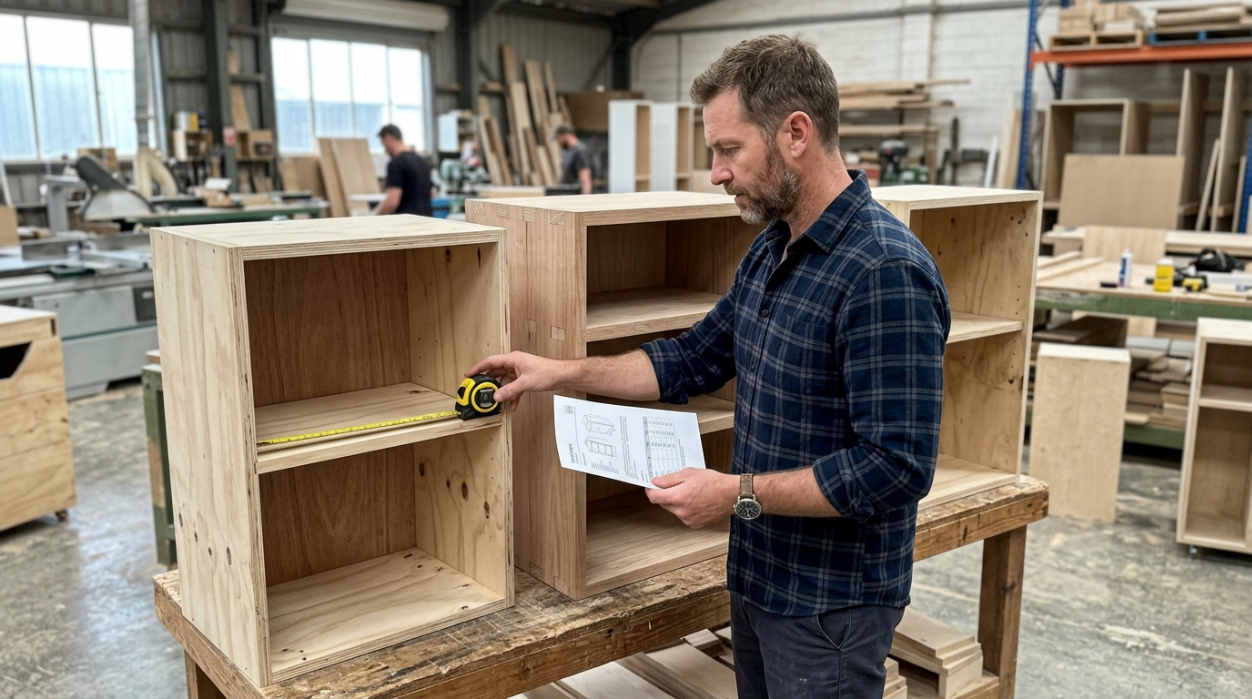
Use the same specifications for every supplier so that you’re comparing construction rather than marketing language.
Specification | Supplier A | Supplier B | Supplier C |
|---|---|---|---|
Box material | |||
Side thickness | |||
Back material | |||
Back thickness | |||
Back attachment | |||
Shelf material/thickness | |||
Bottom construction | |||
Joinery | |||
Framed or frameless | |||
Drawer-box construction | |||
Hardware | |||
KCMA certification | |||
TSCA Title VI documentation | |||
Warranty | |||
Lead time |
The goal is not to find the cabinet with the longest specification sheet. It is to identify which supplier provides the best combination of construction, performance, documentation, warranty, and project fit.
Frequently Asked Questions
What is cabinet box construction?
Cabinet box construction refers to how the structural shell of a cabinet is built. It covers the materials (plywood, particleboard, MDF), panel thickness, joinery methods, and structural design (framed or frameless) that together determine a cabinet’s strength, durability, and lifespan. The box is everything behind the doors and drawer fronts.
Is plywood always better than particleboard for cabinet boxes?
For structural performance, yes. Plywood has superior screw retention, moisture resistance, and longevity. It typically lasts 25 to 30 years compared to 10 to 15 for particleboard. The trade-off is cost: plywood boxes run 30% to 50% more. For budget projects like rental properties, quality particleboard with proper edge banding can work if moisture exposure is controlled.
What thickness should cabinet box sides be?
It depends on the construction style. Framed cabinets perform well with 1/2-inch plywood sides because the face frame adds rigidity. Frameless cabinets need 3/4-inch sides since there’s no face frame for reinforcement. Any cabinet with side panels thinner than 1/2 inch is a budget product with limited longevity.
Why does the back panel matter so much?
The back panel squares the box, prevents racking, and (in wall cabinets) is the primary surface for wall mounting. A thin, stapled-on back is one of the most common failure points in cheap cabinets. Many professional shops now use 1/2-inch captured plywood backs because they eliminate the need for separate nailer strips and provide far better structural integrity.
What is the difference between framed and frameless cabinet box construction?
Framed cabinets have a solid hardwood frame attached to the front opening, which adds rigidity and provides installation tolerance. Frameless cabinets skip the frame entirely, relying on thicker box panels for structure. Frameless designs offer slightly more interior access and a cleaner look, while framed designs are more forgiving during installation on out-of-square walls.
What does KCMA certification mean for cabinet boxes?
KCMA A161.1 is the only performance standard for kitchen and bath cabinets. Certified cabinets have passed tests including 600-pound wall-mount loading and seven-day shelf loading at 15 pounds per square foot. With 40% to 50% of manufacturers failing on their first attempt, the certification is a genuine quality indicator.
Are RTA cabinet boxes lower quality than pre-assembled?
Not necessarily, but they tend to use cam-lock connectors instead of stronger joinery methods like dadoes or dovetails. Cam locks provide fewer support points and can break under stress. High-quality RTA lines exist, but the joinery method and material should be scrutinized more carefully. Our comparison of RTA vs. custom cabinets covers the full trade-off.
How can I tell if a cabinet box is well-constructed without taking it apart?
Open the doors and press the back panel (it shouldn’t flex). Check exposed edges for plywood layers vs. particle texture. Pull drawers fully out and look at how the back panel meets the sides. Try to rack the empty box by pushing diagonally on opposite corners. Noticeable movement means weak joints or thin panels.