TL;DR
Quality kitchen cabinets start with all plywood box construction, dovetail drawer joints, and soft close hardware. These three features matter more than brand name or showroom appearance. An $8,000 plywood kitchen that lasts 20 years costs $400 per year, while a $5,000 particleboard kitchen that lasts 7 years costs $714 per year. Construction quality is the single most reliable predictor of cabinet lifespan, and this guide walks through the 10 core features (plus the deeper construction details most articles skip) that separate cabinets worth buying from cabinets you’ll regret.
How Can You Tell If Kitchen Cabinets Are Good Quality?
You can tell if kitchen cabinets are good quality by checking the cabinet box, drawer construction, hardware, back panel, finish, certification, and warranty. The strongest indicators are plywood construction, well built drawer joints, full extension soft close hardware, rigid cabinet backs, durable finishes, and verifiable certifications. Price and brand name alone do not determine cabinet quality.
For a quick showroom inspection, check these five things first:
Cabinet box: Look for plywood rather than particleboard, especially on the sides, bottom, and structural components.
Drawer joints: Look for tight dovetail or other mechanically strong joints instead of staples.
Hardware: Test the soft close hinges and full extension drawer slides for smooth, controlled movement.
Back panel: Push on the inside back of the cabinet. It should feel rigid and securely attached.
Documentation: Ask for the written warranty, material specifications, and applicable certification or emissions compliance documentation.
If a cabinet passes these checks, you have a much better indication of its construction quality than you would get from its appearance, brand name, or showroom price alone.
10 Signs of Quality Kitchen Cabinets at a Glance
Before comparing brands or prices, use this 10 point checklist to evaluate the actual cabinet construction:
| Quality Sign | What to Look For | Red Flag |
|---|---|---|
| Cabinet box | 3/4 inch plywood construction | Thin particleboard or MDF structural components |
| Drawer joints | Tight dovetail or strong mechanical joints | Staples or weak butt joints |
| Drawer slides | Full extension, soft close slides | Partial extension or rough slides |
| Door hinges | Adjustable soft close hinges (6 way) | Basic non adjustable hinges |
| Back panel | 1/2 inch or thicker, securely dadoed back | Thin or flexible backer |
| Finish | Even, durable, consistent coating | Rough edges, bubbles, thin coverage |
| Emissions compliance | TSCA Title VI documentation where applicable | No compliance documentation |
| Warranty | Clear written coverage | Vague or difficult to enforce warranty |
| Certification | KCMA certification when available | Quality claims with no verification |
| Supplier | Reliable inventory, delivery, and support | Unclear lead times or poor service |
The most important takeaway: construction quality matters more than the cabinet’s brand name or showroom appearance. Start with the box, drawers, hardware, and structural components before comparing finishes or decorative features.
Cabinets eat 30% to 40% of a total kitchen remodel budget, making them the single biggest line item in any kitchen project. Get this decision wrong and you’re looking at a full replacement in under a decade. Get it right and your cabinets can last 20 to 30 years with proper care.
The problem is that quality isn’t obvious at first glance. A glossy showroom door can hide particleboard construction, stapled joints, and hardware that fails after a few thousand cycles. Practitioners on Reddit’s r/Contractor consistently say the same thing: check construction first, worry about brand names later.
This guide covers the 10 features that define quality kitchen cabinets, ranked in the order that experienced contractors and kitchen designers actually evaluate them, plus the deeper construction details that most buying guides leave out. Whether you’re a homeowner comparing options or a trade professional vetting a new supplier, this checklist gives you a framework that works.
Choosing the wrong cabinet quality is one of the top kitchen remodel mistakes homeowners make. Here’s how to avoid it.
At a Glance: Stock vs. Semi Custom vs. Custom Cabinets
| Dimension | Stock Cabinets | Semi Custom | Custom |
|---|---|---|---|
| Price per linear foot | $80 to $120 | $150 to $500 | $500 to $1,200+ |
| Typical box material | Particleboard or MDF | Plywood or furniture board | All plywood or solid wood |
| Joint type | Stapled or cam lock | Dovetail or dowel | Dovetail |
| Lead time | Days (in stock) | 4 to 8 weeks | 8 to 16 weeks |
| Expected lifespan | 5 to 10 years | 15 to 25 years | 20 to 30+ years |
| Customization | Minimal (standard sizes) | Moderate (sizing, finishes) | Full (any dimension or feature) |
For a full breakdown of pricing at each tier, see our guide to kitchen cabinet costs in Washington.
1. All Plywood Box Construction
Best for: Long term durability and moisture resistance in high use kitchens.
This is the single most referenced quality indicator among kitchen design professionals, and it’s the first thing contractors on Reddit check before evaluating anything else. All plywood box construction means the sides, bottom, and back of every cabinet are made from plywood rather than particleboard or MDF.
Why it matters:
- Plywood holds screws and fasteners significantly better than particleboard, which means hinges and drawer slides stay secure over years of daily use.
- It resists moisture more effectively. In kitchens, where steam, splashes, and leaks are inevitable, particleboard swells and delaminates while plywood holds its shape.
- Plywood is repairable. If a cabinet takes damage, a plywood box can often be patched. Particleboard usually can’t.
- All plywood cabinets can last 20 to 30 years or more. Particleboard cabinets often fail within 5 to 10 years under regular use.
Panel thickness specifications matter. Not all plywood boxes are equal. Look for these minimums:
- Side panels: 3/4 inch (18mm) plywood. This is the standard for quality cabinets. Some budget lines use 1/2 inch sides, which flex under heavy loads and hold screws less securely.
- Bottom panel: 3/4 inch for base cabinets, especially under sinks where moisture exposure is highest.
- Back panel: 1/2 inch or thicker plywood, dadoed into the side panels (not just stapled on). More on this in section 4.
- Shelves: 3/4 inch plywood with front edge banding. Anything thinner than 3/4 inch will sag under the weight of dishes and canned goods within a few years.
The cost per year argument: An $8,000 plywood kitchen that lasts 20 years works out to $400 per year. A $5,000 particleboard kitchen that lasts 7 years works out to $714 per year. The “cheaper” option actually costs 78% more annually.
Industry experts put it bluntly: a big name brand using particleboard will not outperform a lesser known manufacturer using full plywood construction. Construction quality beats branding every time. For a deeper comparison, see our plywood vs. particleboard guide.
2. Dovetail Drawer Joints and Drawer Box Construction
Best for: Drawer longevity, especially in kitchens where drawers hold heavy cookware.
Dovetail joints are interlocking, fan shaped cuts that mechanically lock two pieces of wood together. This design distributes stress across the entire joint rather than concentrating it at a few staple or glue points.
What to look for:
- True dovetail joints (not printed on dovetail patterns, which some budget manufacturers use as a visual trick).
- Consistent, tight fitting interlocks with no visible gaps.
- Solid wood drawer boxes, not particleboard with dovetail shaped cuts.
What to avoid:
- Stapled butt joints, which are the weakest construction method. These fail under repeated loading.
- Cam lock or dowel joints, which sit between dovetail and stapled in quality but are less durable long term.
Drawer bottom construction is just as important as the joints. This detail gets overlooked constantly, but it determines whether the drawer sags under load or stays flat for years.
- Quality construction: The drawer bottom is captured in a dado, meaning a groove is cut into all four sides of the drawer box and the bottom panel slides into those grooves. This creates a mechanically locked floor that can’t drop out.
- Budget construction: The bottom is stapled or glued onto the underside of the drawer box. Under repeated loading (a drawer full of cast iron or utensils), these stapled bottoms pull free and sag.
- Thickness matters here too. Look for 1/4 inch plywood drawer bottoms at minimum. Better quality drawers use 3/8 inch or even 1/2 inch bottoms on wider drawers. One kitchen designer shared in a YouTube walkthrough that the drawer bottom is where you’ll see cost cutting first because buyers rarely flip drawers over to check.
Reddit recommendation threads almost always name dovetail drawers as the number two quality check, right after plywood boxes. The reasoning is practical: drawers take more abuse than any other cabinet component. They get slammed, overloaded, and opened thousands of times per year.
3. Soft Close, Full Extension Hardware
Best for: Daily usability, noise reduction, and protecting cabinet structure from impact stress.
Hardware is where quality kitchen cabinets earn their premium in everyday life. Two features define good hardware: soft close mechanisms and full extension drawer slides.
Key features:
- Soft close hinges prevent doors from slamming, reducing wear on the cabinet frame and finish over time. They also eliminate the need for bumper pads.
- Full extension glides let drawers open completely so you can access the entire storage space without reaching blindly into the back.
- Adjustable hinges with three way adjustment screws allow fine tuning of door alignment after installation. Top quality cabinets always include these.
Undermount vs. side mount slides: This is a detail that separates mid range from premium drawers, and it’s worth understanding.
- Undermount slides attach beneath the drawer box, keeping the hardware hidden. They provide smoother motion, allow for wider drawer boxes (because the slides don’t eat into the drawer width), and look cleaner when the drawer is open. Blum’s Tandem and Movento lines are the most commonly referenced examples.
- Side mount slides attach to the sides of the drawer box and the cabinet interior. They’re less expensive, easier to install, and simpler to replace if damaged. But they reduce usable drawer width by about 1 inch total and are visible when the drawer is open.
- Practitioners on Reddit note that undermount slides are standard on any cabinet priced above the budget tier. If a semi custom or custom cabinet uses side mount slides, ask why.
Hinge specifics worth checking:
- Clip on mounting plates allow hinges to snap on and off without tools, making door removal for cleaning or adjustment simple.
- 6 way adjustability (up/down, left/right, in/out) gives installers the ability to achieve perfectly flush doors even on slightly out of square walls. Lower quality hinges offer only 2 way or no adjustment.
- Opening angles vary. Standard hinges open to about 110 degrees. Some applications (corner cabinets, accessibility layouts) benefit from 155 degree or 170 degree hinges. Ask what’s included.
Tradeoffs to know:
- Soft close mechanisms add cost, typically $3 to $8 per hinge more than standard hinges.
- Full extension slides rated for higher weight capacities (75 to 100 pounds) cost more than standard duty slides (50 pounds). Ask about the weight rating.
- Branded hardware (Blum, Hettich, Grass) tends to outlast no name alternatives, but even mid range soft close hardware is a significant upgrade over standard friction slides.
Cabinet professionals on Reddit challenged the assumption that framed cabinets are always superior to frameless, arguing that hardware quality matters more than frame style. A frameless cabinet with premium Blum hinges will outperform a framed cabinet with bottom tier hardware. For more on soft close options, see our soft close cabinets guide.
4. Full Height Back Panels
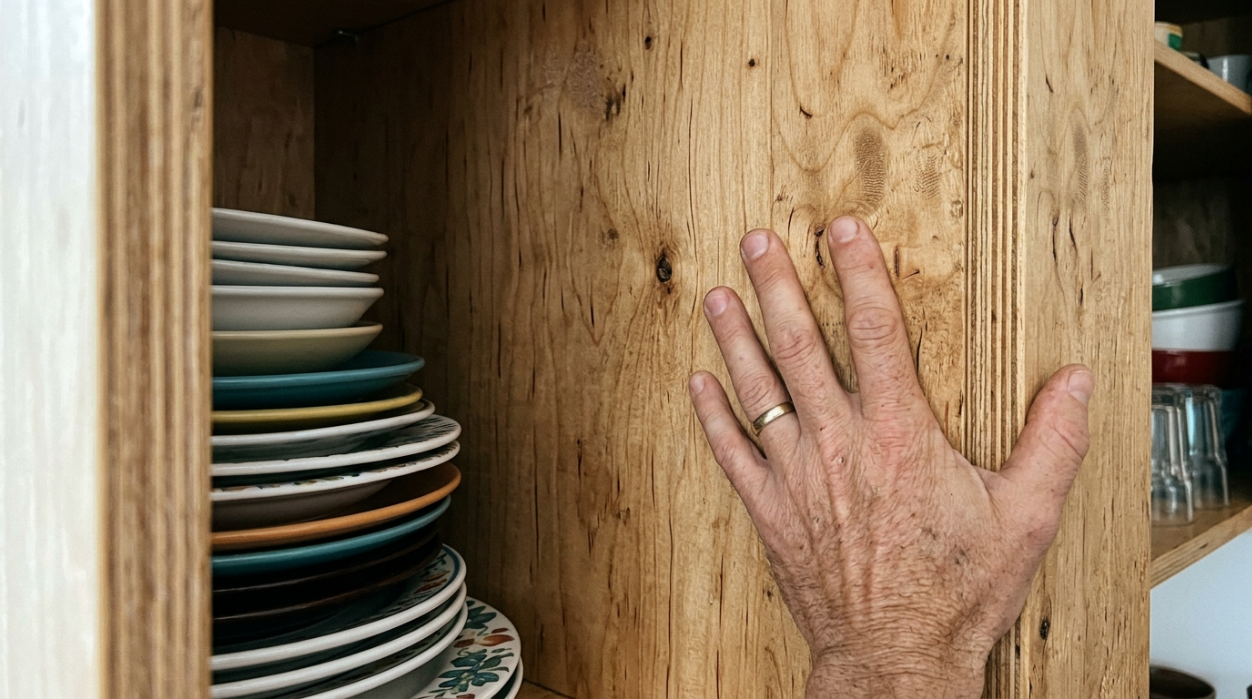
Best for: Structural integrity and long term squareness of the cabinet box.
This is one of the most overlooked quality indicators. Full height back panels fully enclose the rear of the cabinet, adding rigidity that keeps the entire box square under load.
What separates quality from budget:
- Quality cabinets use a full height back panel (1/2 inch plywood or thicker) that’s dadoed or rabbeted into the side panels. The best manufacturers use 1/2 inch backs on all cabinets and 3/4 inch backs on upper cabinets that carry heavy loads.
- Budget cabinets often use partial back panels, thin cardboard like backer boards, or stapled on lauan panels that offer minimal structural support.
- Some stock cabinets skip the full back entirely, relying on the wall for rear support.
Corner bracing and top stretchers work alongside the back panel to maintain box rigidity. Quality cabinets include:
- Top stretchers or I beams that span the top of the cabinet box front to back. These stiffen the box and provide a secure surface for attaching countertops on base cabinets.
- Corner braces (triangular gussets or metal brackets) at the top corners of wall cabinets. These prevent racking and provide additional screw points for wall mounting.
- Budget cabinets skip these reinforcements. The result: boxes that slowly twist under load, causing doors to go out of alignment within a year or two.
Why this matters in practice: When you load a wall cabinet with dishes and glasses (easily 50 to 100 pounds), the back panel is what prevents racking, which is the gradual parallelogram shaped distortion of the box. Without a proper back panel, the box slowly warps, doors stop closing flush, and the cabinet eventually fails.
Check this in any showroom by pressing on the back panel from inside the cabinet. If it flexes significantly or feels like cardboard, it’s not a quality build.
5. Durable, Multi Layer Finish
Best for: Protecting cabinets from moisture, stains, UV damage, and daily wear.
The finish is the first thing you see and the first thing that shows wear. A quality finish isn’t just about aesthetics. It’s a protective barrier.
Signs of a good finish:
- Multiple coats of catalyzed lacquer, conversion varnish, or catalyzed polyurethane.
- Even application with no streaks, bubbles, drips, or rough spots.
- UV protection to prevent fading, especially on cabinets near windows.
- Consistent color and sheen across all doors and drawer fronts.
The painted finish caveat: Here’s something most articles won’t tell you. Painted cabinet finishes are less durable than stained finishes on every brand, regardless of price tier. Paint shows chips, scratches, and wear faster than stain because it sits on top of the wood rather than penetrating it. This doesn’t mean painted cabinets are bad, just that you should set realistic expectations. White painted Shakers will need touch up work over their lifespan.
Edge banding quality is part of the finish story. On cabinets with exposed panel edges (common in frameless construction), the edge banding material and thickness tell you a lot:
- Quality: 1mm to 2mm PVC or ABS edge banding, heat fused or laser edged so there’s no visible seam or adhesive line. Run your finger along the edge. It should feel smooth and indistinguishable from the panel face.
- Budget: Thin melamine tape (often 0.3mm to 0.5mm) that peels, chips, and shows adhesive failure within a year or two. If you can catch it with your fingernail, it’s too thin.
Interior liner materials also affect durability and cleanability:
- Quality cabinets line the interior surfaces with melamine or thermally fused laminate. This creates a smooth, wipeable surface that resists stains from spills, oil, and food residue.
- Budget cabinets leave the interior raw or use unfinished particleboard. Raw interiors absorb moisture and stains, and they’re nearly impossible to clean effectively after a spill sets in.
One of Reddit’s most common pieces of advice: order door samples and see the finish in your own lighting before committing. Showroom lighting flatters everything.
Once you’ve selected your cabinet finish, matching your countertops becomes the next critical decision.
6. Door Construction Details
Best for: Understanding why some doors warp, crack, or look cheap after a few years.
Cabinet doors are the most visible component, and their construction method determines how they hold up over time.
Five piece doors vs. slab doors:
- Five piece (rail and stile) doors consist of a top rail, bottom rail, two stiles, and a center panel. The frame pieces are typically solid hardwood, and the center panel “floats” within the frame, allowing for seasonal wood movement without cracking.
- Slab doors are a single flat panel, common in modern and contemporary kitchens. They can be made from MDF, plywood, or solid wood with veneer. Slab doors demand flatter, more precise manufacturing because any warp or bow is immediately visible.
Center panel materials matter for painted finishes. If you’re choosing painted cabinets, the center panel should be MDF or HDF (high density fiberboard), not solid wood. MDF doesn’t expand and contract with humidity the way solid wood does, so painted MDF panels won’t develop the hairline cracks along the frame joints that plague painted solid wood doors. This is one of the most common complaints from homeowners who chose painted solid wood doors.
Overlay styles affect both appearance and quality perception:
- Full overlay doors cover the entire face frame (or nearly all of it on frameless cabinets), showing minimal gaps between doors. This is the dominant style in modern kitchens.
- Partial overlay doors reveal more of the face frame between doors. Common in builder grade and traditional kitchens.
- Inset doors sit flush within the face frame opening. This is the most demanding construction style because tolerances are extremely tight (typically 1/16 inch gaps). Inset doors require premium hinges and precise box construction. They cost significantly more.
For a full breakdown of door types, styles, and costs, see our cabinet door styles guide.
7. Emissions Compliance (CARB Phase 2 / EPA TSCA Title VI)
Best for: Indoor air quality and building code compliance.
This quality indicator has nothing to do with how a cabinet looks or how long it lasts. It’s about what the cabinet puts into your air.
Composite wood products (plywood, MDF, particleboard) can off gas formaldehyde, a known irritant and carcinogen. Two regulations address this:
- CARB Phase 2 is the California Air Resources Board standard requiring hardwood plywood to emit no more than 0.05 parts per million of formaldehyde.
- EPA TSCA Title VI adopted essentially the same limits at the federal level, effective since 2018.
Although CARB Phase 2 originated as a California rule, it has become a de facto national standard. Quality manufacturers comply regardless of where they sell.
Sustainability and health certifications beyond CARB/TSCA are becoming more common and worth asking about:
- GREENGUARD Gold certifies low chemical emissions for the finished product (not just the raw panel), testing for a broader range of VOCs than CARB Phase 2 alone. This certification is increasingly specified in healthcare, education, and high end residential projects.
- FSC (Forest Stewardship Council) certification verifies the wood was sourced from responsibly managed forests. It doesn’t directly affect cabinet performance, but it matters to buyers who prioritize environmental responsibility.
- NAUF (No Added Urea Formaldehyde) and ULEF (Ultra Low Emitting Formaldehyde) designations indicate panels manufactured with formaldehyde free or near zero formaldehyde adhesives. These exceed CARB Phase 2 requirements.
How to check: Ask the manufacturer or supplier for their CARB Phase 2 or TSCA Title VI compliance certificate. If they can’t produce one, that’s a red flag. For GREENGUARD or FSC claims, ask for the certificate number, which you can verify on the certifying body’s website.
8. Framed vs. Frameless Construction (Both Can Be Quality)
Best for: Understanding that construction style is about preference, not inherent quality.
This is where a lot of buyers get confused. Framed cabinets (traditional American style) have a face frame attached to the front of the box. Frameless cabinets (European style) skip the face frame, relying on thicker side panels for structural support.
Framed cabinet strengths:
- The face frame adds an extra layer of rigidity.
- Wider selection of traditional door styles.
- Well built framed cabinets can last decades.
Face frame joinery is a hidden quality indicator that most buyers never think to check. How the face frame is assembled tells you about the manufacturer’s standards:
- Mortise and tenon or dowel joints are the strongest methods. The rails and stiles interlock mechanically, creating a frame that stays square and tight.
- Pocket screw joints are faster and cheaper to produce. They hold well initially but can loosen over time, especially on cabinets that get bumped during daily use. Pocket screws are acceptable in mid range cabinets but not a sign of premium construction.
Frameless cabinet strengths:
- More interior storage space (no face frame eating into the opening).
- Cleaner, more contemporary look.
- Easier to access drawer and shelf contents.
Frameless limitations:
- Requires precise installation since there’s no face frame to cover gaps.
- Relies more heavily on hardware quality for structural integrity.
- Expected lifespan of roughly 20 to 25 years under normal wear, compared to “almost forever” for well built framed cabinets, according to some industry estimates.
The real variable is material and hardware, not frame style. A frameless all plywood cabinet with premium hardware will outlast a framed particleboard cabinet every time. For a deeper comparison, see our framed vs. frameless cabinets guide.
9. Third Party Certification (KCMA A161.1)
Best for: Objective, verifiable proof of cabinet quality when you can’t physically inspect every unit.
The Kitchen Cabinet Manufacturers Association (KCMA) runs the A161.1 quality certification program, which subjects cabinets to 14 rigorous, third party tests simulating a lifetime of use.
What the testing involves:
- A 600 pound load test on wall cabinets
- 25,000 door and drawer open/close cycles
- Long term shelf loading tests
- Exposure to various stains, chemicals, and moisture on finished surfaces
- Structural integrity tests on joints and fasteners
Why this matters: Approximately 40% to 50% of manufacturers fail their first attempt at KCMA certification. The tests are genuinely demanding. When you see the KCMA seal, it means the cabinet has been independently verified, not just marketed with quality claims.
Limitations:
- Not all quality manufacturers pursue KCMA certification. Some smaller regional builders produce excellent cabinets but don’t invest in the certification process.
- KCMA certification covers the product line at the time of testing. Manufacturing changes after certification could theoretically affect quality.
- The seal applies to specific product lines, not the entire manufacturer’s catalog. Verify which line was certified.
10. Supplier Reliability, Lead Times, and Transparency
Best for: Ensuring quality extends beyond the product to the actual buying and delivery experience.
A beautiful cabinet sitting in a warehouse 2,000 miles away with a 12 week lead time doesn’t help a contractor with a project timeline. Supplier reliability is a quality factor that most articles ignore.
What to evaluate:
- In stock inventory: Does the supplier warehouse products locally, or is everything special order?
- Lead times by tier: Stock cabinets ship in days. Semi custom takes 4 to 8 weeks. Custom runs 8 to 16 weeks. Know what you’re signing up for.
- Design support: Free design quotes, 3D renderings, and software compatible files (like 2020 Design packages) reduce errors and speed up approvals.
- Delivery terms: Understand whether delivery means to your garage, to your jobsite, or inside the house. This varies dramatically.
For a full breakdown of what to expect at each tier, see our guide on cabinet lead times.
Quality control and origin transparency are increasingly important factors that deserve scrutiny:
- Country of origin should be clearly stated, not hidden. Knowing where cabinets are manufactured helps you assess tariff exposure, shipping timelines, and quality consistency.
- Batch or serial labels on individual cabinet boxes indicate a manufacturer with trackable quality control. If a defect surfaces, these labels let the supplier trace it back to the production run.
- ISO 9001 certification (or equivalent quality management systems) at the factory level means there’s a documented process for maintaining consistency. Not all cabinet makers pursue it, but it’s a positive signal for manufacturers producing at scale.
Tradeoffs:
- The fastest lead times usually mean stock or RTA (ready to assemble) cabinets, which limit customization options.
- Local suppliers with warehouse inventory cost more than direct from factory imports, but you avoid shipping delays, tariff uncertainty, and damage claims.
- Dealer markup, freight, and assembly costs are set locally. Practitioners on Reddit consistently advise getting the same brand and layout priced by two or three dealers and comparing line by line.
If you’re a contractor or designer evaluating suppliers, our guide on choosing the best cabinet supplier covers the trade specific considerations.
Beyond the 10 Signs: Construction Details That Separate Good from Great
The 10 signs above cover the essentials. But several additional construction details separate truly well built cabinets from those that just check the basic boxes.
Shelf Construction and Anti Sag Design
Shelves take constant load and are one of the first components to show fatigue in a cheap cabinet. Quality shelf construction includes:
- 3/4 inch plywood shelves as a minimum. Particleboard shelves, even at 3/4 inch, sag noticeably within 2 to 3 years under the weight of dishes or canned goods.
- Front edge banding (1mm+ PVC or solid wood) to prevent delamination where the shelf meets the shelf pins.
- Anti sag center supports on shelves wider than 30 inches. These are usually a metal or hardwood strip on the underside of the shelf, or a center pin support. Without them, wide shelves develop a visible bow.
Toe Kick Construction and Adjustable Levelers
The toe kick is the recessed area at the base of floor cabinets. It seems trivial, but it affects both durability and installation quality.
- Quality cabinets use separate, removable toe kick panels with adjustable leveling legs. The legs allow the installer to fine tune each cabinet for perfectly level alignment, even on uneven floors. This is standard in European frameless construction and increasingly common in better framed lines.
- Budget cabinets have fixed, integrated toe kicks with no leveling adjustment. On an uneven floor, the installer has to shim the entire cabinet, which is less precise and more time consuming.
Sink Base Moisture Protection
The cabinet under the sink is the most vulnerable to water damage. Quality manufacturers address this directly:
- Sealed or coated floors inside sink base cabinets, using polyurethane, aluminum laminate, or a removable waterproof liner tray.
- Water detection indicators (color changing adhesive strips) on some premium lines that alert homeowners to slow leaks before major damage occurs.
- Plywood construction is non negotiable here. A particleboard sink base that encounters even a small drip will swell and delaminate within weeks. One contractor on Reddit described particleboard sink bases as “ticking time bombs.”
For a detailed look at cabinet box materials, joinery, and structural components, see our cabinet box construction guide.
RTA vs. Factory Assembled: How Assembly Method Affects Quality
Ready to assemble (RTA) cabinets and factory assembled cabinets can both deliver quality kitchen cabinets, but the construction methods differ in ways that matter.
Factory assembled cabinets arrive fully built. The joints were glued, clamped, and fastened under controlled conditions with industrial equipment. This produces consistently tight joints and precise alignment.
RTA cabinets ship flat packed and are assembled on site (or by the supplier before delivery). Quality varies enormously depending on the joinery system:
- Dowel and glue RTA systems produce strong joints when assembled correctly. The dowels provide mechanical alignment, and the glue creates a bond comparable to factory assembly.
- Cam lock systems (the most common RTA method) rely on a rotating cam to pull panels together. These are faster to assemble but inherently less rigid than dowel and glue or dovetail joints. Over time, cam locks can loosen, especially if the cabinet is disassembled and reassembled.
- Staple only RTA is the lowest quality tier and should be avoided for any cabinet expected to last more than a few years.
The key question with RTA is whether the assembly is done by someone who knows what they’re doing. A well assembled dowel and glue RTA cabinet can match a factory assembled cabinet in structural performance. A poorly assembled cam lock cabinet will feel wobbly from day one.
For a detailed comparison of RTA and pre assembled options, see our RTA vs. assembled cabinets guide.
Installation Quality: Where Even Great Cabinets Can Fail
A perfectly built cabinet installed poorly is a poor cabinet. Installation is the variable that determines whether the construction quality actually delivers on its promise.
What proper installation looks like:
- Hanging rails (French cleats or metal rail systems) on wall cabinets distribute weight evenly across multiple studs. Quality cabinets include factory installed rails or pre drilled rail mounting points. Budget cabinets are sometimes hung with a handful of screws directly through the back panel, which concentrates stress on small areas.
- Stud fastening pattern: Every wall cabinet should be secured to at least two wall studs with appropriately rated screws (typically #10 x 2 1/2 inch or longer). Some installers use only drywall anchors for one side, which is inadequate for loaded upper cabinets.
- Shimming: Base cabinets should be shimmed level and plumb before being secured. Quality installers check with a 4 foot level across the top and front of every run. Skipping this step means doors will never align properly, regardless of how adjustable the hinges are.
- Seismic considerations: In earthquake prone regions like the Pacific Northwest, cabinet installation should account for lateral forces. This means longer screws, additional blocking in the wall, and in some cases, seismic strapping on upper cabinets. This isn’t code required in most residential applications, but experienced contractors in seismic zones treat it as standard practice.
For a step by step timeline of how installation fits into a full kitchen remodel, see our kitchen remodel timeline guide.
What Makes Kitchen Cabinets High Quality?
High quality kitchen cabinets are defined by how well their structural components, moving parts, finishes, and materials withstand years of normal use. The most important factors are cabinet box construction, drawer joint strength, hardware quality, back panel construction, finish durability, installation, and manufacturer support.
A useful way to evaluate cabinet quality is to separate the cabinet into five parts:
| Cabinet Component | What Determines Quality |
|---|---|
| Box | Material thickness (3/4 inch sides, 1/2 inch+ backs), joinery, corner bracing, rigidity, and moisture resistance |
| Drawers | Joint construction, bottom panel (captured in dado), slide type (undermount preferred), and load capacity |
| Doors | Material, construction method (5 piece vs. slab), hinge type (6 way adjustable), overlay style, and finish |
| Finish | Coating quality, edge banding thickness, interior liner material, consistency, and UV protection |
| Support | Warranty, certification, documentation, delivery, quality control labels, and replacement service |
This is why a cabinet can look expensive without being particularly well constructed. Decorative doors, premium colors, and showroom displays affect appearance, but they do not necessarily tell you how the cabinet box or hardware will perform after years of use.
When comparing cabinets, evaluate the construction underneath the finish first.
10 Kitchen Cabinet Quality Red Flags to Watch For
A cabinet does not have to use every premium feature to be a good purchase. However, several warning signs deserve closer inspection:
- The seller cannot tell you what the cabinet box is made from.
- The cabinet specification says “wood” without identifying the actual panel material or thickness.
- Drawer construction relies on visible staples or weak joints, with stapled on bottoms.
- Drawer slides feel rough, loose, or unstable when fully extended.
- Doors are difficult to align or hinges have limited adjustment (less than 3 way).
- The cabinet back flexes substantially when pressed.
- Finish coverage is inconsistent around edges, corners, or interior surfaces, or edge banding peels easily.
- The supplier cannot provide written warranty terms.
- Claims about certification cannot be verified for the specific product line.
- The salesperson focuses heavily on appearance and brand name but cannot explain the cabinet’s construction, panel thickness, or country of origin.
One red flag does not automatically make a cabinet poor quality. Use the list to identify questions that deserve answers before placing an order.
What About Tariffs in 2026?
The cabinet market has shifted significantly. A 25% Section 232 tariff on imported kitchen cabinets and vanities took effect on October 14, 2025, and remains active throughout 2026. A planned increase to 50% has been delayed until January 2027.
The practical impact: imported budget cabinets have seen price increases of 15% to 25% compared to 2024. The gap between cheap imports and entry level domestic semi custom lines has narrowed substantially. A cabinet that used to cost $3,000 from overseas might now run $3,750, putting it within striking distance of a domestic semi custom option that comes with better materials and actual warranty support.
For trade professionals, this means regional suppliers with large local warehouses offer a genuine advantage. In stock inventory at known prices beats waiting on an import container with uncertain tariff exposure.
The U.S. cabinet market is projected to exceed $34 billion by 2026, and domestic manufacturing capacity is expanding to fill the gap.
How to Evaluate Cabinets at a Showroom
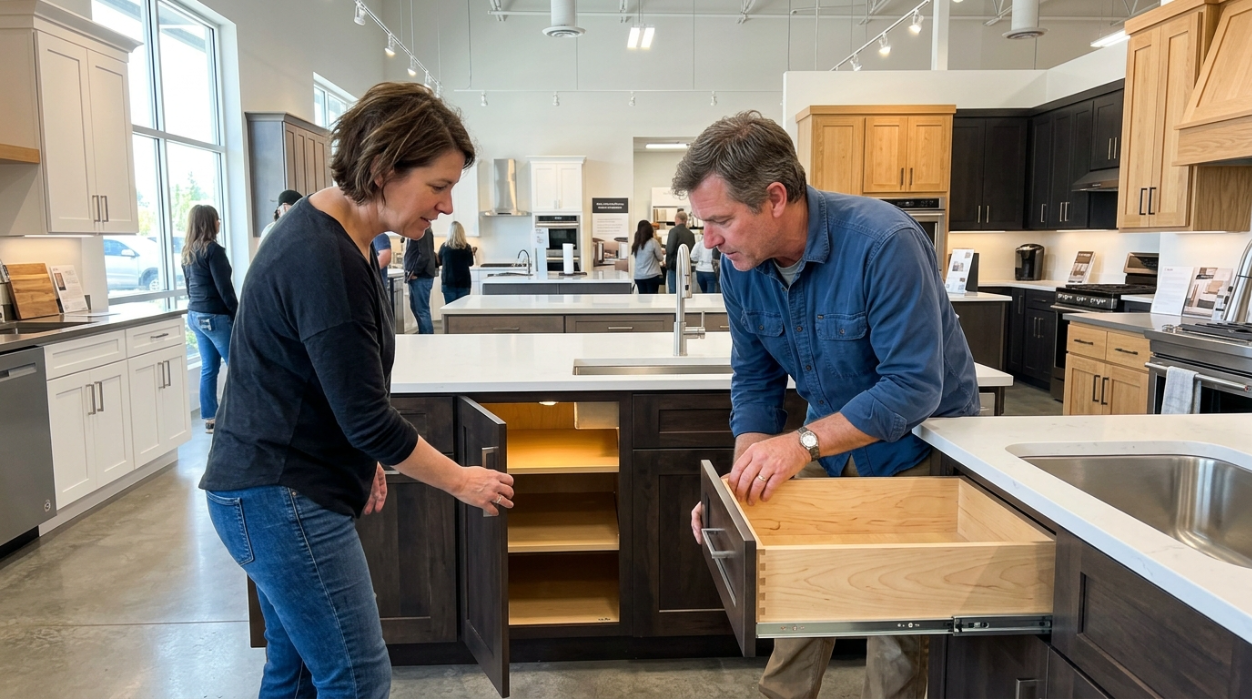
Seeing cabinets online is not the same as touching them. Here’s a practical walkthrough for your next showroom visit. Before you go, learn how to measure your kitchen so you can get an accurate quote on the spot.
Open every door and drawer. Feel the weight of the door. Quality doors feel substantial, not hollow. Close the door slowly, then quickly. Soft close mechanisms should engage smoothly in both cases. Check whether the hinges are clip on (removable without tools) and offer 6 way adjustability.
Pull drawers all the way out. Full extension slides let you access the full depth. While the drawer is extended, look at the joints. You want to see dovetail or at least dowel joints, not staples. Flip the drawer over if possible and check whether the bottom is captured in a dado or stapled on. Check whether slides are undermount or side mount.
Knock on the side panels. Plywood produces a solid, resonant sound. Particleboard sounds flat and hollow. This takes 2 seconds and tells you more than a spec sheet.
Inspect the finish and edge banding. Run your hand across door surfaces and look at edges closely. Feel for rough spots, bumps, or inconsistencies. Run your fingernail along any edge banding. If it catches or lifts, it’s too thin. Check inside corners where finish quality often drops on budget lines. Open the cabinet and look at the interior surfaces: are they finished with melamine or raw?
Check the toe kick and levelers. On base cabinets, look underneath. Adjustable leveling legs indicate a quality build. Fixed toe kicks with no adjustment indicate a budget approach.
Look inside the sink base cabinet. Check for sealed or coated flooring, a waterproof liner, or aluminum laminate. If the sink base interior is raw particleboard, moisture damage is inevitable.
Ask for documentation. Request CARB Phase 2 compliance certificates, warranty terms in writing, and (if available) KCMA certification details, GREENGUARD Gold certification, and country of origin information. A quality supplier will have these ready.
Push on the back panel from inside. It should feel rigid and firmly attached. If it bows easily, structural integrity will suffer under load.
Visit a showroom near you to evaluate quality in person and get a free design quote.
Maintenance and Care by Finish Type
Even quality kitchen cabinets need proper care. The right maintenance routine depends on the finish type.
Painted cabinets:
- Clean with a soft cloth dampened with warm water and mild dish soap. Avoid abrasive cleaners, ammonia based products, and melamine sponges, all of which can dull or damage the paint.
- Touch up chips and scratches promptly with manufacturer provided touch up paint. Exposed wood absorbs moisture and the damage spreads.
- Expect painted finishes to need more frequent maintenance than stained finishes. This is inherent to paint, not a defect.
Stained and lacquered cabinets:
- Clean with a damp (not wet) cloth and dry immediately. Standing water can cloud lacquer finishes.
- Reapply furniture polish or wax every 6 to 12 months to maintain sheen and protection.
- Avoid silicone based polishes, which can create buildup that’s difficult to remove.
Thermofoil and laminate cabinets:
- Clean with mild soap and water. These surfaces are generally more stain resistant than paint or lacquer.
- Avoid excessive heat exposure. Thermofoil can delaminate near ovens, dishwashers, or coffee machines that vent steam directly onto cabinet surfaces.
All finish types:
- Control kitchen humidity with a range hood that vents to the exterior. Excessive moisture is the leading cause of premature finish failure and cabinet degradation regardless of material quality.
- Address plumbing leaks immediately. Even the best all plywood construction will suffer if exposed to sustained water contact.
Kitchen Cabinet ROI: Is Quality Worth the Investment?
The numbers say yes. A minor kitchen remodel in the $28,000 to $30,000 range delivers the best ROI of any interior home improvement project, at 112.9% nationally according to the 2025 Zonda Cost vs. Value Report. That figure jumped 17 percentage points from the prior year.
For a standard 10×10 kitchen, cabinets alone range from $2,000 to $24,000, with most homeowners landing between $4,000 and $13,000. You can expect to recover 65% to 80% of your cabinet investment when selling your home.
Investing in quality kitchen cabinets doesn’t just mean a better kitchen for the years you live in it. It means a better return when you sell. For Seattle area homeowners and investors, see our deeper analysis on kitchen updates and home value.
Frequently Asked Questions
How can I tell if kitchen cabinets are good quality without being an expert?
Start with three checks anyone can do: knock on the side panels (plywood sounds solid, particleboard sounds hollow), pull drawers out fully to inspect the joints (look for dovetail interlocking, not staples), and close a door to test for soft close mechanism engagement. These three tests catch the majority of quality issues within 30 seconds per cabinet.
Are expensive kitchen cabinets always better quality?
No. Price correlates with quality in general, but brand prestige and showroom appearance can inflate costs without improving construction. A lesser known manufacturer using all plywood boxes and dovetail joints will outperform a premium brand relying on particleboard. Focus on materials and construction, not the logo.
How long do quality kitchen cabinets last?
All plywood cabinets with proper hardware and care last 20 to 30 years or more. Particleboard cabinets typically last 5 to 10 years under regular use. Semi custom cabinets fall in the 15 to 25 year range depending on materials and installation quality.
Is KCMA certification necessary for quality cabinets?
KCMA certification is the closest thing to an objective quality guarantee, with 40% to 50% of manufacturers failing their first attempt. However, not all quality builders pursue certification. It’s a strong positive signal when present, but its absence doesn’t automatically mean poor quality, especially among smaller, dealer channel manufacturers.
What’s the difference between CARB Phase 2 and TSCA Title VI?
CARB Phase 2 is the California state standard limiting formaldehyde emissions from composite wood products. TSCA Title VI is the federal EPA rule that adopted essentially the same limits nationwide in 2018. In practice, they require the same emission levels. If a cabinet meets one, it meets both.
Should I choose framed or frameless cabinets?
Both styles can be excellent. Framed cabinets offer extra rigidity from the face frame and suit traditional aesthetics. Frameless cabinets provide more interior storage space and a cleaner contemporary look. The real quality differentiators are box material, hardware, and construction method, not frame style. Read our framed vs. frameless guide for a full comparison.
How are tariffs affecting kitchen cabinet prices in 2026?
The 25% Section 232 tariff on imported cabinets has been active since October 2025, raising prices on imported products by 15% to 25%. This has narrowed the price gap between budget imports and domestic semi custom cabinets, making quality domestic options more competitive on price than they’ve been in years.
How much should I budget for quality kitchen cabinets?
For a typical 10×10 kitchen, expect $4,000 to $13,000 for cabinets alone. Cabinets represent about 29% of a total kitchen remodel budget according to the National Kitchen & Bath Association. For a detailed cost estimate, see our 10×10 kitchen cabinet cost breakdown.
What panel thickness should I look for in quality cabinets?
Look for 3/4 inch (18mm) plywood on side panels, shelves, and base cabinet bottoms. Back panels should be at least 1/2 inch plywood, dadoed into the sides. Drawer bottoms should be 1/4 inch minimum, captured in a dado groove. Anything thinner on structural components is a sign of cost cutting.
Are RTA cabinets lower quality than factory assembled?
Not necessarily. RTA cabinets built with dowel and glue joinery can match factory assembled quality when assembled correctly. Cam lock RTA systems are less rigid but acceptable for mid range applications. The bigger variable is who does the assembly and how carefully. Staple only RTA should be avoided for any long term installation.
How do I protect my sink base cabinet from water damage?
Look for cabinets with sealed or coated flooring inside the sink base, aluminum laminate protection, or removable waterproof liner trays. Regardless of what the manufacturer includes, the sink base should always be all plywood construction, never particleboard. Address even small leaks immediately, because sustained moisture contact will damage any material eventually.