A “10×10 kitchen” is the cabinet industry’s standard way to compare prices. It refers to an L-shaped layout with 10 to 12 cabinets totaling about 20 linear feet of cabinetry. In 2026, the cost of cabinets alone for a 10×10 kitchen ranges from about $1,200 for basic flat-pack sets to $25,000 or more for fully custom cabinetry. Once you add installation, demolition, and accessories, most homeowners spend between $5,000 and $15,000 total for a 10×10 cabinet project. New tariffs on imported cabinets have pushed prices roughly 10 to 14 percent higher than 2024 levels, so older quotes and neighbor recommendations may not reflect what you’ll pay today.
How Much Do 10×10 Kitchen Cabinets Cost in 2026?
A 10×10 kitchen typically costs about $1,200 to $25,000+ for cabinets alone in 2026, depending on whether you choose budget RTA, stock, semi-custom, or fully custom cabinets. For most homeowners, a realistic cabinet-only budget is $3,000 to $13,000. Adding installation, demolition, delivery, trim, and accessories can bring the total cabinet project to roughly $5,000 to $15,000 or more.
The key point: a “10×10 kitchen” is a standardized cabinet-pricing benchmark, not necessarily a 100-square-foot kitchen.
10×10 Kitchen Cabinet Cost at a Glance
Cabinet Type | Typical Cabinet Cost | Typical Installed Project Cost | Best For |
|---|---|---|---|
Budget stock / RTA | $1,200–$2,500 | $3,000–$6,000 | Rental properties and tight budgets |
Quality RTA | $2,000–$6,000 | $4,000–$9,000 | Value-focused remodels |
Semi-custom | $3,000–$13,000 | $6,000–$17,000 | Most homeowners wanting more choices |
Full custom | $15,000–$25,000+ | $18,000–$35,000+ | High-end or unusual kitchens |
These are planning ranges, not quotes. Your final price depends on cabinet dimensions, construction, door style, accessories, delivery, installation, location, taxes, and the number of cabinets required.
What Is a 10×10 Kitchen?
If you’re shopping for cabinets, you’ll see the term “10×10 kitchen” everywhere. It sounds like a room size, but it’s actually a pricing tool. The 10×10 kitchen is a standardized L-shaped cabinet layout that manufacturers and retailers use so you can compare prices between different cabinet brands on equal footing.
A standard 10×10 layout includes:
Wall cabinets: 4 to 6 units in standard widths (30″, 36″, etc.)
Base cabinets: 5 to 6 units including a sink base and possibly a lazy Susan corner
A drawer base: Usually one unit
Here’s what it does not include: crown molding, decorative hardware, countertops, sinks, faucets, or appliances. Those are always priced separately.
One important thing to watch for: the 10×10 sample isn’t identical from one brand to the next. Two cabinet lines can both advertise a “$3,499 10×10 kitchen” and include different numbers of cabinets, different construction quality, and different accessories. Always ask what’s actually included before comparing quotes. And since most real kitchens don’t match the 10×10 template exactly, you’ll want to measure your kitchen cabinets based on your actual space to get an accurate price.
Does a 10×10 Kitchen Actually Measure 10 Feet by 10 Feet?
Not necessarily.
In the cabinet industry, a 10×10 kitchen is primarily a standardized pricing example, rather than a universal room-size specification. Retailers use a representative kitchen layout containing a set number of cabinets so shoppers can compare cabinet lines.
A typical 10×10 example represents approximately 20 linear feet of cabinetry, but the exact cabinet count, cabinet sizes, layout, and included accessories can vary by supplier.
That means a cabinet advertised at “$4,999 for a 10×10 kitchen” should not be treated as a quote for your actual kitchen. Your kitchen may require more or fewer cabinets, different widths, specialty storage, additional panels, or different corner configurations.
Before comparing prices, ask each supplier for the exact cabinet list included in its 10×10 package.
2026 Cabinet Costs by Quality Level (Cabinets Only)
The 10×10 kitchen cabinet cost varies a lot depending on quality. The prices below cover cabinets only, before installation, delivery, demolition, or accessories.
Cabinet Quality | Approx. Cost per Linear Foot | Example 20-LF Cabinet Cost | Best For |
|---|---|---|---|
Budget stock / entry-level RTA | $60–$200 | $1,200–$4,000 | Tight budgets |
Quality RTA | $100–$300 | $2,000–$6,000 | Most value-focused remodels |
Semi-custom | $150–$650 | $3,000–$13,000 | More customization |
Full custom | $500–$1,200+ | $10,000–$24,000+ | Premium kitchens |
The reason is simple: $500 × 20 linear feet = $10,000, so your current full-custom table showing $15,000–$25,000 is not mathematically consistent with the stated linear-foot range.
You should either change the linear-foot range or change the 10×10 total.
That’s an important credibility issue.
These ranges line up with multiple industry sources. HomeGuide reports that 10×10 kitchen cabinets alone cost $3,000 to $11,000 for stock or semi-custom options, and $10,000 to $26,500 for high-end custom cabinetry. Sweeten’s breakdown puts budget stock or RTA cabinets at $2,000 to $3,000, mid-range semi-custom at $4,000 to $6,000, and luxury custom at $6,000 to $15,000 or higher.
For most homeowners doing a kitchen remodel, the quality RTA and semi-custom tiers offer the best combination of durability and value. A plywood-construction RTA cabinet set with soft-close hardware included, priced around $4,000 to $5,000 for a 10×10 layout, is the sweet spot for the majority of kitchen renovations.
The gap between RTA (ready-to-assemble) and custom is bigger than most people expect. NextDay Cabinets notes that RTA cabinets typically cost 30 to 50 percent less than pre-assembled cabinets and 50 to 75 percent less than custom cabinetry. That’s a meaningful difference, and it doesn’t necessarily mean a drop in quality. Our guide on RTA vs. custom cabinets breaks down the construction, durability, and cost differences so you can make the right call for your kitchen.
How Cabinet Construction Affects 10×10 Kitchen Cost
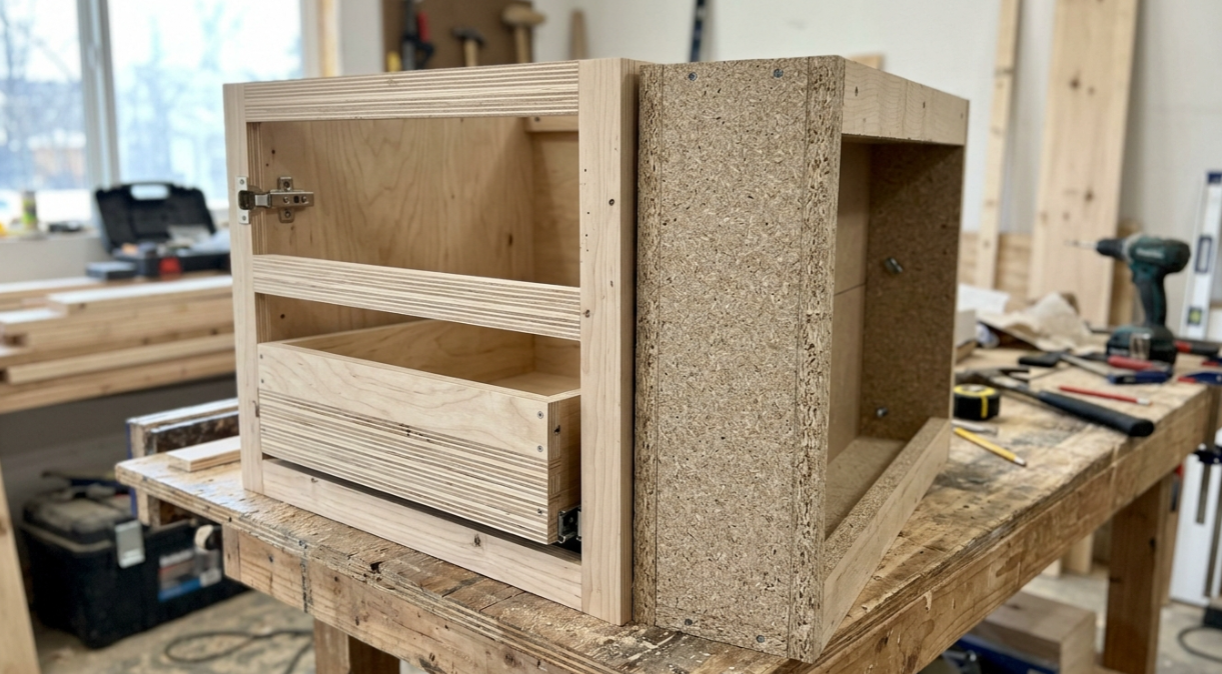
The cabinet box and construction method can significantly affect price. Two kitchens with identical door styles can have very different prices because of differences in materials, joinery, hardware, and construction.
Particleboard Cabinets
Particleboard construction is generally one of the lower-cost options. It can make sense for budget remodels, rental properties, or kitchens where minimizing upfront cost is the priority.
Plywood Cabinets
Plywood boxes typically cost more but are often preferred for their strength, screw-holding ability, and resistance to moisture compared with lower-grade particleboard.
Solid-Wood Components
Solid wood is commonly used for doors, face frames, or other components rather than every part of the cabinet. Depending on the species and construction, it can push the price higher.
Framed vs. Frameless Cabinets
Framed cabinets have a face frame attached to the front of the cabinet box. Frameless cabinets use a box-style construction that provides wider interior access and a more contemporary appearance.
When comparing prices, look beyond the door style. Ask about the box material, drawer construction, hinges, drawer slides, finish, and warranty.
What Makes a 10×10 Kitchen More Expensive?
Several design decisions can increase the cost of a 10×10 cabinet project:
More cabinets: Additional base, wall, or tall cabinets increase material and installation costs.
Specialty cabinets: Lazy Susans, pantry pull-outs, appliance garages, tray dividers, and other organizers cost more than standard cabinets.
Premium finishes: Glazes, specialty paints, stains, and custom colors can increase the cabinet price.
Plywood construction: Higher-grade cabinet boxes generally cost more than basic particleboard construction.
Custom dimensions: Non-standard cabinet widths and heights can push a project toward semi-custom or custom pricing.
Decorative trim: Crown molding, light rails, furniture feet, decorative end panels, and other details add material and labor.
Soft-close hardware: This may be standard on some cabinet lines but an upgrade on others.
Custom installation: Uneven walls, unusual corners, ceiling-height cabinets, and complicated layouts can increase labor.
Kitchen location: Local labor rates, delivery costs, and taxes can substantially change the final price.
The biggest mistake is comparing cabinet prices without comparing the specifications behind those prices.
How to Estimate Costs for Your Kitchen Size
Most kitchens aren’t exactly 10×10. Here’s a simple way to estimate what cabinets will cost for your space: divide any 10×10 price by 20 to get the approximate cost per linear foot. Then multiply by your kitchen’s actual linear footage.
For example, a cabinet line priced at $5,000 for the 10×10 sample works out to $250 per linear foot. A smaller 15-linear-foot galley kitchen would cost roughly $3,750 in cabinets. A larger 30-linear-foot U-shaped kitchen with an island would run about $7,500. These are ballpark numbers, not final quotes, but they’re a reliable starting point.
Cabinet construction style also affects cost. Framed and frameless cabinets use different building methods, and the price difference can add up, especially in larger kitchens.
The Full Installed Cost: What Most Guides Leave Out
The cabinet prices above cover just the boxes. To budget realistically, you need to account for everything that goes into getting those cabinets from a warehouse to your kitchen walls.
Installation Labor
Professional installation for a 10×10 kitchen typically runs $1,500 to $4,000, depending on where you live and whether your cabinets arrive assembled or need to be put together on site. RTA cabinets save money on the product but can add labor hours. Some suppliers offer assembly services so your cabinets arrive ready to hang, which speeds up the installation process considerably.
Demolition and Disposal
Removing your old cabinets and hauling away the debris typically costs $500 to $1,000 for a 10×10 kitchen. Make sure this is included in any quote you receive, because some contractors list it separately.
Accessories and Trim
These smaller items add up faster than you’d think:
Hardware (knobs, pulls): $100 to $400
Crown molding and light rail: $100 to $300
Filler strips, end panels, and toe kicks: $100 to $400
Soft-close hinges and drawer slides (if not already included): $50 to $200
Together, these accessories add $500 to $800 to your cabinet total. On a budget kitchen, that’s a 15 to 25 percent bump. Ask upfront what’s included so there are no surprises.
10×10 Kitchen Cabinet Project Cost Breakdown
For a typical mid-range cabinet project, the cabinet purchase is only part of the final bill.
Cost Component | Typical Planning Range |
|---|---|
Cabinets | $2,000–$13,000+ |
Installation | $1,500–$4,000 |
Demolition and disposal | $500–$1,000 |
Trim, panels, fillers and accessories | $500–$800+ |
Delivery | Varies |
Sales tax | Varies by location |
Plumbing/electrical changes | Varies |
Countertops | Usually separate |
For example, a $5,000 cabinet package could become a substantially larger project after installation, demolition, delivery, tax, trim, and other work are added.
The safest way to budget is to ask for a complete installed estimate rather than relying on the advertised 10×10 cabinet price.
What’s Not Included in Cabinet Installation
Cabinet installation typically does not include plumbing, electrical work, or appliance hookup. Your contractor will coordinate with plumbers and electricians separately. Delivery terms also vary: many suppliers deliver to your garage or first floor only, so plan ahead if your kitchen is on a second floor.
Your Real Total Cost
For a realistic budget, think about the full installed cost: cabinets, plus delivery, plus sales tax, plus installation labor, plus demolition, plus accessories. A $4,000 cabinet set routinely becomes a $7,000 to $8,000 project once everything is factored in. Understanding these common kitchen remodel cost mistakes before you start helps prevent unpleasant surprises once work is underway.
What Kitchen Cabinets Cost in the Seattle and Washington State Area
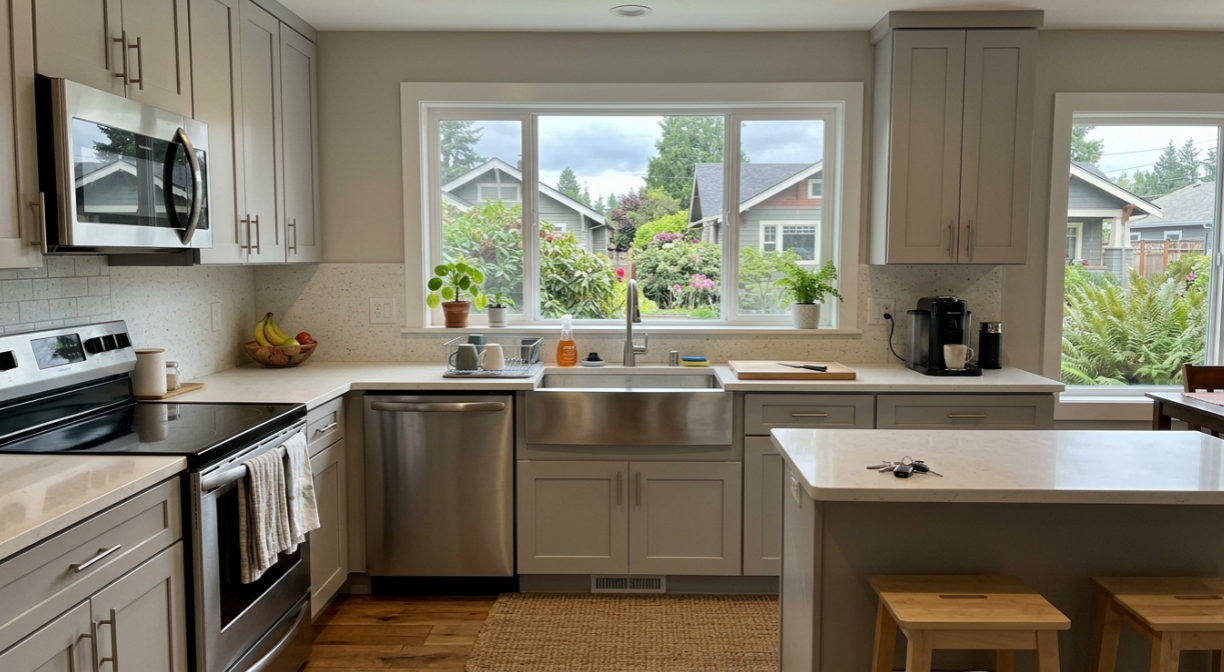
If you live in the Seattle metro area, Tacoma, Lynnwood, Spokane, or elsewhere in Washington State, national cost averages won’t match your experience. Regional pricing runs higher.
According to Homeyou data based on 756 completed projects, the average cabinet installation cost in Seattle is $4,684 to $6,895, with a range from $1,364 to $12,511 depending on scope. Seattle-area pricing runs approximately 21 percent above the national average.
The main reason is labor costs. Bureau of Labor Statistics data from May 2025 shows the Seattle-Tacoma-Bellevue metro had an average hourly wage of $44.13 across all occupations, compared with $33.54 nationally. Construction workers specifically averaged $42.11 per hour in the Seattle area, versus $31.42 nationally. That difference shows up directly in your installation quotes.
Washington’s sales tax (9 to 11 percent depending on your county) applies to both materials and installation labor in most areas. On a $5,000 cabinet order, that’s $450 to $550 in tax. Make sure any estimate you receive accounts for this.
For a full 10×10 kitchen remodel (cabinets, countertops, flooring, plumbing, and appliances), projects in the Greater Seattle area typically land between $25,000 and $45,000. One way to keep costs manageable is to work with a supplier that offers cabinets, countertops, flooring, and other materials in one place, so you’re not coordinating between half a dozen vendors.
If you’re remodeling in Washington, you can visit showrooms in Tukwila, Tacoma, Lynnwood, or Spokane to see cabinet options in person and get a free design quote based on your actual kitchen measurements.
How 2026 Tariffs Are Affecting Cabinet Prices
If cabinet prices seem higher than what you remember hearing a year or two ago, tariffs are a big reason why.
Since October 14, 2025, a 25% tariff has been in effect on all imported kitchen cabinets, bathroom vanities, and their parts. Vietnam, the largest supplier of cabinets to the U.S., now faces a 46 percent tariff. Canada faces 25 percent. These duties hit imported RTA and semi-custom cabinets the hardest.
Even domestically made cabinets aren’t completely shielded. American cabinet manufacturers often use imported components like hardware, drawer slides, and finishes. So tariffs ripple through the supply chain regardless of where the final product is assembled.
The bottom line: most professionally completed 10×10 kitchen remodels in 2026 cost roughly 10 to 14 percent more than the same project would have cost in 2024. If a friend or family member tells you they spent $5,000 on cabinets two years ago, the same cabinets today might run $5,500 to $5,700.
When getting quotes, ask your contractor or cabinet supplier whether their pricing reflects current tariff conditions. Suppliers with large local warehouses may have purchased inventory before the tariffs took effect, which can mean better pricing while that stock lasts.
What Is Included in a 10×10 Cabinet Price?
A 10×10 cabinet price usually refers to the cabinets themselves, not the entire kitchen remodel. However, the exact package varies by supplier.
Item | Usually Included? | Can Cost Extra? |
|---|---|---|
Cabinet boxes | Yes | — |
Doors and drawer fronts | Yes | — |
Standard shelves | Usually | Sometimes |
Hinges | Usually | — |
Drawer slides | Usually | Upgrades possible |
Soft-close hardware | Sometimes | Yes |
Toe kicks | Sometimes | Yes |
End panels | Sometimes | Yes |
Fillers | Sometimes | Yes |
Crown molding | Usually no | Yes |
Decorative hardware | Usually no | Yes |
Countertops | No | Yes |
Sink | No | Yes |
Faucet | No | Yes |
Appliances | No | Yes |
Installation | Usually no | Yes |
Demolition | No | Yes |
Always request an itemized cabinet quote. A lower advertised price may simply exclude items that another supplier has already included.
How to Compare 10×10 Cabinet Quotes
Getting multiple quotes is smart, but comparing them isn’t always straightforward. Here’s what to look for so you’re comparing like with like.
Check the cabinet count. Some suppliers include 10 cabinets in their 10×10 sample, while others include 12 or 13. A higher number of cabinets naturally means a higher price, so make sure you’re comparing the same thing.
Find out what’s included in each cabinet. Soft-close hinges and drawer slides are standard on some lines and cost extra on others. Same with end panels and toe kicks. Two $4,000 quotes can represent very different levels of finish and completeness.
Ask about box construction. Particleboard boxes and plywood boxes can look identical in photos and showrooms. They don’t hold up the same way over 10 or 15 years. A $2,000 10×10 set with particleboard construction is a fundamentally different product than a $4,500 set with plywood boxes, even if the door style looks the same.
Get a real quote based on your kitchen. The 10×10 benchmark helps you narrow down which cabinet line fits your budget. But your actual kitchen has different dimensions, and your costs will differ. Look for a supplier or contractor that offers free design services and can produce a 3D rendering of your kitchen so you can see what you’re getting before committing. If you’re considering new construction or have a larger project, our builder cabinet packages guide covers options for different quality levels.
Where Cabinets Fit in Your Total Kitchen Budget
Cabinets are the single biggest expense in a kitchen remodel, typically taking up 30 to 40 percent of your total budget. According to The Spruce, cabinets cost about $13,000 out of a total average kitchen remodel cost of $24,000.
That ratio holds whether you’re doing a budget renovation or a high-end project. If your total budget is $20,000, plan for $6,000 to $8,000 in cabinets. If it’s $50,000, cabinets will likely run $15,000 to $20,000. Knowing this helps you set realistic expectations before you start getting quotes, rather than falling in love with a cabinet style you can’t afford.
There’s good news on the return on investment front. According to the 2025 Cost vs. Value Report by Zonda and JLC, a minor midrange kitchen remodel recoups approximately 96 percent of its cost at resale. So investing in quality cabinets isn’t just about enjoying your kitchen today; it’s money you’ll likely get back when you sell.
If you’re also choosing countertops, our comparison of quartz vs. granite can help you pick the right material to go with your new cabinets.
What Homeowners and Remodelers Are Reporting in 2026
Published cost averages are useful, but real-world experiences fill in the gaps. On Houzz, homeowners report seeing estimates of $38,000 to $42,000 for cabinets alone in high-end 10×10 kitchen projects with fully custom, locally built cabinetry and premium finishes. Those numbers represent the very top of the market, but they illustrate how far prices can go with custom work.
Practitioners on Reddit’s home improvement and remodeling communities consistently report that plywood-construction RTA cabinets in the $3,000 to $5,000 range (for a 10×10 set) offer the best value for most homeowners. The consensus among experienced remodelers is that these products last nearly as long as many semi-custom lines at significantly lower cost, as long as they’re installed properly.
The takeaway: unless you have specific design requirements that demand custom cabinetry, a quality RTA set gives you solid construction, modern features like soft-close doors, and a price that leaves room in your budget for countertops, flooring, and other finishes. Our breakdown of whether RTA cabinets are worth it covers the pros, cons, and real costs in detail.
Frequently Asked Questions
Is a 10×10 kitchen small?
At 100 square feet, a 10×10 kitchen is below average for new construction but very common in older homes, condos, and apartments. If your kitchen is this size, you’re in good company. Remember that “10×10” in cabinet pricing is a standardized benchmark for comparing costs, not a recommendation for room size.
Do 10×10 cabinet prices include countertops?
No. The 10×10 price covers cabinet boxes only. Countertops are priced separately, typically running $1,500 to $4,500 for a 10×10 kitchen depending on the material you choose. Some suppliers offer both cabinets and countertops (like prefab quartz), which can simplify your shopping and potentially save money. See our guide on matching quartz countertops with cabinets for ideas on pairing materials.
How long does it take to install cabinets in a 10×10 kitchen?
With pre-assembled cabinets and an experienced installer, expect 1 to 3 days. RTA cabinets that need assembly on site can add 1 to 2 days. Some suppliers offer assembly services so your cabinets arrive ready to install, which speeds things up considerably. Frameless (European-style) cabinets sometimes install faster because of simpler mounting systems.
Why are two 10×10 quotes so different from each other?
Usually three reasons: different numbers of cabinets in the sample, different construction quality (particleboard vs. plywood, partial overlay vs. full overlay), and different included accessories. Always ask for an itemized list showing exactly what’s included in each quote before making a decision.
How have tariffs changed 10×10 cabinet pricing in 2026?
A 25 percent tariff on imported cabinets has been in effect since October 2025, with additional country-specific duties reaching 46 percent for products from Vietnam. This has pushed 10×10 kitchen cabinet costs up 10 to 14 percent compared to 2024 levels, with the biggest impact on imported RTA and semi-custom lines. When getting quotes, ask whether prices reflect current conditions, and don’t rely on pricing information from 2024 or earlier.
What should I look for when choosing a cabinet supplier?
Beyond price, consider: whether they have inventory in stock (to avoid long wait times), whether they offer free design help or 3D renderings of your kitchen, clear delivery terms, warranty coverage, and whether their products meet emissions safety standards (look for CARB Phase 2 or EPA TSCA Title VI compliance). If you’re in Washington State, visiting a local showroom lets you see and touch cabinet samples before committing. Krafter’s Land has showrooms in Tukwila, Tacoma, Lynnwood, and Spokane where you can browse options and get a free design quote through an authorized contractor or retailer.