TL;DR
Builder cabinet packages are pre-configured cabinet bundles designed for new construction, production housing, and multi-family projects. The term refers both to a quality tier (“builder grade”) and to a packaging model where all cabinets for a floor plan are bundled, priced, and delivered as one scope of work. Packages typically range from $75 to $350 per linear foot depending on materials and tier, with volume discounts of 20 to 30 percent common for larger projects. This guide defines every key term builders and contractors encounter when specifying cabinet packages, including how cabinetry distributors and manufactured casework fit into the picture.
If you’re a contractor bidding a 40 unit apartment complex or a builder specifying kitchens across a subdivision, “builder cabinet packages” is the language you speak every day. But the term means different things depending on who’s using it, and no single resource breaks down every concept involved.
This glossary fills that gap. It covers what builder cabinet packages actually include, how quality tiers work, what the industry jargon means, and how to evaluate a package before you commit.
Looking for supplier specific pricing for your next project? Explore contractor cabinet pricing and lead times.
Quick Answer: What Are Builder Cabinet Packages?
Builder cabinet packages are pre-configured cabinet bundles designed for new construction, production homes, and multi-family projects.
Most packages include:
- Base cabinets
- Wall cabinets
- Pantry cabinets
- Hinges and drawer hardware
- Filler pieces
- Delivery
Typical pricing in 2026:
| Package Type | Typical Cost |
|---|---|
| Builder grade | $75 to $150 per linear foot |
| Semi custom | $150 to $300+ per linear foot |
| Custom | $300 to $600+ per linear foot |
| Multi family kitchens | $1,200 to $1,800 per unit |
| Turnkey installed packages | $3,900 to $7,900 per unit |
The best package depends on project type:
- Rentals → Builder grade
- Production housing → Builder packages
- Owner occupied homes → Semi custom
- Luxury homes → Custom cabinetry
What Are Builder Cabinet Packages?
The term carries two distinct meanings in practice, and confusing them causes problems.
Meaning 1: A quality tier. “Builder grade” is an industry label for products built to meet code requirements using simple, cost effective materials with minimal detailing. A builder grade cabinet might use particleboard doors with a melamine finish and basic hardware. Norfolk Kitchen & Bath defines it as “product built to meet construction code requirements, using simple, inexpensive materials with minimal detailing.”
Meaning 2: A bundled project scope. This is the meaning that matters most to trade professionals. A builder cabinet package is a complete cabinet order, covering all base cabinets, wall cabinets, tall units, hardware, and sometimes countertops, bundled for a specific floor plan or project. Packages are structured to align with layout requirements, unit counts, and overall project needs. They exist so builders can standardize selections, lock in pricing, and streamline procurement across multiple units or phases.
The second definition is the commercially relevant one. A builder cabinet package doesn’t have to mean cheap materials. It means a repeatable, standardized cabinet specification tied to a floor plan and priced for volume. The quality can range from entry level particleboard to all plywood construction with soft close hardware. What makes it a “builder package” is the packaging model, not the materials.
Practitioners on Reddit’s r/Contractor forum confirm this distinction. In a thread about sourcing cabinets in the Seattle metro, contractors discussed the difficulty of finding quality to price balance, with several noting that “builder grade” shouldn’t automatically mean bottom tier. One user specifically mentioned Bellmont Cabinets as a Washington based frameless option that bridges the gap between stock and semi custom.
If you’re planning a broader kitchen project, the kitchen remodel glossary covers additional terms you’ll encounter.
The Role of Cabinetry Distributors in Builder Packages
Most builders don’t buy cabinets directly from manufacturers. They work through a cabinetry distributor, a regional or national middleman that stocks inventory, handles logistics, and often provides design support. Understanding how distributors operate changes how you evaluate builder cabinet packages.
A cabinetry distributor serves as the bridge between cabinet manufacturers and the contractors or builders who install the product. Distributors typically carry multiple cabinet lines across different price tiers, which lets them assemble packages that match a project’s budget and aesthetic requirements. They warehouse product locally, which is one reason builder packages ship faster than custom orders. When a distributor has a 110,000+ square foot warehouse stocked with popular SKUs, lead times drop from weeks to days.
Practitioners on contractor forums frequently point out that the relationship with a good distributor matters more than the specific cabinet brand. One general contractor in a YouTube walkthrough about multi family procurement explained that his distributor handles everything from 2020 design files to per unit labeling, essentially acting as a project manager for the cabinet scope. That level of service is what separates a true distributor from a retailer that happens to sell cabinets.
Here’s what to look for when evaluating a cabinetry distributor for builder packages:
- Local inventory depth. A distributor that warehouses product in your region eliminates shipping delays and makes emergency replacements feasible. Ask how many SKUs they keep in stock versus special order.
- Multi line access. The best distributors carry entry level through semi custom lines, so you can source different tiers for different projects without switching vendors.
- Trade pricing structure. Distributors should offer tiered pricing that rewards volume and consistency. Contractor pricing through committed distributor relationships can yield 20 to 30 percent off retail.
- Design and ordering support. Look for distributors that provide 2020 Design files, shop drawings, and 3D renderings. This support reduces ordering errors and speeds client approvals.
- Delivery logistics. Confirm whether the distributor handles delivery to the jobsite, how units are labeled (critical for multi family), and whether they offer staged deliveries for phased projects.
For builders running multiple projects, establishing a single distributor relationship simplifies procurement, keeps pricing consistent, and creates accountability when something goes wrong. The distributor absorbs the complexity of coordinating with manufacturers so the builder doesn’t have to.
For a deeper look at choosing the right cabinet supplier, that guide walks through the full evaluation framework.
Builder Cabinet Packages at a Glance
| Factor | Builder Package | Semi Custom | Custom |
|---|---|---|---|
| Price | Lowest | Moderate | Highest |
| Material | Particleboard or plywood | Plywood | Solid wood |
| Cabinet sizes | Fixed | Flexible | Unlimited |
| Lead times | 1 to 3 weeks | 4 to 8 weeks | 8 to 16 weeks |
| Best for | Production housing | Owner occupied homes | Luxury projects |
| Volume discounts | Yes | Sometimes | Rarely |
Cabinet Grade Tiers: A Quick Reference Glossary
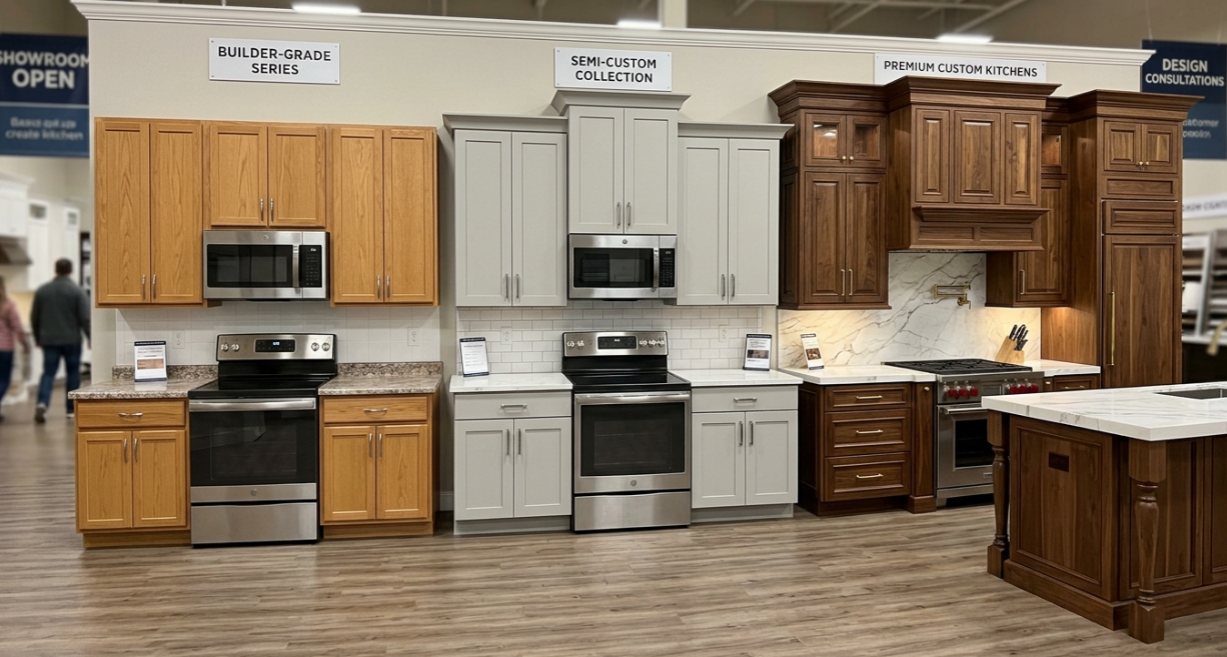
Cabinets fall into a hierarchy of grades. Understanding where builder packages sit in this hierarchy helps you specify the right product for each project type.
| Grade | Box Material | Door Options | Sizing | Hardware | Lead Time | Cost (per linear foot) | Best For |
|---|---|---|---|---|---|---|---|
| Construction | Particleboard, MDF | Limited stock styles | Fixed (3″ increments) | Basic slides, exposed hinges | Immediate/days | $75 to $100 | Rentals, budget flips |
| Builder/Stock | Particleboard or plywood | Stock styles (5 to 15 options) | Fixed (3″ increments) | Standard or soft close | 1 to 3 weeks | $75 to $150 | Production housing, multi family |
| Semi Custom | Plywood | Wide selection (50+) | Flexible (½” to 1″ increments) | Soft close, undermount | 4 to 8 weeks | $150 to $300+ | Spec homes, mid range custom |
| Custom | Solid wood, premium plywood | Unlimited | Any dimension | Premium soft close, specialty | 8 to 16 weeks | $300 to $600+ | High end custom homes |
A few clarifications worth noting:
Builder grade, stock, and RTA overlap significantly. Sea Pointe Construction notes that “Builder Grade, Ready To Assemble (RTA), and Stock Cabinets are of the same class of cabinetry; they are typically the most affordable and have the quickest turn around time.” But they’re not identical. RTA describes assembly format (flat packed). Stock describes inventory method (pre manufactured, warehouse ready). Builder grade describes intended use (production construction). A cabinet can be all three simultaneously.
For a deeper comparison of RTA vs. custom cabinets, including when each makes sense for different project types, that guide is worth reading.
Semi custom represents a meaningful jump. Semi custom cabinetry typically costs 1.5 to 2 times the price of an equivalent stock package for the same kitchen footprint. The difference comes from plywood box construction, higher quality joinery, more size flexibility, and a much wider finish selection.
For a detailed breakdown of lead times across all tiers, that comparison helps with project scheduling.
Manufactured Casework vs. Builder Cabinet Packages
Builders working on commercial, institutional, or mixed use projects will encounter the term “manufactured casework,” and it’s worth understanding how it differs from residential builder cabinet packages.
Manufactured casework refers to factory built cabinetry and millwork produced to commercial specifications, typically following the Architectural Woodwork Standards (AWS) published by the Architectural Woodwork Institute. These standards define three grades of quality: Economy, Custom, and Premium. Each grade specifies tolerances for joinery, materials, finish, and installation that go beyond what residential cabinet standards require.
The key differences between manufactured casework and builder cabinet packages:
Standards framework. Builder cabinet packages follow KCMA A161.1 testing (a residential performance standard). Manufactured casework follows AWS grades, which address dimensional tolerances, veneer matching, edge banding quality, and joint standards at a more granular level. The AWS framework was designed for environments like hospitals, schools, labs, and corporate offices where cabinets see heavy daily use from many people.
Materials and construction. Manufactured casework almost always uses industrial grade substrates: high pressure laminate (HPL) over plywood or industrial particleboard with PVC edge banding rated for high traffic. Residential builder packages can get away with melamine interiors and thermofoil doors. Casework for a medical office or university lab cannot.
Procurement process. Manufactured casework is typically specified by architects and procured through a competitive bid process with submittals, shop drawings, and formal approval cycles. Builder cabinet packages are sourced through distributor relationships with standardized catalogs. The procurement overhead for casework is significantly higher, which is part of why it costs more.
When the lines blur. Mixed use developments (ground floor commercial, upper floors residential) sometimes use the same cabinetry distributor for both scopes. In these cases, the distributor may offer manufactured casework lines for commercial tenant spaces and builder cabinet packages for residential units. Some manufacturers produce both product types, which simplifies coordination.
For residential builders, manufactured casework is rarely relevant unless the project includes a community center, clubhouse, or commercial space. But for contractors who cross between commercial and residential work, understanding both categories prevents specification errors and helps you quote accurately.
Practitioners on Reddit’s r/woodworking and r/cabinetmaking forums note that the manufactured casework market has shifted heavily toward CNC production in recent years. One cabinetmaker described the transition: shops that previously built everything by hand now use CNC routers for panel cutting and boring, which has improved consistency and reduced lead times. This mirrors the production efficiency that makes residential builder packages so cost effective at scale.
How Much Do Builder Cabinet Packages Cost in 2026?
Several factors determine cabinet package pricing:
- Material selection
- Cabinet style
- Cabinet construction
- Hardware upgrades
- Unit volume
- Installation
- Countertops
- Geographic location
Cabinet Pricing by Linear Foot
| Cabinet Type | Cost Per Linear Foot |
|---|---|
| Construction grade | $75 to $100 |
| Builder package | $75 to $150 |
| Semi custom | $150 to $300 |
| Custom | $300 to $600 |
Cabinet Pricing by Project Type
| Project Type | Average Cost |
|---|---|
| Apartment kitchen | $1,200 to $1,800 |
| Production home | $3,000 to $6,000 |
| Installed package | $3,900 to $7,900 |
| Luxury home | $10,000 to $25,000+ |
For regional pricing context specific to Washington State, see the kitchen cabinet cost guide.
What Increases Cabinet Package Costs?
- Plywood construction
- Soft close hardware
- Specialty storage
- Pantry towers
- Island cabinets
- Crown molding
- Installation
Key Terms in Builder Cabinet Packages
These are the terms you’ll encounter when specifying, quoting, or evaluating builder cabinet packages. Each definition explains not just what the term means, but why it matters on the jobsite.
RTA (Ready to Assemble)
Cabinets shipped flat packed for on site or shop assembly. RTA reduces shipping costs and warehouse space requirements. Assembly adds labor time but gives builders flexibility on scheduling. Most builder grade and stock cabinets are available in RTA format.
Read more about what RTA cabinets are and how they compare on cost and quality.
Framed vs. Frameless (Full Access)
Framed cabinets have a solid wood face frame attached to the front of the cabinet box. The frame adds structural rigidity and is the traditional American construction style. Shaker style doors on framed boxes are the most common builder package configuration in the U.S.
Frameless cabinets (also called European or full access) rely on thicker side panels for structure, with no face frame. This gives wider drawer and door openings, about 1.5 inches more usable interior space, and a cleaner, more modern look.
Both styles appear in builder packages. The choice depends on the aesthetic target and buyer demographic. For a full breakdown, see the framed vs. frameless cabinets guide.
Full Overlay
A door style where the door covers most or all of the cabinet face frame (on framed cabinets) or the full box front (on frameless). Full overlay is standard in nearly all builder packages today because it creates a clean, consistent look without visible gaps between doors. Partial overlay, where the frame is visible, is mostly limited to budget tier or replacement projects.
Soft Close Hardware
Hinges and drawer slides with integrated dampers that prevent slamming. Increasingly standard even in builder grade lines, soft close hardware reduces wear, noise complaints (critical in multi family), and warranty claims. One practitioner comparison notes the key hardware distinction: builder grade packages use basic slides and hinges, while custom or semi custom packages specify premium soft close mechanisms. However, the line is blurring as soft close becomes a baseline expectation.
Box Construction Materials
The cabinet body (the box) is built from one of three materials, and this single factor drives most of the quality and cost difference between tiers:
Particleboard. Compressed wood particles bonded with resin. Cheapest option. Prone to swelling if exposed to moisture. Common in construction grade and entry level builder packages.
MDF (Medium Density Fiberboard). Smoother and denser than particleboard. Takes paint finishes well. Used for doors and drawer fronts more than for box construction, though some builder packages use it for both.
Plywood. Layers of wood veneer glued with alternating grain direction. Stronger, more moisture resistant, and significantly more durable than particleboard. Standard in semi custom and above. Some premium builder packages specify plywood boxes as a key differentiator.
Material quality correlates directly with price: stock cabinetry often uses particleboard, semi custom provides plywood construction, and custom cabinetry features solid wood with premium craftsmanship. For practical tips on spotting quality cabinets, that guide covers the visual and structural cues.
Linear Foot Pricing
The standard unit for quoting builder cabinet packages. One linear foot equals one foot of cabinet run along a wall, measured at the base. Builder grade cabinets typically fall between $75 and $150 per linear foot. Multi family projects with basic melamine or MDF cabinets can come in at $80 to $350 per linear foot depending on scope and finish level.
This pricing method works for rough budgeting, but actual package pricing depends on the specific cabinet configuration, number of specialty units (lazy Susans, corner cabinets, pantry towers), and hardware selections.
KCMA Certification (ANSI/KCMA A161.1)
The performance standard for cabinet durability, administered by the Kitchen Cabinet Manufacturers Association. Cabinets with this certification have passed rigorous structural and finish testing: doors and drawers are cycled 25,000 times, wall cabinets are subjected to a 600 pound load, shelves undergo long term load tests, and finished surfaces are exposed to various stains and chemicals.
This certification matters because roughly 40 to 50 percent of manufacturers fail their first attempt. When evaluating builder cabinet packages, asking whether the product carries KCMA certification is one of the fastest ways to separate serious manufacturers from commodity suppliers.
CARB Phase 2 / EPA TSCA Title VI
Formaldehyde emission standards for composite wood products including hardwood plywood, MDF, and particleboard. Originally a California regulation, CARB Phase 2 became the national standard in June 2018 when the EPA required all composite wood products to meet equivalent standards under TSCA Title VI.
For builders, this isn’t optional. Any cabinet using composite wood sold in the U.S. must comply. Verify compliance documentation from your supplier, especially for multi family and commercial projects where building inspectors or property managers may request certificates.
Dovetail Joinery
A drawer construction method where interlocking, fan shaped cuts join the drawer front to the sides. Dovetail joints resist pulling forces far better than stapled or glued butt joints. They’re a reliable indicator of semi custom or custom quality. Most builder grade packages use stapled or cam lock construction instead, which is adequate for light to moderate use but shows wear faster.
Filler Strips
Pieces of matching material (typically 1.5″ to 6″ wide) used to cover gaps when standard size cabinets don’t perfectly fill a wall. Because stock and builder grade cabinets come in fixed 3 inch width increments, fillers are almost always needed. They’re a small cost item but a common source of callbacks if forgotten during ordering. Always account for fillers in your package takeoff.
2020 Design Files
The industry standard software (now “2020 Spaces”) used for cabinet layout design, rendering, and ordering. Many suppliers provide 2020 catalog files so contractors and designers can drop cabinet models directly into their kitchen plans. Having 2020 files from your supplier speeds up the design to approval process significantly and reduces ordering errors.
Cabinet Allowance
A budget amount set aside for cabinets in a new construction contract. Homeowners building custom or semi custom homes frequently encounter this term when their builder presents a base specification with upgrade options. Discussions on Houzz confirm that many buyers first learn about “builder packages” when their builder shows them the base allowance and asks if they want to upgrade.
For trade pros, the allowance structure is a sales tool: it sets a baseline (the builder package) and creates a clear path for upselling to semi custom or custom finishes.
Melamine and Thermofoil
Melamine is a resin saturated paper laminated to particleboard or MDF. It’s the most common interior finish (and sometimes exterior finish) in builder grade cabinets. Durable for its price, but vulnerable to chipping at edges and difficult to repair.
Thermofoil is a thin vinyl film heat wrapped over an MDF substrate. It provides a smooth, painted look without actual paint, making it popular in builder packages for white or light colored kitchens. The main weakness: thermofoil can peel or bubble near heat sources (above ovens or near dishwashers that vent steam).
Shaker Style
A recessed panel door style with clean lines, a flat center panel, and a simple frame. Shaker is the dominant door style in both builder and semi custom packages because it works across traditional and transitional design aesthetics. Roughly 60 to 70 percent of builder packages in the U.S. specify some variation of Shaker.
What’s Typically Included in a Builder Cabinet Package
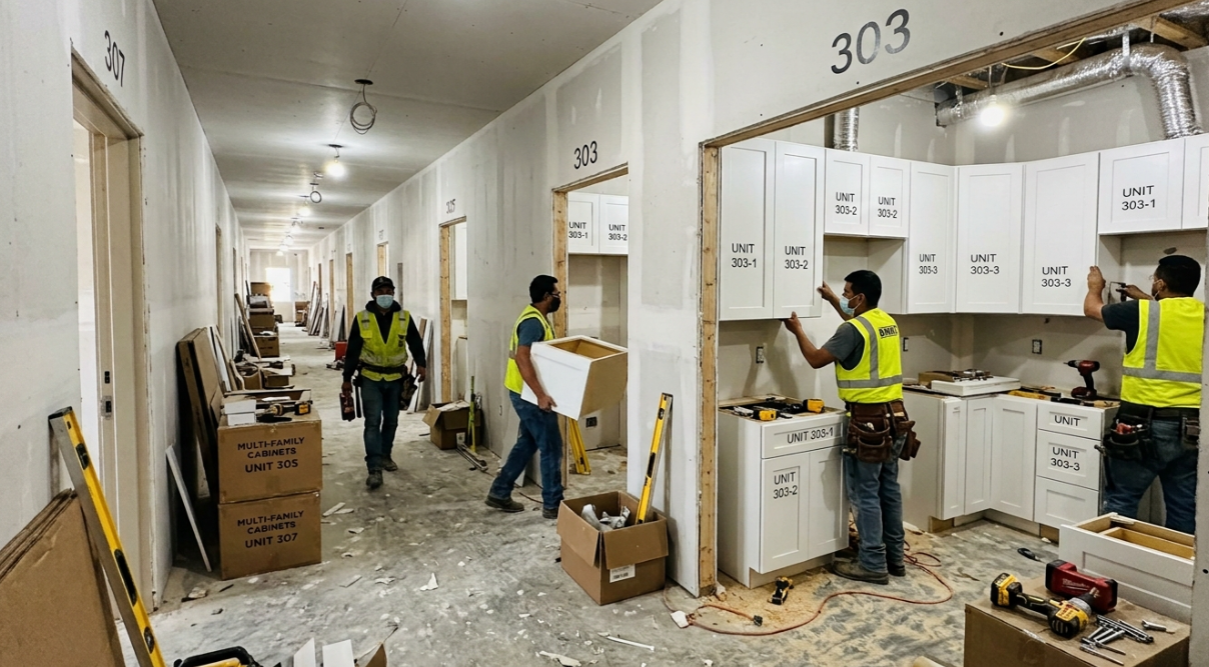
A standard builder cabinet package for production housing or multi family typically covers:
Always included:
- Base cabinets (all sizes for the floor plan)
- Wall cabinets (typically 30″ or 36″ tall)
- Tall/pantry units (if applicable to layout)
- Hardware (hinges and drawer slides, soft close or standard depending on tier)
- Filler strips and end panels
- Delivery (usually first floor or garage drop)
Sometimes included (varies by supplier and tier):
- Countertops (often sold separately, but turnkey packages bundle them)
- Vanity cabinets (bathroom)
- Island cabinets
- CAD shop drawings or 2020 design files
- On site labeling (cabinets labeled by unit number for multi family)
- Project management services
- Installation
Not included in most packages:
- Plumbing
- Electrical
- Appliance hookup or installation
- Demolition of existing cabinets (remodel scenarios)
- Crown molding or decorative trim (sometimes offered as an add on)
One multi family supplier structures their builder cabinet packages into three tiers. The base “Convenience Package” at $3,900 per unit includes estimating, CAD drawings, kitchen and vanity cabinets with hardware, delivery labeled per unit, and project management. The “Strategic Package” at $5,300 per unit adds installation. The “Premium Package” at $7,900 per unit is full turnkey.
A practitioner on the Fine Homebuilding forum pointed out a reality that shapes these economics: “All of the major builders who use cabinets from the major national cabinet suppliers, the installers get $11 to $15 a box.” That tight per box installation rate is why material selection in builder packages trends toward simplicity and standardization. There isn’t much margin to absorb complexity.
Before ordering any package, accurate measurements are essential. The step by step cabinet measuring guide walks through the process.
Which Builder Cabinet Package Is Right for Your Project?
| Project | Recommended Package |
|---|---|
| Apartment complex | Builder grade |
| Student housing | Builder grade |
| Workforce housing | Builder grade |
| Spec home | Builder package |
| Mid range home | Semi custom |
| Forever home | Semi custom |
| Luxury custom home | Custom |
Choose Builder Grade If:
- Cost is the priority.
- Standardized floor plans are used.
- Unit turnover is expected.
For rental specific guidance, the cabinets for rental property guide covers material choices that hold up to tenant wear.
Choose Semi Custom If:
- Buyers expect upgrades.
- Durability is important.
- The kitchen is a selling point.
Choose Custom If:
- The design requires non standard dimensions.
- Premium finishes are expected.
- Cabinetry is a focal point.
How to Evaluate a Builder Cabinet Package
Not all builder packages are equal, and the cheapest quote isn’t always the best value once you factor in callbacks, warranty claims, and tenant satisfaction. Here’s what to check.
The Trade Pro Checklist
1. Box material. Ask specifically: is the box particleboard, MDF, or plywood? For rental properties and production housing, particleboard is often acceptable. For owner occupied homes, plywood boxes significantly reduce long term warranty issues.
2. Drawer construction. Stapled butt joints are standard at the builder tier. Dovetail joints indicate a step up. The drawer box takes more abuse than any other cabinet component, so this is where quality differences show up first.
3. Hardware grade. Side mount slides vs. undermount soft close. Basic exposed hinges vs. concealed soft close hinges. In multi family, soft close hardware reduces noise complaints and maintenance calls. It’s worth the small per unit upcharge.
4. Emissions compliance. Confirm CARB Phase 2 and EPA TSCA Title VI compliance in writing. This isn’t negotiable for U.S. projects.
5. KCMA certification. If the cabinets carry ANSI/KCMA A161.1 certification, they’ve been independently tested. If they don’t, ask why.
6. Warranty terms. What’s covered, for how long, and what voids the warranty? Pay attention to moisture exclusions, which can eliminate coverage for the most common failure mode of builder grade cabinets.
7. Lead time and inventory. Builder packages depend on predictable timelines. A supplier quoting 12 week lead times on stock cabinets is a red flag. Some manufacturers have reduced lead times to 5 to 8 weeks through streamlined manufacturing and better inventory management. In stock programs with local warehousing eliminate this variable entirely.
8. Design support. Does the supplier provide 2020 files, 3D renderings, or shop drawings? This support reduces ordering errors and speeds up client approvals, especially on spec homes where buyers want to visualize their kitchen.
9. Distributor relationship depth. For multi project builders, evaluate whether the cabinetry distributor can handle phased deliveries, maintain consistent pricing across projects, and provide a single point of contact for issue resolution. A distributor that treats every order as a one off transaction will cost you time on your tenth project.
Builder Cabinet Package Buying Checklist
Before placing an order, confirm:
| Item | Verified |
|---|---|
| Cabinet box material | ✓ |
| Drawer construction | ✓ |
| Soft close hardware | ✓ |
| KCMA certification | ✓ |
| CARB Phase 2 compliance | ✓ |
| Warranty | ✓ |
| Lead times | ✓ |
| Installation scope | ✓ |
| Delivery | ✓ |
| Shop drawings | ✓ |
| Distributor inventory depth | ✓ |
| AWS grade (if commercial scope) | ✓ |
Builder Grade vs. Semi Custom vs. Custom: When to Upgrade
The right tier depends on the project, not on abstract quality preferences. Here’s a practical framework.
Stick with builder grade packages when:
- The project is multi family rental (apartments, workforce housing)
- You’re building spec homes in a price sensitive market
- Unit counts are high enough to benefit from volume pricing (20 to 30% discounts are common at scale)
- Speed matters more than customization (builder packages ship faster and install faster)
- The end user won’t be the buyer (investors, property management companies)
Move to semi custom when:
- The project is owner occupied housing in the mid range market
- Buyers expect to see their specific kitchen before committing
- The floor plan has non standard dimensions that fixed size stock cabinets can’t fill cleanly
- Long term durability matters (semi custom plywood construction lasts 20 to 30 years with proper installation)
- The kitchen is the primary selling feature
Go custom when:
- The buyer is paying for a luxury experience and expects unique finishes, unusual dimensions, or specialty storage
- The project is a one off or has a design concept that stock configurations can’t achieve
- Budget and timeline accommodate 8 to 16 week lead times and higher per foot costs
The cost jump from builder to semi custom is meaningful but not always as dramatic as people assume. According to the International Association of Certified Home Inspectors, the average lifespan of kitchen cabinets is approximately 50 years. Builder grade cabinets fall well short of that, with some sources suggesting cosmetic deterioration within five years under normal use. Semi custom cabinets, with plywood construction and better joinery, close that gap significantly.
For builders advising clients on this decision, the conversation should center on the intended use of the home, the target buyer profile, and the total cost of ownership (not just the cabinet line item).
To compare the economics of RTA and custom options in more detail, that analysis breaks down the real numbers.
Cost Summary for Builder Cabinet Packages
| Project Type | Typical Range (per unit or per linear foot) | Notes |
|---|---|---|
| Multi family, melamine/MDF | $1,200 to $1,800 per unit | Kitchen only, basic configuration |
| Multi family, full package | $3,900 to $7,900 per unit | Ranges from cabinets only to full turnkey with install |
| Builder grade, per linear foot | $75 to $150 | Standard stock/RTA product |
| Semi custom, per linear foot | $150 to $300+ | Plywood, wider options |
| Custom, per linear foot | $300 to $600+ | Solid wood, any configuration |
Volume discounts of 20 to 30 percent off standard retail are achievable for developers committing to consistent, recurring orders across multiple projects.
How Cabinetry Distributors and Manufactured Casework Affect Your Package Decision
For builders who work across project types, the relationship between cabinetry distributors, manufactured casework, and standard builder cabinet packages creates both opportunities and pitfalls.
A cabinetry distributor that carries both residential and commercial lines can simplify procurement for mixed use projects. Instead of sourcing builder packages from one vendor and manufactured casework from another, you consolidate through a single distributor who understands both AWS commercial grades and KCMA residential standards. This reduces coordination overhead and often unlocks better pricing because the distributor sees your total volume across both categories.
The pitfall comes from conflating the two. Manufactured casework specified to AWS Premium grade will cost two to three times more than a comparable residential builder package. If a commercial architect specifies AWS Custom grade for a clubhouse kitchen and you quote it using residential builder package pricing, you’ll lose money. Always confirm the specification standard before quoting.
For residential only builders, the takeaway is simpler: find a cabinetry distributor with deep local inventory, multiple product lines, and genuine trade support. The distributor is your supply chain, and the strength of that relationship directly affects your lead times, pricing, and callback rate.
7 Common Builder Cabinet Package Mistakes
1. Choosing cabinets based only on price
The cheapest package often creates higher maintenance costs. A practitioner on a Fine Homebuilding thread noted that installers earning $11 to $15 per box on national builder accounts have zero margin to deal with quality issues, meaning problems get passed to the GC.
2. Ignoring cabinet box materials
Particleboard and plywood perform very differently. In a kitchen where the sink base gets occasional moisture exposure, particleboard can swell and delaminate within a few years.
3. Forgetting filler strips
Missing fillers are a major source of callbacks. Every package takeoff should include fillers for wall ends, corners, and transitions.
4. Assuming countertops are included
Many cabinet packages don’t include countertops. Always confirm scope before comparing quotes.
5. Skipping certification checks
Always verify KCMA and TSCA compliance. These aren’t optional for U.S. projects, and they indicate the manufacturer takes quality seriously.
6. Underestimating lead times
Delays in cabinet delivery can affect the entire construction schedule. Work with a distributor that maintains local warehouse inventory.
7. Not requesting design files
2020 files and CAD drawings reduce ordering mistakes. If your cabinetry distributor doesn’t provide them, that’s a signal their ordering process will create friction.
Frequently Asked Questions
What does “builder grade” actually mean for cabinets?
Builder grade means the cabinet meets construction code requirements using cost effective materials. It’s the standard specification in production housing and multi family construction. The term describes both a quality tier (simple materials, limited style options) and a purchasing model (standardized, volume priced packages). It doesn’t automatically mean poor quality, though the materials are simpler than semi custom or custom alternatives.
What’s the difference between builder grade and stock cabinets?
They overlap heavily. Stock cabinets are pre manufactured in fixed sizes and held in inventory. Builder grade cabinets are specified for construction projects. In practice, most builder packages use stock cabinets. The distinction matters mainly when a builder sources semi custom cabinets through a builder package framework, which some suppliers offer for mid range projects.
What is a cabinetry distributor?
A cabinetry distributor is a wholesale intermediary between cabinet manufacturers and trade buyers (contractors, builders, designers). Distributors stock inventory locally, provide design and ordering support, and handle logistics. For builder cabinet packages, working through a strong distributor relationship is the most efficient way to lock in pricing, reduce lead times, and get consistent product across multiple projects.
What is manufactured casework?
Manufactured casework is factory built cabinetry produced to commercial specifications, typically following the Architectural Woodwork Standards (AWS). It’s used in hospitals, schools, offices, and other institutional settings where durability requirements exceed residential standards. Manufactured casework is relevant for builders working on mixed use projects that include both residential and commercial spaces.
How much do builder cabinet packages cost per unit in multi family?
Kitchen cabinets in melamine or MDF for multi family projects typically run $1,200 to $1,800 per unit for cabinets alone. Full service packages that include design, delivery, and installation can range from $3,900 to $7,900 per unit depending on scope.
Do builder cabinet packages include countertops?
Sometimes. Basic packages typically include only cabinets and hardware. Turnkey or “premium” packages from some suppliers bundle countertops, but these are priced separately in the package breakdown. Always confirm what’s included before comparing quotes.
What certifications should I look for in builder grade cabinets?
Two are essential. KCMA A161.1 certification confirms the cabinets have passed structural, durability, and finish testing. CARB Phase 2 (or EPA TSCA Title VI) compliance is legally required for any composite wood product sold in the United States and confirms formaldehyde emission limits are met.
How long do builder grade cabinets last?
The industry benchmark for kitchen cabinets is approximately 50 years, but builder grade cabinets with particleboard construction fall short. Cosmetic wear (peeling, swelling, hardware loosening) often appears within 5 to 10 years under normal use. Plywood based builder packages last significantly longer. The actual lifespan depends heavily on installation quality and moisture exposure.
Can I get volume discounts on builder cabinet packages?
Yes. Contractor pricing and volume commitments can yield 20 to 30 percent off standard retail pricing. Many suppliers and cabinetry distributors offer tiered pricing structures where recurring orders across multiple projects lock in lower per unit costs.
What’s the typical lead time for builder cabinet packages?
Stock and RTA builder packages can ship within days to 3 weeks. Some streamlined manufacturers have compressed typical industry lead times from 12 weeks down to 5 to 8 weeks. Local suppliers with warehouse inventory can often offer next day pickup for unassembled cabinets, which is the fastest option for time sensitive projects.
Are builder cabinet packages cheaper than buying cabinets individually?
Yes. Package pricing usually includes volume discounts and standardized specifications that reduce procurement and installation costs.
Do builder cabinet packages include installation?
Not always. Some suppliers sell cabinets only, while others offer turnkey packages.
Are plywood cabinets worth the extra cost?
For owner occupied homes, plywood cabinets typically provide better moisture resistance and longer service life.
Can I upgrade a builder cabinet package?
Yes. Most suppliers allow upgrades for hardware, cabinet boxes, finishes, countertops, and storage accessories.
How does manufactured casework differ from builder cabinet packages?
Manufactured casework follows AWS commercial standards with tighter tolerances, heavier duty materials, and a formal submittal process. Builder cabinet packages follow KCMA residential standards and are procured through distributor catalogs. Casework costs more and takes longer but meets the demands of high traffic commercial environments.
How many cabinets are included in a standard builder package?
The number varies by floor plan, but a standard kitchen package typically includes all required base, wall, and pantry cabinets.
Need builder cabinet packages for your next project in Washington State? Krafter’s Land Cabinetry supplies framed Shaker, frameless European, and Slim Shaker lines through authorized dealers and licensed contractors, with large local warehousing, 2020 Design file support, and CARB Phase 2 / TSCA Title VI compliance across all cabinet products. Visit the Washington showrooms in Tukwila, Tacoma, Lynnwood, or Spokane to review options in person.