TL;DR
Choosing the right cabinet supplier for contractors comes down to five things: in stock inventory depth, actual lead times, construction quality, tariff exposure, and whether the supplier protects your trade margins. This guide compares eight suppliers on those criteria and includes a dedicated section for Seattle area contractors navigating local sourcing challenges.
For Washington State contractors who want a single vendor solution covering cabinets, countertops, flooring, and more, Krafter’s Land Cabinetry is the top pick, with four WA showrooms, a 110,000+ square foot warehouse, and next day RTA pickup. Nationally, J&K Cabinetry and NextDAY Cabinets stand out for volume buyers and Mid Atlantic pros respectively.
The U.S. kitchen cabinet market is projected to reach $26.9 billion by 2026, and contractors are absorbing more risk than ever to capture their share. A 25% Section 232 tariff on imported cabinets has been active since October 2025. Lead times have stretched 10 to 15% compared to 2023. And 75% of companies in the building products space report supply chain disruptions.
Picking the wrong cabinet supplier for contractors doesn’t just mean paying too much. It means delayed countertop templating, idle crews, missed project starts, and homeowners who lose patience. This article compares eight suppliers across the dimensions that actually matter to trade professionals, with honest tradeoffs for each.
If you’re evaluating contractor cabinet pricing and lead times, this guide builds on that foundation with specific supplier profiles and a 2026 tariff adjusted lens.
Quick Answer: Which Cabinet Supplier Is Best for Contractors?
The best cabinet supplier for contractors depends on your priorities.
| If you prioritize… | Best supplier |
|---|---|
| One stop sourcing | Krafter’s Land |
| Lowest pricing | Buy Wholesale Cabinets |
| Fastest pickup | Krafter’s Land |
| National availability | J&K Cabinetry |
| Trade only purchasing | Krafter’s Land and NextDAY |
| Washington contractors | Krafter’s Land |
| Design support | Contractor Cabinets |
| Budget flips | Buy Wholesale Cabinets |
| Seattle area projects | Krafter’s Land |
Most contractors should prioritize inventory depth and lead time reliability over cabinet pricing. A supplier with a larger warehouse and shorter lead times can save more money than a lower priced supplier that delays installation.
At a Glance Comparison Table
| Supplier | Best For | Trade Only? | Lead Time (In Stock) | Style Range | Design Support | WA Showrooms |
|---|---|---|---|---|---|---|
| Krafter’s Land | WA contractors wanting one stop sourcing | Yes | Next day pickup (RTA); ~1 week assembled | Frameless, Shaker framed, Slim Shaker | Free 2020 Design files, 3D renders | 4 (Tukwila, Tacoma, Lynnwood, Spokane) |
| J&K Cabinetry | High volume RTA buyers nationwide | Yes (pro account required) | 5 to 7 days average | Shaker, raised panel, transitional | Pro account tools | 0 in WA (national warehouses) |
| Highland Cabinetry | Speed critical nationwide projects | No (sells to homeowners too) | Ships quickly from stock | Shaker, traditional | Basic | 0 |
| Contractor Cabinets | Western US builders wanting design help | Contractor focused | Varies | Multiple framed/frameless | Free 3D renders, estimates | 0 |
| Pioneer Cabinetry | Contractors wanting simplified selection | Wholesale focused | Ships from stock | Curated/limited | Basic | 0 |
| NextDAY Cabinets | Mid Atlantic trade pros | Yes (no retail sales) | 1 to 2 weeks | Broad catalog | Contractor guides, design support | 0 |
| Buy Wholesale Cabinets | Flippers and investors at lowest cost | No (sells to DIY) | Ships from stock | Budget to mid range | Minimal | 0 |
| ABS Building Supply | Lynnwood/Greater Seattle area | No | Varies | Cabinets and vanities | Basic | 2 (Lynnwood, Battle Ground) |
What Makes a Good Cabinet Supplier for Contractors?
Not every cabinet supplier for contractors is designed with trade professionals in mind. The best ones share six characteristics that separate reliable partners from sources of frustration.
Inventory Depth
Suppliers with large warehouses typically offer more reliable lead times. A 110,000+ square foot regional warehouse beats a promise that cabinets are “on order from the factory.”
Trade Only Pricing
Trade only suppliers protect contractor margins by preventing homeowners from buying products directly. This single factor determines whether your markup survives a client’s Google search.
Construction Quality
Look for:
- Plywood cabinet boxes
- Dovetail drawers
- Soft close hardware
- Solid wood doors
For a deeper dive into what separates quality construction from marketing claims, see this guide on spotting quality cabinets.
Design Support
Free renderings and 2020 Design files reduce quoting time.
Delivery Reliability
Late deliveries can delay countertop fabrication, plumbing, electrical work, and final inspections.
Multi Category Sourcing
Purchasing cabinets, countertops, flooring, and tile from one supplier reduces administrative overhead. Any cabinet supplier for contractors worth considering should offer at least some vendor consolidation options.
How We Evaluated These Suppliers
The criteria here come from what contractors actually report caring about, not marketing copy. Practitioners on Reddit’s r/Contractor and r/cabinetry consistently rank construction quality and lead time reliability above brand name recognition. Here are the ten factors we weighted:
- In stock inventory depth so you’re not waiting on a container ship
- Lead times (stated vs. actual) because a promised date means nothing if it slips
- Construction quality markers like plywood boxes, dovetail drawers, and soft close hardware
- Tariff exposure given the current 25% Section 232 duties on imports
- Trade program structure including account requirements and margin protection
- Design support such as 2020 Design files, 3D renderings, and quoting tools
- Warranty specifics covering box, doors, drawers, and hardware separately
- Compliance certifications (CARB Phase 2, EPA TSCA Title VI)
- Delivery logistics including drop policies and timing
- Multi category sourcing to consolidate vendors and purchase orders
Understanding the difference between framed vs. frameless cabinets also matters here, since not every supplier carries both, and your project style dictates which construction type you need.
Cabinet Supplier vs Cabinet Manufacturer vs Cabinet Distributor: What’s the Difference?
Contractors often use the terms cabinet supplier, manufacturer, wholesaler, and distributor interchangeably, but they are not the same thing.
| Term | Definition | Best for |
|---|---|---|
| Manufacturer | Builds cabinets | Custom projects |
| Distributor | Warehouses and distributes products | Large volume builders |
| Supplier | Sells products and manages fulfillment | Remodelers and contractors |
| Wholesaler | Focuses on discounted bulk purchasing | Flippers and developers |
Most contractors work with suppliers rather than manufacturers because suppliers handle inventory, warehousing, logistics, design support, and delivery.
Understanding the difference helps you choose the right partner and avoid paying custom cabinet prices for projects that don’t require them.
The 8 Best Cabinet Suppliers for Contractors
Each cabinet supplier for contractors listed below has been evaluated on the ten criteria outlined above. Here are the profiles, strengths, and tradeoffs for each.
1. Krafter’s Land Cabinetry
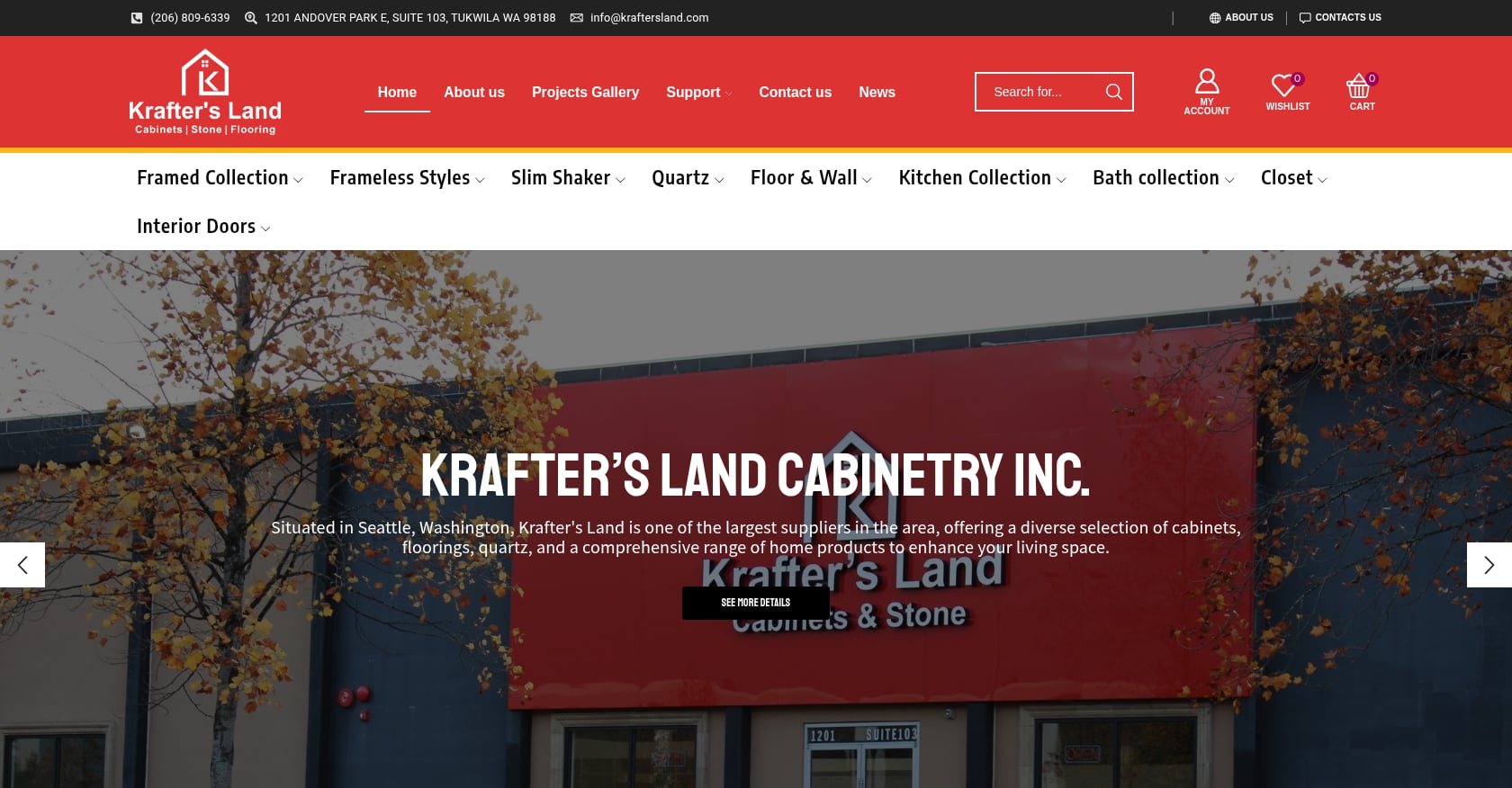
Best for: Washington State contractors who want a single vendor for cabinets, countertops, flooring, shower doors, and closets.
Krafter’s Land operates on a dealer and contractor only purchasing model. That means no direct to consumer online sales, which protects your trade margins in a way that consumer facing suppliers simply cannot.
Key features:
- Four Washington showrooms: Tukwila, Tacoma, Lynnwood, and Spokane
- 110,000+ sq ft warehouse supporting deep in stock inventory
- Next day pickup for RTA cabinets, approximately one week for assembly, roughly two weeks for full installation on the frameless line
- Three style lines: Frameless European, Shaker framed, and Slim Shaker
- Free design and quotes with 2020 Design files and a project preview tool
- Multi category sourcing: cabinets, quartz countertops, SPC flooring, porcelain tile, shower doors, closets, and interior doors from one PO
- CARB Phase 2 and EPA TSCA Title VI compliant materials
- 5 year limited warranty on cabinets and closets; 15 year limited warranty on quartz countertops
Why contractors choose it:
No other supplier on this list lets you consolidate cabinets, countertops, flooring, and tile into a single purchase order from a single local partner. That cuts vendor coordination dramatically. The four showrooms also double as client meeting spaces where you can walk homeowners through finish selections in person rather than passing around sample chips on a jobsite.
Tradeoffs:
- Delivery is first floor or garage drop only, so plan crew accordingly for upper floor projects
- Installation scope excludes plumbing and electrical, requiring GC coordination
- No consumer facing online ordering (by design, but worth noting if your clients want to browse independently)
Register as a trade partner at Krafter’s Land
2. J&K Cabinetry
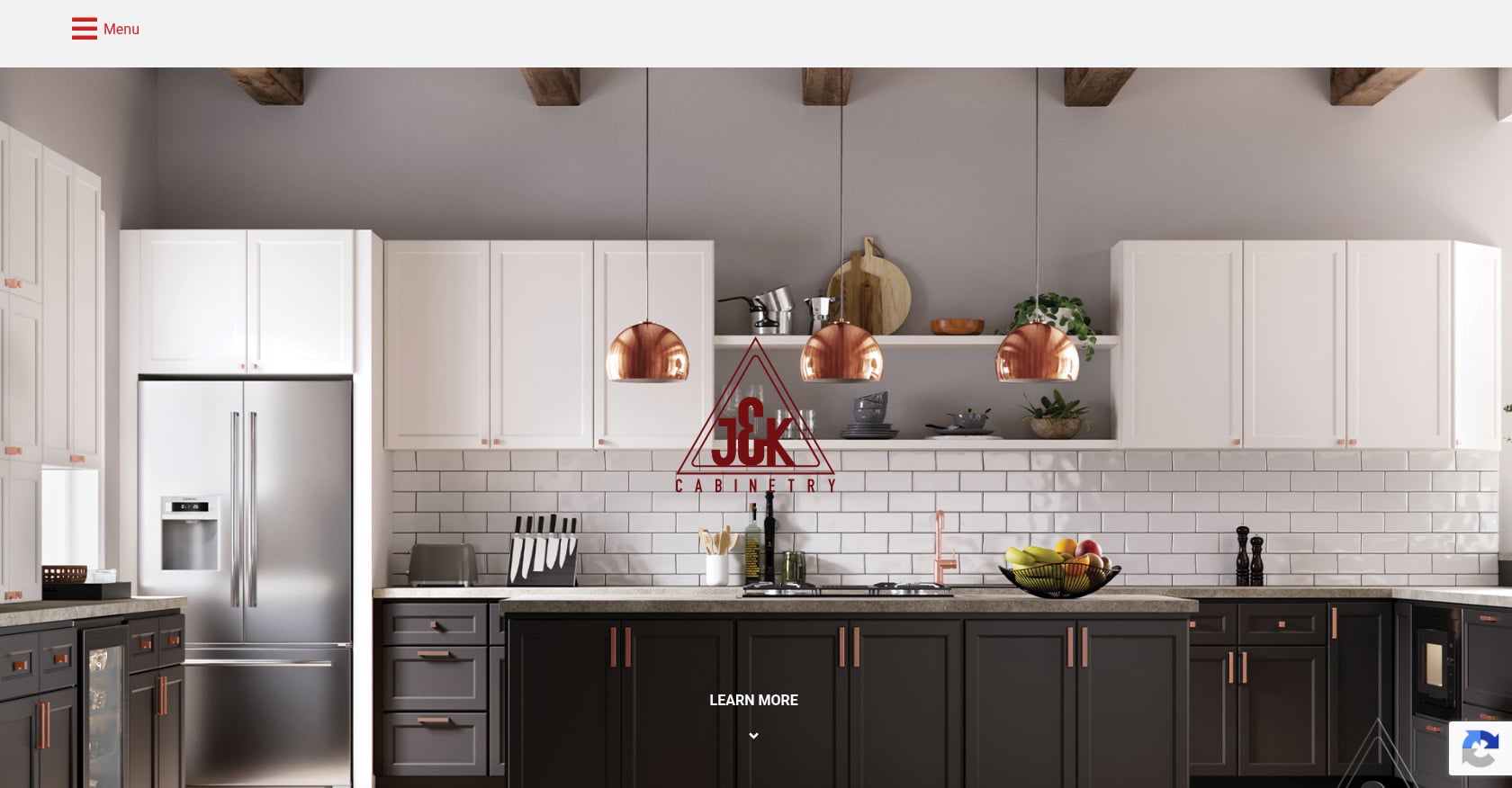
Best for: High volume RTA buyers who need consistent all plywood construction across a national footprint.
J&K has built a strong reputation among contractors for delivering solid value at scale. All collections feature 100% solid wood doors, plywood construction, and soft close hardware as standard. Their Houston location alone holds a 4.8 star rating across 141 reviews on BirdEye, which is notable for a wholesale supplier.
Key features:
- All plywood box construction with solid wood doors across every line
- Soft close hinges and drawer glides standard
- Same week delivery for in stock Shaker cabinets; 5 to 7 day average lead time on all orders
- Pro only pricing available after business certification and account registration
- National warehouse network
Tradeoffs:
- Finish inconsistencies are the most commonly cited complaint among contractors, particularly in paint and stain matching across large orders
- Shipping damage comes up regularly in reviews, so inspect deliveries carefully
- No Washington State showrooms
An ex custom cabinetmaker on Reddit’s r/cabinetry reported switching to recommending a similar all plywood, dovetail drawer supplier (Fabuwood) after leaving the custom shop world, noting that half inch plywood backs and solid dovetail drawers were the minimum standard for trade work. J&K checks those same boxes at a competitive price.
3. Highland Cabinetry
Best for: Contractors running speed critical projects who need quick ship all wood cabinets at wholesale pricing.
Highland manufactures and distributes all wood cabinets at wholesale pricing, serving suppliers, contractors, and homeowners nationwide. Repeat customers consistently cite the gap between what the cabinets cost and how expensive they look installed.
Key features:
- All wood cabinet construction at wholesale pricing tiers
- Ships nationally with quick turnaround on in stock items
- Pricing that holds up for repeat buyers on multi project accounts
Tradeoffs:
- Sells to homeowners as well as contractors, so there is no trade only margin protection
- Mixed fulfillment reviews: a ComplaintsBoard report details an order where delivery was attempted a month early, and the complete order still was not ready at the rescheduled date
- Less transparency around warranty specifics compared to suppliers like Krafter’s Land or J&K
If fulfillment reliability is critical for your operation (and it should be), verify stock levels and get delivery dates in writing before committing to Highland on a tight timeline project.
4. Contractor Cabinets
Best for: Western US builders who want hands on design support from a cabinet focused team.
Contractor Cabinets positions itself as a service first supplier for builders in the western United States. Their cabinet experts provide free design consultations, 3D renders, and estimates, a workflow similar to what Krafter’s Land offers in Washington but without the physical showroom presence.
Key features:
- Free design consultations with 3D renderings and estimates
- Focused on the contractor and builder market segment
- Western US geographic focus
Tradeoffs:
- Limited publicly available data on warehouse inventory depth or stock levels
- No showroom presence in Washington State for walk through meetings
- Less clarity on construction specifications (plywood vs. particleboard) in public facing materials
If you are comparing design support options, check whether the supplier provides 2020 Design files specifically, since those files integrate with most kitchen design software and speed up the quoting process considerably.
5. Pioneer Cabinetry
Best for: Contractors who want a curated, simplified cabinet selection without wading through hundreds of SKUs.
Pioneer takes the opposite approach from mega catalog suppliers. They offer a smaller, intentionally curated selection of soft close wholesale cabinets and serve the Seattle and surrounding areas.
Key features:
- Curated product range designed for faster decisions
- Soft close hardware standard
- Wholesale pricing for trade accounts
- Mentions Seattle and surrounding areas in service coverage
Tradeoffs:
- Fewer style options means less flexibility for design heavy projects
- Less publicly available information on construction details and warranty terms
- Smaller catalog means potential limitations for multi style projects in the same development
The curated approach works well for flippers and multi unit builders who standardize on one or two cabinet styles across all their projects. It’s less ideal for custom remodelers who need a broader palette.
6. NextDAY Cabinets
Best for: Mid Atlantic dealers and contractors who want a purely trade focused distributor.
NextDAY Cabinets does not sell to retail customers at all. This makes them one of the few genuinely trade only operations on this list, alongside Krafter’s Land. They also maintain a strong content marketing presence, publishing contractor guides and resources that signal serious investment in their trade audience.
Key features:
- Purely trade focused: no retail customer sales
- Strong educational content library for contractors
- Broad catalog across multiple price tiers
- Mid Atlantic distribution focus with established logistics
Tradeoffs:
- Primarily serves the Mid Atlantic region, making them less practical for Pacific Northwest contractors
- No Washington State presence or showrooms
- Lead times may be longer for West Coast delivery
For contractors deciding between RTA and custom cabinets, NextDAY publishes useful comparison content, though their stock and pricing advantages are strongest within their home geography.
7. Buy Wholesale Cabinets
Best for: Flippers, real estate investors, and multi unit turns where lowest possible cost per unit is the primary driver.
This supplier leans hard into the price argument, targeting contractors, builders, and DIY buyers alike with wholesale positioning.
Key features:
- Aggressive wholesale pricing aimed at budget conscious buyers
- Serves contractors, builders, and DIY homeowners
- Stock cabinets available for quick ship
Tradeoffs:
- Sells to DIY customers, which means your homeowner clients could potentially buy the same cabinets at the same price, undercutting your markup
- Less information available on construction quality markers (plywood vs. particleboard, drawer box construction)
- Limited design support compared to service oriented suppliers
The margin protection issue matters more than most contractors realize. Practitioners on Reddit have noted that when a homeowner Googles their contractor’s cabinet brand and finds the same product at the same price online, it creates uncomfortable conversations about markups. Trade only suppliers eliminate that problem entirely.
8. ABS Building Supply
Best for: Contractors in the Lynnwood and Greater Seattle area who want a local option with a long track record.
ABS Building Supply has been operating in the Greater Seattle market since 2012, serving contractors and homeowners with cabinets, vanities, and related building supplies. Their Lynnwood and Battle Ground locations provide local pickup options for contractors in those areas.
Key features:
- Local presence in Lynnwood and Battle Ground, Washington
- Over a decade of operation in the Greater Seattle market
- Cabinets and vanities with contractor pricing
Tradeoffs:
- Also sells to homeowners, reducing trade only margin protection
- Smaller showroom and warehouse footprint compared to Krafter’s Land’s 110,000+ sq ft warehouse
- Fewer product categories, meaning you will likely need additional vendors for countertops, flooring, and tile
Seattle Area Cabinet Suppliers: A Local Contractor’s Guide
National supplier lists are useful for comparison, but Seattle area contractors face sourcing dynamics that are specific to the Puget Sound region. This section covers everything local pros need to know about finding, evaluating, and working with a cabinet supplier for contractors in the greater Seattle market.
Why Seattle Area Sourcing Is Different
The Seattle metro area presents challenges that contractors in other parts of the country don’t typically deal with:
- Traffic and delivery logistics along I 5: A supplier in Tukwila and a jobsite in Everett can mean 90 minutes of drive time during peak hours. Suppliers with multiple locations across the corridor cut that friction substantially.
- Higher freight costs: Getting cabinets from national warehouses on the East Coast or Midwest into the Pacific Northwest adds shipping cost that erodes the savings from a “cheaper” out of state supplier.
- Labor shortages in King and Snohomish counties: 94% of contractors report difficulty filling positions, meaning idle crew days caused by cabinet delays are even more expensive here than in most markets.
- Eastside and South King County growth: Bellevue, Kirkland, Redmond, Renton, and Kent are seeing heavy remodel and new construction activity. Suppliers who can deliver to the Eastside without excessive lead time hold a real advantage.
For Seattle area contractors, proximity to inventory is not just convenient. It directly determines whether a project stays on schedule.
Seattle Area Cabinet Suppliers: Comprehensive Local List
Here’s a focused rundown of suppliers with actual physical presence in or near Seattle, ranked by relevance to trade professionals:
Krafter’s Land Cabinetry remains the strongest option for Seattle area contractors who want trade only purchasing, multi category sourcing, and fast turnaround. Two of their four Washington showrooms (Tukwila and Lynnwood) sit along the I 5 corridor, and the Tacoma location covers South Sound projects. The Spokane showroom handles Eastern Washington.
ABS Building Supply provides a local alternative in Lynnwood with a smaller footprint and a more limited product range. Solid for basic cabinet and vanity sourcing but requires separate vendors for countertops, flooring, and tile.
Pioneer Cabinetry mentions Seattle area service coverage and offers a curated wholesale selection. Their simplified approach works for contractors who standardize on a few styles but may feel limiting for design oriented remodels.
National suppliers like J&K Cabinetry, Highland Cabinetry, and Buy Wholesale Cabinets can ship to Seattle, but none maintain local warehouses or showrooms in Washington. That means longer lead times and no option for same day or next day pickup.
Seattle Area Cabinet Showrooms and Addresses
Being able to walk a client through a showroom changes the sales conversation. Here are the showroom locations available to Seattle area contractors:
Krafter’s Land Cabinetry:
- Tukwila (Seattle metro): serves central Seattle, Renton, Kent, and Eastside projects
- Lynnwood: covers North Seattle, Shoreline, Edmonds, Everett, and Snohomish County
- Tacoma: handles South Sound, Federal Way, Lakewood, and Olympia corridor projects
- Spokane: Eastern Washington coverage
ABS Building Supply:
- Lynnwood
- Battle Ground (Southwest Washington)
No other supplier on the eight supplier list maintains walk in showrooms in Washington State. For contractors who use showroom visits as part of their client management workflow (helping homeowners pick finishes, confirming color choices in person), this limits options to Krafter’s Land and ABS.
Contractors working on design forward projects in Seattle may also benefit from showroom features built for designers.
Seattle Area Cabinet Pricing and Costs
Cabinet pricing in the Seattle metro tends to run higher than the national average for several reasons:
- Freight premiums on cabinets shipped from East Coast or Midwest warehouses
- Tariff pass throughs on imported product (the 25% Section 232 duty is baked into 2026 pricing)
- Higher cost of living that inflates local labor and overhead for suppliers operating in King County
For a 10×10 kitchen (the industry standard benchmark), Seattle area contractors should expect to pay 5 to 15% more than national averages depending on the supplier’s sourcing model. Suppliers with regional warehousing (product already in the state, tariffs already paid) offer more predictable pricing than those ordering per project from overseas.
A detailed breakdown of kitchen cabinet costs in Washington covers specific price ranges by cabinet tier and project type.
The most common pricing mistake Seattle contractors make is comparing sticker prices without factoring in freight. A cabinet that’s $50 cheaper per unit from a supplier in North Carolina becomes more expensive once you add $800 to $1,500 in shipping to the Puget Sound.
For standardized cost benchmarks, this guide to 10×10 kitchen cabinet costs provides useful reference points.
Seattle and Eastside Service Coverage and Delivery Logistics
Delivery logistics separate good suppliers from great ones in the Seattle area. Key questions to ask:
- Does the supplier run their own delivery fleet, or do they use third party freight? Suppliers with their own trucks can schedule more precisely and handle damage claims faster.
- What’s the delivery zone? Some suppliers cover Seattle proper but charge extra for Eastside cities like Bellevue, Kirkland, and Redmond. Others treat the entire I 5 corridor from Olympia to Everett as their standard delivery area.
- First floor or garage drop vs. room of choice delivery? Most wholesale suppliers (including Krafter’s Land) deliver to the first floor or garage. Plan crew accordingly if the kitchen is on an upper level.
- What about Eastern Washington? Krafter’s Land’s Spokane showroom means Eastern WA contractors don’t have to rely on freight from the west side of the Cascades. Most other Seattle area suppliers don’t offer Eastern Washington coverage at all.
Practitioners on Reddit’s r/Seattle and contractor forums frequently mention that delivery windows in the metro area can be unpredictable due to traffic. Suppliers who provide narrower delivery windows (or who allow will call pickup) reduce the amount of time your crew spends waiting at a jobsite.
Seattle Area Lead Times and Stock Expectations
Lead times for Seattle area projects depend heavily on where the supplier’s inventory actually sits:
| Scenario | Typical lead time |
|---|---|
| In stock RTA, local warehouse pickup | Same day to next day |
| In stock assembled, local warehouse | 3 to 7 days |
| In stock RTA with assembly service | ~1 week |
| Ordered from national warehouse | 1 to 3 weeks (plus freight transit) |
| Semi custom from manufacturer | 3 to 6 weeks |
| Full custom | 8 to 16+ weeks |
The fastest path for Seattle contractors is working with a supplier that holds inventory locally. Krafter’s Land’s 110,000+ square foot warehouse in Washington means most popular SKUs are available for next day pickup in RTA format. Contractors running tight timelines on kitchen remodel projects benefit most from this local stock model.
For a broader comparison across cabinet types, the guide on cabinet lead times by category covers what to expect from stock, semi custom, and custom orders.
One important note: during peak remodel season (roughly April through September in the Pacific Northwest), even local inventory can get thin on popular finishes like white Shaker and grey Shaker styles. Ordering two to three weeks before your install date, rather than the week of, provides a buffer that prevents scheduling headaches.
Local Brand and Manufacturer Comparisons for Seattle Area Projects
Seattle area contractors generally choose between three sourcing strategies:
Regional suppliers with local warehousing (Krafter’s Land, ABS Building Supply): Fastest lead times, most predictable pricing, and the ability to handle issues in person. Best for remodelers and builders who value schedule reliability.
National wholesale suppliers shipping to Seattle (J&K Cabinetry, Highland, Buy Wholesale Cabinets): Potentially lower unit pricing, but freight costs and longer lead times can offset savings. Works best for contractors who plan far ahead and aren’t on tight schedules.
Local custom and semi custom shops (Bellmont Cabinets, Huntwood): Higher price points but fully customizable. Best for luxury projects where the homeowner wants specific wood species, finishes, or non standard dimensions. Lead times of 6 to 16 weeks are standard.
For most mid range remodel and new construction work in the Seattle market, regional suppliers with local warehousing hit the sweet spot between cost, speed, and quality. Custom shops make sense for high end projects, but they’re overkill for rental property renovations or multi unit builder packages.
What Tariffs Mean for Your Cabinet Sourcing in 2026
This is the factor most cabinet supplier for contractors comparison pages ignore entirely, and it’s arguably the most important variable in 2026 purchasing decisions.
A 25% Section 232 tariff on imported kitchen cabinets and vanities took effect on October 14, 2025, and remains active throughout 2026. A planned increase to 50% was delayed on December 31, 2025, and is now scheduled for January 1, 2027. For Chinese origin cabinets specifically, combined duty rates can exceed 70% when antidumping and countervailing duties stack on top of Section 232.
What does this mean in practice? As of November 2025, CPI for kitchen furniture was up 4.6% year over year, more than double the 2.7% increase in overall CPI. That gap will likely widen.
The practical takeaway: suppliers who source domestically or maintain large regional warehouses with inventory already in the country offer more predictable pricing. Suppliers who order per project from overseas expose you to price fluctuations between the time you quote a job and the time you purchase materials.
Cabinet Lead Times in 2026: Stock vs Semi Custom vs Custom
Cabinet lead times vary significantly depending on cabinet type. A reliable cabinet supplier for contractors should be transparent about these timelines and provide accurate delivery windows.
| Cabinet type | Typical lead time | Best for |
|---|---|---|
| In stock RTA | 1 to 7 days | Flips |
| Stock assembled | 1 to 3 weeks | Remodels |
| Semi custom | 2 to 6 weeks | Mid range kitchens |
| Custom | 6 to 16 weeks | Luxury projects |
Many contractors underestimate the downstream effects of delayed cabinet deliveries. Even a one week delay can affect:
- Countertop templating
- Plumbing
- Electrical
- Flooring
- Painting
- Final inspections
Choosing an in stock supplier reduces scheduling risk.
The Hidden Cost of Cabinet Delays
Most contractors mentally budget for the cabinet cost. Few budget for the cost of waiting.
Here’s the cascade that plays out when cabinets arrive late: countertops can’t be templated until cabinets are installed. Plumbing trim and under cabinet lighting wait on countertops. Final paint touch ups wait on trim completion. Your crew either sits idle or you send them to another job and then struggle to pull them back when the cabinets finally show up.
Industry data backs this up. In 2025, the average wait time for cabinet installations increased 10 to 15% compared to 2023, with 70% of builders reporting delays in obtaining raw materials. Meanwhile, 94% of contractors report difficulty filling open positions, meaning that when a delay does hit, you can’t just throw more labor at the problem to catch up.
The real solution is not ordering earlier (though that helps). It’s working with a supplier who actually has product in stock and can prove it. Regional warehousing beats container ship ETA tracking every time.
If you’re building a realistic schedule around cabinet lead times, this kitchen remodel timeline guide breaks down phase by phase dependencies.
Supplier Evaluation Checklist: 10 Questions to Ask Before Signing Up
Before committing to any cabinet supplier for contractors, ask these questions. The answers will tell you more than any sales presentation.
- What percentage of your catalog is in stock right now? Vague answers like “most items” are a red flag.
- What is your stated lead time, and what was your actual average lead time last quarter? The gap between these two numbers is what matters.
- Are cabinet boxes plywood or particleboard? Particleboard sags under countertop weight and swells if it contacts moisture. Not negotiable for trade work.
- Where are your cabinets manufactured, and what tariff exposure do I face? If they can’t answer this clearly, your pricing is unpredictable.
- Do you sell directly to homeowners? If yes, your clients can price shop your margin away.
- What does your warranty actually cover? Get specifics on box, doors, drawer boxes, and hardware separately.
- Do you provide 2020 Design files or only PDFs? 2020 files integrate with industry standard design software and dramatically reduce quoting time.
- What are your delivery terms? First floor drop, jobsite delivery, or threshold only? Know before you schedule labor.
- Can I source countertops, flooring, or tile from you as well? Consolidating vendors reduces coordination overhead and often improves pricing.
- What compliance certifications do your products carry? CARB Phase 2 and EPA TSCA Title VI should be the minimum for any U.S. project.
For contractors still refining their measurement process, reducing return rates starts with accurate cabinet measurements before ordering.
Cabinet Suppliers in Washington State: What Local Contractors Should Prioritize
Washington contractors face different sourcing challenges than contractors in other regions. Choosing the right cabinet supplier for contractors in this market requires paying attention to factors that national guides overlook.
Local considerations include:
- Delivery across the I 5 corridor
- Longer lead times for Eastern Washington
- Higher freight costs
- Seattle area labor shortages
- Limited warehouse inventory outside major metropolitan areas
When evaluating suppliers, prioritize:
- Local warehouse access
- Multiple showroom locations
- Same week pickup
- Local countertop fabrication
- Regional delivery fleets
Suppliers with Washington showrooms often provide better scheduling flexibility than national online suppliers.
Making Your Decision
The cabinet supplier for contractors market in 2026 rewards those who prioritize inventory reliability, tariff awareness, and trade only margin protection over the lowest sticker price. The cheapest quote from a supplier who ships late or sells the same product to your homeowner clients at the same price is not actually cheap.
For Washington State and Seattle area contractors, Krafter’s Land Cabinetry offers the strongest combination of in stock depth, fast turnaround, multi category sourcing, and trade only purchasing protection. Four showrooms, a 110,000+ sq ft warehouse, and the ability to pull cabinets, quartz countertops, flooring, tile, and shower doors from one vendor makes it the default recommendation for PNW trade professionals.
Open a trade account with Krafter’s Land
Cabinet Construction Quality Comparison: What Contractors Should Look For
Not all cabinets are built to the same standards. Before opening a trade account, compare these construction details across every cabinet supplier for contractors you’re considering.
| Feature | Recommended | Avoid |
|---|---|---|
| Cabinet box | Plywood | Particleboard |
| Drawer joints | Dovetail | Stapled |
| Door material | Solid wood | MDF only |
| Drawer glides | Soft close | Roller |
| Back panel | 1/2 inch plywood | Thin hardboard |
Particleboard cabinets may cost less initially, but exposure to moisture often leads to swelling, sagging, and premature failure. Most contractors consider plywood construction non negotiable.
FAQ
What is the typical lead time for contractor cabinet orders?
It depends on cabinet type. Stock and RTA cabinets ship in 3 to 7 days from suppliers with warehouse inventory. Semi custom cabinets take 2 to 6 weeks. Full custom ranges from 6 to 16 weeks. In stock RTA from a regional supplier like Krafter’s Land is available for next day pickup unassembled, or approximately one week if you need assembly.
How do 2026 tariffs affect cabinet pricing for contractors?
A 25% Section 232 tariff on imported cabinets has been active since October 2025. Chinese origin cabinets face even steeper combined duties that can exceed 70%. This makes domestically sourced or regionally warehoused inventory significantly more price stable than import to order purchasing.
Why does “trade only” matter when choosing a cabinet supplier for contractors?
Suppliers that also sell directly to homeowners at wholesale pricing undercut your ability to mark up materials. When a homeowner can Google the same cabinet and buy it at the same price you paid, your margin disappears. Trade only suppliers like Krafter’s Land and NextDAY Cabinets protect this by restricting purchases to licensed contractors and authorized dealers.
What construction quality markers should contractors look for in cabinets?
The minimum standard for trade quality cabinets includes all plywood box construction, solid wood or plywood doors, dovetail drawer boxes, and soft close hinges and drawer glides. Reddit discussions among contractors consistently emphasize that particleboard boxes sag and stapled drawers fail, making these features non negotiable rather than premium upgrades. For a deeper comparison of construction methods, see this guide on whether RTA cabinets are worth it.
Can I get cabinets and countertops from the same supplier?
Some suppliers offer multi category sourcing. Krafter’s Land, for example, provides cabinets, quartz countertops, SPC flooring, porcelain tile, shower doors, and closets, all under one purchase order. This reduces vendor coordination, simplifies scheduling, and can improve pricing.
How do I verify a cabinet supplier’s inventory claims?
Ask for current stock reports, not catalog listings. Request the percentage of SKUs currently in the warehouse versus on order. If possible, visit the warehouse or showroom. Suppliers with large regional warehouses (100,000+ sq ft) are generally more reliable than those who order from manufacturers per project.
What certifications should contractor grade cabinets carry?
At a minimum, look for CARB Phase 2 and EPA TSCA Title VI compliance, which regulate formaldehyde emissions from composite wood products. These certifications ensure your installations meet U.S. indoor air quality standards and building code requirements. KCMA certification is an additional quality benchmark worth checking.
Is IKEA a viable cabinet supplier for contractors?
IKEA has durable goodwill among some trade pros for its frameless system and pricing. However, practitioners on Reddit consistently warn that the particleboard construction swells when exposed to moisture, and contractors unfamiliar with the rail mounting system often charge extra for installation. It can work for budget conscious flips, but most trade professionals prefer all plywood suppliers for remodel and new construction work.
How much do contractors mark up cabinets?
Most contractors apply a 10 to 30% markup on cabinets, although the percentage varies depending on design services, installation complexity, warehousing, and project management requirements.
Are wholesale cabinets worth it?
Wholesale cabinets are worth it when they combine lower pricing with acceptable construction quality. Contractors should prioritize plywood construction, reliable lead times, and warranty coverage over the lowest price.
What is the difference between RTA and assembled cabinets?
RTA (ready to assemble) cabinets ship flat packed and require assembly. Assembled cabinets arrive prebuilt and reduce labor requirements but typically cost more.
What is KCMA certification?
The Kitchen Cabinet Manufacturers Association (KCMA) certification program tests cabinets for durability, structural performance, and finish quality. Many contractors consider KCMA certification an important quality benchmark.
Which cabinet suppliers have showrooms in the Seattle area?
Two suppliers on this list maintain physical showrooms near Seattle: Krafter’s Land Cabinetry (Tukwila, Lynnwood, Tacoma, and Spokane) and ABS Building Supply (Lynnwood and Battle Ground). Krafter’s Land offers the broader showroom network with four locations covering both sides of the Cascades, while ABS serves Lynnwood and Southwest Washington.
What should Seattle area contractors budget for kitchen cabinets?
Seattle area cabinet pricing runs 5 to 15% above national averages due to freight premiums, tariff pass throughs, and higher regional operating costs. Working with a supplier that warehouses inventory locally in Washington eliminates the freight premium and provides more predictable project budgets. See the full breakdown of Washington State cabinet costs for detailed pricing by tier.
Do any Seattle cabinet suppliers offer next day pickup?
Krafter’s Land offers next day pickup on in stock RTA cabinets from their Washington warehouse. This is the fastest turnaround available from any supplier on this list for Seattle area contractors. Assembled cabinets take approximately one week, and full installation on the frameless line runs roughly two weeks.
Can Seattle area contractors get same week delivery on cabinets?
Yes, if the supplier maintains local inventory. Krafter’s Land and ABS Building Supply both offer local pickup or delivery options from their Washington locations. National suppliers shipping from out of state warehouses typically require one to three weeks for Seattle delivery, and freight costs can add $800 to $1,500 to the order total.