TL;DR
Slim shaker cabinets are a modern variation of the classic shaker door style, featuring narrow stiles and rails between 0.5 and 1.5 inches wide instead of the traditional 2 to 3.5 inches. They split the difference between a full shaker profile and a flat slab door, giving kitchens a cleaner, more contemporary look while retaining some visual depth. One piece MDF construction is generally preferred for painted finishes, and hardware often mounts on the panel rather than the frame. Suppliers like Krafter’s Land now offer dedicated slim shaker cabinet series with curated color options (including Cotton Oak and Jade Green), making it easier to spec a full kitchen without mixing product lines. The style is one of the fastest growing cabinet trends heading into 2026.
Quick Answer: What Are Slim Shaker Cabinets?
Slim shaker cabinets are recessed panel cabinet doors with narrower stiles and rails than traditional shaker doors. Most slim shaker profiles use approximately ½ to 1½ inch frame widths, compared with roughly 2 to 3 inches or more for conventional shaker styles. The narrower frame creates a cleaner, lighter appearance while retaining the depth and visual detail of a shaker door. Slim shaker cabinets are especially suited to modern, transitional, and minimalist kitchens.
Shaker cabinets have dominated American kitchen design for decades. The flat recessed panel, the clean lines, the absence of ornate detail: these features made shaker the default for everything from farmhouse renovations to urban condos. But the classic shaker profile, with its wide 2.5 to 3 inch frame, carries visual weight that doesn’t always fit the stripped back kitchens homeowners and designers are gravitating toward now.
That tension created slim shaker cabinets. Sometimes called skinny shaker, thin shaker, micro shaker, or narrow shaker depending on the manufacturer, this style keeps the five piece door architecture but narrows the frame dramatically. The result is a door that reads modern without going fully minimal.
Whether you’re a contractor evaluating product lines or a homeowner comparing door profiles, this guide covers the dimensions, construction, design context, and practical trade offs you need to make a confident decision.
Explore slim shaker and other cabinet lines at Krafter’s Land showrooms across Washington State.
What Exactly Is a Slim Shaker Cabinet?
A slim shaker cabinet features a door with a recessed center panel bordered by narrow perimeter stiles (vertical pieces) and rails (horizontal pieces). The door can be built as a true five piece assembly or routed from a single piece of MDF to mimic the shaker profile. Either way, the defining characteristic is the frame width.
Traditional shaker stiles and rails run 2 to 3 inches wide. Slim shaker cabinets cut that down to roughly an inch or less. That seemingly small dimensional change shifts the entire visual character of the door, exposing more of the center panel and reducing the shadow lines that make traditional shaker feel heavier.
The Three Sub Profiles of Slim Shaker
Not all slim shaker doors are equally slim. The industry has settled into three general tiers:
- Ultra slim / Micro shaker: 0.5 to 0.75 inches frame width. The most minimal version, nearly slab like but with a faint shadow line.
- Standard slim / Skinny shaker: 0.75 to 1.25 inches frame width. This is the most popular variation specified in modern transitional renovations.
- Modified thin rail: 1.25 to 1.5 inches frame width. A subtle refinement of the traditional shaker that still reads noticeably lighter.
Most manufacturers and cabinet suppliers stock the standard slim range. Ultra slim profiles tend to involve custom or semi custom runs, which affects cabinet lead times and pricing.
Why Suppliers Build Dedicated Slim Shaker Cabinet Series
A few years ago, slim shaker doors were mostly a custom order item. You’d pick a traditional shaker line and ask the manufacturer to mill narrower stiles and rails. That worked, but it meant longer lead times, inconsistent pricing, and no guarantee the proportions would look right across an entire kitchen of different door sizes.
That’s changed. Suppliers have recognized the demand and now build dedicated slim shaker cabinet series, full product lines where every component (doors, drawer fronts, panels, fillers, moldings) is engineered around the slim profile from the start.
What a Dedicated Slim Shaker Line Gets You
The rationale for a purpose built slim shaker series is straightforward. When a manufacturer designs an entire line around the narrow profile, several things improve:
- Consistent proportions across sizes. A 12 inch wide spice pull out and a 36 inch base cabinet door both look intentional, not like the narrow frame was squeezed onto a door it wasn’t designed for.
- Matched accessories. End panels, decorative fillers, crown molding returns, and island panels all carry the same profile depth and visual language.
- Predictable inventory. Trade pros can spec from a catalog with known SKUs and lead times rather than requesting custom modifications that vary by order.
- Tested hardware templates. The manufacturer has already worked out where hinges sit, where soft close mechanisms clear, and where pulls mount without interfering with the narrow frame.
Practitioners on Reddit’s r/kitchendesign and cabinetmaking forums frequently note frustration with suppliers who treat slim shaker as an afterthought, offering it only as a “modified” version of their standard shaker line. The joints don’t hold up, the proportions feel off on smaller doors, or the molding profiles don’t match. A dedicated series avoids those problems.
For contractors and designers working with cabinet supplier partners, asking whether the slim shaker option is a standalone series or just a modified door on an existing line is one of the most important questions during spec review.
Slim Shaker vs. Traditional Shaker vs. Flat Slab
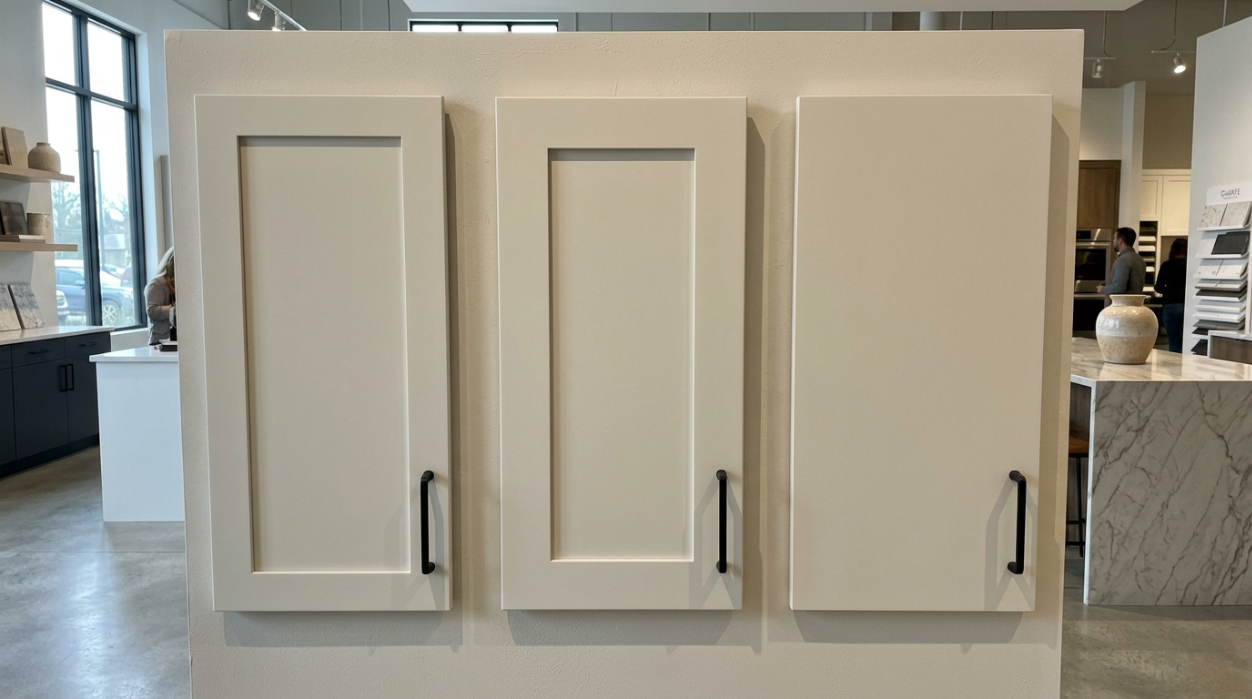
The easiest way to understand slim shaker cabinets is to place them between the two styles they borrow from.
| Feature | Slim Shaker | Traditional Shaker | Flat Slab |
|---|---|---|---|
| Frame width | 0.5″ to 1.5″ | 2″ to 3.5″ | None |
| Visual weight | Low | Medium to high | Minimal |
| Aesthetic feel | Modern transitional | Traditional, farmhouse | Ultra modern, European |
| Dust/grease collection | Less (shallower recess) | More (deeper recess) | Least |
| Hardware flexibility | Limited (narrow frame) | High | Highest |
| Installation forgiveness | Low (reveals imprecision) | High (hides small gaps) | Moderate |
The way one Florida kitchen designer put it: “Traditional shaker says farmhouse out loud. Slim shaker says nothing and lets the hardware, countertop, and lighting do the talking.” That positioning, quiet but not blank, is why the style appeals to people who find slab doors too cold but traditional shaker too busy.
Slim shaker doors pair naturally with frameless cabinet boxes. The frameless (European) construction eliminates the face frame between doors, reinforcing the clean, continuous look that slim shaker is designed to create. They work on framed boxes too, but the aesthetic payoff is strongest with frameless.
For a deeper side by side comparison with the classic white shaker, see this breakdown of white shaker vs. slim shaker cabinets.
Slim Shaker Cabinets: Pros and Cons
Slim shaker cabinets offer a middle ground between traditional recessed panel doors and completely flat slab doors. The narrow frame can make a kitchen feel cleaner and more contemporary, but it also introduces some practical considerations.
| Advantage | Potential drawback |
|---|---|
| Cleaner, more contemporary appearance | Narrow frames can make hardware placement more difficult |
| More visual panel area than traditional shaker | Installation reveals may be more noticeable |
| Less visually heavy than traditional shaker | Very narrow profiles can require specialized construction |
| Works well with modern and transitional designs | Some custom profiles may cost more |
| Pairs well with frameless cabinetry | Fewer manufacturers may stock ultra slim profiles |
| Available in painted and wood finishes | Construction quality matters more with narrow frames |
Construction Methods: What’s Behind the Door Matters
The narrow frame of a slim shaker door creates real engineering challenges that most product pages skip over. Understanding construction methods helps you evaluate quality and avoid problems down the road.
One Piece Routed (MDF/HDF)
For painted slim shaker cabinets, one piece MDF or HDF doors are generally the best option. Because they are routed from a single piece, there are no joints that can crack over time due to wood movement.
Practitioners on the WOODWEB cabinetmaking forum are blunt about this. One cabinetmaker stated: “I would only do thin shaker in one piece doors. Also make them with a melamine back for stability.” Another described building five piece slim shaker doors with mitered corners as “a giant pain in the rear.”
The reason is straightforward. In a traditional shaker door with 2.5 inch stiles, standard tenon or dowel joints have plenty of surface area and glue coverage to maintain structural integrity as wood expands and contracts seasonally. At 0.75 to 1.25 inches, that structural margin shrinks dramatically. Joints become the weak point.
Five Piece Assembled (Solid Wood)
Five piece construction is still used for stained slim shaker doors where you need visible wood grain. Solid wood or veneer wrapped MDF stiles and rails are joined at the corners, with a floating center panel. This method works, but it demands tighter joinery tolerances and better wood selection than a traditional shaker door.
If you’re comparing RTA vs. custom cabinets, pay attention to how the manufacturer handles this joint. Cheap five piece slim shaker doors are more likely to develop hairline cracks at the corners within a year or two. For more detail on what separates good construction from bad, the guide on cabinet box construction covers the box side of the equation.
Thermofoil / RTF
Many budget to mid range slim shaker doors use thermofoil (Rigid Thermofoil) over an MDF substrate. The vinyl wrap creates a seamless, moisture resistant surface that is easy to clean. Thermofoil slim shaker doors typically feature a 1 inch frame and work well in rental units, laundry rooms, and bathrooms where humidity resistance matters more than a premium finish.
Cabinet Box Quality
The door gets the attention, but the box holds the weight. Regardless of door style, look for:
- Box material: 1/2 inch or 3/4 inch furniture grade plywood with UV cured interior veneer. Avoid particleboard or low density chipboard that sags under heavy countertops.
- Drawer boxes: 5/8 inch solid hardwood with dovetail joinery.
- Hardware: Concealed under mount drawer glides with full extension and soft close dampening.
For multi unit projects or large kitchens, builder cabinet packages from trade focused suppliers often bundle box quality with door style, making it easier to spec consistently.
What to Look for When Buying Slim Shaker Cabinets
The slim profile is only one part of cabinet quality. Before ordering, compare the following specifications:
- Frame width: Ask for the exact stile and rail measurement rather than relying on the term “slim shaker.”
- Door thickness: Confirm the thickness of the finished door and whether the profile changes at the back.
- Door construction: Determine whether the door is one piece MDF, five piece solid wood, veneer, thermofoil, or another construction.
- Center panel: Ask whether the panel is MDF, solid wood, veneer, or another engineered material.
- Cabinet box: Compare plywood, particleboard, or other carcass materials.
- Drawer construction: Check drawer box material, joinery, and slide type.
- Hinges: Look for adjustable concealed hinges when appropriate for the cabinet system.
- Finish: Ask about the paint, conversion varnish, thermofoil, or other finish system.
- Warranty: Review what the warranty covers and whether door warping, joint separation, and finish defects are included.
- Samples: Order or inspect a door sample before committing to an entire kitchen.
Slim Shaker Color Options: Cotton Oak, Jade Green, and Beyond
Color is where slim shaker cabinets get interesting, and where dedicated product lines really show their value. Because the narrow frame exposes so much of the center panel, color and texture choices carry more visual weight than they do on a traditional shaker door. The frame almost disappears, so the finish becomes the primary design statement.
Cotton Oak
Cotton Oak is a light, warm toned wood finish that has gained traction in slim shaker lines over the past two years. It sits somewhere between a bleached white oak and a natural maple, with soft grain patterning that reads calm rather than busy.
The appeal is practical. Cotton Oak gives kitchens the warmth of natural wood without the heaviness of darker stains. On a slim shaker profile, the minimal frame lets the grain pattern flow almost continuously across a run of cabinets, creating a seamless, built in look. It pairs well with white quartz countertops, matte black hardware, and concrete look flooring.
For designers working in the Pacific Northwest, where natural materials and light filled interiors are a consistent client request, Cotton Oak slim shaker has become a go to specification. It reads contemporary without feeling cold. According to Houzz’s 2026 Kitchen Trends Study, wood cabinets have overtaken white as the most popular color choice for the first time, with 29% of renovating homeowners now choosing wood finishes. Cotton Oak fits squarely in that movement.
Jade Green
Jade Green is a muted, earthy green that falls between sage and forest green. It has depth without being dark, which makes it work on full kitchen runs rather than just as an accent island color.
Green kitchen cabinets have been climbing steadily in designer trend reports, and the slim shaker profile is a particularly good match. A traditional shaker door with wide stiles in Jade Green can look heavy, almost furniture like. The slim frame keeps the color statement elegant and restrained.
One YouTube kitchen designer walkthrough noted that green cabinets “need the right profile to avoid looking like painted antiques,” and recommended slim or slab profiles specifically. Jade Green slim shaker checks that box. It’s bold enough to anchor a room but refined enough that it won’t feel dated in five years.
Other Popular Slim Shaker Colors
White remains a top seller, but its dominance is fading. Popular slim shaker palettes also include:
- Warm natural oak (slightly darker than Cotton Oak, more visible grain)
- Greige (gray beige hybrid, very popular in transitional kitchens)
- Navy (best as a lower cabinet or island color paired with lighter uppers)
- Charcoal black (dramatic, works in larger kitchens with ample natural light)
- Sage green (lighter and more muted than Jade Green)
The narrow frame benefits from solid colors or consistent grain patterns because there’s less frame area to showcase material variation.
When pairing slim shaker cabinets with countertops, the minimal door profile gives you more freedom with bold stone choices. A busy veined quartz that might clash with a heavy traditional shaker frame can look balanced next to a slim profile. For specific pairing ideas, see this guide on how to match countertops with cabinets.
Hardware and Installation Considerations
This is where slim shaker cabinets demand more thought than their traditional counterparts.
Hardware Placement
The narrow frame changes where you can mount pulls and knobs. With a traditional shaker door offering 2+ inches of border, you can place hardware almost anywhere on the stile. With a slim shaker frame at 0.75 inches, that’s no longer realistic.
TaylorCraft Cabinet Door Company recommends that knobs and pulls should not be installed on the narrow frame of skinny shaker doors. Instead, hardware mounts on the center panel itself, which actually opens up more placement options than you might expect, including centered vertical pulls and lower third positioning.
The best hardware choices for slim shaker cabinets:
- Finger pulls or edge pulls: Maintain the minimal aesthetic completely.
- Thin bar pulls (3 to 5 inches): Mounted vertically on the panel, not the stile.
- Knobs: Small diameter knobs mounted on the panel near the stile edge.
A Houzz forum user captured the thinking well: “I like a finger pull. The sleek was the point of the door, right? The sweet spot between slab and shaker traditional.”
Best Hardware for Slim Shaker Cabinets
Hardware selection depends heavily on the width of the door frame. Very narrow stiles may not provide enough surface area for conventional hardware mounting, so the center panel or an alternative mounting location may be preferable.
| Hardware type | Works well with slim shaker? | Why |
|---|---|---|
| Finger pulls | Excellent | Keeps the door profile visually minimal |
| Edge pulls | Excellent | Preserves the clean lines of the door |
| Small knobs | Good | Works when mounted with adequate clearance |
| Thin bar pulls | Good | Can complement the contemporary profile |
| Large decorative pulls | Sometimes | Can overpower a very narrow frame |
| Traditional cup pulls | Depends | Better suited to wider transitional profiles |
Installation Precision
Slim shaker cabinets are less forgiving during installation. The thin frame reads almost like a picture frame around the panel, so the door looks architectural rather than decorative. Gaps, sags, and crooked reveals that would be invisible on a 3 inch traditional shaker stile become obvious at 1 inch.
This means accurate kitchen cabinet measurements matter even more than usual. Shimming, leveling, and door adjustment need to be precise. For contractors working on tight timelines, it’s worth budgeting an extra hour or two for final alignment on a slim shaker kitchen versus a traditional one.
Are Slim Shaker Cabinets Easy to Clean?
Slim shaker cabinets are generally straightforward to clean, but the recessed panel and interior profile can collect more dust than a completely flat slab door.
For routine cleaning:
- Use a soft, damp microfiber cloth.
- Wipe spills promptly.
- Avoid excessive water around door edges and joints.
- Follow the cabinet manufacturer’s recommendations for cleaners.
- Avoid abrasive pads that can damage painted or coated finishes.
- Pay particular attention to the recessed panel and inside corners where dust can accumulate.
The amount of cleaning required depends more on the door profile and finish than on the term “slim shaker” itself. A very shallow profile can be easier to maintain than a deeper traditional shaker door, while a slab door generally has the fewest recessed surfaces.
Best Applications for Slim Shaker Cabinets
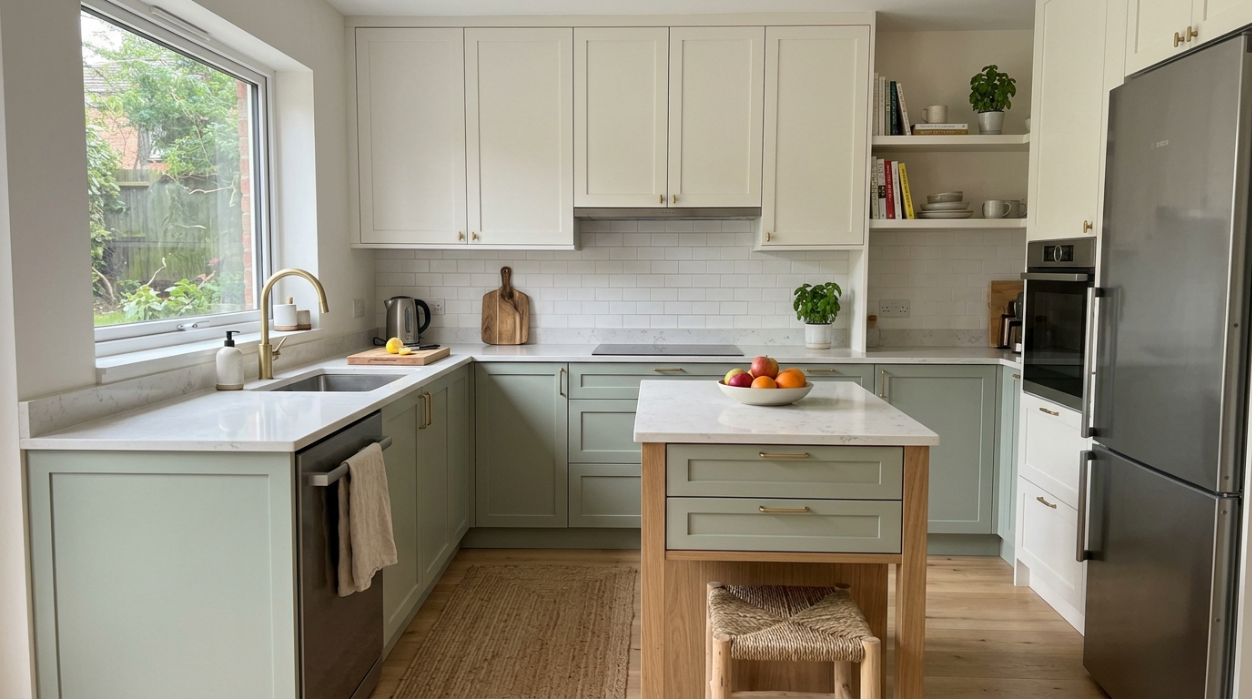
While kitchens are the primary use case, the style works well in several other areas.
Kitchens are the obvious fit, particularly smaller or contemporary layouts where heavy door profiles can make the space feel cramped. A slim shaker profile on upper cabinets in a small kitchen reduces visual bulk without sacrificing the sense of structure that slab doors lack.
Bathroom vanities benefit from the cleaner lines. The slim profile suits the scale of vanity doors, which are smaller than kitchen doors and can look over framed with traditional shaker proportions.
Closets and wardrobes are a growing application. Slim shaker closet doors provide structure without visual weight, a good fit for walk in closets where you want the cabinetry to feel built in rather than boxy.
Laundry rooms and mudrooms are practical candidates, especially when using thermofoil slim shaker doors that resist moisture and clean easily.
Cost and Resale Value
Slim shaker cabinets often cost slightly more than traditional shaker from the same manufacturer, primarily because the narrower profiles require tighter tolerances and sometimes custom tooling. That said, the premium is modest. Large price differences between slim and traditional shaker usually indicate a different manufacturer tier or material grade, not just a profile change.
For budget context, a standard 10×10 kitchen cabinet layout in slim shaker will typically run 5% to 15% more than the same layout in traditional shaker, depending on the supplier and construction method.
On resale, the picture is reassuring. Homes featuring shaker style cabinetry see an average return on investment of 80% to 85% during resale. Buyers perceive these kitchens as move in ready. The difference between slim and traditional shaker is an aesthetic nuance, not a resale multiplier. Neither version hurts value.
Frequently Asked Questions
What is the difference between slim shaker and regular shaker cabinets?
The primary difference is frame width. Traditional shaker cabinets have stiles and rails that are 2 to 3.5 inches wide. Slim shaker cabinets reduce that to 0.5 to 1.5 inches. The narrower frame exposes more of the center panel, creating a cleaner, more modern appearance while keeping the recessed panel structure that defines shaker design.
Are slim shaker cabinets more expensive?
Slightly, in most cases. The narrow profiles require tighter manufacturing tolerances. Expect a 5% to 15% premium over traditional shaker from the same supplier. Door profile alone rarely justifies thousands of extra dollars, so large price gaps usually reflect material or brand tier differences.
Will slim shaker cabinets hurt my home’s resale value?
No. Shaker style cabinets remain the most popular door style in American kitchens, and the slim variation is viewed as a contemporary update, not a risky departure. Buyers see both versions as current and desirable.
What materials work best for slim shaker doors?
For painted finishes, one piece MDF or HDF is the strongest choice because it eliminates joint cracking. For stained finishes, five piece solid wood construction works but demands higher joinery quality. Thermofoil over MDF is a good budget option for moisture prone areas.
Can I install standard pulls on slim shaker cabinets?
Not on the frame itself, which is typically too narrow. Pulls and knobs should mount on the center panel. This actually provides more placement flexibility. Finger pulls and thin bar pulls are the most popular choices.
Do slim shaker cabinets work with both framed and frameless boxes?
Yes. Slim shaker doors mount on either construction type. However, the aesthetic pairs most naturally with frameless (European style) cabinets, where the absence of a face frame reinforces the minimal look the slim profile is designed to achieve.
What is the difference between a slim shaker series and a modified traditional shaker door?
A dedicated slim shaker series is engineered from the ground up with narrow proportions across every component: doors, drawer fronts, end panels, fillers, and moldings. A modified traditional shaker is a standard line with narrower stiles swapped in. The series approach produces better visual consistency, more reliable joinery, and matched accessories. Always ask your supplier which approach they use.
What slim shaker colors are trending for 2026?
Wood tones like Cotton Oak have overtaken white as the top choice nationally. Jade Green, navy, greige, and charcoal black are all strong options. The slim profile works well with both solid paint colors and consistent wood grain finishes because the narrow frame keeps the visual focus on the panel surface.
Are slim shaker cabinets just a trend, or are they here to stay?
The data suggests staying power. The NKBA ranks shaker as the top door style in U.S. remodels, and industry forecasts consistently name the slim variation as the leading evolution of that style heading into 2026 and beyond. Because it’s a refinement of an established classic rather than a completely new style, it carries less trend risk than more dramatic departures.
Where can I see slim shaker cabinets in person before ordering?
If you’re in Washington State, Krafter’s Land showrooms in Tukwila, Tacoma, Lynnwood, and Spokane carry slim shaker alongside frameless European and traditional shaker lines. Seeing profiles side by side, with actual lighting and countertop samples, is the fastest way to confirm a door style choice.