
TL;DR
Traditional white shaker cabinets use wider rails and stiles, typically around 2.25 to 3 inches, creating a classic, substantial appearance. Slim shaker cabinets narrow those frames to roughly 0.75 to 1.5 inches, producing a cleaner, more contemporary look. Choose traditional white shaker for timeless, transitional, farmhouse, or resale focused kitchens. Choose slim shaker for modern or minimalist spaces, smaller kitchens, and homeowners who prefer a lighter visual profile.
Quick Answer: White Shaker vs Slim Shaker
Traditional white shaker cabinets are the better choice if you want a timeless, versatile look with broad hardware compatibility and strong appeal across traditional, transitional, farmhouse, and craftsman homes. Slim shaker cabinets are better if you want a cleaner, more contemporary appearance, have a smaller kitchen, or prefer narrower door frames with less visual weight.
The biggest difference is frame width, not construction. Both styles typically use a five piece door with a recessed center panel. Traditional shaker uses wider rails and stiles, while slim shaker reduces those dimensions to create a more minimalist appearance.
Choose traditional white shaker if: you prioritize timeless design, maximum hardware flexibility, or resale appeal.
Choose slim shaker if: you prioritize modern aesthetics, visual simplicity, or a lighter looking kitchen.
If you’re undecided: traditional shaker is the safer long term choice; slim shaker is the stronger choice for a deliberately modern kitchen.
The shaker cabinet family dominates American kitchens for good reason. Clean lines, no ornamentation, and a recessed center panel that works in almost any setting. But within that family, there’s a decision that trips up homeowners, designers, and contractors alike: should you go with a traditional white shaker or a slim shaker?
The answer isn’t about quality. It’s about proportion.
This guide breaks down the exact dimensional, visual, and practical differences between white shaker and slim shaker cabinets so you can choose with confidence. Whether you’re specifying cabinets for a client or picking finishes for your own remodel, the comparison below covers everything from frame widths to hardware pitfalls to resale impact, including a section on how the white finish itself affects pricing.
Exploring both styles for an upcoming project? Check contractor cabinet pricing and lead times to plan your timeline.
What Is a White Shaker Cabinet?
A white shaker cabinet combines two separate design characteristics: a Shaker style door and a white or off white finish. Shaker describes the door construction and proportions, while white describes the cabinet’s color.
A traditional Shaker door is typically a five piece design consisting of two vertical stiles, two horizontal rails, and a recessed center panel. Traditional versions use relatively wide rails and stiles, giving the door a more substantial appearance.
Because “white” refers only to the finish, a white Shaker cabinet can use different materials, construction methods, and cabinet box configurations. The same Shaker door profile can also be finished in colors such as green, blue, gray, or natural wood tones. For a full breakdown of door profile options beyond shaker, the cabinet door styles guide covers types, costs, and care across the board.
For this comparison, “white shaker” refers specifically to a traditional Shaker door with a white or off white finish.
Is Slim Shaker the Same as Shaker?
Yes. Slim shaker is a variation of the Shaker door style rather than an entirely different cabinet category.
The main difference is proportion. Traditional Shaker doors use wider rails and stiles, while slim shaker doors reduce the width of those components. The narrower frame exposes more of the recessed center panel and creates a cleaner, more contemporary appearance.
Manufacturers do not use one universal definition for “slim shaker,” “skinny shaker,” or “micro shaker.” Frame dimensions can vary by manufacturer, so always confirm the actual rail and stile width before ordering.
What Is a Slim Shaker Cabinet?
A slim shaker cabinet uses the same five piece construction as a traditional shaker, but with significantly narrower stiles and rails. Where a classic shaker frame runs 2.25 to 3.5 inches, a slim shaker frame measures roughly 0.5 to 1.5 inches. You’ll also see this style called “skinny shaker” or “micro shaker” depending on the manufacturer.
The visual effect is dramatic. The narrower frame exposes more of the center panel, creating a look that sits, as designer Jen Nash (Head of Design at Magnet) described it, “halfway between a Shaker and slab door.” One Houzz forum user who installed slim shaker cabinets during a remodel noted: “The shaker trim part is 1/2 inch although I’ve seen slimmer ones.”
Slim shaker cabinets capture something that neither full shaker nor flat slab doors can achieve on their own. They deliver the structured definition of a framed door without the visual heaviness of classic shaker, and they provide the sleek modern flow of a flat panel without feeling sterile.
Like traditional shaker, slim shaker cabinets are most commonly ordered in white and off white finishes. But the narrower profile lends itself especially well to contemporary palettes, including soft grays and two tone combinations.
For a deeper exploration of this style, read the full slim shaker cabinets guide.
Slim Shaker vs Traditional Shaker vs Slab Cabinets
Slim shaker sits between traditional Shaker and slab cabinetry visually. Traditional Shaker emphasizes the frame around the recessed panel, slab doors eliminate the frame entirely, and slim shaker reduces the frame to create a more minimalist version of the classic profile.
| Door style | Frame/detail | Overall appearance | Best suited to |
|---|---|---|---|
| Traditional Shaker | Wide frame | Classic and substantial | Transitional, farmhouse, traditional |
| Slim Shaker | Narrow frame | Minimal and refined | Contemporary, modern, transitional |
| Slab | No frame | Completely flat and streamlined | Modern, minimalist, contemporary |
Choose traditional Shaker when you want the most established and versatile look. Choose slim shaker when you want some architectural detail without the visual weight of a wide frame. Choose slab when you want the cleanest possible cabinet front. For a broader comparison of modern styles including slab and European frameless options, see the modern kitchen cabinets overview.
Slim shaker can therefore be a useful middle ground for homeowners who like modern cabinetry but do not want the completely flat appearance of slab doors.
White Shaker vs Slim Shaker: Key Differences
| Feature | Traditional White Shaker | Slim Shaker |
|---|---|---|
| Door construction | Five piece door with recessed center panel | Five piece door with recessed center panel |
| Typical frame width | About 2.25 to 3 inches | About 0.75 to 1.5 inches |
| Visual weight | Heavier and more substantial | Lighter and more streamlined |
| Overall style | Traditional, transitional, farmhouse, craftsman | Modern, contemporary, minimalist |
| Small kitchens | Can look visually heavier | Often works especially well |
| Large kitchens | Excellent | Excellent |
| Hardware flexibility | Very high | More limited on narrow stiles |
| Cleaning | More pronounced recesses | Generally shallower visual detailing |
| Design flexibility | Very high | High, but more modern leaning |
| Resale consideration | Familiar and broadly accepted | Attractive to buyers who prefer contemporary design |
| Best for | Timeless, versatile kitchens | Minimalist, modern kitchens |
| Main drawback | Can feel visually heavier | Hardware and proportion require more planning |
Frame Width: Why One Measurement Changes Everything
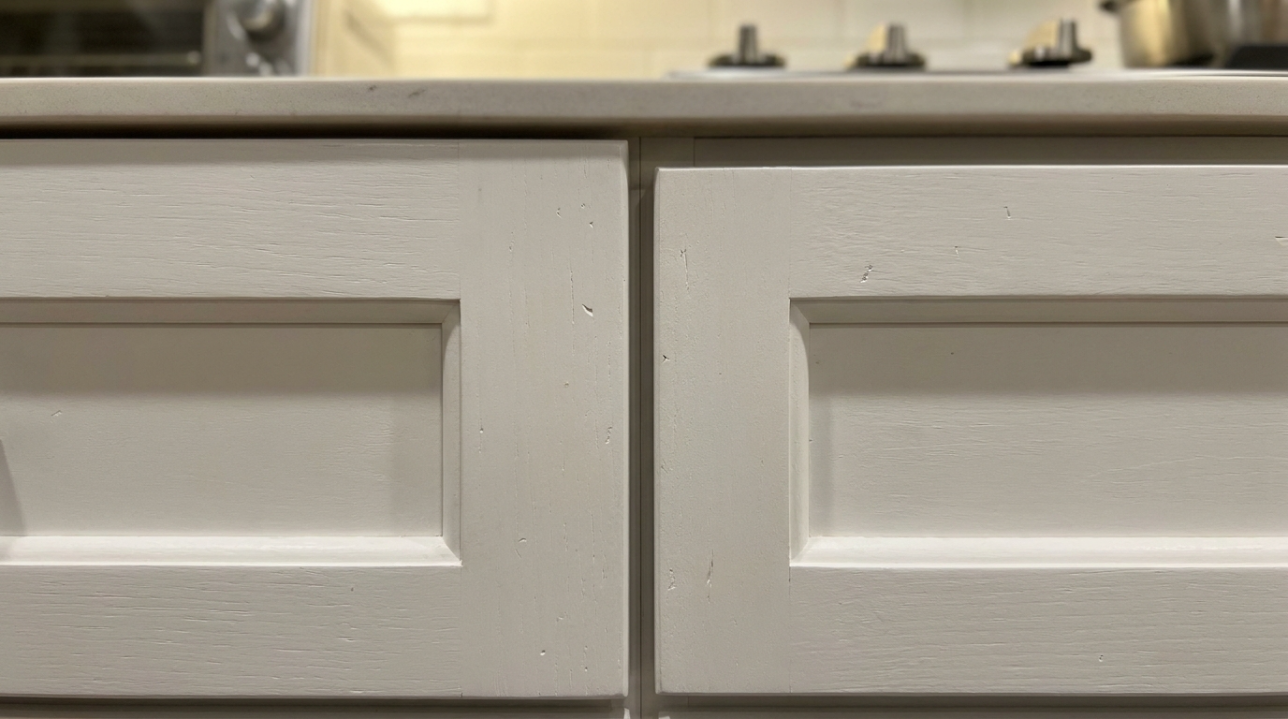
The entire white shaker vs slim shaker cabinets debate comes down to frame width. That’s it. Same construction method, same recessed panel, same hardware mounting approach. But the difference between a 3 inch frame and a 3/4 inch frame transforms the aesthetic.
A wider frame creates pronounced shadow lines and a sense of architectural depth. In a large kitchen with high ceilings, those frames anchor the room and prevent the space from feeling flat. Traditional shaker frames have enough surface area to support almost any hardware style, from oversized bin pulls to decorative knobs.
A narrower frame does the opposite. It minimizes the border, letting the center panel dominate the visual. The result is a cleaner, quieter door that reads as modern without abandoning the shaker silhouette entirely. In small kitchens, this matters. Narrower frames reduce visual clutter and make the cabinetry feel less busy. For space constrained projects in the Pacific Northwest, the small kitchen cabinets sourcing guide offers additional planning tips.
One point of frequent confusion: door style and cabinet box construction are separate decisions. You can pair a slim shaker door with either a framed or frameless cabinet body. If you’re unsure about the difference, the framed vs. frameless cabinets guide explains the distinction clearly.
How Frame Width Changes the Look of a Kitchen
Frame width affects more than the cabinet door itself. Because cabinets cover a large percentage of the visible wall area in most kitchens, even a small change in door proportions can change the perceived character of the entire room.
Wider Shaker Frames
Traditional Shaker frames create stronger borders around each door. This emphasizes individual cabinet fronts and adds visual definition. The effect works particularly well in kitchens with traditional, farmhouse, craftsman, or transitional architecture.
Narrower Shaker Frames
Slim shaker frames reduce the amount of visible framing around each door. The recessed panels become larger visually, and the cabinetry reads as a more continuous surface. This can complement contemporary and minimalist kitchens where visual simplicity is a priority.
The Key Consideration
Slim shaker does not automatically make a kitchen look larger. Cabinet color, lighting, countertop contrast, backsplash pattern, ceiling height, and cabinet layout all affect how spacious a kitchen feels. The narrower frame simply reduces the visual complexity of each individual door.
Hardware Compatibility: The Hidden Problem With Slim Shaker
This is where the comparison gets practical, and where most guides fall short.
Traditional shaker stiles measure 2.25 to 3 inches wide, which provides plenty of flat surface for standard hardware bases. A standard cabinet knob or bar pull mounts comfortably with room to spare. You won’t think twice about hardware when specifying classic white shaker cabinets.
Slim shaker is a different story. When the stile narrows to 1 inch or even 3/4 inch, the flat mounting surface shrinks dramatically. The problem is geometric: a standard shaker stile transitions from its flat outer face into the recessed panel via an angled drop off (the bevel). If the base of a knob or the rosette of a pull is wider than the flat surface of the slim stile, it overhangs that bevel. The door won’t sit flush, the hardware wobbles, and the entire installation looks wrong.
Practitioners on forums report that this mistake has become significantly more common as slim and skinny shaker profiles have surged in popularity. Contractors who’ve worked with traditional shaker for years get caught off guard by the tighter tolerances.
Solutions for Slim Shaker Hardware
Edge pulls and finger pulls bypass the narrow front face completely. They mount to the top or side edge of the door, eliminating the stile width problem entirely.
Micro knobs (under 1 inch diameter) work on stiles as narrow as 1 inch, though you’ll want to test fit before committing to a full order.
Center panel mounting places the pull on the flat recessed panel instead of the stile. This works aesthetically in some designs but can look unusual in others.
Bar pulls with small rosettes (under 3/4 inch) can work on slim stiles if the pull is centered carefully. Matte black and brushed nickel finishes pair well with both white shaker and slim shaker styles.
The bottom line: if you’re choosing slim shaker, plan your hardware before ordering doors. Not after. This is especially relevant for soft close cabinet setups where hinge alignment and door weight already require careful attention.
Cleaning and Maintenance
Every cabinet door has grooves, and grooves collect grease. The question is how deep those grooves go.
Traditional shaker doors have a more pronounced recess between the frame and the center panel. That deeper channel creates corners where cooking grease, dust, and moisture accumulate over time, particularly on cabinets near the stove or above the dishwasher. You’ll need a toothbrush or detail brush to get into those corners during deep cleaning.
Slim shaker cabinets have a shallower recess. Fewer deep corners means a flat microfiber cloth can handle most of the surface in a single pass. Several cabinet retailers describe this as one of the key selling points of the slim profile: simpler cleaning because of fewer deep grooves.
Both styles benefit from weekly wipe downs with a damp microfiber cloth and mild soap. Avoid abrasive cleaners on painted white finishes.
One thing to keep in mind: white cabinets of either style show fingerprints, grease splatter, and discoloration more readily than wood tone or darker finishes. If low maintenance is a top priority and you’re open to exploring beyond white, grey shaker cabinets or natural shaker cabinets hide everyday wear better.
White Finish Cost Difference: Does Choosing White Cost More?
One question that rarely gets a straight answer: does ordering cabinets in a white finish actually cost more than ordering them in another color or a natural wood tone?
The short answer is yes, usually. But the premium is smaller than most people assume, and the reason has nothing to do with the shaker profile itself.
Why White Finishes Add Cost
White and off white cabinets require a painted or sprayed finish over the substrate. That means extra production steps compared to a stained or natural wood cabinet, where the finish is simpler and more forgiving. Painted white finishes demand more prep (sanding, priming, multiple coats) and tighter quality control because every imperfection shows. A tiny dust speck under a clear stain is invisible. Under a high gloss or satin white coat, it’s a defect.
According to a 2024 cost analysis by Angi, painting or refinishing kitchen cabinets professionally runs $3,000 to $10,000 on average, with white requiring the most coats for even coverage. For factory finished cabinets, the material cost difference between a white painted door and a stained door is typically $15 to $40 per door depending on manufacturer, material, and finish sheen. On a kitchen with 30 doors and drawer fronts, that translates to roughly $450 to $1,200 in added finish cost.
Material Matters More Than Color
The bigger cost driver is what’s underneath the paint. A white painted solid maple door costs considerably more than a white thermofoil door over MDF. The finish is the same color, but the material and construction method create a wide price gap.
Here’s a rough breakdown of what to expect for a standard white shaker or slim shaker door:
| Construction | Approximate cost per door | Notes |
|---|---|---|
| Thermofoil over MDF | $25 to $60 | Lowest cost. White is the default color. Risk of delamination near heat sources. |
| Painted MDF (routed one piece) | $50 to $100 | No wood grain show through. Seamless. Vulnerable to moisture at edges. |
| Painted solid wood (maple, birch) | $80 to $180+ | Most durable painted surface. Seasonal expansion can cause hairline cracks at joints. |
Practitioners on Reddit cabinetry forums frequently point out that thermofoil white cabinets are often the cheapest option a manufacturer offers, which creates a misleading impression. The low sticker price reflects the material, not the color. When comparing apples to apples (same wood species, same construction), white painted finishes cost more than stained finishes almost every time.
White Slim Shaker vs White Traditional Shaker: Any Finish Price Difference?
Typically no. The finish cost per square foot of surface area is roughly the same regardless of frame width. Slim shaker doors have slightly less total surface area (narrower rails and stiles), which could theoretically reduce paint material costs by a few dollars per door. In practice, manufacturers price white slim shaker and white traditional shaker doors the same or within a dollar or two of each other.
The real cost difference between the two styles shows up in availability and production volume. Traditional white shaker is the single most produced cabinet door in North America, which means it benefits from massive economies of scale. Slim shaker production volumes are growing but haven’t reached that level yet, so some manufacturers charge a modest upcharge ($5 to $15 per door) for the slim profile. That upcharge reflects tooling and batch size, not finish cost.
How to Minimize White Finish Costs
If budget is tight but white cabinets are non negotiable, a few strategies can help:
- Choose a matte or flat sheen. High gloss white requires more coats and more careful sanding between coats. Matte finishes are more forgiving and often cost less to produce.
- Consider off white or warm white. Pure bright white is the hardest shade to get perfectly even. Slightly warm whites (think Swiss Coffee, Dove White) are more forgiving in production and tend to cost the same or less.
- Ask about stock white options. Many suppliers carry a specific “standard white” that’s produced in high volume. Custom white color matching adds cost. Sticking with the manufacturer’s stock white avoids that premium.
- Use thermofoil on low visibility cabinets. For pantry interiors, utility rooms, or laundry cabinetry, thermofoil white delivers the look at the lowest price point. Save painted solid wood for the kitchen where it’s seen daily.
For a deeper look at how material and construction choices affect your total project budget, the kitchen cabinet cost breakdown covers Washington State pricing in detail.
Slim Shaker Door Construction: What You’re Actually Getting
Not all slim shaker doors are built the same way. Understanding the construction method matters because it affects durability, paint finish longevity, and behavior in humid environments.
Three Common Construction Methods
Applied moulding. Thin strips of trim are glued onto a flat slab panel to create the shaker profile. This is the most affordable approach, but visible seams can form where the moulding meets the panel. Over time, especially if the wood expands or contracts with humidity changes, those seams become more noticeable. A door manufacturer with over 20 years of experience has noted that this is one of the most common complaints with applied moulding slim shaker doors.
One piece MDF routed. A single piece of MDF is routed on a CNC machine to carve out the shaker profile. No seams, no applied trim. The door moves as one unit, which eliminates the seam separation problem. However, MDF is vulnerable to moisture damage at exposed edges.
Membrane pressed (thermofoil). A vinyl or PVC film is heat pressed over an MDF substrate that has been routed to the slim shaker profile. Cost effective and moisture resistant on the surface, but the film can delaminate in high heat areas (near ovens or dishwashers) over time.
For painted finishes on solid wood slim shaker doors, seasonal expansion and contraction is a real concern. When stiles and rails are already narrow, even small dimensional changes can cause paint cracking along joints. This is more pronounced in climates with significant humidity swings.
If you want to understand how material choices affect cabinet longevity, the plywood vs. particle board guide covers the underlying box construction in detail.
Cost and ROI
The price difference between white shaker and slim shaker cabinets is smaller than most people expect. In many cases, it’s negligible when you’re comparing the same material and finish.
Classic shaker cabinets often cost slightly less because they’re more widely manufactured and benefit from economies of scale. Slim shaker cabinets use less material per door (narrower stiles and rails), which can reduce manufacturing costs, but smaller production volumes can offset that savings.
Slim shaker doors made with melamine or thermofoil materials tend to cost less than solid wood or painted options. But that’s a material difference, not a style difference.
Resale Value
Both styles perform well at resale. Estimated ROI data suggests classic shaker cabinets deliver roughly 85% return on investment by year four, while slim shaker designs reach about 82% by year five. The difference is minimal, and it’s worth noting that these numbers reflect estimated market trends rather than controlled studies.
The practical takeaway: shaker is widely accepted across real estate markets because it reads as “classic and safe.” Whether the frame is 3 inches or 1 inch, buyers see a clean, well built kitchen. The slim vs classic decision is an aesthetic nuance, not a resale multiplier.
For a broader look at how cabinet choices affect home value, see the guide on kitchen updates and home value ROI.
Trend Outlook: Are White Shaker Cabinets Still in Style?
Yes, but the context around them is shifting.
According to the 2026 Houzz Kitchen Trends Study, wood finishes captured 29% of homeowner priorities, edging past white painted cabinets at 28% for the first time. The 2025 NKBA Kitchen Trends Report found that only 29% of designers still prefer the traditional all white kitchen.
White cabinets haven’t fallen off a cliff. They still deliver strong resale results, with homes selling 13 days faster and commanding 3.7% higher prices than homes with darker alternatives. But the era of all white everything is winding down. Two tone designs, warm whites, and natural wood accents are the current direction.
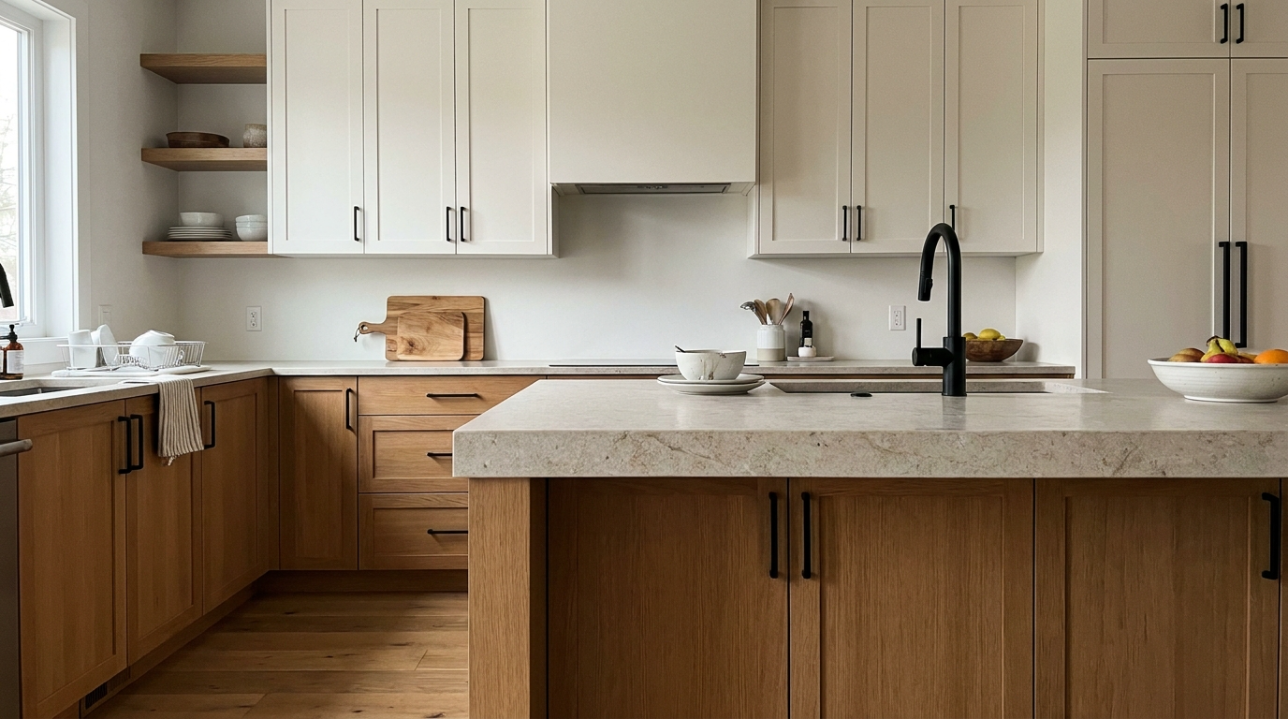
This is where the white shaker vs slim shaker cabinets comparison gets interesting. The two tone kitchen trend often pairs slim shaker uppers in white with wood tone or dark painted lowers. That combination gives you the brightness of white overhead with grounding warmth at the base. It’s one of the most effective ways to split the difference between both styles and both color trends. For color pairing inspiration, the cabinet color project photos page shows real installed examples.
Will Slim Shaker Cabinets Look Dated?
Slim Shaker has less historical track record than traditional Shaker, so homeowners cannot point to decades of widespread use to prove its longevity. That makes the style somewhat more design sensitive than traditional Shaker.
However, slim Shaker is not a radically decorative trend. It retains the basic recessed panel geometry that makes Shaker cabinetry broadly versatile while reducing the width of the surrounding frame.
The safest approach is to treat slim Shaker as a contemporary interpretation of Shaker rather than trying to make the entire kitchen depend on a short lived trend.
If you want the lowest design risk: choose traditional Shaker.
If you want a more current minimalist look and plan to stay in the home: slim Shaker is a reasonable choice.
If you want both: use slim Shaker on the main cabinetry and introduce timeless materials through countertops, flooring, lighting, and hardware.
How to Choose Between White Shaker and Slim Shaker Cabinets
Use the following decision framework if you are still undecided.
| Your priority | Better starting choice | Why |
|---|---|---|
| Timeless appearance | Traditional white Shaker | Familiar and broadly adaptable |
| Modern appearance | Slim Shaker | Narrower framing creates a cleaner profile |
| Maximum hardware options | Traditional Shaker | More mounting surface |
| Minimal visual detail | Slim Shaker | Less visible framing |
| Farmhouse kitchen | Traditional Shaker | Strong architectural fit |
| Contemporary kitchen | Slim Shaker | Complements modern proportions |
| Lowest design risk | Traditional Shaker | Longer established aesthetic |
| Small kitchen | Slim Shaker may have an edge | Can reduce visual complexity |
| Strongest personalization | Either | Depends on color, hardware, and materials |
| Long term personal use | Either | Choose based on architecture and taste |
Choose Traditional White Shaker If:
- Your home is traditional, farmhouse, craftsman, or transitional.
- You want maximum flexibility when selecting knobs and pulls.
- You prefer a more substantial cabinet profile.
- You want the safest established aesthetic.
- You expect to change hardware or other finishes over time.
Choose Slim Shaker If:
- Your home is contemporary, modern, or minimalist.
- You prefer narrower, quieter cabinet detailing.
- You want the recessed panel to occupy more of the door visually.
- You are comfortable planning hardware around narrow stiles.
- You are designing primarily for your own long term preferences.
Consider Mixing the Two
Mixing profiles can work, but it should look intentional. A common strategy is to use one profile for the main cabinetry and a contrasting profile or finish for a clearly defined feature such as an island.
The goal is visual hierarchy, not random variation. Keep the relationship between cabinet profiles, colors, hardware, countertops, and lighting deliberate.
Putting It All Together
The white shaker vs slim shaker cabinets decision isn’t about finding the “right” answer. It’s about matching proportions to your space, your style, and your priorities. The core construction is identical. The cost difference is usually trivial. The resale impact is a rounding error. What changes is the feel of the room.
Wider frames ground a kitchen. Narrower frames lighten it. Everything else follows from that.
If you’re a contractor or designer specifying cabinets for a project, the hardware compatibility issue is the single most important practical takeaway from this comparison. Measure your stile width, test fit your hardware, and don’t assume that what worked on traditional shaker will work on a 3/4 inch slim profile.
Ready to spec your next project? Krafter’s Land carries both shaker framed and slim shaker cabinet lines with fast lead times and trade pricing. Find a cabinet supplier for your next build.
White Shaker vs Slim Shaker: The Bottom Line
Traditional white Shaker is the safer choice if your priority is timelessness, broad hardware compatibility, and a style that works across many architectural settings.
Slim Shaker is the better choice if you want a lighter, more contemporary cabinet profile and are willing to plan hardware and proportions more carefully.
The difference is primarily one of proportion. Both can produce an excellent kitchen when the construction, finish, layout, hardware, and installation are right.
When in doubt, choose traditional Shaker for the lowest design risk. Choose slim Shaker when the narrower profile is an intentional part of your overall kitchen design.
Contractor Checklist: What to Confirm Before Ordering
If you are specifying cabinets for a client or ordering cabinetry for a renovation, confirm the following before the purchase order is finalized:
- Exact rail and stile dimensions
- Door thickness
- Door construction method
- Center panel material
- Cabinet box construction
- Finish type and color
- Hardware mounting requirements
- Hinge type and adjustment range
- Overlay or inset configuration
- Sample door approval
- Lead time
- Replacement door availability
- Warranty terms
- Shipping and damage procedures
For slim Shaker specifically, obtain a physical door sample whenever possible. Confirm the actual flat mounting surface before selecting knobs or pulls, because the manufacturer’s stated frame width does not necessarily tell you how much usable surface is available for hardware. Learning how to read specification sheets can save significant headaches during this process.
FAQ
What is the main difference between white shaker and slim shaker cabinets?
Frame width. Traditional white shaker cabinets have stiles and rails measuring 2.25 to 3.5 inches wide. Slim shaker cabinets narrow that frame to 0.5 to 1.5 inches. The construction method (five piece door with a recessed center panel) is the same for both. That single measurement difference shifts the look from classic traditional to modern minimalist.
Are slim shaker cabinets more expensive than traditional shaker?
Usually not. The price difference is minimal or nonexistent when comparing the same material and finish. Classic shaker may cost slightly less due to wider availability and manufacturing scale. Slim shaker uses less material per door, which can offset costs. The biggest price variable is material choice (solid wood vs. MDF vs. thermofoil), not frame width.
Does a white finish cost more than other cabinet colors?
In most cases, yes. White painted finishes require more preparation, more coats, and tighter quality control than stained or natural wood finishes. The premium typically runs $15 to $40 per door at the factory level. Thermofoil white is the exception, often being the cheapest option a manufacturer offers since white is the default thermofoil color. The finish cost is the same whether the door is traditional shaker or slim shaker.
Can I use regular cabinet hardware on slim shaker doors?
Not always. Standard knobs and pulls are designed for stiles that are 2 inches or wider. On slim shaker stiles (1 inch or narrower), hardware bases can overhang the bevel where the frame meets the recessed panel. Edge pulls, finger pulls, and micro knobs are the safest options for narrow profiles. Always test fit hardware before placing a full order.
Which style has better resale value?
Both perform well. Estimated ROI data puts classic shaker at roughly 85% return by year four and slim shaker at about 82% by year five. The practical difference is negligible. Real estate agents and appraisers see both as “nice kitchen.” The slim vs classic distinction is aesthetic, not financial.
Are white shaker cabinets still popular in 2026?
White remains the most requested cabinet finish, though its dominance is narrowing. The 2026 Houzz Kitchen Trends Study shows wood finishes (29%) slightly ahead of white painted cabinets (28%) in homeowner preferences. The bigger shift is away from stark white toward warmer, creamier whites, and away from all white kitchens toward two tone designs.
Will slim shaker cabinets look dated in a few years?
It’s possible but unlikely. Slim shaker isn’t a standalone trend; it’s the shaker door family adapting to minimalist taste. The construction is identical to traditional shaker, and only the proportions changed. Classic shaker has centuries of staying power that slim shaker hasn’t earned yet, so there is some risk. Homeowners planning to sell within 3 to 5 years may feel safer with the traditional profile.
Is slim shaker easier to clean than traditional shaker?
Yes, slightly. The shallower recess on slim shaker doors means fewer deep corners where grease and dust accumulate. A flat microfiber cloth can cover most of the surface in a single wipe. Traditional shaker’s deeper channel around the recessed panel requires more detailed cleaning, especially on cabinets near the cooktop.
Can I mix white shaker and slim shaker in the same kitchen?
Absolutely. Two tone and mixed profile kitchens are one of the strongest design directions right now. Common pairings include slim shaker wall cabinets with a traditional shaker island, or white slim shaker uppers with wood tone classic shaker bases. The key is maintaining consistency within zones (all uppers match, all lowers match) rather than alternating randomly.