TL;DR
Prefab quartz countertops are factory-cut to standard dimensions with finished edges, ready for quick installation at 25-35% less cost than custom work. Slab quartz is cut from a full-size raw slab to your kitchen’s exact measurements, offering unlimited customization in edges, dimensions, and layout. The quartz material itself is identical in both formats. Your kitchen layout, budget, and timeline determine which option is the better fit.
If you’re shopping for quartz countertops, you’ve probably run into two terms that sound similar but mean very different things: prefab and slab. Understanding the distinction between prefab quartz vs slab quartz is the single most important decision you’ll make before placing an order, because it affects your cost, timeline, design options, and how your finished kitchen actually looks.
This guide breaks down both formats with real numbers, standard sizes, and practical advice so you (or your contractor) can make the right call.
Explore quartz countertop options to see what’s available as you read through this comparison.
Quick Answer
If your kitchen has standard cabinet dimensions and you want the lowest installed cost, prefab quartz is usually the better choice. If your kitchen has large islands, custom layouts, waterfall edges, or you want the fewest visible seams, slab quartz is worth the additional cost. Both use the same engineered quartz material, so durability, maintenance, and stain resistance are essentially identical. The biggest differences are customization, fabrication, installation time, and overall project cost.
Prefab Quartz vs Slab Quartz at a Glance
Choose prefab quartz if:
Your countertop runs are under 108–112 inches
Your countertops are standard 25–26 inches deep
Budget is your highest priority
You need installation within a few days
You are remodeling a rental, flip, or production home
You don’t mind standard edge profiles
Choose slab quartz if:
Your island exceeds 26 inches deep
You want waterfall edges
You want premium edge profiles
Your kitchen has unusual angles
You want the fewest seams possible
Color consistency across the entire kitchen matters
What Is Prefab Quartz?
Prefabricated quartz countertops are slabs that have been cut to standard dimensions, polished, and edge-finished at the factory before they reach a showroom or job site. You’re buying a ready-made piece of countertop rather than a raw material that needs fabrication.
Think of it like buying a pre-hung door versus having a carpenter build one from scratch. The engineered stone is the same. The difference is how much work happens before it reaches your kitchen.
Standard Prefab Sizes
Prefab quartz comes in a handful of predictable dimensions:
Counter runs: 110 or 112 inches long by 26 inches wide
Island pieces: 108 inches long by 42 or 52 inches wide
Thickness: 2 cm (most common) and 3 cm
MSI, the largest US quartz importer, standardizes their prefab at 112 inches long, 26 inches wide, and 2 cm thick, with three edges finished in a simple flat/eased profile.
What You Get (and Don’t Get)
Prefab pieces arrive with edges already polished, usually in a basic flat or eased profile. Major distributors like MSI offer roughly 60 colors and patterns. That’s a solid selection, but it’s a fraction of what’s available in full slab format.
The key limitation: prefabricated countertops have zero flexibility when it comes to dimensions and edge options. What ships from the factory is what you install.
What Is Slab Quartz?
A slab quartz countertop is custom-cut from a full-size raw quartz slab to your kitchen’s exact measurements. The fabricator templates your space, programs a CNC machine to cut the stone, profiles your chosen edge, makes all sink and faucet cutouts, and installs the finished piece.
Full Slab Dimensions
Raw quartz slabs are much larger than prefab pieces:
Standard slab: 120 inches by 55-56 inches
Jumbo slab: 126 inches by 63 inches
Thickness options: 1.2 cm, 2 cm, and 3 cm
That extra width (55-65 inches versus 26 inches for prefab) is what makes slab quartz capable of covering deep islands and L-shaped counters without seams. If you’re weighing quartz countertops vs marble, the slab fabrication process works the same way for both materials.
Full Customization
With slab quartz, you choose everything: the exact dimensions, the edge profile (ogee, bullnose, waterfall, mitered, beveled), the finish, and the cutout placements. This is why designers and remodelers working on high-end or unusually shaped kitchens almost always go with custom slab fabrication.
What Is the Difference Between Prefab Quartz and Slab Quartz?
Although both products are made from the same engineered quartz material, the manufacturing process is different.
Feature | Prefab Quartz | Slab Quartz |
|---|---|---|
Factory finished | Yes | No |
Custom fabricated | No | Yes |
Edge already polished | Yes | No |
Sink cutouts included | Usually No | Yes |
Standard sizes | Yes | No |
Custom sizes | Limited | Unlimited |
Installation speed | Fast | Longer |
Best for | Standard kitchens | Custom kitchens |
Prefab Quartz vs Slab Quartz: Side-by-Side Comparison
Feature | Prefab Quartz | Slab Quartz |
|---|---|---|
Installed cost per sq ft | $50 to $120 | $50 to $200+ |
Typical kitchen total | $3,000 to $7,500 | $5,000 to $20,000 |
Standard counter width | 26 inches | Up to 65 inches |
Max single-piece length | 108 to 112 inches | 120 to 126 inches |
Thickness | 2 cm or 3 cm | 1.2 cm, 2 cm, or 3 cm |
Edge profiles | Flat/eased only | Any profile available |
Color/pattern options | ~60 popular styles | Hundreds |
Lead time | Same day to 5 days | 2 to 8 weeks |
Seam risk | Higher on large layouts | Lower (bigger pieces) |
Best for | Standard layouts, vanities, flips | Custom kitchens, large islands |
No other comparison on this topic presents these numbers in a single table, so bookmark this if you’re building a spec sheet for clients or presenting options to a homeowner.
Cost Breakdown: Where the Savings Actually Come From
The price gap between prefab quartz and slab quartz is real, but often overstated by marketing materials. Here’s what the numbers actually look like.
Prefab countertops cost 25-35% less than custom slab work, with some industry dealers reporting even steeper savings. One stone dealer (SBMTX) breaks it down bluntly: a prefab countertop averages $300 for 108 inches of stone at counter depth (25.5 inches), while a slab will run upwards of $1,000 in materials alone.
The savings come from three places:
Factory efficiency. Cutting hundreds of identical pieces is cheaper per unit than custom CNC work.
Reduced labor. No templating visit, no custom programming, less installation time.
Less waste. Factories optimize cuts from full slabs, passing that efficiency to buyers.
The Hidden Cost Trap
Here’s what most guides skip: if your prefab pieces don’t match your cabinet dimensions, you’ll need to hire a stone fabricator to modify them. At that point, you’re paying for the prefab material plus custom labor, which basically defeats the purpose. You’d be better off ordering a custom-cut slab from the start.
This is why the fit between your countertops and cabinets matters so much. Working with a supplier that handles both, like a company offering framed cabinets and quartz countertops together, eliminates the risk of dimensional mismatches.
Cost Calculator: Which Option Saves More?
Kitchen Size | Prefab Quartz | Slab Quartz |
|---|---|---|
40 sq ft | $2,000–$4,800 | $2,500–$8,000 |
55 sq ft | $2,750–$6,600 | $3,500–$11,000 |
70 sq ft | $3,500–$8,400 | $4,500–$14,000 |
90 sq ft | $4,500–$10,800 | $6,000–$18,000 |
Seams: The Biggest Real-World Concern
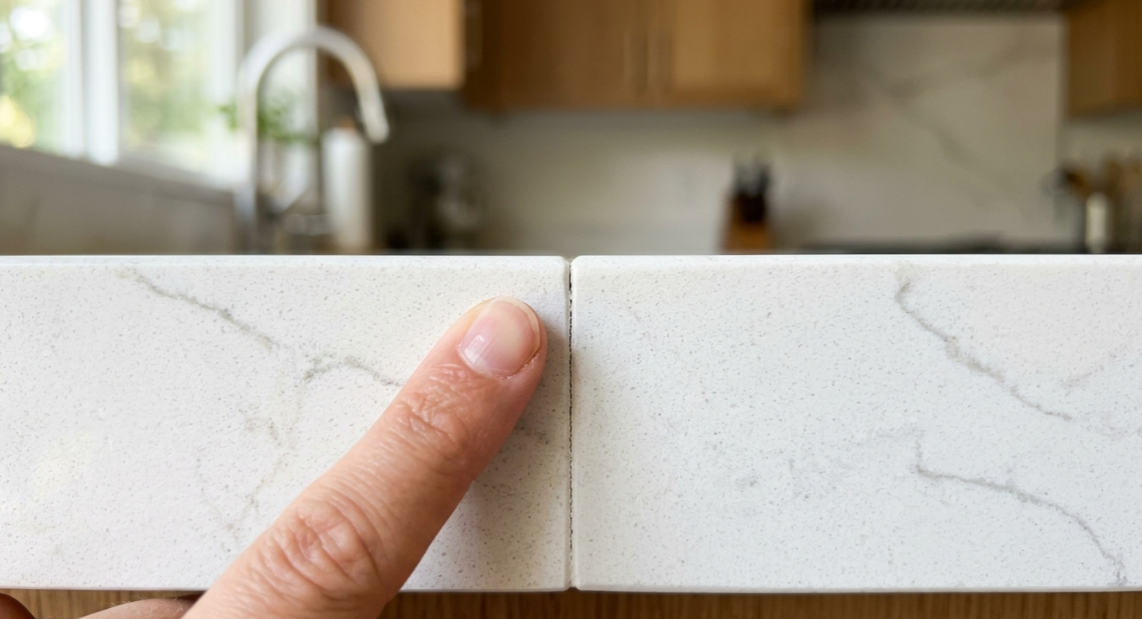
This is where the prefab quartz vs slab quartz debate gets practical. Seams are the most common source of buyer regret, and they’re far more likely with prefab installations.
The 26-Inch Rule
Prefab countertops max out at 26 inches wide. If your island or peninsula exceeds that depth (and most islands do), you’ll need two pieces joined by a seam. A skilled installer can make quartz seams nearly invisible because the material’s uniform particle distribution allows for good color matching. But “nearly invisible” and “invisible” aren’t the same thing.
The 107-Inch Rule
Industry dealers point to a concrete threshold: when your kitchen has a continuous counter run of 107 inches or less at 25.5-inch depth, prefab works perfectly. Go beyond that, and you’re introducing seams in potentially prominent spots.
What Can Go Wrong
Practitioners on DIY forums report that the most common prefab complaint is seam lippage, a visible step or ridge where two pieces meet. One homeowner described catching their thumbnail on the lip where pieces joined. Their installer acknowledged the problem but said nothing could be done, ultimately requiring a full countertop replacement. The lesson: specify seam quality expectations in writing before installation begins.
For a seamless center island, slab quartz is almost always the better choice. One exception: if you’re installing an apron-front farm sink, two prefab pieces can meet at the sink, hiding the seam effectively.
How Many Seams Should a Quartz Countertop Have?
Most professional fabricators try to minimize seams whenever possible.
Typical recommendations include:
Kitchen Layout | Recommended Number of Seams |
|---|---|
Small straight kitchen | 0–1 |
L-shaped kitchen | 1–2 |
Large U-shaped kitchen | 2–3 |
Large island | 0 preferred |
Commercial kitchen | Depends on layout |
While well-made seams are difficult to notice, every additional seam creates another potential location for color variation or slight height differences.
Dye Lot Variation: What Contractors Wish Homeowners Knew
This issue gets almost zero attention in most prefab vs slab comparisons, but it matters for any kitchen requiring multiple prefab pieces.
Prefabricated countertops may have dye lot variation from one piece to another. If your kitchen needs three or four prefab sections, you might notice slight color differences between pieces sourced from different production runs. Quartz is engineered (90-95% ground quartz plus 5-10% resins and pigments), and batch-to-batch consistency isn’t always perfect, particularly with imported materials.
With slab quartz, your entire kitchen is cut from one or two slabs that you select in person. Color consistency is guaranteed because you’re looking at the actual material before it’s cut.
Does Prefab Quartz Use the Same Brands as Slab Quartz?
Many manufacturers sell both prefab and full slab versions of the same quartz colors.
Examples include:
MSI Q Quartz
LX Hausys Viatera
Silestone
Caesarstone
Vadara
Wilsonart Quartz
Availability varies by distributor. Some colors are produced only as slabs, while the most popular designs are often available in prefab sizes.
When to Choose Prefab Quartz
Prefab is the right call in these situations:
Standard kitchen layouts. Straight runs of cabinets under 108 inches with 25.5-inch depth throughout.
Bathroom vanities. Standard 25-inch and 49-inch vanity tops are the ideal prefab use case. Quick, affordable, and no customization needed.
Tight budgets. If you want real quartz (not laminate) but can’t stretch to custom pricing, prefab gets you genuine engineered stone for thousands less.
Fast timelines. Rental turnovers, contractor flips, or any project where waiting 4-8 weeks isn’t an option. Prefab ships in days.
Multi-unit and builder-grade projects. When you’re outfitting 20 apartments with identical kitchens, prefab’s consistency and pricing make it the obvious choice.
Homeowners on Houzz forums report that prefab quartz works well with IKEA kitchen systems, though some fabricators automatically quote plywood support on top of IKEA cabinets when the FIXA bracket system may make it unnecessary. Worth verifying before paying for extras you don’t need.
If you want to see how different countertop and cabinet combinations look in real installations, browse the projects gallery for reference.
When to Choose Slab Quartz
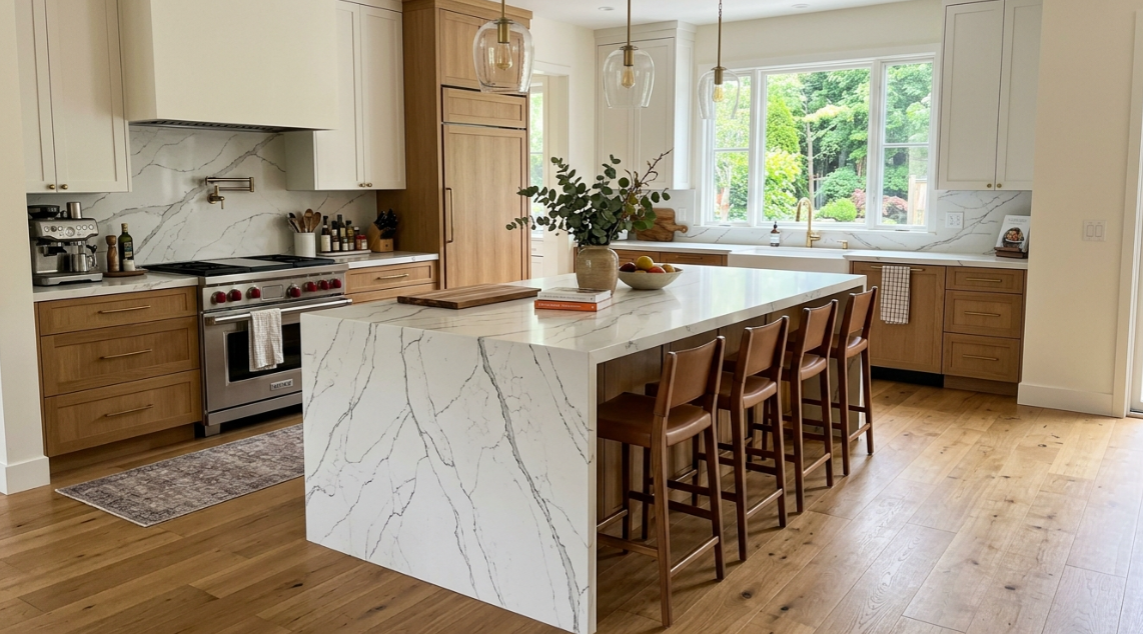
Slab is worth the extra cost when:
Your kitchen has an L-shape or U-shape with few good seam locations.
Your island exceeds 26 inches in depth, which is most islands.
You want specific edge profiles like ogee, waterfall, or mitered edges.
Seamless appearance matters in visually prominent areas.
Your kitchen has unusual angles or non-standard cabinet depths. Modern frameless cabinet systems often feature deeper configurations that require custom slab work.
The bottom line: if your layout is anything other than straightforward, slab quartz gives you the flexibility to handle it cleanly.
Common Misconceptions
“Prefab Means Lower Quality”
This is the biggest myth in the prefab quartz vs slab quartz conversation. The quartz material itself is the same durable, engineered stone whether it’s prefab or custom. You get the same resistance to stains and scratches either way. MSI confirms that their prefab line uses exactly the same quartz as their custom slab products.
The one caveat: some budget prefab manufacturers use lower-grade materials. Chinese-sourced quartz, for example, is more likely to show discolorations from resin pooling than quartz sourced elsewhere. Ask about the origin of the material, not just the format.
“Slab Is Always Worth the Upgrade”
Not true. For a standard bathroom vanity or a simple galley kitchen, you’d be paying premium custom fabrication prices for a result that looks identical to prefab. Save the slab budget for spaces where it actually makes a visible difference.
“Prefab Can’t Have Sink Cutouts”
Prefab pieces can accommodate sink cutouts, but adding them introduces extra cost and fabrication time. At some point, the modifications erode the savings that made prefab attractive in the first place.
“Quartz Has 51% Market Share, So Everyone’s Doing It”
This one’s actually true. As of 2026, quartz holds 51% of the US countertop market. The question isn’t whether to choose quartz. It’s which format fits your project.
Making the Final Decision
The choice between prefab quartz and slab quartz isn’t about quality. It’s about fit. Measure your cabinet runs, check your island depth, decide which edge profiles matter to you, and set your budget. Those four factors will make the decision obvious.
For contractors and remodelers working with clients who need both cabinets and countertops, having a single supplier coordinate dimensions between the two prevents the costly mismatches that force prefab buyers into unplanned custom modifications. That’s the kind of coordination that saves time and money on every project.
Request a free design consultation to get help matching the right quartz format to your specific layout and budget.
Frequently Asked Questions
Is prefab quartz the same quality as slab quartz?
Yes. The engineered stone composition (90-95% ground quartz, 5-10% resins and pigments) is identical. The difference is in the manufacturing format, not the material quality. Both offer the same stain and scratch resistance.
What sizes do prefab quartz countertops come in?
Standard prefab counter pieces measure 110 to 112 inches long by 26 inches wide in 2 cm thickness. Island pieces run about 108 inches long by 42 to 52 inches wide. A 3 cm option at 100 by 26 inches is also common.
How much cheaper is prefab than slab quartz?
Prefab typically costs 25-35% less than custom slab work. In dollar terms, a full prefab kitchen runs $3,000 to $7,500 installed, while custom slab kitchens range from $5,000 to $20,000 depending on complexity and material selection.
Can you customize a prefab quartz countertop?
To a limited degree. A fabricator can make sink cutouts or trim a piece to fit. But extensive modifications add cost and time, often eliminating the savings. If your layout requires significant customization, a slab is the better starting point.
Is prefab quartz good for kitchen islands?
It depends on the island’s dimensions. If your island is under 26 inches deep and under 108 inches long, prefab works fine. Larger islands will require seams or multiple pieces, making custom slab the cleaner option.
What edge profiles are available with prefab quartz?
Most prefab comes with a flat or eased edge only. If you want ogee, bullnose, waterfall, beveled, or mitered edges, you’ll need custom slab fabrication.
How long does prefab quartz take to install compared to slab?
Prefab can be available same-day or within 3 to 5 days. Custom slab requires templating followed by 2 to 8 weeks of fabrication before installation. For urgent projects, prefab’s speed advantage is significant.
Does prefab quartz work in bathroom vanities?
Bathroom vanities are the single best application for prefab quartz. Standard vanity widths (25 and 49 inches) align perfectly with prefab sizing, and the simpler layouts rarely need custom work. Check our kitchen and bath remodeling resources for more guidance on vanity projects.