
TL;DR
Cabinet backorders are not ordinary inventory hiccups. They sit on the critical path of every kitchen remodel, meaning one missing piece can stall countertop templating, plumbing, appliance installation, and final close-out. This guide defines the key terms contractors and dealers need to know, explains why cabinet backorders hit harder than other material delays, and walks through a step-by-step protocol for handling partial deliveries on an active jobsite. Prevention strategies, from supplier selection to SKU-level stock verification, round out the picture.
Why This Guide Exists
A backorder on drywall screws is an inconvenience. A backorder on a 36-inch sink base cabinet is a project shutdown.
That distinction is the reason generic inventory management advice falls short for trade professionals working in kitchens. Knowing how to handle cabinet backorder and partial delivery coordination requires understanding both the supply chain terminology and the construction sequencing that makes cabinets uniquely high-stakes. A late or incomplete cabinet shipment doesn’t just mean an empty box on a shelf. It means idle crews, a countertop fabricator who can’t template, a plumber who can’t rough in, and a homeowner whose move-in date just slipped.
This glossary-and-guide hybrid is written for contractors, remodelers, dealers, and project managers who source cabinets for a living. Every definition includes cabinet-specific context. Every recommendation ties back to jobsite reality.
👉 If you’re comparing suppliers and want to see contractor cabinet pricing and lead times, start there for the sourcing side of the equation.
What to Do When a Cabinet Delivery Is Incomplete
When a cabinet delivery is incomplete, inspect the shipment against the purchase order and packing list, photograph any damage, document missing items on the delivery receipt, and contact the supplier for a written backorder ETA. Then determine whether the available cabinets can be installed safely without affecting alignment, countertop measurements, or the finished layout. Notify the homeowner and downstream trades, revise the schedule, and escalate the order if the supplier cannot meet the revised deadline.
The key rule: Do not schedule dependent work around an unconfirmed delivery date. Verify which cabinet SKUs are missing, what work can proceed, and when the remaining items are expected before committing to a new installation or countertop appointment.
Partial Cabinet Delivery Checklist: What to Do First
Use this checklist when a cabinet shipment arrives with missing, damaged, or backordered items.
Match the delivered cabinets against the purchase order, packing list, and delivery manifest.
Record every missing item by SKU, cabinet size, finish, and quantity.
Inspect accessible packaging and cabinet components for visible shipping damage.
Photograph damaged items, packaging, labels, and discrepancies.
Record shortages and visible damage on the delivery receipt or carrier documentation, where permitted.
Contact the supplier or dealer to confirm whether the missing items are backordered, shipped separately, or omitted from the order.
Request a written ETA and shipment or tracking reference for every outstanding item.
Identify which installation tasks can continue without creating rework.
Notify the homeowner, installer, countertop fabricator, and other affected trades.
Update the project schedule and assign someone to track the outstanding items.
Before signing off: Follow the supplier’s and carrier’s documentation procedures, and do not assume that a signature, inspection, or claim deadline has the same effect under every delivery contract. If the shipment is incomplete, make the discrepancy clear in the delivery records.
Should You Install the Cabinets You Have or Wait?
Delivery situation | Recommended action | Main risk to check |
|---|---|---|
Missing filler strip or nonessential accessory | Consider proceeding if the installation can be completed correctly without it | Whether the item affects final fit or finish |
Missing cabinet at the end of a run | Consider installing the available cabinets if layout, leveling, and fastening remain correct | Whether the missing cabinet affects the countertop edge or finished panel |
Missing cabinet in the middle of a continuous run | Usually pause the affected run until the missing cabinet arrives or an approved installation plan is established | Alignment, spacing, and rework |
Missing sink base or appliance-opening cabinet | Assess whether the affected run can be installed accurately without it | Plumbing connections, appliance clearances, and countertop dimensions |
Missing finished end panel or color-matched component | Confirm whether installation can proceed without risking finish damage or a mismatch | Visible finish, panel dimensions, and production-lot variation |
Backorder with no reliable ETA | Escalate to the supplier and investigate alternatives before committing to more dependent work | Schedule slippage and replacement compatibility |
Damaged cabinet with an uncertain replacement date | Document the damage and ask the supplier about replacement options and timing | Whether the damaged unit can be safely used or must be replaced |
Decision rule: Proceed only when the available cabinets can be installed accurately, the missing items will not compromise the finished layout, and the next scheduled trade can perform its work without creating avoidable rework. If these conditions are not met, pause the affected work and obtain a revised plan.
Core Glossary Terms
Backorder
A backorder occurs when you place an order for an item that is not currently in stock but is expected to be replenished and shipped at a future date. Demand has temporarily exceeded supply.
Why it matters for your project: In cabinet work, a backorder doesn’t just delay one box. Custom kitchen cabinets typically require 8 to 14 weeks of lead time, and delays of 2 to 6 additional weeks are not uncommon due to manufacturing backlogs, material shortages, or quality control rejections. Because cabinets are a dependency for nearly every trade that follows, even a short backorder can push your entire project timeline by weeks.
Important distinction: A backordered item is expected to come back into production. An out-of-stock item might never be manufactured again. If your supplier tells you a door style or finish is “discontinued,” that’s not a backorder; that’s a sourcing crisis requiring a different response.
Partial Backorder / Partial Shipment
A partial backorder happens when you order multiple items, some ship immediately, and the rest are placed on backorder for later fulfillment. The result is a split delivery: boxes arrive in waves rather than all at once.
Why it matters for your project: A kitchen order might include 20 cabinet boxes, 4 filler strips, 2 decorative end panels, and a range hood surround. If 18 of the 20 boxes ship but the sink base and a finished end panel are backordered, you have a partial delivery. And that partial delivery creates a decision point: install what you have, or wait. A cabinet industry source puts it bluntly: do not let installers start on a partial delivery unless you know when the rest arrives. Starting without that information risks stranding your crew mid-install with no clear return date.
Cabinet Lead Time vs. Shipping Time
Cabinet lead time generally covers the period from order placement to production completion or readiness for dispatch, depending on the supplier’s definition. Shipping time covers transportation from the shipping point to the delivery destination. Confirm whether the quoted lead time includes production, handling, and transit before scheduling installation.
Cabinet type | Illustrative planning range | What to verify |
|---|---|---|
Stock / in-stock cabinets | Same day to 3 weeks | Actual SKU availability, order processing, and delivery date |
Ready-to-assemble (RTA) cabinets | 1–3 weeks | Inventory status, packing time, and shipping method |
Semi-custom cabinets | 4–10 weeks | Manufacturer production schedule and finish availability |
Fully custom cabinets | 8–16+ weeks | Approved drawings, production queue, finishing, and freight |
These ranges are planning estimates, not guaranteed industry-wide lead times. Actual delivery depends on the manufacturer, product configuration, supplier inventory, order complexity, and transportation. Confirm the expected ready-to-ship date and estimated arrival date separately.
For more detail, see the guide to cabinet lead times by type.
Critical Path
In project management, the critical path is the longest sequence of dependent tasks that determines your minimum project duration. In a kitchen remodel, cabinets sit squarely on the critical path.
Why it matters for your project: Nothing downstream can proceed until cabinets are installed and leveled. Countertops can’t be templated. Plumbing and electrical finals can’t happen. Appliances can’t be set. Backsplash can’t go up. According to the 2025 Houzz Kitchen Trends Study, most major kitchen remodels take 10 to 17 weeks from demolition to final inspection. A two-week cabinet delay can consume 10 to 20 percent of that entire window.
Countertop Template Dependency
Countertop fabricators measure (template) your countertops only after cabinets are fully installed and leveled. They need the actual installed dimensions, not the design drawings, because installation introduces minor variations.
Why it matters for your project: If even one cabinet is missing from a run, the fabricator typically won’t template that section. And since fabrication itself takes 1 to 2 weeks after templating, a missing cabinet creates a cascading delay that’s longer than the backorder itself.
Ship-and-Hold vs. Split Shipment
When a partial backorder occurs, the supplier faces two choices. They can split the shipment, sending available items now and backordered items later. Or they can hold the entire order until everything is ready (ship-and-hold).
Why it matters for your project: Split shipments let you start some work sooner but create coordination headaches, including multiple delivery days, multiple inspections, and the risk of items stored on-site getting damaged before install. Ship-and-hold simplifies logistics but delays everything to the pace of the slowest item. One experienced cabinet supplier noted that when a kitchen is meant to arrive together, the whole delivery waits on its slowest line item. A stocked kitchen with one made-to-order pantry or one custom-colored island waits for that piece. This is the most common reason a fast-tier kitchen arrives on a slow-tier schedule.
In-Stock Program vs. Made-to-Order
An in-stock program means the supplier warehouses finished cabinets locally, ready for pickup or delivery. Made-to-order means production doesn’t begin until you place the order.
Why it matters for your project: Suppliers with large regional warehouses and in-stock programs dramatically reduce backorder risk. If the product already exists on a shelf 20 miles from your jobsite, there’s no factory queue, no overseas shipping delay, and no production bottleneck standing between you and your cabinets. The tradeoff is a more limited range of styles and finishes. But for contractors running multiple projects, the speed and reliability often outweigh the narrower selection.
👉 Learn how regional warehouse suppliers compare in this guide to choosing a cabinet supplier for contractors.
SKU-Level Availability
“In stock” describes a product line, not every individual item within it. A supplier might advertise their White Shaker line as in-stock, but that doesn’t guarantee the 18-inch wall cabinet with a specific hinge configuration is sitting in the warehouse right now.
Why it matters for your project: Always confirm availability at the SKU level, item by item, before finalizing your project schedule. Practitioners on industry forums report this as one of the most common sourcing traps: you assume the whole line is available, order confidently, then discover one or two pieces are backordered after demolition has already started.
Receiving Inspection
A delivery-day process where you unpack, count, and visually inspect every cabinet and accessory before the delivery truck leaves.
Why it matters for your project: Cabinets are unpacked and checked to make sure all ordered parts are there and undamaged. If anything is missing or broken, it has to be reordered, and the whole project gets set back roughly ten days. Signing off on a delivery without inspecting it means you lose your window to file an immediate damage claim, and you may eat the replacement cost or timeline penalty.
Delivery Coordination Window
The period after your order is ready during which you must accept delivery. Miss the window and storage fees begin.
Why it matters for your project: One cabinetry company charges $2 per cabinet per day after a 14-calendar-day coordination window, with charges starting on day 15. On a 30-cabinet kitchen order, that’s $60 per day. If your jobsite isn’t ready to receive cabinets because demolition ran long or permits stalled, those fees stack up fast.
Buffer Time
Scheduled padding built into your project timeline to absorb delivery delays without pushing downstream trades.
Why it matters for your project: Building 1 to 2 weeks of buffer between your expected cabinet delivery date and the day you schedule countertop templating gives you room to absorb a short backorder or shipping delay without cascading consequences.
Punch-Out Items
Items outstanding after the main delivery and installation. These might be backordered accessories, replacement parts for damaged pieces, or items that were missed in the original order.
Why it matters for your project: Punch-out items require a return trip, which means re-coordinating with the installer, the homeowner, and possibly the countertop fabricator. Every punch-out extends your project close-out and delays final payment.
Damage Claim / Shipping Damage Report
A formal report filed with the supplier or carrier when delivered cabinets arrive damaged.
Why it matters for your project: Document damage with photos before the driver leaves. Note it on the delivery receipt. Top logistics providers target a 99% damage-free delivery rate, but even that 1% can hit your project. One cabinet buyer reported receiving damaged and missing doors and cabinets, and five months later still hadn’t received replacements despite repeated calls and emails. Having written documentation from day one is your best protection.
For a full walkthrough of what to check on delivery day, see this cabinet delivery checklist.
Restocking Fee
A charge applied when you return cabinets to the supplier. Policies vary, but fees of 15 to 25 percent are common, and some items (custom finishes, special orders) may be non-returnable.
Why it matters for your project: If you reject a partial delivery because you’d rather wait for the full order, understand the restocking implications first. Refusing shipment isn’t always free.
Why Cabinet Backorders Hit Harder Than Other Materials
Most backorder advice online is written for eCommerce retailers worried about customer satisfaction scores. Cabinet backorders in construction are a different animal entirely.
The Domino Sequence
Here’s what happens when a cabinet backorder hits a live kitchen remodel:
Cabinet delivery delayed or incomplete — one or more pieces missing from the order.
Installation paused or partial — installer can’t finish the run.
Countertop templating postponed — fabricator won’t measure an incomplete cabinet layout.
Countertop fabrication delayed — can’t fabricate what hasn’t been templated.
Plumbing final pushed — sink and faucet install depends on countertop.
Appliance installation delayed — range, dishwasher, and hood can’t be set without surrounding cabinets.
Backsplash, paint, and trim postponed — finish work needs completed cabinets and countertops as reference surfaces.
Close-out and final inspection delayed — permits can’t be closed.
Homeowner move-in pushed — possibly living in a hotel or rental, adding personal cost.
Contractor final payment delayed — retention tied to project completion.
Every step depends on the one before it. A kitchen can be held up by one missing finished end panel just as easily as by a missing sink base. Understanding how to handle cabinet backorder and partial delivery coordination means understanding this chain of dependencies.
The Real Cost of Idle Crews
When cabinets don’t arrive on schedule, the installer crew you booked still needs to be paid or reassigned. If they move to another job, getting them back for yours could take another week or two. Meanwhile, your plumber, electrician, and countertop fabricator are all bumped, and each of them has their own booking queue. The cascade moves in one direction: later.
How to Calculate the Cost of a Cabinet Backorder
The financial impact of a cabinet backorder depends on the work that must stop, whether crews can be reassigned, how many appointments need to be rescheduled, and whether the delay triggers contractual costs.
Use this formula to estimate the direct cost of a delay:
Estimated delay cost = idle labor + remobilization + rescheduling fees + storage or temporary accommodation costs + other documented delay expenses
Cost category | How to calculate it |
|---|---|
Idle labor | Unproductive paid hours × labor cost per hour |
Remobilization | Additional travel, setup, delivery, or return-visit costs |
Trade rescheduling | Documented cancellation, rescheduling, or rebooking charges |
Storage | Applicable storage fees × billable units or days |
Temporary accommodation | Additional documented accommodation expenses attributable to the delay |
Other project costs | Contractually applicable charges and other verified expenses |
Example: A contractor has two installers who each incur $45 per hour in labor cost. Both spend four paid hours waiting or performing work that cannot be billed elsewhere because a required cabinet is missing.
Idle labor: 2 installers × 4 hours × $45 = $360.
Return visit: $180 in documented additional labor and travel.
Rescheduling fee: $100.
Estimated direct cost: $640.
This example illustrates the calculation; it is not an industry-average backorder cost. If the crew can be reassigned productively, calculate the actual incremental cost instead of automatically counting every scheduled labor hour as a loss.
Keep the original estimate, supplier commitments, invoices, timesheets, and rescheduling records. These documents help quantify the impact and support any applicable claim or contractual discussion.
A detailed look at how these phases interlock is available in this kitchen remodel timeline guide.
How to Handle a Partial Cabinet Delivery: Step-by-Step Protocol
When a split shipment shows up on your jobsite, follow this sequence.
Step 1: Inspect Everything Before the Truck Leaves
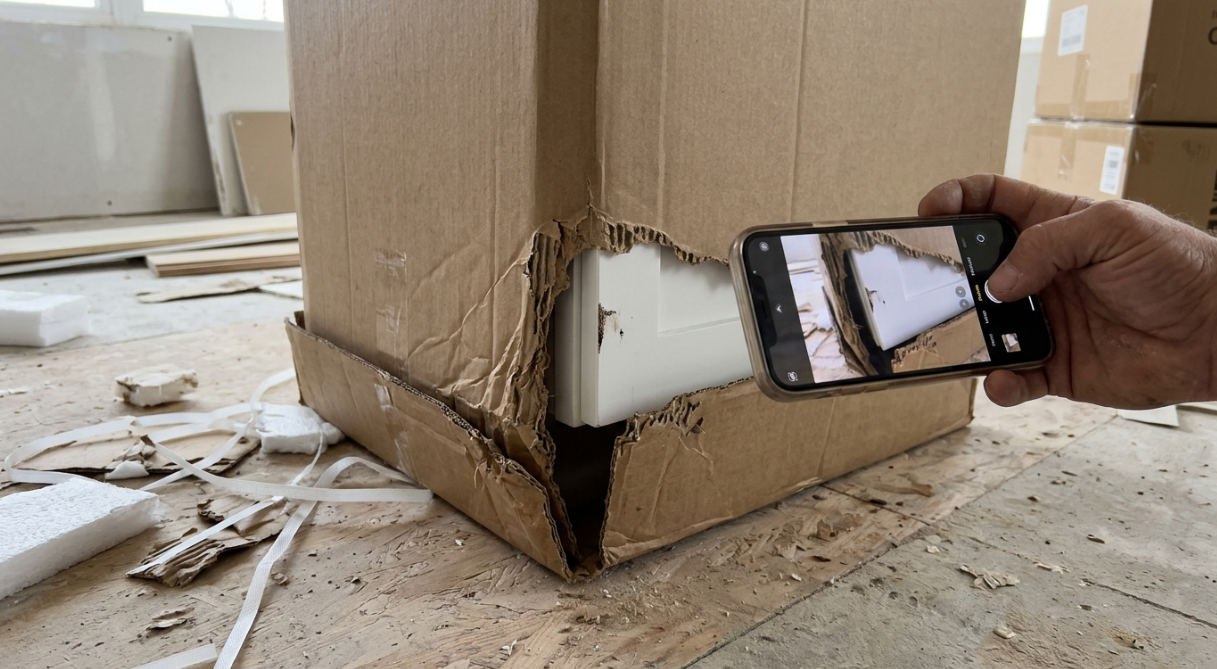
Open every box. Count every piece against the packing list and your original order. Check for shipping damage, wrong finishes, and mismatched hardware. Photograph anything that’s damaged, and note discrepancies on the delivery receipt before the driver leaves.
This step is non-negotiable. One supplier acknowledged that split shipments create confusion: “Your order was shipped from our facility in two separate packages. Once the shipment is handed over to UPS, the delivery timing of each box is unfortunately outside of our control. At times, carriers will scan, route, and deliver packages separately even when they leave us together.” If you don’t catch problems at delivery, proving them later becomes much harder.
Step 2: Identify Exactly What’s Missing
Don’t just note “2 boxes short.” Identify the specific SKUs, sizes, and functions of the missing pieces. Is it a filler strip you can work around, or is it the corner base cabinet that anchors an entire run?
Step 3: Get a Firm Backorder ETA
Contact the supplier immediately. “A few more weeks” is not an ETA. Get a specific revised promise date in writing. If they can’t give one, that tells you something important about whether to wait or pivot.
Cabinet Backorder Escalation Timeline: From Delivery Day to Resolution
Use the following timeline as an internal project-management protocol. Adjust the response deadlines to match the order terms, project urgency, and supplier’s stated commitments.
Timing | Action | Required outcome |
|---|---|---|
Delivery day | Reconcile the shipment against the order and document missing or damaged items | A written discrepancy record with affected SKUs and quantities |
Same business day | Contact the supplier or dealer | Confirmation of the reason for the shortage and the person responsible for resolving it |
Within 1 business day | Request an updated ETA, shipment status, and tracking details where available | A documented delivery commitment or clear statement that the date is unconfirmed |
When an ETA changes | Ask what caused the change and whether the order can be expedited, split-shipped, or sourced elsewhere | A revised plan with dates and available options |
When a commitment is missed | Escalate to the supplier’s manager or order-resolution team | A written recovery plan and a new decision deadline |
Before the delay affects dependent trades | Notify the homeowner and subcontractors, then update the schedule | Revised appointments and clear communication of downstream impacts |
When the delay threatens the project deadline | Compare replacement products, alternate suppliers, contractual remedies, and the cost of waiting | A documented decision based on time, cost, compatibility, and client approval |
Escalation rule: A supplier’s inability to confirm a delivery date is a scheduling risk, even if the order has not officially exceeded its estimated lead time. Track the original promised date, every revised ETA, the reason for each change, and the next agreed action.
Do not promise a new project completion date until the outstanding cabinets and the dependent trade schedule have been reassessed.
Step 4: Make the Install-or-Wait Decision
This is the critical judgment call. Consider these factors:
Install what arrived if:
The missing pieces are at the end of a run (not in the middle)
Installing the available cabinets allows the countertop fabricator to template at least one section
The backorder ETA is more than 2 weeks out, meaning waiting wastes more time than partial progress
The missing items are accessories (crown molding, light rail) that don’t affect cabinet function
Wait for the full order if:
The missing piece is in the middle of a run, making it impossible to install surrounding cabinets correctly
There’s a color or lot matching risk (cabinets from different production runs may have slight finish variations)
The backorder ETA is under one week
Installing partials would require repositioning or removing cabinets later
Measurement errors during initial planning can also force reorders, creating a situation that looks like a backorder. Reducing that risk starts with accurate cabinet measurement.
Step 5: Communicate to All Stakeholders
Once you’ve made the decision, notify everyone affected:
Homeowner: Explain the delay, provide a revised timeline, and describe what work can continue in the meantime. Be specific. “We’re waiting on the 36-inch sink base, which pushes countertop templating to the week of [date]” is far better than “there’s a delay.”
Subcontractors: Contact your plumber, electrician, countertop fabricator, and tile installer with updated scheduling. The earlier you notify them, the better your chances of keeping your slot in their queue.
Supplier: Confirm the backorder in writing. Request proactive updates rather than having to chase them.
Step 6: Reschedule Downstream Trades
Adjust your project schedule based on the revised cabinet delivery date plus your buffer time. Don’t schedule countertop templating for the same day as the replacement delivery. Give yourself at least 2 to 3 days of margin.
Step 7: Protect Stored Cabinets
If partial cabinets are sitting on the jobsite waiting for their companions, protect them. Cover them with moving blankets or plastic sheeting. Keep them away from areas with active demolition dust, painting overspray, or moisture. Cabinets stored carelessly on a jobsite develop scratches, dings, and swelling that create their own set of problems.
Preventing Cabinet Backorders Before They Happen
Knowing how to handle cabinet backorder and partial delivery coordination is essential. Preventing the situation entirely is better. Here are the most effective prevention strategies.
Choose a Supplier with Local Warehousing and In-Stock Programs
The single biggest factor in backorder risk is whether your cabinets exist in a warehouse right now or need to be built from scratch. Suppliers with large local inventory, particularly those maintaining six-figure square footage of warehouse space, can pull your order off the shelf and have it ready for pickup or delivery within days rather than months.
This is the structural advantage of stock and RTA programs over special-order-only suppliers. The cabinets are already manufactured, finished, and stored locally. There’s no factory queue, no overseas container delay, and no production-line bottleneck.
👉 Compare RTA vs. assembled cabinet lead times to see how format choice affects delivery speed.
Confirm SKU-Level Availability Before Ordering
Don’t assume. Call or visit the supplier and verify that every single item on your order is available. Remember: “in stock” describes a line, not every SKU. A 30-inch base might be available while the matching 18-inch wall cabinet is backordered. Ask about each piece individually.
Cabinet Order Verification Checklist Before Demolition
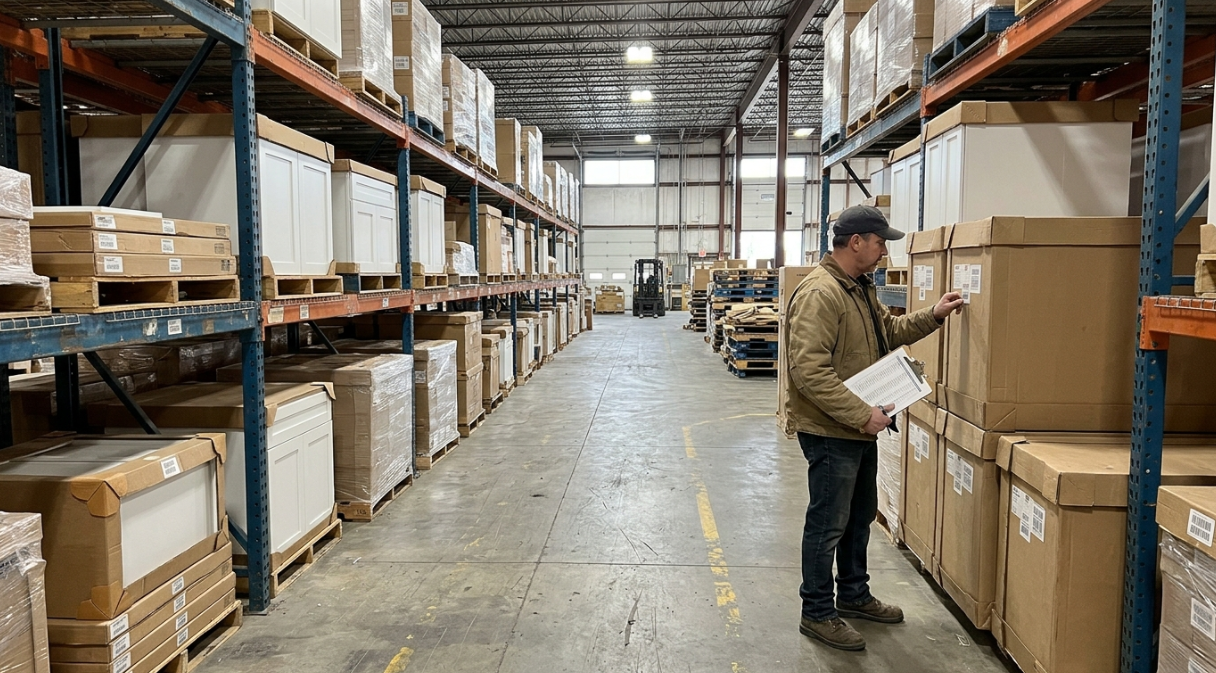
Before demolition or any work that depends on the cabinet delivery date, confirm the following:
Verification item | What to confirm | Evidence to keep |
|---|---|---|
SKU-level inventory | Every cabinet, panel, filler, molding, and accessory is available or has a documented ETA | Itemized availability confirmation |
Order completeness | Cabinet sizes, quantities, finishes, and configurations match the approved plan | Final purchase order and cabinet schedule |
Production status | Identify which items are in stock and which require manufacturing | Written order-status report |
Delivery window | Confirm the expected dispatch date, transit estimate, and delivery appointment | Supplier confirmation |
Split-shipment policy | Establish whether available items can ship before backordered items | Written delivery terms |
Damage and shortage policy | Confirm notification deadlines, documentation requirements, and replacement procedures | Supplier and carrier claim instructions |
Storage and holding terms | Check how long the supplier will hold an order and when fees apply | Written storage or delivery policy |
Alternative products | Identify compatible backup styles or suppliers if a critical SKU becomes unavailable | Approved alternatives and revised pricing |
Schedule buffer | Leave sufficient time for delivery discrepancies and replacement parts | Updated project schedule |
Responsibility for follow-up | Assign a person to track outstanding items and supplier commitments | Order-tracking log |
Do not treat an order confirmation as proof that every item is physically available. Confirm which SKUs are on hand, which are awaiting production, and which dates are estimates rather than firm commitments.
Build Buffer Into Your Schedule
Add 1 to 2 weeks of padding between your expected cabinet delivery and the start of installation. This buffer absorbs minor shipping delays without forcing you to reschedule downstream trades. For a full breakdown of how to sequence phases correctly, see this kitchen remodel checklist.
Pre-Agree on a Backup Style with the Client
Before ordering, discuss with the homeowner what happens if their first-choice finish or style becomes unavailable. Having a pre-approved backup prevents a scramble if you learn mid-project that a specific door style is discontinued or delayed by months. This conversation is much easier during the design phase than during demolition.
Order Cabinets During Design, Before Demo
Place your cabinet order as early in the design phase as possible. Appliances are specified first because they set cabinet openings. Cabinets go next, as they carry the longest lead time in the package. Waiting until after demolition to finalize the cabinet order is one of the most common kitchen remodel mistakes to avoid.
Verify Delivery Terms and Scope
Understand exactly what “delivery” means for your supplier. Some deliver to the jobsite garage or first-floor entry only. Others offer room-of-choice delivery for an additional fee. Knowing these terms prevents coordination failures on delivery day and ensures someone is present to receive and inspect.
When to Switch Suppliers or Products Mid-Project
Sometimes a backorder drags on with no resolution. At what point do you cut your losses and source elsewhere? Consider switching when:
The revised ETA has slipped more than twice
The supplier can’t provide a firm date
The delay will push your project past a contractual deadline or penalty clause
The homeowner’s temporary living situation is becoming untenable
An alternative supplier has a comparable product in stock right now
One cabinet buyer reported their order was delivered with damaged and missing components, and five months later, they still hadn’t received replacements despite repeated contact attempts. Waiting indefinitely is not a strategy. Set a deadline with your original supplier, and have a backup plan ready.
When Is It Worth Switching Cabinet Suppliers?
Switching suppliers during a kitchen remodel can resolve a prolonged shortage, but it may introduce differences in dimensions, finishes, hardware, cost, and warranty coverage. Compare the alternatives before canceling or replacing the original order.
Factor | Continue with the original supplier | Consider an alternative |
|---|---|---|
Delivery commitment | A credible revised ETA fits the project schedule | No reliable ETA or repeated missed commitments |
Product compatibility | Remaining items match the installed cabinets | A compatible alternative can be verified |
Finish consistency | Replacement components can match the original finish | A substitute finish is available and approved |
Total cost | Waiting costs less than changing suppliers | Documented delay costs exceed the cost of switching |
Contract terms | Cancellation or replacement would trigger substantial costs | Contract terms allow a practical alternative |
Schedule impact | Downstream trades can be rescheduled without major disruption | A readily available alternative can reduce the delay |
Client approval | The homeowner prefers the original product | The homeowner approves the substitute and any price or appearance changes |
Before making the switch, verify the cancellation terms, refund or restocking provisions, replacement lead time, compatibility, warranty implications, and any additional labor required. Obtain the homeowner’s written approval for material substitutions and revised costs.
Decision rule: Switch when a verified alternative provides a better overall outcome for the project, not simply because another supplier advertises faster delivery. Compare confirmed availability and total project impact rather than headline lead times alone.
If you need to evaluate a new source quickly, this guide for evaluating cabinet suppliers covers what to look for.
Backorder Communication Template for Contractors
When you need to notify a homeowner about a cabinet backorder, clarity and specificity build trust. Here’s a framework:
Subject: Kitchen Cabinet Delivery Update, [Project Address]
“Hi [Client Name],
I want to update you on our cabinet delivery. We received [X of Y] pieces on [date]. The [specific missing item(s), e.g., 36-inch sink base cabinet and one decorative end panel] are currently on backorder with the supplier. The revised delivery date we’ve received is [date].
Here’s what this means for the schedule:
Cabinet installation will proceed with the pieces we have, covering [describe which sections].
Countertop templating for the [affected area] will move from [original date] to [revised date].
Plumbing and appliance installation will shift accordingly, with a new target of [date range].
Our revised project completion estimate is [date], a [X]-day shift from the original plan. I’m in contact with the supplier and will update you as soon as the backordered items ship.
Please let me know if you have questions.”
Adjust the specifics, but the structure matters: state what’s missing, when it’s expected, what the downstream impact is, and what the new timeline looks like. Never leave a client guessing.
Frequently Asked Questions
What is the difference between a cabinet backorder and an out-of-stock cabinet?
A backordered cabinet is temporarily unavailable but expected to be replenished and shipped once production catches up. An out-of-stock cabinet might be permanently unavailable, particularly if the style or finish has been discontinued. The response to each is different: backorders require patience and schedule adjustments, while out-of-stock situations may require selecting an alternative product entirely.
Can I install some cabinets while waiting for the rest of a partial delivery?
It depends on which pieces are missing and where they fall in the layout. If the missing piece is at the end of a run, you can often install everything else and even have that section templated for countertops. If the missing piece is in the middle of a run, installing around it risks alignment issues and may require removing and repositioning cabinets later. Always confirm the backorder ETA before starting a partial install.
How much buffer time should I build into my schedule for cabinet deliveries?
For stock and RTA cabinets, 1 week of buffer is usually sufficient. For semi-custom orders, build in 2 weeks. For fully custom work, 2 to 3 weeks of buffer is reasonable given the longer production timelines and higher variability. This buffer goes between expected delivery and the day you schedule your countertop fabricator.
How do I know if a cabinet line is truly in stock at the SKU level?
Call the supplier and verify each item individually. Ask about the specific sizes, configurations, and accessories on your order, not just the line in general. A product line being “in stock” does not guarantee that every individual SKU within it is available for immediate shipment.
What should I do if a supplier keeps pushing back the backorder date?
Set a firm internal deadline. If the ETA has been revised more than twice or the total delay exceeds 3 to 4 weeks beyond the original promise, begin sourcing alternatives. Contact other local suppliers with in-stock programs to check availability of comparable styles. Having a pre-agreed backup with your client makes this pivot much faster.
Are there storage fees if I can’t accept my cabinet delivery on time?
Many suppliers impose storage fees after a set coordination window. For example, some charge $2 per cabinet per day after a 14-day hold period. On a kitchen with 25 to 30 cabinets, that’s $50 to $60 daily. Coordinate your jobsite readiness with your delivery date to avoid these charges.
Who is responsible for damaged cabinets found after the delivery driver leaves?
Responsibility varies by supplier policy, but your position is strongest when you document damage before the driver departs. Once you sign a clean delivery receipt, proving that damage occurred during transit rather than on your jobsite becomes difficult. Always inspect, photograph, and note issues on the receipt at the time of delivery.
How do cabinet backorders affect countertop scheduling?
Countertop fabricators will not template until all cabinets in a section are installed and leveled. A single missing cabinet in a run can prevent templating for that entire countertop section. Since fabrication itself takes 1 to 2 additional weeks after templating, a cabinet backorder can push your countertop installation date by 3 weeks or more beyond the cabinet delay itself.
👉 Planning a project and want to reduce backorder risk from the start? Explore contractor cabinet pricing and lead times to find suppliers built for trade professionals who need reliable, fast-turn inventory.