
TL;DR
Dealer pricing is the discounted price a manufacturer or distributor charges authorized resellers, contractors, and builders for products meant to be resold or installed. In the cabinet industry, it’s calculated by applying a confidential multiplier to a published list price, and it typically runs 30 to 50 percent below retail. In 2026, a 25% tariff on imported cabinets is reshaping dealer pricing across the industry, making domestic sourcing and supplier relationships more important than ever.
Quick Answer: What Is Dealer Pricing in Cabinets?
Dealer pricing in cabinets is the discounted price that manufacturers or distributors offer authorized cabinet dealers, contractors, builders, and other qualified trade professionals. It is commonly calculated by multiplying the manufacturer’s published list price by a dealer multiplier. For example, a cabinet order with a $20,000 list price and a 0.45 multiplier has a dealer net cost of $9,000 before freight, taxes, and other applicable charges. The dealer then adds a markup to cover operating expenses, design services, delivery, and profit.
Key takeaway: Cabinet dealer pricing is determined by more than the discount percentage. The manufacturer’s list price, dealer multiplier, product specifications, freight, and additional services all influence the final cost.
What Is Dealer Pricing in the Cabinet Industry?
Dealer pricing is the trade-level price that a cabinet manufacturer or distributor offers an authorized reseller or qualified professional. It is generally lower than the manufacturer’s published list price because dealers purchase products for resale, installation, or inclusion in larger construction and remodeling projects.
In the cabinet industry, dealer pricing allows contractors, kitchen designers, builders, and cabinet retailers to purchase inventory at a negotiated cost and establish their own selling prices.
Unlike standard retail pricing, dealer pricing often depends on several factors:
Dealer status: Whether the buyer has an approved trade or reseller account.
Purchase volume: How much cabinetry the dealer purchases annually.
Manufacturer pricing structure: The list price and multiplier assigned to the account.
Product category: Whether the cabinets are stock, RTA, semi-custom, or custom.
Additional costs: Freight, assembly, modifications, accessories, and delivery.
For example, a contractor purchasing cabinets for several residential projects may qualify for a different pricing tier than a homeowner purchasing cabinets for a single kitchen renovation.
Dealer pricing is particularly important for contractors because it determines the starting cost of a cabinet project. Understanding the difference between dealer cost and the final selling price helps businesses establish competitive quotes without sacrificing profitability.
Explore contractor cabinet pricing to see how trade programs work in practice.
How Dealer Pricing Works in Cabinets: The Multiplier System
Cabinet dealer pricing revolves around two numbers: a published list price and a confidential multiplier.
The list price (sometimes called MSRP) is set by the manufacturer and printed in catalogs or specification sheets. Nobody actually pays list price. It exists as a reference point from which all other pricing is derived.
The multiplier is a decimal, typically between 0.36 and 0.54, that the dealer applies to the list price to arrive at their net cost. A multiplier of 0.45 means the dealer pays 45% of list price.
Worked Example
Say you’re quoting a kitchen with a catalog list price of $20,000 across all cabinet SKUs:
List price: $20,000
Dealer multiplier: 0.45
Dealer net cost: $20,000 × 0.45 = $9,000
Dealer resale price (with 40% markup): $12,600
Retail price (if buying without trade status): $14,000 to $16,000
That $9,000 is what the dealer actually pays the manufacturer. Everything above it covers the dealer’s overhead, design time, freight, and margin.
For a real-world reference point, you can see how list prices translate to actual kitchen budgets in this 10×10 kitchen cabinet cost breakdown.
Why the Same Brand Quotes Differently From Two Suppliers
This confuses homeowners and even some newer contractors. Two quotes on the same cabinet brand can differ by 20% or more, and the cabinets themselves have nothing to do with it.
Different distributors negotiate different multipliers with the manufacturer. They apply different margins, operate in different markets, and land on different discount tiers based on their purchase volume and account history. A high-volume dealer in Seattle might get a 0.42 multiplier while a smaller dealer in a rural market gets 0.50 on the same line.
What Moves the Multiplier
Several factors determine where your multiplier lands:
Annual purchase volume. More volume usually earns a lower (better) multiplier.
Account history. Long-standing relationships and reliable payment terms help.
Product mix. Some product lines carry different multiplier tiers than others. Construction type matters here too, as framed and frameless cabinets often fall into different price groups.
Location and market. Regional competition and freight costs influence the numbers.
Promotional periods. Manufacturers occasionally offer temporary multiplier reductions to drive volume.
Cabinet Dealer Markup vs. Profit Margin: What’s the Difference?
Cabinet dealer markup and profit margin are two different measurements used to determine how much a dealer earns when reselling cabinets.
Markup is the percentage added to the dealer’s purchase cost to establish the selling price. Gross profit margin measures the percentage of the final selling price that remains after subtracting the cabinet’s purchase cost.
Understanding the difference is essential for contractors and cabinet businesses that want to price projects profitably.
Cabinet Dealer Markup vs. Margin Example
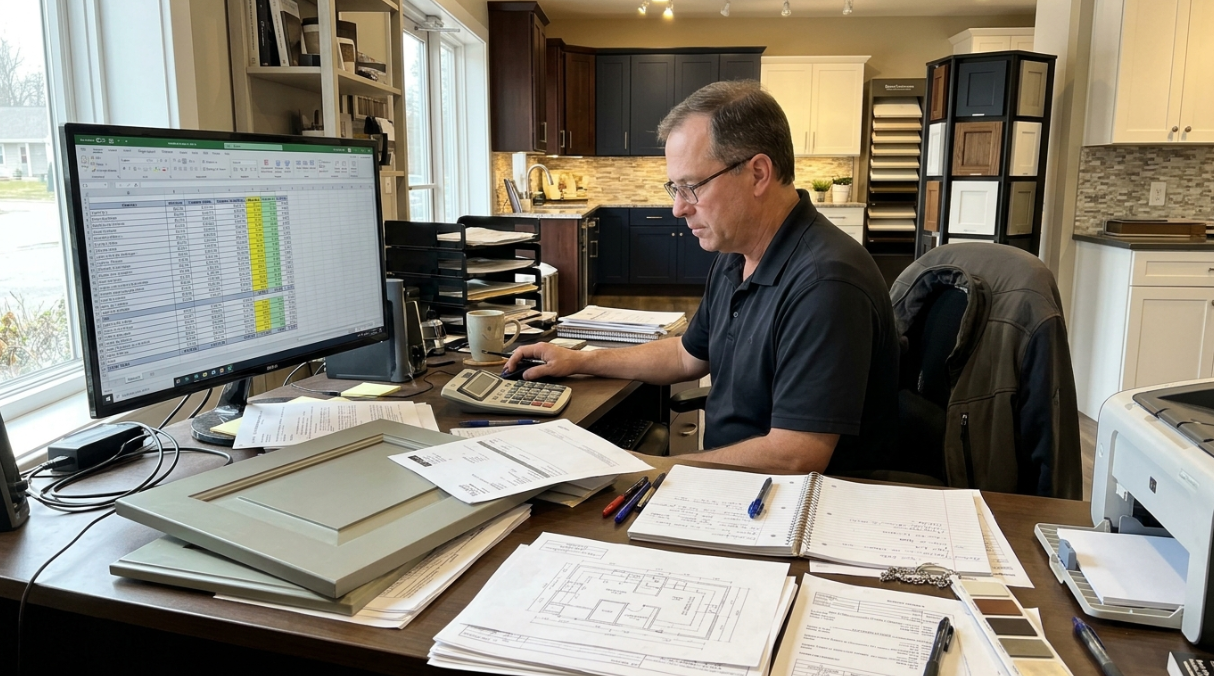
Suppose a cabinet dealer purchases an order for $9,000 and wants to apply a 40% markup.
Calculation | Amount |
|---|---|
Dealer net cost | $9,000 |
Markup percentage | 40% |
Dollar markup | $3,600 |
Selling price | $12,600 |
Gross profit before other expenses | $3,600 |
Gross profit margin | 28.57% |
The formulas are:
Markup formula:
Markup = (Selling Price − Cost) ÷ Cost × 100
Gross profit margin formula:
Gross Profit Margin = (Selling Price − Cost) ÷ Selling Price × 100
In this example, a 40% markup produces a 28.57% gross profit margin, not a 40% margin.
How Different Markups Affect Cabinet Selling Prices
Using a $9,000 dealer purchase cost, here is how different markup percentages affect the final selling price.
Dealer markup | Selling price | Gross profit | Gross margin |
|---|---|---|---|
20% | $10,800 | $1,800 | 16.67% |
30% | $11,700 | $2,700 | 23.08% |
40% | $12,600 | $3,600 | 28.57% |
50% | $13,500 | $4,500 | 33.33% |
60% | $14,400 | $5,400 | 37.50% |
70% | $15,300 | $6,300 | 41.18% |
These are illustrative calculations, not universal cabinet-industry markup standards. Actual pricing depends on the dealer’s operating expenses, market competition, service level, and business model.
Why this matters: A dealer needs to account for more than the difference between the purchase price and selling price. Design labor, freight, showroom expenses, delivery, installation coordination, and customer service can all reduce the amount left as operating profit.
The List Price Trap
A veteran cabinet sales professional on an industry blog made a point that’s worth highlighting: a lower multiplier doesn’t always mean a better deal. Some manufacturers set higher list prices and offer lower multipliers. Others do the reverse. What matters is the net cost, which is the list price times the multiplier. Always compare the final dollar amount, not just the multiplier in isolation.
How to Calculate the Actual Cost of a Cabinet Dealer Order
Calculating cabinet dealer pricing requires more than multiplying the manufacturer’s list price by the dealer multiplier. Contractors should also account for freight, assembly, modifications, accessories, and other charges that affect the final purchase cost.
The basic dealer pricing formula is:
Dealer Net Cost = Manufacturer List Price × Dealer Multiplier
However, the complete purchase cost may include additional expenses.
Example: Calculating a $20,000 Cabinet Order
Assume a contractor receives a cabinet quote with a $20,000 list price and a 0.45 dealer multiplier.
Cost component | Calculation | Amount |
|---|---|---|
Manufacturer list price | Given | $20,000 |
Dealer multiplier | Given | 0.45 |
Dealer net cost | $20,000 × 0.45 | $9,000 |
Freight and delivery | Illustrative charge | $500 |
Assembly and modifications | Illustrative charge | $750 |
Accessories and additional components | Illustrative charge | $250 |
Total purchase cost | Sum of costs | $10,500 |
The contractor’s actual purchase cost is $10,500, not $9,000.
If the contractor wants to apply a 40% markup to the total purchase cost:
Total purchase cost: $10,500
Markup: 40%
Selling price: $14,700
Gross profit before other expenses: $4,200
Gross profit margin: 28.57%
This calculation demonstrates why contractors should evaluate the complete supplier quote instead of focusing exclusively on the advertised dealer multiplier.
Note: All additional charges in this example are hypothetical. Actual freight, assembly, and modification costs vary by supplier, location, order size, and product specifications.
Dealer Pricing vs. Wholesale vs. Retail vs. List Price
Cabinet pricing involves several different price levels. Understanding these terms helps contractors, dealers, and homeowners identify what a supplier is actually quoting.
Pricing term | Meaning | Who typically pays it? |
|---|---|---|
List price / MSRP | Manufacturer’s published reference price before applicable discounts | Reference price; not necessarily the actual transaction price |
Dealer cost / net price | Dealer’s purchase price after applying the negotiated multiplier | Authorized dealer or trade buyer |
Wholesale price | Business-to-business selling price for products purchased in commercial quantities or for resale | Distributor, reseller, or trade buyer |
Dealer selling price | Price the dealer charges the customer after adding its markup and applicable services | Homeowner, contractor’s client, or builder |
Retail price | Price offered to the general consumer through a retail store or online supplier | End consumer |
Dealer pricing and wholesale pricing overlap, but they are not always interchangeable. Wholesale describes a broader business-to-business pricing arrangement, while dealer pricing often refers to negotiated pricing offered through an authorized manufacturer or distributor relationship.
A dealer’s net cost is not necessarily the same as the final wholesale price because freight, handling, account terms, and other charges may be added.
Important: Always establish whether a quoted price represents the manufacturer’s list price, dealer net cost, or the final customer selling price. Comparing different price levels can produce misleading savings calculations.
For homeowners wondering how dealer pricing compares to what they’d pay at a big-box store, this cabinet supplier vs. Home Depot guide breaks down the real differences.
Who Qualifies for Dealer Pricing
Dealer pricing isn’t available to everyone. Suppliers gate it behind qualification requirements to protect their distribution channel and the margins of their trade partners.
Typical requirements include:
Business license. Proof that you operate a legitimate business, not a one-time personal purchase.
Resale certificate or contractor license. Demonstrates you’re buying for resale or installation, not personal use.
Authorized dealer agreement. Some manufacturers require a formal application, territory assignment, and minimum purchase commitment.
Volume thresholds. Better multiplier tiers unlock at higher annual purchase levels. A dealer buying $500,000 per year will get a different multiplier than one buying $50,000.
Many suppliers operate on a tiered system. Entry-level trade accounts might start at a multiplier of 0.52, while high-volume partners earn 0.40 or better. The gap between tiers represents real money on every project.
Trade programs are why you’ll often see login-gated pricing on supplier websites. The pricing is there, but you need an approved account to see it. Krafter’s Land, for example, operates a dealer and contractor-only purchasing model with login-gated pricing, which protects the margins of its trade partners while offering free design and quotes through its showrooms.
See how builder cabinet packages are structured with pricing tiers and grades.
How Contractors Can Negotiate Better Cabinet Dealer Pricing
Contractors and remodelers can potentially improve their cabinet purchasing terms by building a consistent relationship with suppliers and demonstrating reliable purchasing activity.
Although manufacturers and distributors control their own discount structures, trade buyers can take several steps to negotiate more favorable pricing.
1. Consolidate Cabinet Orders
Suppliers may offer better pricing to businesses that purchase larger quantities or maintain consistent order volumes.
Instead of splitting purchases across multiple suppliers, contractors can evaluate whether consolidating orders creates opportunities for volume-based discounts.
2. Build a Long-Term Supplier Relationship
A consistent purchasing relationship can help contractors establish account credibility.
Reliable payments, repeat orders, and clear communication may make it easier to negotiate better account terms over time.
3. Ask About Volume-Based Pricing Tiers
Ask the supplier whether its dealer program includes different pricing levels based on annual purchasing volume.
Understanding the thresholds helps contractors determine whether increasing their order volume would produce meaningful savings.
4. Compare Multiple Cabinet Suppliers
Obtaining quotes from several suppliers creates a clearer picture of market pricing.
Compare equivalent cabinet schedules, specifications, freight charges, and delivery terms rather than relying exclusively on multiplier percentages.
5. Negotiate Freight and Additional Services
Even when a supplier cannot reduce the cabinet multiplier, it may be possible to negotiate freight arrangements, free design services, volume incentives, or more favorable payment terms.
These benefits can improve the total economics of a project without requiring a lower product price.
6. Request Written Pricing Agreements
For contractors managing several projects, written pricing agreements and quote-validity periods can help reduce unexpected cost changes.
Always confirm what products, quantities, and dates are covered by the agreement.
Key takeaway: Better cabinet dealer pricing is not always achieved by negotiating a lower multiplier. Volume incentives, freight arrangements, service inclusions, and price protection can also reduce the total cost of purchasing cabinets.
Why Dealer Pricing Isn’t Posted Publicly
If you’ve ever tried to find cabinet pricing on a manufacturer’s website and hit a login wall, there’s a deliberate strategy behind it.
Channel Conflict Protection
When dealer pricing is public, end consumers can see exactly what the dealer pays and pressure them to sell at cost. This destroys the dealer’s ability to cover their overhead, design services, and project management, which is the value they add to the transaction. Keeping pricing gated protects the entire distribution channel.
Margin Management
Dealers carry significant fixed costs: showroom rent, design staff, samples, delivery vehicles. Their markup on cabinets (typically 25 to 50 percent above dealer cost) isn’t pure profit. It funds the infrastructure that makes the sale possible. Public pricing undermines this.
A designer on Houzz put it bluntly: “The dealer will never ever give you their cost multiplier.” That opacity exists by design. It’s not about hiding something shady; it’s about maintaining a pricing structure that keeps dealers in business and able to provide service.
Market Segmentation
Manufacturers use different multiplier tiers to serve different markets. A builder buying 200 kitchens per year for a tract development has different economics than a remodeler doing 30 kitchens. Public pricing would make this segmentation impossible.
What This Means for Contractors
Practitioners on contractor forums highlight a real tension here. One contractor on the Mike Holt forum noted that their customers sometimes had better pricing at the supply house than they did, even after buying just a few thousand dollars’ worth of product. This is exactly why dealer-only pricing structures, where the supplier doesn’t sell directly to consumers, matter to trade professionals. It protects their ability to mark up and still offer competitive installed pricing.
Typical Dealer Discount Ranges in Cabinetry
How much cheaper is dealer pricing compared to retail? The range depends on the brand, product tier, and your account level, but here are industry benchmarks:
Trade pricing vs. retail: Typically 30 to 50 percent below retail on the same product, depending on the brand and discount tier.
Trade program savings: Members of formal trade programs typically save 20 to 40 percent compared to standard retail pricing.
Multiplier range: Real-world multipliers across major cabinet manufacturers range from about 0.36 to 0.54.
Markup Benchmarks for Dealers Setting Resale Prices
When dealers set their own prices to end buyers, industry benchmarks from wholesale pricing guides suggest these markups over dealer cost:
RTA kitchen cabinets: 50 to 70% markup over wholesale cost
Assembled stock cabinets: 60 to 80% markup
Custom cabinets: 80 to 120% markup
These markups might seem steep, but they reflect the different levels of service, lead time, and customization involved. A custom cabinet order requires far more design time, revision cycles, and coordination than an RTA cabinet pulled from warehouse stock.
An industry source that’s worth noting: a veteran cabinet rep explained that some manufacturers bill the remodeler directly at a higher multiplier than the dealer pays, with the dealer receiving the difference as a commission. The remodeler thinks they’re buying direct, but they’re actually purchasing through a regional dealer. This tiered structure is common but rarely disclosed.
2026 Cabinet Tariffs: How Import Duties Affect Dealer Pricing
U.S. import tariffs are an important factor influencing cabinet sourcing, supplier costs, and dealer pricing in 2026. For contractors and cabinet dealers purchasing imported products, understanding how import duties affect landed costs can help prevent inaccurate project estimates.
What Is the Current U.S. Cabinet Tariff in 2026?
Under the U.S. Section 232 measures introduced in September 2025, certain imported kitchen cabinets, bathroom vanities, and related parts became subject to additional import duties.
The original measure established a 25% tariff on covered products. A subsequent December 31, 2025 proclamation delayed the planned increase to 50% for another year.
As of November 2026, the general rate established under this measure remains 25% for covered products, with the previously announced increase scheduled for January 1, 2027, subject to applicable country-specific arrangements and subsequent government changes.
Not every imported cabinet product necessarily receives the same treatment. Product classification, country of origin, applicable trade arrangements, and customs rules can affect the actual duty.
How Cabinet Tariffs Affect Dealer Costs

Import duties can increase the landed cost of imported cabinets before distributors and dealers calculate their selling prices.
For example, assume an imported cabinet order has a customs value of $3,000 and is subject to a 25% additional duty.
Cost component | Amount |
|---|---|
Customs value | $3,000 |
Additional tariff at 25% | $750 |
Cost after tariff | $3,750 |
This example excludes freight, insurance, brokerage, other applicable duties, and domestic handling charges.
The tariff does not automatically translate into an identical percentage increase in the final retail price. Manufacturers, importers, distributors, and dealers may absorb some costs, adjust their margins, or pass some of the increase to customers.
What Cabinet Dealers Should Consider When Sourcing Imported Products
Contractors and cabinet dealers should evaluate more than the manufacturer’s published list price when comparing imported and domestically sourced products.
Important considerations include:
Country of origin: Determine where the cabinets are manufactured, not simply where the supplier is headquartered.
Tariff classification: Confirm whether the product falls under the applicable tariff provisions.
Landed cost: Include applicable duties, freight, brokerage, and handling.
Supplier pricing stability: Ask whether quotes account for possible tariff changes.
Inventory availability: Confirm whether the supplier already has inventory in the United States and whether the quoted price reflects its actual acquisition cost.
Why Domestic Cabinet Sourcing Matters
Domestic manufacturing and U.S.-based inventory can reduce exposure to certain import-related cost fluctuations, although domestic products may still contain imported materials or components.
For contractors quoting projects several months in advance, predictable pricing and reliable inventory can be just as important as the initial dealer multiplier.
A supplier offering a lower multiplier is not necessarily the least expensive option if its list prices, freight charges, or sourcing costs are higher.
For a deeper look at how these costs play out regionally, this kitchen cabinet cost in Washington guide covers current pricing benchmarks.
The Domestic Sourcing Advantage
Suppliers who warehouse domestically and source from tariff-exempt channels can offer stable dealer pricing without the tariff surcharge baked into their list prices. For trade professionals quoting projects months in advance, this stability matters as much as the base price. A lower multiplier means nothing if the list price jumps 25% between when you quote and when you order.
How to Compare Dealer Quotes
Getting multiple quotes is standard practice. Comparing them accurately is where most trade professionals and homeowners go wrong.
Compare on the Same Cabinet Schedule
A “cabinet schedule” is a line-by-line list of every cabinet box, including size, door style, finish, modifications, and accessories. Comparing quotes that aren’t based on the same schedule is meaningless. One supplier might quote 30 cabinets while another quotes 28 because they combined sizes differently.
Look at Multiplier AND List Price Together
As noted earlier, the multiplier alone tells you nothing useful. A 0.40 multiplier on a $25,000 list equals $10,000. A 0.50 multiplier on an $18,000 list equals $9,000. The higher multiplier produced the lower cost. Always compare the bottom-line net price.
Check What’s Included
Dealer pricing quotes can vary dramatically based on what’s bundled in:
Freight and delivery. Is it included or a separate line item?
Assembly. Are you getting RTA (ready-to-assemble) or pre-assembled boxes? The pricing difference is significant.
Modifications. Fillers, panels, crown molding, and special-depth cabinets can add 10 to 20 percent to a base quote.
Design services. Some suppliers include design and 3D renderings at no charge. Others bill separately.
Verify Quote Validity and Price Holds
With tariff uncertainty and material cost fluctuations, the window during which a quote remains valid matters. A quote that’s good for 30 days is worth more than one that expires in 7. Ask about price hold policies, especially on projects with long lead times.
Lead times themselves are a hidden cost in dealer pricing discussions, because delays mean carrying costs, schedule disruptions, and potentially re-quoting at higher prices. This cabinet lead times guide covers what to expect across stock, semi-custom, and custom tiers.
How to Compare Two Cabinet Dealer Pricing Quotes
Two cabinet suppliers can offer different multipliers and list prices for the same project. This is why contractors should compare the actual net cost rather than automatically choosing the supplier with the lowest multiplier.
Consider a contractor comparing two hypothetical suppliers for the same cabinet specifications.
Example: Supplier A vs. Supplier B
Pricing detail | Supplier A | Supplier B |
|---|---|---|
Manufacturer list price | $25,000 | $18,000 |
Dealer multiplier | 0.40 | 0.50 |
Dealer net cost | $10,000 | $9,000 |
Freight | $500 | $750 |
Modifications | $300 | $200 |
Total purchase cost | $10,800 | $9,950 |
Supplier A offers the lower multiplier, but Supplier B provides the lower total purchase cost.
The difference is $850.
However, the contractor should only choose Supplier B if both quotes cover equivalent cabinet specifications, construction quality, accessories, warranties, and delivery requirements.
Five Questions to Ask Before Choosing a Cabinet Supplier
Are both quotes based on the exact same cabinet schedule?
Are the cabinet materials and construction specifications equivalent?
Are freight, assembly, and modifications included?
Does the supplier guarantee the quoted price for a specified period?
What happens if cabinets arrive damaged, incomplete, or incorrect?
The best dealer pricing is not necessarily the lowest multiplier or lowest initial quote. It is the most competitive total purchase cost for the required product quality, service, and delivery conditions.
Hidden Costs That Can Increase Cabinet Dealer Pricing
A cabinet supplier’s quoted dealer price does not always represent the complete cost of purchasing and delivering the order. Additional charges can increase the final amount and reduce the dealer’s expected profit margin.
Contractors should identify these expenses before accepting a supplier quote or submitting a final project estimate.
1. Freight and Shipping
Cabinets are bulky products that require careful packaging and transportation. Freight charges can vary based on shipment size, delivery distance, warehouse location, and shipping method.
Ask whether the supplier provides free freight above a minimum order value or charges separately for each shipment.
2. Assembly Charges
RTA cabinets generally require assembly before installation. Although their purchase price may be lower, contractors must account for the labor and time required to assemble them.
Compare the total cost of RTA and assembled cabinets rather than looking at the product price alone.
3. Cabinet Modifications
Special cabinet dimensions, finished ends, custom-depth units, fillers, decorative panels, and upgraded accessories may increase the original quote.
Request an itemized breakdown of these additions before approving the order.
4. Storage and Delivery
Large projects may require temporary storage, phased deliveries, or additional handling. These services can introduce costs that aren’t included in the initial cabinet quote.
Confirm delivery arrangements, unloading responsibilities, and storage fees before placing the order.
5. Damaged or Missing Components
Cabinet shipments can occasionally arrive with damaged doors, missing hardware, or incorrect components.
Ask about the supplier’s replacement policy, warranty coverage, and procedures for reporting shipping damage. Delayed replacements can also affect installation schedules and project profitability.
6. Price Changes and Quote Expiration
Cabinet prices can change because of manufacturer adjustments, material costs, freight expenses, and import duties.
Ask how long the quoted price remains valid and whether the supplier provides written price protection after the order is approved.
Cabinet Dealer Quote: Additional Cost Checklist
Cost category | What to verify |
|---|---|
Freight | Is shipping included? |
Assembly | Are cabinets delivered assembled? |
Modifications | Are special sizes and accessories extra? |
Delivery | Is unloading included? |
Storage | Are temporary storage fees applicable? |
Replacements | Who covers damaged or missing components? |
Taxes | Are applicable taxes included? |
Price protection | How long is the quote valid? |
Practical advice: Ask suppliers to provide a complete, itemized quote. This makes it easier to identify hidden charges, calculate actual acquisition costs, and compare the profitability of different cabinet suppliers.
Evaluate Quality Alongside Price
The lowest dealer price isn’t always the best deal. Cabinet box construction, hardware quality, finish durability, and warranty terms all affect the total cost of ownership. A cheaper cabinet that needs replacement in five years costs more than a well-built one that lasts fifteen.
When you’re ready to compare dealer pricing from a supplier with gated trade pricing, large in-stock inventory, and free design services, find the best cabinet supplier for your contracting business.
Related Pricing Terms Quick Reference
Term | Definition |
|---|---|
List Price / MSRP | The manufacturer’s published reference price. Starting point for all pricing calculations. |
Multiplier | A decimal applied to list price that determines dealer cost. Lower means cheaper for the dealer. |
Net Price | The actual dollar amount the dealer pays after applying the multiplier. List price × multiplier = net price. |
Trade Discount | The percentage reduction from retail that a qualified trade professional receives. |
Price Hold | A guarantee from the supplier that the quoted price will remain valid for a specified period. |
Freight Class | A shipping classification that affects delivery costs. Cabinets are bulky and heavy, so freight is a real cost factor. |
MAP (Minimum Advertised Price) | The lowest price a manufacturer allows dealers to advertise publicly. Common in consumer goods, less formal in cabinetry. |
Channel Pricing | The practice of offering different price levels to different types of buyers (builders vs. retailers vs. designers). |
For a broader glossary of kitchen remodeling terms, including project phases, permits, and timelines, see this kitchen remodel glossary and planning guide.
Frequently Asked Questions
What is the typical dealer discount on kitchen cabinets?
Trade pricing on cabinets typically runs 30 to 50 percent below retail, depending on the brand, product tier, and the dealer’s volume-based discount level. Formal trade programs commonly advertise savings of 20 to 40 percent versus standard retail pricing.
How is dealer pricing calculated?
In the cabinet industry, dealer pricing is calculated by multiplying the manufacturer’s published list price by a confidential multiplier (a decimal like 0.45). The result is the dealer’s net cost. The dealer then adds their own markup to arrive at the price charged to the end buyer.
Can homeowners get dealer pricing on cabinets?
Generally, no. Dealer pricing is reserved for authorized resellers, licensed contractors, builders, and other trade professionals. Homeowners typically access better-than-retail pricing by working with a trade professional who passes along some of their discount as part of a project quote.
Why do two dealers quote different prices on the same cabinet brand?
Different dealers negotiate different multipliers based on their purchase volume, account history, market, and relationship with the manufacturer. They also apply different markups to cover their own overhead and services. Two quotes on the same cabinet specification can vary by 20% or more for these reasons alone.
How do 2026 tariffs affect cabinet dealer pricing?
Imported kitchen cabinets currently face a 25% Section 232 tariff, with a scheduled increase to 50% on January 1, 2027. This has driven retail cabinet pricing 15 to 20 percent higher in early 2026 compared to early 2025. Dealers sourcing imported lines face compressed margins, making domestic-inventory suppliers more price-competitive.
Why isn’t dealer pricing shown on cabinet supplier websites?
Suppliers keep dealer pricing behind login gates to protect their distribution channel. Public pricing would allow end consumers to see dealer costs and undercut the dealer’s ability to charge for their services (design, project management, delivery, installation). It would also prevent manufacturers from offering different tiers to different account levels.
Is dealer pricing the same as wholesale pricing?
They overlap but aren’t identical. Wholesale pricing is a broader term for any business-to-business price on goods meant for resale. Dealer pricing specifically refers to the price offered to authorized resellers under a structured multiplier system, usually with tiered discounts based on volume and account status.
What should I look for when comparing dealer pricing quotes?
Compare on the same detailed cabinet schedule. Check whether freight, assembly, modifications, and design services are included or extra. Look at the net price (not just the multiplier), verify how long the quote is valid, and assess cabinet quality indicators alongside the price.