TL;DR
A Cambria jumbo slab measures 132″ x 65.5″ (roughly 60 square feet) and costs approximately $2,400 to $5,700 for the slab material alone, or $65 to $150 per square foot installed. The design tier affects the price more than the slab size itself. For contractors and remodelers quoting mid-to-large kitchen layouts, one jumbo slab can actually cost less than two standard slabs, a slab-yield calculation that separates accurate estimates from ones that blow up during fabrication.
How much does a Cambria jumbo slab cost in 2026?
A Cambria jumbo quartz slab measures approximately 132 x 65.5 inches and provides a nominal 60 square feet of surface area. Estimated material-only pricing ranges from $2,400 to $5,700 per slab, while fabricated and installed Cambria countertops may cost approximately $65 to $150 per square foot. Actual prices depend on the selected design, thickness, fabricator, edge profile, cutouts, and installation requirements. Cambria does not publish a universal retail slab price, so homeowners and contractors should request a project-specific quote from an authorized Cambria partner.
What Is a Cambria Jumbo Slab?
A Cambria jumbo slab is the larger of Cambria’s two primary engineered quartz slab formats. Where the standard slab measures 122″ x 55.5″ and yields about 47 square feet of material, the jumbo slab stretches to 132″ x 65.5″ and yields approximately 60 square feet. That extra 13 square feet matters more than it sounds, especially when specifying kitchen islands and L-shaped countertops where seams would otherwise land in a visible spot and create client complaints.
Cambria actually offers three slab sizes:
Slab Format | Dimensions | Approximate Yield |
|---|---|---|
Standard | 122″ x 55.5″ | 47 sq ft |
Jumbo | 132″ x 65.5″ | 60 sq ft |
Super Jumbo | 136″ x 80″ | 76 sq ft |
The super jumbo format, introduced at KBIS 2023, makes Cambria the only U.S. quartz manufacturer producing slabs at that scale. But for most residential kitchen projects, the jumbo slab is the size that comes up during the quoting and specification process.
Two important caveats for trade professionals: not all Cambria designs are available in jumbo, and available thicknesses include 1cm, 2cm, and 3cm depending on the pattern. Confirm jumbo availability for a specific design before templating. Discovering a size limitation after the client has signed off on a selection creates costly change orders and project delays.
If you’re weighing prefabricated quartz against full slab formats for client jobs, our guide on prefab vs. slab quartz breaks down the size, cost, and seam differences that affect project estimates.
How Much Does a Cambria Jumbo Slab Cost?

There is no published list price for Cambria quartz. The company sells exclusively through authorized dealers and trained fabricators, which means every quote is filtered through channel pricing. As one Houzz forum contributor put it, “Cambria has an established minimum market price that no fabricator can sell under or he gets cut off.” That floor protects both the brand and dealer margins, making pricing more consistent across fabrication shops than many contractors expect.
Here’s what multiple sources report for 2026:
Cost Component | Range Per Sq Ft | Whole Jumbo Slab (60 sq ft) |
|---|---|---|
Material only | $40–$95 | $2,400–$5,700 |
Installed (material + fab + install) | $65–$150 | $3,900–$9,000 |
Sources: SlabWise, HomeGuide, DG Floors pricing data
The wide range exists because of Cambria’s design tier system, which is the single biggest cost driver and the variable that trade professionals need to nail down before presenting estimates to clients.
Cambria Jumbo Slab Cost Breakdown: Material vs. Installed Pricing
The price of a Cambria jumbo slab is only one part of the total countertop budget. Fabrication, transportation, edge finishing, cutouts, and installation can significantly increase the final project cost.
For estimating purposes, separate the material purchase from the fabrication and installation expenses.
Cost Component | What It Covers | How It Affects the Budget |
|---|---|---|
Slab material | Selected Cambria quartz design and thickness | Depends on the design and supplier |
Templating | Measuring cabinets and creating the countertop layout | Usually quoted as part of the project |
Fabrication | Cutting, shaping, polishing, and finishing | Depends on layout complexity |
Sink cutout | Opening for an undermount or drop-in sink | May be charged separately |
Cooktop cutout | Opening for the cooking appliance | Depends on specifications |
Edge finishing | Eased, beveled, ogee, or mitered edges | Depends on linear footage and profile |
Transportation | Moving slabs and finished countertop pieces | Depends on distance and handling requirements |
Installation | Positioning, joining, leveling, and securing countertops | Depends on project complexity |
Example: Estimating a 60-Square-Foot Cambria Countertop
Suppose a contractor is preparing a preliminary estimate for a kitchen requiring approximately 60 square feet of finished Cambria countertop.
Using an illustrative installed rate of $100 per square foot:
Item | Calculation | Estimated Cost |
|---|---|---|
Finished countertop area | 60 sq ft | — |
Material, fabrication, and installation | 60 × $100 | $6,000 |
Additional waterfall or specialty edge work | Separate allowance | Not included |
Additional plumbing or appliance work | Separate allowance | Not included |
Preliminary countertop budget | $6,000 |
This is an illustrative installed-price calculation, not a supplier quote. Confirm whether the fabricator’s per-square-foot price includes templating, cutouts, transportation, and standard edge finishing before presenting the estimate to a client.
For larger kitchens, the final material requirement should be determined using a slab nesting plan rather than assuming that 60 square feet of finished countertop will fit into one 60-square-foot slab.
How Cambria Design Collections Affect Jumbo Slab Pricing
Cambria jumbo slab pricing depends heavily on the selected design, rather than dimensions alone. Two slabs with identical measurements can have different prices because of their design classification, finish, and availability.
Cambria organizes its designs into collections and series, with options ranging from simpler quartz appearances to more elaborate marble-inspired patterns.
When comparing designs, contractors and homeowners should consider:
Design classification: Different Cambria designs may have different dealer pricing.
Veining and pattern complexity: More elaborate visual patterns may carry different price points.
Surface finish: Polished, matte, and specialty finishes may have different availability.
Slab format: Confirm whether the selected design is offered in jumbo rather than assuming all patterns come in the larger format.
Thickness: Availability in 1cm, 2cm, and 3cm varies by design.
For an accurate comparison, request quotes for multiple Cambria designs using the same slab format, thickness, edge profile, and countertop layout.
This helps identify whether a higher estimate comes from the material selection or from fabrication and installation costs.
For Washington State trade professionals budgeting a full kitchen project, kitchen cabinet costs in Washington provide useful context on the other major line item you’ll be coordinating.
Jumbo Slab vs. Standard Slab: When the Upgrade Pays Off
This is where the math gets interesting, and where accurate quoting separates experienced trade professionals from those who end up absorbing cost overruns.
The Slab-Yield Trap: Why Square Footage Alone Can Mislead
One of the biggest mistakes in countertop estimating is assuming that a slab’s advertised square footage equals its usable countertop area.
A standard Cambria slab measures approximately 122″ x 55.5″, while a jumbo slab measures approximately 132″ x 65.5″. Although these dimensions translate into roughly 47 and 60 square feet of nominal surface area, the actual amount of countertop that can be fabricated depends on the dimensions and arrangement of individual pieces.
For example, a kitchen requiring 48 square feet of countertop does not automatically need two standard slabs. If the individual countertop sections fit within the standard slab’s dimensions, the fabricator may be able to produce the layout from one slab. Conversely, a smaller countertop may require additional material if its dimensions, overhangs, or design pattern create inefficient cuts.
This is why professional fabricators use slab nesting layouts rather than relying exclusively on square-foot calculations.
Before specifying a jumbo slab, evaluate:
Individual piece dimensions: Can every countertop section fit within the slab’s length and width?
Cutting layout: Can the fabricator arrange the pieces without overlapping cuts?
Waste allowance: How much material will be lost through trimming, cutting, and finishing?
Vein direction and pattern matching: Does the design require additional material to maintain visual continuity?
Seam placement: Can the countertop be fabricated with acceptable seam locations?
Overhangs and waterfall panels: Do these additional pieces change the slab requirements?
The practical takeaway is that slab selection should be based on a fabricator-approved cutting layout, not simply the total countertop square footage.
When Is a Cambria Jumbo Slab Worth the Extra Cost?
A Cambria jumbo slab is not automatically the most economical option for every countertop project. Its larger dimensions are valuable when they improve material utilization, reduce seams, or accommodate oversized countertop sections.
However, a standard slab may be more practical for smaller kitchens and layouts that do not require the additional surface area.
Consider these situations when selecting between the two formats:
Project Situation | Recommended Starting Point | Reason |
|---|---|---|
Small kitchen with limited countertop space | Standard slab | May provide sufficient material without paying for unused capacity |
Large kitchen island | Jumbo slab | Provides more length and width for oversized pieces |
Long countertop requiring fewer seams | Jumbo slab | Offers greater flexibility in cutting and layout |
L-shaped kitchen | Depends on nesting layout | Corner geometry and individual piece dimensions determine material requirements |
Waterfall island | Compare both formats | Additional vertical panels increase material demand |
Bathroom vanity | Standard slab or smaller format | A jumbo slab may create unnecessary material waste |
Large kitchen with multiple countertop sections | Compare slab layouts | Fabricator nesting efficiency determines the most economical option |
Three questions to ask before ordering:
Can the countertop pieces fit within one standard slab?
Will the jumbo format reduce seams or improve pattern continuity?
Does the reduction in slab requirements justify the additional material cost?
The most cost-effective choice is the slab format that accommodates the complete cutting layout with acceptable waste, not necessarily the one with the lowest advertised price per square foot.
This kind of miscalculation is one of the most common kitchen remodel mistakes to avoid.
The Seamless Island Benefit
The other reason jumbo slabs exist is aesthetics, and clients increasingly demand seamless islands. A standard slab tops out at 122 inches long. A ten-foot island (120 inches) barely fits, and once you account for overhangs and cutting tolerances, you’re often past the limit. The jumbo’s 132-inch length gives fabricators the room they need.
One Florida design studio reported that clients wanting a ten-foot island with no seam were bumped into jumbo territory during selection. Because the studio caught it during the design phase rather than at templating, the jumbo slab was specified up front, avoiding a costly mid-project change order. Designers and remodelers who routinely spec large islands should default to jumbo slab pricing in their initial estimates for anything approaching 120 inches.
Quick Scenario Comparison
Scenario | Slab(s) Needed | Approx. Material Cost (Mid-Tier) |
|---|---|---|
42 sq ft kitchen | 1 standard (47 sq ft) | $2,820–$3,990 |
48 sq ft kitchen | 2 standard slabs (94 sq ft total) | $5,640–$7,520 |
48 sq ft kitchen | 1 jumbo (60 sq ft) | $2,400–$5,700 |
58 sq ft kitchen | 1 jumbo (60 sq ft) | $2,400–$5,700 |
65 sq ft kitchen | 2 standard or 1 jumbo + waste analysis | Varies, need fabricator nesting |
The 48 sq ft scenario is the clearest case where specifying a single jumbo saves the client real money and protects your estimate. For layouts above 60 square feet, multiple slabs are required regardless of format, and the yield math gets more complex.
How to Calculate How Many Cambria Jumbo Slabs You Need
Estimating the number of Cambria jumbo slabs required for a kitchen involves more than dividing the total countertop square footage by 60.
A jumbo slab has approximately 60 square feet of nominal surface area, but the actual number of finished countertop pieces that can be produced depends on their individual dimensions and cutting arrangement.
Use the following process to prepare an initial estimate:
Step 1: Measure the countertop sections.
Measure the length and depth of every countertop section. Include islands, peninsulas, and other separate surfaces.
Step 2: Calculate the total countertop area.
Multiply the length by the depth of each section, then add the individual areas together.
For example:
Countertop Section | Dimensions | Area |
|---|---|---|
Main countertop | 120″ x 25.5″ | 21.25 sq ft |
Island | 96″ x 42″ | 28 sq ft |
Secondary countertop | 60″ x 25.5″ | 10.625 sq ft |
Total | 59.875 sq ft |
Step 3: Compare the total with the nominal slab area.
A Cambria jumbo slab provides approximately 60 square feet of nominal surface area. However, this example should not be assumed to fit on one slab simply because the total area is slightly below 60 square feet.
The fabricator must check whether all three pieces can be arranged within the actual slab dimensions.
Step 4: Account for fabrication requirements.
Consider cutouts, edge finishing, seams, overhangs, vein direction, and any waterfall panels.
Step 5: Request a cutting layout.
Have the fabricator prepare a slab nesting plan to verify the required material quantity before ordering.
Estimation formula:
Total countertop area (sq ft) = Sum of each countertop section’s length × depth ÷ 144.
This calculation provides the initial countertop area, not the final slab quantity. Always confirm the required number of slabs through a fabricator-approved layout.
Weight, Handling & Delivery Logistics
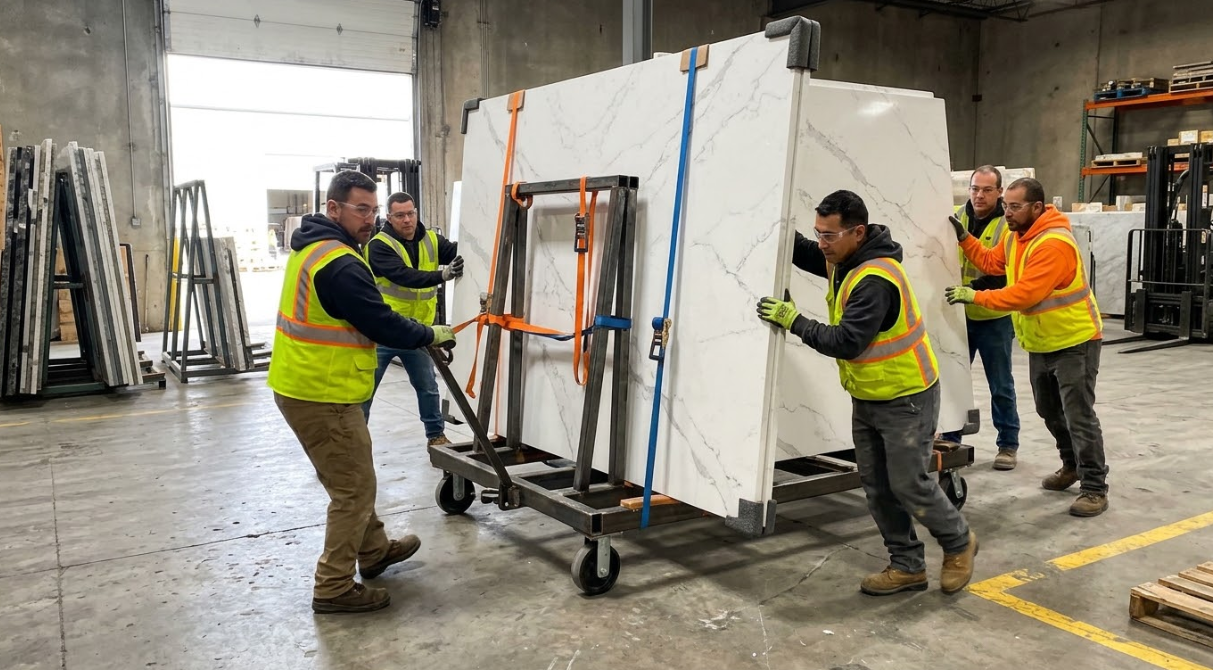
A fact that rarely appears in cost guides but matters enormously on job day: a Cambria jumbo slab is heavy. At 60 square feet, Cambria’s published weight specs put the slab at roughly 600 pounds at 2cm thickness and about 900 pounds at 3cm.
That weight creates practical constraints that contractors and project managers need to plan around:
Doorways and hallways. The slab measures 132 inches (11 feet) on its long side. During the site walk, verify that the entry path to the kitchen can physically accommodate it. This should be part of your pre-templating checklist.
Elevators. In high-rise condo and multi-story work, practitioners report that assuming a jumbo slab solves a seam problem without checking access is a common and expensive mistake. The slab eliminates the island seam only if it can physically reach the space.
Crew size. Safe handling requires the slab to be carried on edge by a minimum two-person crew, though many fabrication shops use four people for 3cm jumbo slabs. Plan your labor accordingly.
HOA and building restrictions. Some condos have delivery windows, elevator weight limits, or corridor protection requirements that add scheduling complexity. For GCs coordinating multiple trades, this needs to be established before the slab is ordered.
Fabricators also factor remake risk into jumbo slab pricing. According to SlabWise, a single remake on a Cambria slab can cost $1,500 to $4,000 or more, depending on the design and slab size. That risk gets priced into quotes, especially on higher-tier designs where replacement slabs may not be immediately available. Accurate templating and careful handling on-site are the most effective ways to control this exposure.
Cambria Jumbo Slab Weight by Thickness
Cambria jumbo slabs are available in different thicknesses depending on the selected design. Thickness affects the slab’s total weight, handling requirements, fabrication process, and final application.
For a nominal 60-square-foot jumbo slab, the approximate weights are:
Slab Thickness | Approximate Weight per Sq Ft | Estimated Jumbo Slab Weight |
|---|---|---|
1cm | 6 lbs | 360 lbs |
2cm | 10 lbs | 600 lbs |
3cm | 15 lbs | 900 lbs |
These figures are calculated using Cambria’s published approximate weight per square foot and a nominal 60-square-foot slab. Actual weights can vary.
Which thickness should you choose?
1cm: Suitable for select specialty and vertical applications, including certain wall cladding and backlighting projects.
2cm: Offers a thinner countertop profile and may require additional edge-building depending on the desired appearance.
3cm: Creates a thicker countertop profile without requiring the same built-up edge treatment as thinner material.
Not every Cambria design is available in every thickness. Confirm the design’s specifications before ordering, and have the fabricator determine the appropriate lifting equipment and handling procedure.
If you’re a contractor planning the logistics of a full kitchen job, our kitchen remodel checklist covers the delivery and sequencing steps that prevent these surprises.
What Else Affects the Final Cambria Jumbo Slab Cost?
The slab and its design tier are the biggest variables, but several other factors shape the installed price that trade professionals need to account for in estimates.
Edge profiles. A simple eased or beveled edge might add $2–$5 per linear foot. A mitered or waterfall edge can run $20–$40 per linear foot. On a large island with waterfall sides, edge work alone can add $500–$1,500. Presenting these options to clients with clear pricing attached prevents scope creep. For a full breakdown, see our guide on countertop edge profiles.
Cutouts. Sink and cooktop cutouts typically cost $100–$250 each. Undermount sink cutouts require more precise work than drop-in styles. Itemize these in your estimates rather than burying them in a per-square-foot rate.
Number of seams. Even a jumbo slab may need seams on L-shaped or U-shaped layouts. Each seam adds fabrication time and material waste. For guidance on where seams should land to minimize visibility and maximize slab yield, our seam placement guide walks through the planning process.
Fabricator nesting efficiency. How well a fabricator arranges countertop pieces on the slab directly affects waste. Some shops report 10–15% better yields using digital nesting software compared to manual layout, translating to $500–$1,500 in savings on a large Cambria kitchen job. If you’re working with a fabrication partner, ask how they optimize nesting.
Regional labor rates. Washington State installation rates tend to run higher than the national average. A project quoting $85/sq ft installed in a lower-cost market might come in at $100–$120/sq ft in the Seattle metro area. Trade professionals operating in the Puget Sound region should build this differential into client proposals.
The fabrication shop’s business model. A practitioner on the Houzz forums noted that “the higher costs are from the full-service design shops who offer design integration for your whole project. They don’t sell just counters. There is no money in that.” If you’re a designer or remodeler partnering with a full-service fabricator, the installed rate reflects their design coordination, not just material and labor.
Another Houzz contributor pointed out that “a LOT of the cost is for the labor which is pretty much the same for granite or quartz.” The slab size changes material cost, but fabrication and installation labor stay roughly constant whether you’re working with a standard or jumbo slab. This is useful when explaining cost breakdowns to clients.
Cambria vs. Other Quartz Brands: Jumbo Slab Dimensions
Jumbo is not a standardized measurement across countertop manufacturers. Each brand uses its own slab dimensions, and not every design is available in the largest format.
The following comparison illustrates the differences between two manufacturers with published jumbo specifications.
Manufacturer | Jumbo Slab Dimensions | Approximate Nominal Area |
|---|---|---|
Cambria | 132″ x 65.5″ | 60 sq ft |
Caesarstone | 128″ x 64.5″ | Approximately 57 sq ft |
Cambria also publishes a super jumbo specification of approximately 136″ x 80″, or 76 square feet, in its product specification documentation. Confirm current availability for the specific design and project before including it in a material estimate.
When comparing quartz manufacturers, evaluate more than the advertised slab area. Thickness, design availability, usable cutting area, warranty coverage, and fabricator support all influence the final project cost.
For contractors, the most useful comparison is the amount of finished countertop each slab can produce without compromising seam placement or design continuity.
For a broader comparison of quartz slab options and how they’re priced for different project types, prefab vs. slab quartz covers the fundamentals.
How to Quote Cambria Jumbo Slabs Accurately for Client Projects
Since Cambria controls its distribution channel, pricing consistency is higher than with many natural stone products. But trade professionals can still sharpen their estimates and protect margins with the right approach:
Source quotes from multiple authorized fabricators. Cambria’s material cost is fairly standardized across dealers, but fabrication markup, edge pricing, and installation fees vary widely. A 30% gap between two fabricator quotes on the same Cambria design is not unusual. Comparing line-item breakdowns reveals where the variance lives.
Run the slab yield calculation before presenting the estimate. Have the fabricator show you the nesting layout. If the client’s pieces fit on one jumbo slab with reasonable waste, that’s your signal. If they need to cut from two slabs, understand why before committing to a price in your proposal. Getting this wrong is the fastest way to lose margin.
Guide clients to the right design tier early. If a client is drawn to Brittanicca but the project budget says otherwise, knowing which Tier 2 or Tier 3 designs have a similar aesthetic lets you steer the conversation productively. The savings between tiers can be $20–$40 per square foot, which translates to $1,200–$2,400 on a typical kitchen.
Confirm jumbo availability for the selected design before templating. Not all patterns ship in jumbo. Discovering this after the client has signed off creates change orders, delays, and erodes trust.
Verify the delivery path during the site walk. Measure doorways, hallways, and stairwells. If a jumbo slab can’t reach the kitchen, the project needs a standard slab with a seam, and you need to manage that expectation with the client before they’ve committed to a seamless island vision.
Coordinate countertop and cabinet timelines. On projects where both cabinets and countertops are being supplied, sequencing matters. Cabinets need to be installed and level before templating. For trade professionals sourcing cabinets and countertops from a single supplier, consolidated scheduling reduces the gaps between trades. See matching quartz countertops with cabinets for design coordination guidance.
Cambria Jumbo Slab Quote Checklist for Contractors
Before submitting a Cambria jumbo slab order or preparing a countertop proposal, confirm the following details with the authorized fabricator.
Item to Confirm | Why It Matters |
|---|---|
Cambria design name | Determines the exact material being quoted |
Slab format | Confirms standard or jumbo availability |
Slab thickness | Affects weight, appearance, and fabrication |
Slab quantity | Prevents material shortages and unnecessary purchases |
Countertop dimensions | Establishes the actual cutting requirements |
Sink and cooktop cutouts | Prevents missing fabrication allowances |
Edge profile | Determines additional finishing work |
Backsplash requirements | Adds material and installation considerations |
Vein direction and pattern matching | May affect slab utilization and seam placement |
Delivery access | Confirms that the slab or finished pieces can reach the installation area |
Fabrication and installation charges | Clarifies what is included in the quote |
Warranty and care documentation | Helps communicate product coverage to the client |
Before approving the order: Request a slab layout or digital nesting plan showing how the countertop pieces will be cut. Confirm the expected seams, material waste, and additional slab requirements before finalizing the client’s price.
A detailed quotation prevents misunderstandings between the homeowner, contractor, and fabricator while reducing the risk of unexpected material expenses.
Frequently Asked Questions
How much does a Cambria jumbo slab weigh?
At 2cm thickness, a 60 sq ft Cambria jumbo slab weighs approximately 600 pounds. At 3cm, that climbs to about 900 pounds. Cambria’s published specs put the material at roughly 10 lbs per square foot at 2cm and 15 lbs per square foot at 3cm. Plan crew size and equipment accordingly.
Can clients buy a Cambria jumbo slab directly?
No. Cambria sells exclusively through authorized and trained fabricators. End users cannot purchase a loose slab. Projects are routed through Cambria dealers who handle templating, fabrication, and installation, which is why contractors and designers working with established dealer relationships can offer faster project timelines.
Do all Cambria designs come in jumbo?
They do not. Cambria’s FAQ states that “not all designs are available in all slab sizes.” Confirm jumbo availability for the specific pattern before templating to avoid costly re-selections mid-project.
Is a jumbo slab always more cost-effective than two standard slabs?
Not always. For projects needing 42 square feet or less, a single standard slab is the obvious specification. The jumbo pays off when countertop area falls between 48 and 60 square feet, since that range forces a second standard slab purchase that inflates costs by up to 38%. Above 60 square feet, multiple slabs are required regardless, and the math depends on fabricator nesting.
What is a Cambria super jumbo slab?
Cambria’s super jumbo measures approximately 136″ x 80″ and yields a nominal 76 square feet at 3cm thickness. It’s the largest quartz slab produced by any U.S. manufacturer and is designed for commercial applications or very large residential installations where seam elimination is critical.
How does Cambria jumbo slab cost compare to natural stone?
Tier 1–2 Cambria designs ($65–$92/sq ft installed) price competitively with mid-range granite. Tier 5 Cambria designs ($100–$150+/sq ft installed) overlap with premium marble and quartzite, but with the consistency and lower maintenance of engineered quartz. When presenting options to clients, the comparison depends entirely on which design tier is being considered.
Why do different fabricators quote such different prices for the same Cambria design?
Cambria’s material cost is relatively standardized at the wholesale level. The variation comes from each shop’s fabrication markup, edge profile pricing, cutout fees, overhead, and whether they’re a full-service design firm or a fabrication-only operation. For contractors and remodelers comparing fabrication partners, requesting line-item breakdowns reveals where each shop adds its margin.
Does Cambria quartz come with a warranty?
Yes. Cambria backs its quartz surfaces with a transferable limited lifetime warranty covering manufacturing defects. The transferability adds resale value for clients, which can be a useful selling point during the specification process. Specific terms and exclusions are outlined on Cambria’s website.
What is the exact size of a Cambria jumbo slab?
A Cambria jumbo slab measures approximately 132 inches long by 65.5 inches wide, providing a nominal surface area of 60 square feet. Actual usable dimensions may vary, so confirm the slab specifications and cutting requirements with the fabricator before ordering.
Is Cambria jumbo quartz available in 2cm and 3cm thicknesses?
Yes. Cambria offers slabs in 1cm, 2cm, and 3cm thicknesses, depending on the selected design. However, not every design is available in every thickness or slab format. Check the current product specifications before placing an order.
Does a Cambria jumbo slab eliminate countertop seams?
Not necessarily. A jumbo slab provides more surface area than a standard slab, which can reduce the number of seams on certain countertop layouts. However, L-shaped countertops, large islands, waterfall edges, and complicated kitchen configurations may still require multiple pieces and seams.
Can a Cambria jumbo slab fit on a 10-foot kitchen island?
A 10-foot island measures 120 inches in length, while a Cambria jumbo slab is approximately 132 inches long. This provides a nominal 12-inch difference in length. However, the finished countertop must also accommodate the island’s depth, overhangs, edge treatment, and fabrication tolerances. Have the fabricator verify the complete cutting layout before assuming one slab will work.
Is a Cambria jumbo slab worth the extra money?
It depends on the countertop layout and the cost difference between slab formats. A jumbo slab can be worthwhile when its additional dimensions reduce seams, improve cutting efficiency, or eliminate the need for another slab. For smaller projects, a standard slab may be more economical.
Does Cambria sell jumbo slabs directly to homeowners?
Cambria works through exclusive authorized partners rather than offering direct slab sales to homeowners. Customers should contact an authorized Cambria dealer or fabricator for product selection, pricing, templating, and installation arrangements.
If you’re a trade professional in Washington State planning kitchen projects that include quartz countertops alongside cabinetry, explore quartz and cabinet options to benchmark overall project budgets and streamline multi-category sourcing through a single supplier.