
TL;DR
SPC flooring thickness refers to the total measurement of all layers in a plank, typically ranging from 3.5mm to 8mm (sometimes up to 10mm). It is not the same as wear layer thickness, which only measures the thin protective top coat. Thicker planks are not automatically better. Core density, wear layer quality, subfloor preparation, and even your regional climate matter just as much, sometimes more, than raw millimeters. This guide breaks down every thickness spec you need to read before buying.
Quick Answer: What SPC Flooring Thickness Should You Buy?
If you’re choosing SPC flooring for most homes, 5mm to 6mm total thickness with a 20 mil (0.5mm) wear layer offers the best balance of durability, price, and installation performance. Bedrooms and low traffic spaces can use 4mm to 5mm products, while commercial buildings often benefit from 6mm to 8mm planks. The most important factor is not thickness alone. It is the combination of core density, wear layer, locking system, and a properly prepared subfloor.
Picking SPC flooring sounds straightforward until you start reading spec sheets. One product says “6mm,” another says “6/0.5mm + 1.5mm IXPE,” and a third just labels itself “commercial grade” without any numbers at all. The confusion is real, and it leads to bad purchasing decisions.
This guide explains what SPC flooring thickness actually measures, how to read the notation, and how to match thickness to your project. It also tackles a question the industry has been debating openly: does thicker always mean better? And because SPC is a rigid product sensitive to temperature swings, there’s a section on how U.S. regional climate should influence your thickness choice.
If you’re new to this flooring category entirely, start with our guide to SPC flooring for the fundamentals before going deeper on thickness specs.
What Is SPC Flooring Thickness?
SPC stands for Stone Plastic Composite. The core is roughly 60 to 70% calcium carbonate bonded with virgin PVC and stabilizers, creating a rigid, dimensionally stable plank. Some manufacturer formulations push calcium carbonate content even higher, around 72%.
Every SPC plank is a sandwich of four distinct layers, from top to bottom:
- Wear layer, a transparent protective coating that resists scratches and scuffs
- Decorative film, the printed image layer (wood grain, stone, etc.)
- Rigid SPC core, the structural body that provides stability and click lock strength
- Attached underlayment, an IXPE or EVA foam pad for acoustics and comfort (not always included)
When someone says “SPC flooring thickness,” they mean the total measurement from the bottom of the underlayment (or bottom of the core, if there is no pad) to the top of the wear layer. That total number, always expressed in millimeters, is the headline spec on most product listings.
The overall thickness usually falls between 3.5mm and 8mm, though premium products can reach 10mm. Environmental product declarations have confirmed product thickness ranges from 3.2mm to 9.5mm across the category.
How to Read the Notation
In international markets, SPC thickness uses a combined format that packs multiple specs into one shorthand. For example:
5.5 / 0.5 mm + 1.5 mm IXPE
This means:
- 5.5 mm = total plank thickness (the structural portion)
- 0.5 mm = wear layer thickness (the protective surface)
- 1.5 mm IXPE = attached underlayment thickness and type
If you see “6mm SPC flooring” on a product page without further detail, you don’t actually know the breakdown. That 6mm might be a 4mm core with 2mm of EVA padding, or it might be a 5mm core with 1mm of IXPE. The performance difference between those two products is significant.
Looking for detailed breakdowns on specific products? Browse our support hub for guidance on waterproof flooring options with complete specs.
Total Thickness vs. Wear Layer Thickness vs. Core Thickness
This is the single most common confusion point in SPC flooring, and getting it wrong costs money. These three numbers describe completely different things.
Total Plank Thickness
The bottom to top measurement of the entire plank, including any attached padding. Measured in millimeters. This is what determines your transition strip height, door clearance, and how the floor meets adjacent surfaces.
Wear Layer Thickness
The transparent protective coating on top of the decorative film. In North America, it is measured in mil (one mil equals 0.001 inch, or about 0.0254mm). Internationally, it is measured in millimeters. A 20 mil wear layer equals approximately 0.5mm.
Here is a critical distinction that most guides gloss over: the wear layer only prevents surface scuffing and micro scratches. It does not contribute to structural durability. A thicker wear layer will not stop your floor from denting under heavy furniture.
Core Thickness
The rigid SPC body between the decorative film and the underlayment. This is the structural foundation. It determines locking strength, bending stiffness, and resistance to point loads. A 6.0mm plank has approximately 3 to 4 times the bending stiffness of a 4.0mm plank because the core itself is about 1.5 to 1.6 times thicker.
Underlayment Thickness
The IXPE or EVA foam backing, typically 1mm, 1.5mm, or 2mm thick. It improves comfort underfoot and acoustic performance. While it adds to the total thickness number on the spec sheet, its contribution is about user experience, not structural strength.
For a broader look at how SPC compares to other vinyl options on these specs, see our SPC vs. LVP comparison.
Mil to MM Conversion Reference
| Mil | Millimeters | Common Label |
|---|---|---|
| 6 mil | 0.15 mm | Budget residential |
| 8 mil | 0.20 mm | Entry residential |
| 12 mil | 0.30 mm | Standard residential |
| 20 mil | 0.50 mm | Residential/light commercial |
| 28 mil | 0.70 mm | Commercial |
| 30 mil | 0.75 mm | Heavy commercial |
Common SPC Thickness Ranges
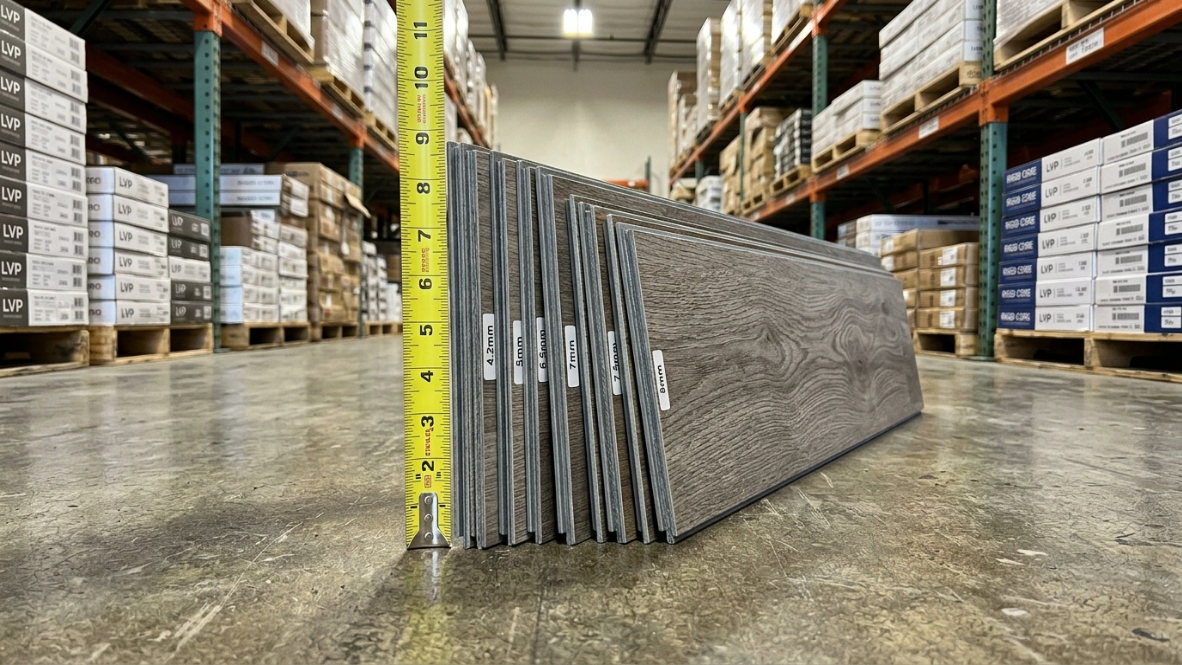
Most SPC flooring on the market falls into a handful of thickness tiers. The table below reflects the consensus from manufacturers, trade publications, and flooring engineers. Many manufacturers aim for a “sweet spot” in the 5 to 6mm range, balancing cost efficiency with adequate performance.
| Total Thickness | Typical Core | Typical Wear Layer | Best Application |
|---|---|---|---|
| 3.5 to 4.5 mm | 3.0 to 3.5 mm | 0.2 to 0.3 mm (8 to 12 mil) | Budget residential, rentals, low traffic bedrooms |
| 5.0 to 5.5 mm | 3.5 to 4.0 mm | 0.3 to 0.5 mm (12 to 20 mil) | Standard whole home residential, multifamily |
| 5.5 to 6.0 mm | 4.0 to 4.5 mm | 0.5 mm (20 mil) | Light commercial (offices, boutique retail) |
| 6.0 to 8.0 mm | 4.0 to 5.5 mm | 0.5 to 0.7 mm (20 to 28 mil) | High traffic commercial (corridors, hospitality) |
| 8.0 to 10.0 mm | 5.5 to 8.0 mm | 0.7 mm+ (28 to 30 mil) | Premium and heavy duty commercial |
Real Product Examples
To make these numbers concrete:
- A 6mm SPC product might break down as a 4mm core with 2mm EVA underlayment, in a 7.5″ x 48″ plank format.
- A 7mm product often means a 5mm core with 2mm EVA, in a wider 9″ x 60″ plank.
- A 10mm premium product could feature a 30 mil (0.75mm) wear layer, an 8mm core, with IXPE padding included in the total.
For an example of a mid range residential product, take a look at our 6.5mm vinyl flooring options to see how these specs translate into an actual product.
SPC Thickness Comparison at a Glance
| Thickness | Best For | Typical Lifespan | Recommended? |
|---|---|---|---|
| 4mm | Bedrooms, rentals | 5 to 10 years | Budget choice |
| 5mm | Most residential homes | 10 to 20 years | Yes |
| 6mm | Whole home residential, light commercial | 15 to 25 years | Best overall |
| 7mm | Premium residential | 20 to 25 years | Excellent |
| 8mm+ | Commercial, hospitality | 20+ years | Commercial use |
How to Choose the Right Thickness for Your Project
Thickness selection is really a matching exercise. You are matching plank specs to traffic level, subfloor condition, and practical constraints like door clearance. Here is how to think about each scenario.
Residential Bedrooms and Low Traffic Rooms
A 4mm to 5mm plank with a 12 mil wear layer will handle bedrooms, guest rooms, and closets without issues. These spaces see minimal foot traffic and almost no rolling loads. The thinner profile also simplifies transitions to adjacent rooms and keeps costs down.
The catch: thinner planks demand a flatter subfloor. Engineering data shows that 4.0mm planks telegraph subfloor irregularities, causing click failures at the locking joints. If your subfloor is not flat within 2mm per 2 meters, either self level it or step up to a thicker plank.
Whole Home Residential
For a full house installation covering kitchens, living rooms, and hallways, 5mm to 6mm with a 20 mil wear layer is the practical sweet spot. This range provides enough rigidity to bridge minor subfloor imperfections and enough wear protection for 15 or more years of family use.
Our Series 1 flooring collection shows options designed for this residential application range.
Light Commercial
Offices, boutique retail spaces, and small restaurants typically need 5.5mm to 6mm planks with a 20 mil wear layer. The slightly thicker core handles rolling office chairs and moderate foot traffic without flexing at the joints.
High Traffic Commercial
Corridors, hotel lobbies, big box retail, and restaurant dining areas call for 6mm to 8mm planks with wear layers of 20 to 28 mil. At this tier, core density becomes as important as raw thickness (more on that below).
Premium and Heavy Duty
Healthcare facilities, airports, and industrial showrooms push into the 8mm to 10mm range with 28 to 30 mil wear layers. These products represent the top of the category.
For projects that demand this premium tier, our LSPC flooring series was developed specifically for high performance applications with enhanced thickness and rigidity.
Climate Considerations for SPC Thickness in U.S. Regions
SPC flooring is marketed as dimensionally stable, and compared to WPC or traditional hardwood, it is. But “stable” does not mean “immune to temperature.” Climate conditions across the United States vary dramatically, and that should inform your thickness selection.
Why Temperature Matters for Rigid Core Flooring
SPC cores contain PVC, which expands and contracts with temperature changes. The calcium carbonate filler reduces this movement significantly compared to pure vinyl, but it doesn’t eliminate it. Thinner planks (3.5mm to 4.5mm) have less mass to absorb thermal stress, making them more susceptible to gapping or buckling at temperature extremes. Thicker cores distribute thermal stress across more material, reducing the chance of visible joint separation.
Practitioners on Reddit’s flooring forums report that SPC installed in sunrooms, enclosed porches, or rooms with large south facing windows sometimes develops gaps at plank seams during winter when heating creates a wide temperature differential between the warm surface and the cold subfloor below. One installer noted that stepping up from a 4mm to a 5.5mm core in a sunroom application eliminated the seasonal gapping issue entirely.
Hot Climate Regions (Southwest, Deep South, Florida)
In states like Arizona, Nevada, Texas, and Florida, interior temperatures can spike if HVAC fails or during move in periods before the system is running. Sustained surface temperatures above 140°F can soften PVC based cores. Direct sunlight through uncovered windows can push floor surface temps well above ambient room temperature.
For these regions:
- Choose 5mm or thicker planks with a core density above 1.95 g/cm³.
- Avoid installing SPC in enclosed sunrooms or solariums without UV filtering window treatments.
- Leave the manufacturer’s recommended expansion gap (typically 1/4″ to 3/8″). In hot climates, erring toward the larger gap is wise.
- Light colored flooring reflects more heat than dark wood grain patterns, reducing surface temperature buildup.
Cold Climate Regions (Pacific Northwest, Midwest, Northeast)
In Washington State (where Krafter’s Land operates), Minnesota, Michigan, and the Northeast corridor, the concern flips. Cold subfloors, especially concrete slabs in basements, can make thin SPC planks feel uncomfortably hard underfoot and increase the risk of contraction gaps during winter.
For cold climate installations:
- A 5.5mm to 6.5mm plank with attached IXPE underlayment provides a thermal break between the cold slab and the walking surface.
- Basements and slab on grade applications benefit from 6mm or thicker products. The added mass improves both thermal comfort and acoustic dampening against the hard substrate.
- Maintain indoor temperatures above 55°F during and after installation. Several manufacturers void warranties if the product is installed in unheated or seasonally heated spaces.
If you’re planning a kitchen remodel in the Pacific Northwest and weighing flooring options, our waterproof kitchen flooring guide covers how SPC handles the moisture and temperature conditions common in Washington homes.
Humid Regions (Southeast, Gulf Coast, Hawaii)
SPC’s waterproof core is a genuine advantage in humid climates. Unlike hardwood, it won’t cup or buckle from moisture absorption. But humidity still matters at the subfloor level. Concrete slabs in humid regions can produce moisture vapor that, without a proper vapor barrier, gets trapped under the flooring and promotes mold.
For humid climates:
- SPC with attached IXPE underlayment that includes a built in moisture barrier simplifies installation over concrete.
- Thickness itself is less critical than underlayment spec in these regions. A 5mm plank with quality IXPE outperforms a 7mm plank with basic EVA when humidity is the primary concern.
- Conduct a calcium chloride moisture test or relative humidity test on concrete subfloors before installation.
Extreme Temperature Swing Regions (Mountain West, High Desert, Parts of the Midwest)
Areas like Denver, Salt Lake City, Boise, and parts of Montana experience 60°F or greater daily temperature swings in spring and fall. Indoor environments with poor insulation or large thermal mass walls transmit those swings to the floor.
For these conditions:
- 5.5mm to 7mm thickness provides the best balance of thermal resistance and cost.
- Maintaining consistent HVAC operation (keeping indoor temps between 65°F and 80°F year round) matters more than any thickness upgrade.
- Avoid leaving SPC planks in an unheated garage or trailer overnight before installation. Acclimate the product in the room where it will be installed for at least 48 hours.
The Bottom Line on Climate and Thickness
Climate doesn’t override the other factors in thickness selection, but it should be part of the equation. A 4mm plank that performs fine in a climate controlled office in San Diego might gap or feel painfully hard in a Seattle basement. When in doubt, stepping up one thickness tier (from 4mm to 5mm, or from 5mm to 6mm) provides meaningful insurance against temperature related issues for relatively little additional cost per square foot.
Does Thicker SPC Flooring Always Mean Better?
No. This is the most persistent myth in the SPC category, and it deserves a direct challenge.
A March 2026 article in Floor Covering News, authored by INSTALL’s executive director, stated plainly that thinner SPC products in the 4mm to 5mm range can often perform just as reliably when matched to the right conditions. The key insight: when subfloors are well prepared and flat within tolerance, thinner SPCs perform just as reliably and often simplify transitions and height clearances.
There are three specific reasons why “thicker = better” fails as a rule.
The Wear Layer Inflation Trade Off
This is a buyer trap that most guides ignore. If the total thickness stays the same, an unnecessarily thick wear layer often means the manufacturer has reduced the SPC core thickness to maintain a price point. You end up with a product that resists surface scratches beautifully but flexes at the joints because the structural core is too thin. A balanced spec sheet beats an impressive sounding wear layer number every time.
Core Density Trumps Raw Thickness
A denser core resists indentation from furniture legs, equipment wheels, and point loads. For commercial applications, target a core density of 2.0 g/cm³ or higher. Below 1.85 g/cm³ usually signals filler heavy material with recycled PVC blended in.
One telling example from a commercial flooring guide: a regional supermarket chain specified a 2.05 g/cm³ minimum density after their previous SPC floor dimpled under checkout queue stanchions within six months. The replacement floor, with the same visual design but a denser core, has been flat for four years.
Transition Height and Door Clearance
Renovation projects must consider how SPC flooring thickness affects door clearance, transition strips to adjacent rooms, and base trim adjustments. A thick plank sounds appealing on paper but creates real headaches if it raises the floor height enough to require cutting down doors or installing bulky transition pieces.
If you’re planning a full kitchen remodel, our kitchen remodel timeline guide covers how flooring selection fits into the broader project schedule.
Practitioners on forums have also noted that adding thick underlayment to an already rigid SPC plank can create a spongy, unstable feel. One user described how a 2mm foam underlayment beneath a 4mm SPC plank resulted in an “overly soft or spongy sensation” that undermined the whole purpose of choosing a rigid core product. In remodel work especially, maintaining locking quality and wear layer specification often delivers greater value than maximizing thickness alone.
Wear Layer Thickness Quick Reference
The wear layer is what determines how long the floor looks good, not how long the structure lasts. Here is what to expect from each tier in terms of realistic lifespan:
| Wear Layer | Expected Lifespan | Application |
|---|---|---|
| 6 to 12 mil (0.15 to 0.30 mm) | 5 to 10 years | Light residential, rental turnover |
| 12 to 20 mil (0.30 to 0.50 mm) | 10 to 15+ years | Standard residential, whole home |
| 20 to 28 mil (0.50 to 0.70 mm) | 15 to 20+ years | Commercial, hospitality, retail |
| 28+ mil (0.70 mm+) | 20 to 25+ years | Heavy commercial, institutional |
A quality 20 mil floor with ceramic bead treatment is engineered for 15 to 25+ years with proper maintenance. At the other end, an 8 mil budget product might only last 5 to 10 years before visible wear makes it unattractive, especially in high traffic areas.
What to Ask Your Flooring Supplier

Vague labels like “commercial grade” or “heavy duty” mean nothing without numbers behind them. Before placing an order, ask these specific questions:
- What is the actual wear layer thickness in mil or mm? Don’t accept a grade label without the measurement.
- What is the core density? For commercial projects, you need 2.0 g/cm³ minimum. For residential, anything above 1.9 g/cm³ is acceptable.
- Does the total thickness include attached underlayment? A “7mm” product might be a 5mm core plus 2mm of EVA. Knowing the breakdown matters.
- What is the subfloor flatness tolerance? Most SPC products require 2mm per 2 meters or less. Thinner planks are less forgiving.
- What locking system does the product use? Click lock quality is the hidden thickness benefit. A well engineered lock on a 5mm plank outperforms a cheap lock on a 7mm plank.
- Is the wear layer virgin PVC or recycled? Recycled content in the wear layer can reduce clarity and scratch resistance.
As Mohawk VP Adam Ward noted in Floor Covering News, “The problem was never SPC; it was low quality SPC.” Understanding thickness specs is your first defense against low quality products that damaged the category’s reputation.
Contact our team if you need help selecting the right SPC thickness for your next project. We work with contractors, dealers, and remodelers across Washington State.
Frequently Asked Questions
What is the best SPC flooring thickness for a kitchen?
A kitchen sees water exposure, dropped items, and steady foot traffic. Most professionals recommend 5.5mm to 6mm total thickness with a 20 mil wear layer. This combination provides enough rigidity to handle point loads from appliances and enough wear protection for the daily demands of a kitchen.
Is 4mm SPC flooring good enough for a home?
It can be, but only in the right conditions. A 4mm SPC plank works for low traffic bedrooms, closets, or rental properties where budget matters. The subfloor must be very flat (within 2mm per 2 meters) because thin planks telegraph every bump and dip. For whole home installations with varied traffic levels, 5mm or above is a safer choice. If you’re outfitting a rental, our cabinets for rental properties guide covers similar cost vs. durability decisions for the full kitchen.
What does “mil” mean on SPC flooring specs?
Mil is a unit of measurement equal to one thousandth of an inch (0.001″). It is used in North America to describe wear layer thickness. A 20 mil wear layer equals approximately 0.5mm. Do not confuse mil with millimeter; they are different units, and mixing them up leads to purchasing the wrong product.
Does SPC flooring thickness include the underlayment?
It depends on the manufacturer. Some list total thickness including the attached IXPE or EVA pad, while others list the core separately and note the pad as an addition (e.g., “5.5mm + 1.5mm IXPE”). Always check whether the headline number includes the padding, because this affects your height calculations for transitions and door clearance.
What is the difference between SPC and LSPC flooring thickness?
LSPC (Luxury Stone Plastic Composite) typically occupies the premium end of the thickness range, often 8mm to 10mm total. It uses the same core technology as standard SPC but with a thicker rigid core and often a higher grade wear layer. LSPC products target applications where maximum stability, sound dampening, and underfoot comfort are priorities.
Does a thicker SPC plank mean better sound insulation?
Not necessarily. Acoustic performance depends more on the underlayment type and thickness than on the rigid core. A 5mm SPC plank with a 2mm IXPE pad may perform better acoustically than a 7mm plank with a 1mm EVA pad. If sound transmission is a concern, look at the underlayment spec specifically and check the product’s IIC (Impact Insulation Class) and STC (Sound Transmission Class) ratings.
How does SPC flooring thickness compare to LVP?
Standard LVP (Luxury Vinyl Plank) is typically thinner and more flexible than SPC, often ranging from 2mm to 5mm with a WPC or flexible vinyl core. SPC’s rigid stone composite core makes it denser and stiffer at equivalent thicknesses. A 5mm SPC plank will feel firmer underfoot and bridge subfloor imperfections better than a 5mm LVP plank. For a detailed comparison, see our SPC vs. LVP flooring guide.
Can I install thick SPC flooring over existing flooring?
In many cases, yes. SPC’s rigid core and click lock installation allow it to float over existing hard surfaces like tile, hardwood, or vinyl, provided the existing floor is flat, clean, and firmly bonded. However, adding SPC thickness on top of an existing floor raises the overall floor height. Account for door clearance, transition heights to adjacent rooms, and appliance fit before committing to a thick product for an overlay installation.
Does climate affect which SPC thickness I should choose?
Yes. In hot climate states like Arizona and Texas, thicker cores (5mm+) resist heat related expansion better than ultra thin options. In cold regions like Washington or Minnesota, 5.5mm to 6.5mm planks with attached IXPE provide a thermal break that improves comfort on cold concrete slabs. Areas with extreme daily temperature swings benefit from 5.5mm to 7mm products and consistent indoor climate control. The climate section above covers regional recommendations in detail.
See how different SPC thicknesses look in completed installations across our showrooms, or visit us in Tukwila, Tacoma, Lynnwood, or Spokane to see samples in person.