TL;DR
SPC flooring stands for Stone Plastic Composite (or Stone Polymer Composite) and is a rigid core luxury vinyl flooring built with a dense, mineral filled core. It resists dents, handles moisture well, and comes in wood look or stone look designs. The plank itself can be waterproof, but the installed floor still depends on subfloor prep, a quality locking joint, and correct installation technique.
So what is SPC flooring in practical terms? It is a type of rigid core luxury vinyl flooring. Its core combines limestone (calcium carbonate), PVC, and stabilizers into a dense, hard plank that resists dents and does not swell from water. The top layer is a printed film that mimics wood grain, natural stone, or ceramic tile, protected by a transparent wear layer. The Resilient Floor Covering Institute (RFCI) defines rigid core flooring as modular flooring with a rigid polymeric core, a decorative top surface, and an optional attached underlayment.
This is not a niche material. In 2024, rigid core products (including SPC and WPC) represented 57.3% of total resilient flooring sales in the U.S., totaling $4.8 billion. If you are comparing flooring for a kitchen, bathroom, basement, or rental property, SPC is one of the most common options you will encounter.
Browse product categories at Krafter’s Land showrooms in Tukwila, Tacoma, Lynnwood, or Spokane to compare flooring alongside cabinets, countertops, and tile.
SPC flooring is a rigid core luxury vinyl flooring made from limestone powder (calcium carbonate), PVC, and stabilizers. Its dense stone polymer core makes it more dent resistant than traditional vinyl flooring while remaining waterproof at the plank level. SPC flooring is best for kitchens, bathrooms, basements, rental properties, and high traffic homes because it combines durability, moisture resistance, and realistic wood or stone designs with relatively low maintenance.
At a Glance
| Feature | SPC Flooring |
|---|---|
| Full Name | Stone Plastic Composite (Stone Polymer Composite) |
| Flooring Type | Rigid Core Luxury Vinyl |
| Waterproof | Yes (plank), installation still matters |
| Good for Bathrooms | Yes |
| Good for Basements | Yes |
| Good for Kitchens | Yes |
| Can be Refinished | No |
| Typical Lifespan | 15 to 25+ years depending on quality |
| DIY Friendly | Yes (Click Lock) |
| Best Advantage | Dent resistance |
| Biggest Weakness | Requires a flat subfloor |
What Does SPC Stand For?
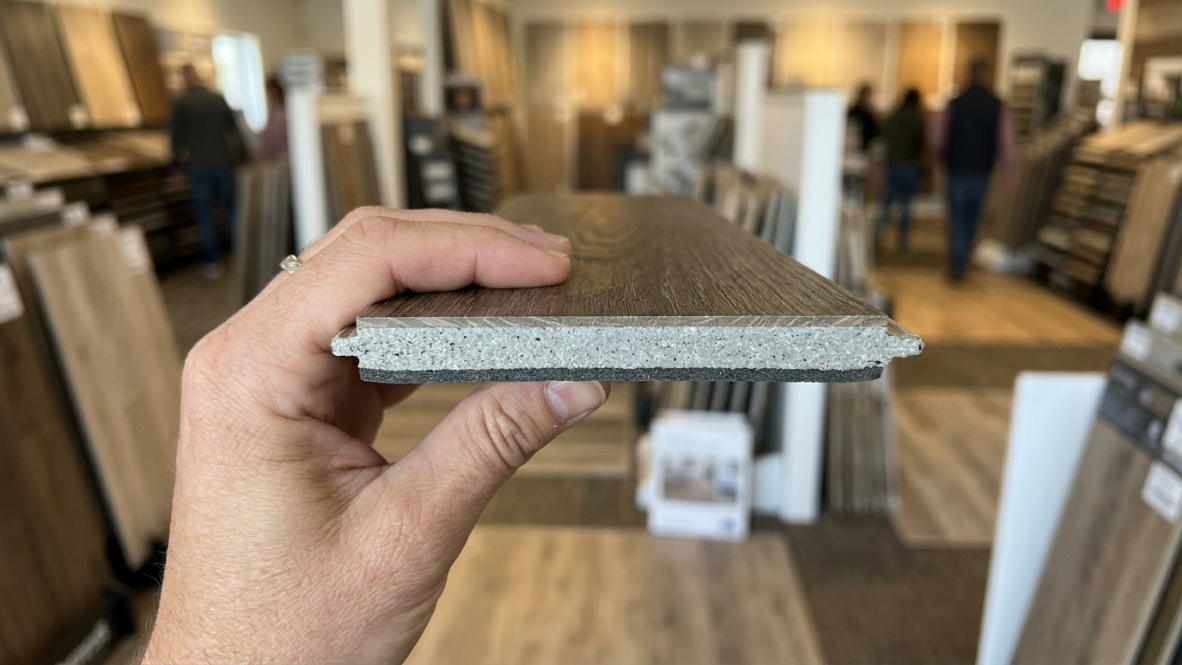
SPC stands for Stone Plastic Composite or Stone Polymer Composite. Both names describe the same product: a rigid core vinyl plank or tile with a dense, mineral filled core. You may also see the abbreviation defined as Solid Polymer Core, which is the term RFCI uses within its rigid core flooring category.
The names vary by manufacturer, region, and trade organization, but they all point to the same construction: a hard core made primarily from calcium carbonate (limestone powder), polyvinyl chloride, and stabilizers. If you see different labels on spec sheets, catalogs, and showroom tags, know that all three terms refer to the same type of core. When buyers search “what is SPC flooring,” the acronym itself is often the first point of confusion, but once you get past the naming, every version describes an identical product category.
Is SPC Flooring the Same as Vinyl, LVP, or LVT?
This is where most of the confusion lives. Short answer: SPC flooring is vinyl flooring, but not all vinyl flooring is SPC. People who already understand what is SPC flooring at the core level still get tripped up by the overlapping terminology at the retail level. For a deeper breakdown of how these two terms relate, see the full SPC vs LVP comparison.
| Term | What It Describes | Plain Meaning |
|---|---|---|
| SPC | Core construction | A rigid stone/polymer core inside the plank or tile |
| LVP | Shape and format | Luxury vinyl plank, usually a long wood look piece |
| LVT | Shape and format | Luxury vinyl tile, often a stone look or ceramic look piece |
| WPC | Core construction | A foamed/expanded polymer core, lighter and softer than SPC |
| Rigid core | Product category | Any vinyl flooring with a rigid polymeric core |
SPC and LVP are not competing categories. LVP and LVT describe format and appearance, while SPC and WPC describe the internal core that drives performance. A wood look SPC plank is both SPC and LVP. A tile look SPC product is both SPC and LVT.
When a showroom tag says “SPC LVP,” it means a wood look plank with a stone/polymer rigid core. When it says “SPC LVT,” it means a tile look format with the same type of core. The SPC part tells you how the floor performs. The LVP or LVT part tells you how it looks.
What Is SPC Flooring Made Of?
SPC flooring is a layered product. The exact stack varies by brand, but most SPC planks contain five layers from top to bottom:
1. UV or protective coating. A thin topcoat that helps resist surface staining, fading, and minor abrasion.
2. Wear layer. A transparent film that sits on top of the printed design and takes daily abuse from foot traffic, pet claws, and chair legs. Thickness is measured in mils (thousandths of an inch). Thicker wear layers generally mean longer surface life, though thickness alone does not guarantee scratch resistance.
3. Printed design layer. The high resolution image of wood grain, stone, marble, or whatever look the manufacturer chose.
4. SPC rigid core. The defining layer. A dense, compressed mix of limestone powder, PVC, and stabilizers. This core gives SPC flooring its hardness, dent resistance, and dimensional stability. It is also why the plank does not swell or warp from water contact.
5. Attached pad or underlayment. Often made from IXPE, EVA, or cork. This backing layer helps with sound reduction, minor cushioning, and easier floating installation. Not all products include one, and adding a separate underlayment is not always allowed by the manufacturer.
Understanding what is SPC flooring at the layer level matters because performance depends on how each layer is specified, not just whether it exists. The core is what separates SPC from flexible sheet vinyl, peel and stick tiles, or traditional glue down LVT. If you want to see how core composition varies across product lines, Krafter’s Land published a look at their LSPC flooring series that breaks down these differences.
How SPC Flooring Is Manufactured
Many people know what is SPC flooring made of but not how it gets from raw powder to a finished plank. The process is straightforward in concept, though quality control at each stage is what separates a reliable product from a cheap one.
Raw Materials
The core ingredients are limestone powder (calcium carbonate), PVC resin, and stabilizers. These are dry blended in precise ratios. The limestone content typically makes up 60% to 80% of the core by weight, which is what gives SPC its density and rigidity. The remaining components include the printed decorative film, a transparent wear layer, a UV coating, and (for most products) an attached backing pad.
Manufacturing Process
- Mixing. Limestone powder, PVC resin, and stabilizers are combined in a high speed mixer until uniform.
- Heating. The blended material is fed into an extruder and heated until it reaches a workable, semi molten state.
- Extrusion. The heated compound is forced through a flat die to form a continuous rigid core sheet at a controlled thickness.
- Lamination. The decorative printed film is bonded to the top of the still warm core using heat and pressure.
- Wear layer application. A transparent wear layer (usually PVC or polyurethane based) is pressed onto the decorative film to protect the printed surface.
- UV coating. A final UV cured topcoat is applied, adding scratch and stain resistance.
- Cutting. The continuous sheet is cut into individual plank or tile dimensions.
- Click lock profiling. Edges are milled with precision routing tools to create the tongue and groove click lock profiles that allow tool free installation.
- Quality inspection. Finished planks go through dimensional checks, visual inspection, and (in better factories) batch testing for locking joint strength, flatness, and wear layer adhesion.
The critical variable most buyers never see is consistency. Small deviations in core density, extrusion temperature, or click profile milling can cause locking failures and dimensional problems that only show up after installation. This is one reason why brand and factory source matter more than most spec sheets suggest.
SPC Flooring Thickness: What the Numbers Actually Mean
Thickness is one of the first specs buyers notice when researching what is SPC flooring, but it is also one of the most misunderstood. A thicker plank is not automatically a better plank.
Total thickness for SPC flooring typically ranges from about 4mm to 8mm. That number includes the wear layer, decorative film, rigid core, and any attached pad. Two planks with identical total thickness can perform very differently if the core, wear layer, and pad proportions differ.
Here is what matters more than the total number:
Core thickness determines rigidity, dent resistance, and how well the plank bridges minor subfloor imperfections. A thicker core (say 4.5mm or above) generally provides better structural integrity and a more solid feel underfoot.
Wear layer thickness determines how long the surface holds up to foot traffic and abrasion. A 12 mil wear layer on a budget product wears through much faster than a 20 mil or 28 mil layer on a mid range or commercial grade plank.
Attached pad thickness affects sound dampening and comfort. But too thick a pad under a thin core can create flex, which stresses locking joints.
Practitioners on Reddit frequently point out that a 5mm SPC with a 20 mil wear layer and quality click system will outperform a 7mm product with a 6 mil wear layer and a flimsy lock. The numbers on the box tell part of the story. The proportions tell the rest.
For a full breakdown of how to read and compare thickness specs, see the SPC flooring thickness guide.
Pros and Cons of SPC Flooring
Knowing what is SPC flooring at the construction level only gets you halfway. What really matters is how it performs in a home or commercial space. Here are the actual strengths and weaknesses.
Pros
Dent and indentation resistance. SPC’s dense core makes it harder to dent than WPC or flexible vinyl. RFCI notes that the solid polymer core provides greater resistance to indentations along with improved dimensional stability and favorable temperature stability. For high traffic kitchens, rental units, or commercial spaces, this matters.
Water resistance. SPC planks do not absorb water the way wood or laminate does. The core will not swell, buckle, or delaminate from spills or humidity. That makes SPC vinyl flooring a practical choice for bathrooms, laundry rooms, and basements. For kitchen specific options, see the guide to waterproof kitchen flooring.
Broad visual range. SPC is not limited to one look. It comes in wide plank oak, narrow hickory, herringbone patterns, stone look tiles, and concrete look formats. For a sense of the design variety available, Krafter’s Land flooring collections show how different styles can fit different project aesthetics.
Floating click installation. Most SPC products use a click lock system that lets the floor float over the subfloor without glue or nails. This can speed up remodels significantly, especially in occupied homes or rental turnovers.
Easy maintenance. Sweep, vacuum, damp mop. No waxing, sealing, or refinishing needed.
Cons
Hard and cold underfoot. The density that makes SPC dent resistant also makes it feel firm and cool, especially over concrete. An attached pad helps, but SPC will never feel like carpet or cork.
Not scratch proof. The wear layer resists normal scuffing, but grit, pet claws, heavy furniture, and dragged objects can still scratch or gouge the surface. Practitioners on Reddit report seeing scratched SPC floors within a year, even when the product was marketed as scratch resistant.
Locking joints can fail. This is a bigger deal than most product pages admit. A flooring industry commenter on Reddit said they had seen plenty of joint failures but had never seen a wear layer fail in a decade. The click lock connection is often the real weak link.
Needs a flat subfloor. SPC is rigid, so it does not flex to accommodate dips, humps, or voids in the substrate. Subfloor prep is not optional, and skipping it is one of the most frequent causes of SPC complaints.
Cannot be refinished. Unlike hardwood, you cannot sand and restain SPC. When the wear layer is gone, the floor is done.
Quality varies enormously. A well made SPC product installed correctly can last years. A cheap, thin product over a rough subfloor can fail within months.
How Long Does SPC Flooring Last?
| Product Quality | Expected Lifespan |
|---|---|
| Budget SPC | 10 to 15 years |
| Mid range SPC | 15 to 20 years |
| Premium SPC | 20 to 30 years |
| Commercial Grade | 25+ years |
These ranges assume proper installation and reasonable maintenance. In practice, lifespan depends more on the following factors than on the price tag alone:
Wear layer thickness and quality. A thicker, harder wear layer resists surface degradation longer. But cheap wear layers can delaminate or cloud regardless of thickness.
Installation quality. Poorly seated click joints, missing expansion gaps, and uneven subfloors create stress points that shorten life dramatically.
Subfloor condition. A flat, stable substrate is the foundation everything else relies on. Dips and humps cause flex, which causes cracking and joint separation.
Maintenance habits. Grit left on the surface acts like sandpaper under foot traffic. Regular sweeping is the single cheapest way to extend SPC floor life.
Traffic volume. A hallway in a family of five with dogs wears differently than a guest bedroom. Match the product spec to the actual use.
SPC vs WPC Flooring
RFCI identifies two rigid core constructions: SPC (solid/dense polymer core) and WPC (expanded polymer core). Neither is automatically better. The right choice depends on the room, the traffic, the subfloor, and the client’s comfort expectations.
| Factor | SPC | WPC |
|---|---|---|
| Core feel | Dense, hard, rigid | Lighter, foamed, softer |
| Dent resistance | Stronger | Weaker |
| Comfort underfoot | Firmer, can feel cold | Warmer, quieter |
| Sound | Can sound hollow or clicky | Usually quieter |
| Dimensional stability | Very stable | Good, slightly less stable |
| Temperature tolerance | Strong | Good |
| Common failure mode | Brittle or weak locking joints | Dents and compression marks |
A flooring professional on Reddit put it plainly: SPC is more rigid and dent resistant, but that same rigidity makes thin SPC more prone to breaking if poorly supported. Another installer who compared many products noted that thicker WPC products with stronger locking systems often outperformed cheap, thin SPC in real world callbacks.
Pick SPC for density and stability in high traffic or temperature variable spaces. Pick WPC for comfort and sound in living areas and bedrooms. Either way, the locking system and subfloor prep matter more than the acronym on the box.
SPC Flooring vs Laminate vs Hardwood vs Tile
Once you know what is SPC flooring and how it compares to WPC, the next question is usually how it stacks up against entirely different flooring categories.
| Flooring | Waterproof | Dent Resistant | Scratch Resistant | Comfortable | Cost |
|---|---|---|---|---|---|
| SPC | Yes | Excellent | Good | Medium | $$ |
| Laminate | No | Good | Excellent | Medium | $ |
| Hardwood | No | Fair | Fair | Excellent | $$$$ |
| Porcelain Tile | Yes | Excellent | Excellent | Hard | $$$ |
SPC and laminate both click together and look like wood, but laminate swells when wet. That rules laminate out for bathrooms, kitchens near sinks, and basements. SPC handles those spaces without issue.
Hardwood wins on feel, character, and long term value since it can be sanded and refinished multiple times. But hardwood costs significantly more, cannot handle moisture, and requires more upkeep. For a rental or a busy family kitchen, SPC is the more practical pick.
Porcelain tile matches or exceeds SPC on durability and water resistance. It is harder, heavier, and more permanent. The tradeoff is higher installation cost, cold feel, and the difficulty of removal or replacement. In bathrooms where a permanent, high end finish is the goal, tile often makes more sense. In spaces where speed, budget, or future flexibility matter, SPC is the easier call.
Is SPC Flooring Waterproof?
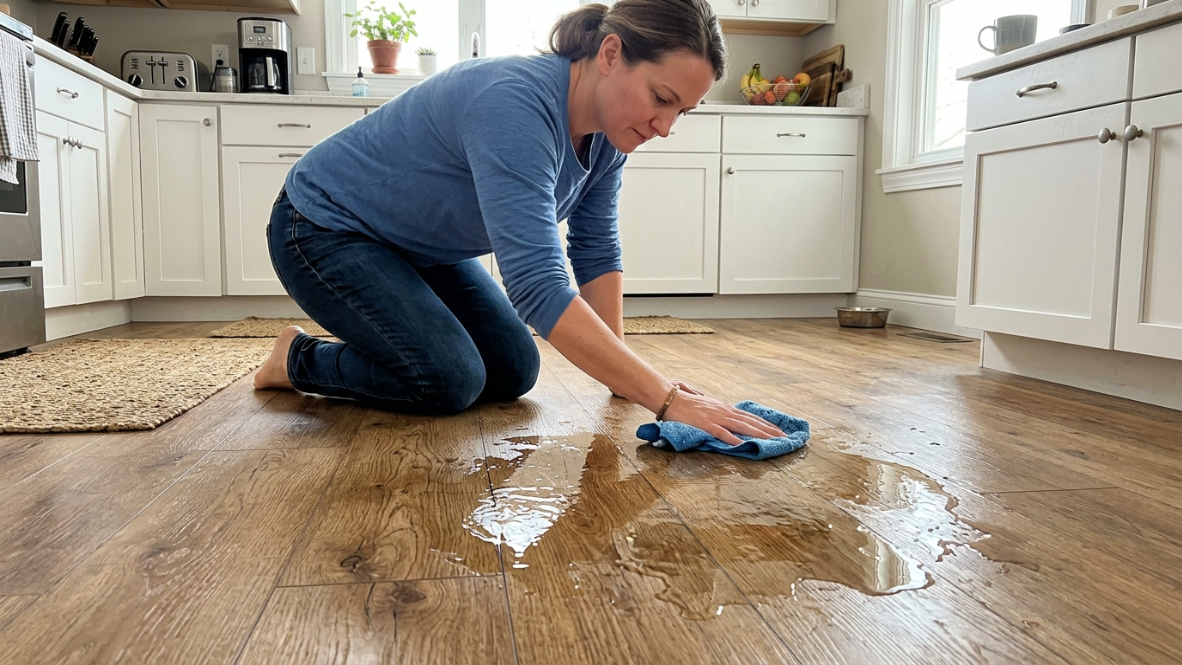
The plank is typically waterproof. The installed floor is not a bathtub.
This distinction trips up many buyers. SPC’s rigid core does not absorb water, swell, or delaminate from contact with liquid. That is genuinely useful in kitchens, bathrooms, and basements. But “waterproof plank” and “waterproof floor” are two very different things.
Water can still travel around plank edges, under baseboards, through transition strips, and into seams. Moisture trapped underneath a floating floor can create mold, odor, and subfloor damage even when the planks themselves are fine. RFCI describes rigid core products as having “water resistant capabilities,” noticeably more careful language than the “100% waterproof” marketing claims common in the retail space.
Manufacturer installation guides reinforce this. One commercial SPC installation manual requires that mold and moisture issues be corrected before installation, that concrete floors be dry and prepared under ASTM F710, and that below grade slabs include a suitable vapor retarder.
SPC is a good choice for spill prone rooms. It is not a substitute for fixing leaks, wet slabs, or poor drainage.
Where SPC Flooring Works Best
Stone polymer composite flooring performs well in:
- Kitchens where spills, drops, and heavy foot traffic are daily events
- Bathrooms and powder rooms where moisture exposure is constant
- Laundry rooms where water splashes are inevitable
- Basements where humidity is higher, provided moisture conditions are controlled
- Rental properties where durability and easy turnover matter
- Mudrooms and entryways where grit and wet shoes come in
- Pet and kid households where the floor takes a beating
- Light commercial spaces like small retail stores, offices, or showrooms
SPC also fits well in whole home remodels where flooring needs to coordinate with cabinets, countertops, and tile. When selecting surfaces for a kitchen or bath renovation, flooring decisions often happen alongside choices about quartz vs granite countertops and cabinet styles.
Where SPC Flooring May Not Be the Best Choice
Knowing what is SPC flooring good at also means knowing where it falls short. Consider alternatives if:
- The subfloor has major movement or deflection. SPC is rigid and unforgiving. It will not flex gracefully over a bouncy plywood subfloor or cracked concrete.
- Warmth and softness matter most. Clients who want a warm, soft feel underfoot will not get it from SPC, even with an attached pad.
- The client expects real hardwood character. SPC can look like wood, but it does not feel, sound, or age like wood. Clients who value refinishability and natural patina should consider actual hardwood.
- The budget cannot include subfloor prep. If the floor is not flat, SPC will eventually fail. Leveling compound, grinding, and patching add cost that many buyers do not anticipate.
- The space has chronic moisture or active leaks. Waterproof planks do not fix a wet basement or a leaking pipe. Fix the water problem first.
- The installation is outdoors or unconditioned. Manufacturer guidelines commonly require service life temperatures between 55°F and 100°F. Garages, patios, and buildings without climate control are typically off limits unless the manufacturer explicitly approves them.
Is SPC Flooring Safe? VOCs and Indoor Air Quality
Safety concerns around SPC flooring usually center on two things: the PVC content and volatile organic compound (VOC) emissions. Both deserve a straight answer.
SPC contains PVC, which is a thermoplastic polymer. Some environmental groups flag PVC production and end of life disposal as concerns. During normal residential use, however, properly manufactured SPC flooring does not off gas PVC in any meaningful way. The risk is not in the material sitting on your floor. It is in how the product was manufactured and what additives were used.
The more practical concern for homeowners is VOC emissions from the finished product. Low quality SPC from unregulated factories can contain plasticizers (including phthalates) and release volatile compounds that affect indoor air quality, especially in the first weeks after installation.
Two certifications help cut through the marketing noise. FloorScore certification means the product has been independently tested for 35 VOC compounds under California’s Section 01350 standard. ASSURE Certified, administered by RFCI, goes further for rigid core products specifically, covering indoor air quality, performance properties, heavy metals, and ortho phthalates.
If indoor air quality matters (and it should, especially in homes with children or in tight, energy efficient buildings), ask the supplier for third party test documentation. A logo on the box is not enough. Ask for the actual certification number or test report.
Practitioners on flooring forums consistently recommend ventilating the space well for the first few days after installation, even with certified products. Open windows, run fans, and avoid sealing the room up immediately.
What to Check Before Buying SPC Flooring
Spec sheets can be misleading if you only look at one or two numbers. Here is what actually matters when evaluating what is SPC flooring worth buying versus what should be avoided.
Total thickness and core thickness. Total plank thickness is useful but not the whole picture. A 6mm plank with a thick core and thin wear layer performs differently than a 6mm plank with a thin core and thick wear layer. Ask about core thickness separately. Products like this 6.5mm vinyl flooring help illustrate how thickness specs break down in practice.
Wear layer thickness. Measured in mils. A 20 mil wear layer is standard for residential use, while 28 mil is common for heavy residential or light commercial. But wear layer thickness alone does not determine surface durability. Finish quality, texture, and daily maintenance habits all play a role.
Locking system quality. This is the spec most people overlook, and the one that causes the most real world failures. A flooring distributor on LinkedIn warned that weak SPC locking systems lead to gapping, breakage, installer complaints, warranty pressure, and unsellable inventory. Ask what click profile the product uses. Inspect full planks, not just small display samples.
Attached pad type. IXPE, EVA, and cork pads each have different sound and comfort properties. Some products ship without a pad. Adding a separate underlayment is sometimes prohibited because too much cushion stresses the locking joints.
Subfloor flatness tolerance. Most SPC products require the substrate to be flat within 3/16 inch over 10 feet. This is not the same as “level.” A floor can be slightly out of level (tilted relative to gravity) and still be flat enough. A floor can also look level but have dips and humps that cause bounce, hollow sound, and broken joints.
Certifications. Look for FloorScore or ASSURE Certified documentation. Ask for test reports, not just logos.
Warranty exclusions. Read the fine print. Many warranties exclude scratches from normal use, rolling loads, moisture damage from improper installation, sun exposure, and subfloor issues. Some are non transferable.
For contractors and dealers sourcing rigid core vinyl flooring for projects, a weak click system is not a small defect. It becomes a callback and margin problem. If you are a trade professional, register as a vendor to access Krafter’s Land’s dealer and contractor network across Washington.
Installation Notes Contractors and Homeowners Should Know
SPC flooring clicks together. That does not mean it installs over anything.
Subfloor prep is not optional. The subfloor must be clean, dry, smooth, structurally sound, and flat. High spots should be ground down. Low spots should be filled. Carpet, cushioned vinyl, and layered soft substrates are typically not acceptable underneath click SPC.
Flat and level are different problems. Level means horizontal relative to gravity. Flat means a smooth plane without humps, dips, or voids. A floor can be slightly out of level but flat enough for SPC. A floor that looks level can still have hidden dips that cause the planks to flex, bounce, and eventually crack at the locking joints. Practitioners on flooring forums call lack of substrate flatness “probably the number one cause” of click flooring failures.
Expansion gaps matter. SPC expands and contracts with temperature changes. Leave the gap the manufacturer specifies around walls, cabinets, islands, and transitions. Do not pin the floor with moldings or heavy furniture placed too close to edges.
Moisture barriers may still be needed. Even though SPC planks resist water, concrete subfloors can transmit moisture vapor. Manufacturer instructions commonly require moisture testing and, on below grade or on grade concrete, a suitable vapor retarder.
Do not add underlayment unless the manufacturer allows it. If the product already has an attached pad, stacking additional underlayment can create too much cushion, which stresses locking joints and leads to failure.
Temperature matters during installation. Store materials in a climate controlled space between 65°F and 85°F, and let them acclimate for at least 48 hours before work begins. Keep the room within that range during and after installation.
Different click systems need different techniques. Installers moving between laminate, LVT, and SPC should review the specific product’s installation instructions. Not every click floor installs the same way, and forcing a technique from one product onto another can damage joints.
An experienced installer on Reddit summed it up well: newer SPC products can be long lasting, good looking options for busy homes, and they generate few complaints when quality and installation are both right. The problems show up when cheap products meet poor prep.
SPC Flooring and Radiant Heat
A common question from homeowners and contractors in colder climates: can SPC flooring go over radiant heating systems?
The short answer is yes, most SPC products are compatible with radiant heat, but with conditions. Manufacturers typically approve hydronic (water based) radiant heat and sometimes electric systems, provided the surface temperature at the flooring does not exceed a stated maximum, usually around 80°F to 85°F.
The reason SPC handles radiant heat better than many other vinyl products goes back to its core composition. The high limestone content gives it strong dimensional stability across temperature changes. It expands and contracts less than WPC or flexible vinyl when temperatures shift.
That said, there are rules to follow. The heating system must be operational for at least two weeks before installation so the subfloor fully acclimates. Temperature should be reduced to around 65°F during the actual install, then gradually brought back up over several days. Sudden temperature spikes can stress locking joints.
Not every SPC product carries the same radiant heat approval. Always verify with the specific manufacturer’s installation guide before committing. Getting this wrong can void the warranty entirely.
Maintenance Tips for SPC Flooring
| Do | Avoid |
|---|---|
| Sweep often | Steam mops (unless approved) |
| Use felt pads | Steel wool |
| Damp mop | Flood mopping |
| Use pH neutral cleaner | Bleach |
| Trim pet nails | Dragging furniture |
A few additional points worth noting. Place walk off mats at all exterior doors to catch grit before it reaches the floor. Grit is the real enemy of wear layers, not water or foot traffic. For furniture, use flat, non staining felt pads rather than rubber or plastic casters, which can leave marks or create suction that damages the surface.
Avoid leaving standing water on the floor, even though the planks resist moisture. Water that sits in seams or along edges for extended periods can migrate underneath and cause problems with the subfloor, not the SPC itself.
SPC Flooring Cost in 2026
| Cost | Typical Range |
|---|---|
| Material | $2 to $7/sq ft |
| Installation | $2 to $5/sq ft |
| Premium Products | $6 to $10/sq ft |
| Total Installed | $4 to $12+/sq ft |
The wide range reflects real differences in product quality, wear layer thickness, design realism, and locking system engineering. A $2/sq ft product from an unknown factory is not the same as a $6/sq ft product with a 28 mil wear layer, attached IXPE pad, and certified indoor air quality documentation.
Installation costs also vary by region. In the Pacific Northwest, expect installation to land toward the middle or upper end of that range, depending on subfloor condition and job complexity. Subfloor leveling, old flooring removal, and transition work are commonly billed separately.
For contractors and builders coordinating kitchen or bath projects, bundling flooring selection with other finish materials can simplify logistics. Krafter’s Land showrooms carry SPC flooring alongside cabinets, countertops, tile, and shower products, which helps when planning a kitchen remodel or bathroom renovation with multiple finish selections happening in parallel.
SPC Flooring FAQ
What is SPC flooring, and what does it stand for?
SPC stands for Stone Plastic Composite, Stone Polymer Composite, or (in RFCI industry terminology) Solid Polymer Core. All three names describe a dense, rigid core made from limestone powder, PVC, and stabilizers used in vinyl flooring planks and tiles. When people ask what is SPC flooring, the simplest answer is: a waterproof, dent resistant vinyl plank or tile with a stone filled core.
Is SPC flooring the same as LVP?
Not exactly. SPC describes the rigid core inside the flooring. LVP means luxury vinyl plank and describes the plank shape and wood look format. Many SPC floors are also LVP, but some LVP products use a WPC core or a flexible core instead. The terms describe different aspects of the same product.
Is SPC flooring waterproof?
The plank and core are commonly waterproof or highly water resistant. But the installed floor is not a sealed membrane. Water can still get under planks through edges, seams, and transitions. Subfloor moisture, active leaks, and flooding can still cause problems. Always follow the manufacturer’s moisture and subfloor prep requirements.
Does SPC flooring scratch?
Yes, it can scratch. The wear layer resists normal scuffing, but grit, pet claws, dragged furniture, and abrasive cleaning products can scratch or dull the surface. Use walk off mats at entries, put felt pads under furniture legs, and sweep regularly.
Is SPC flooring better than WPC?
Neither is universally better. SPC is denser and more dent resistant, making it a strong choice for high traffic areas and spaces with temperature swings. WPC is softer and quieter underfoot, which makes it more comfortable in living rooms and bedrooms. The best choice depends on the room, the subfloor, and what matters most to the people using the space.
Can SPC flooring go over existing tile?
Sometimes. If the existing tile is firmly bonded, smooth, dry, structurally sound, and flat within the product’s tolerance, some manufacturers allow it. Grout lines may need to be filled to meet flatness requirements. Always check the specific product’s installation instructions before installing over an existing hard surface.
Does SPC flooring need underlayment?
It depends on the product. Many SPC planks come with an attached pad, and adding a separate underlayment on top of the built in pad is often prohibited. Too much cushion underneath a floating floor can stress the locking joints and cause failure. If the product does not have an attached pad, the manufacturer may recommend or require a specific underlayment type.
Is SPC flooring safe for indoor air quality?
Quality SPC flooring with FloorScore or ASSURE certification meets strict VOC emission standards. Budget products from unregulated factories may contain higher levels of plasticizers or volatile compounds. Ask for third party test documentation, ventilate well after installation, and choose certified products whenever possible.
Can SPC flooring be used with radiant heat?
Most SPC products are approved for use over radiant heating systems, as long as the surface temperature stays below the manufacturer’s stated maximum (usually 80°F to 85°F). The heating system should be running for at least two weeks before installation. Always verify compatibility with the specific product’s installation guide.
Why do SPC floors fail?
The most common causes are poor subfloor preparation (dips, humps, deflection), weak or brittle locking joints, missing expansion gaps, moisture problems underneath the floor, and installation that ignores manufacturer instructions. The wear layer is rarely the failure point. Flooring professionals consistently report that joint separation, hollow sound, bounce, and cracked click edges are far more common complaints than surface wear.
Planning a kitchen, bath, rental, or whole home remodel in Washington? Request a free quote to coordinate flooring with cabinets, countertops, tile, and shower products at Krafter’s Land showrooms in Tukwila, Tacoma, Lynnwood, and Spokane.