TLDR
A quartz countertop edge profile is the shape cut and polished into the visible edges of your countertop before installation. For most kitchens, an eased (slightly softened square) edge is the best default because it is modern, affordable, easy to clean, and forgiving on chips. Upgrade only when you have a specific reason: half bullnose for family-friendly softness, bevel for subtle detail, or mitered/waterfall for a statement island. Edge profiles are priced per linear foot and must be finalized before fabrication, so always see a physical sample before approving.
Quick Answer: What Is the Best Edge Profile for Quartz Countertops?
The best quartz countertop edge profile for most kitchens is an eased edge, which has a flat face with slightly softened corners. It offers a clean, versatile appearance, is easy to clean, and is often included in the standard countertop fabrication price. Half bullnose is a good alternative for a softer, rounded look, while beveled edges add subtle detail. Mitered and waterfall edges create a thicker, more dramatic appearance but typically cost more to fabricate and install.
Quartz countertop edge costs depend on the profile, the amount of exposed edge, local labor rates, and fabrication complexity. Before approving a design, compare physical edge samples, confirm the price per linear foot, and check how the profile will look with your specific quartz slab.
What Is a Quartz Countertop Edge Profile?
A countertop edge profile is the shape cut, ground, and polished into the exposed edges of a quartz countertop slab. Not every edge gets profiled. The edges pushed against a wall or backsplash stay raw. Only the front-facing, side-facing, and island edges are finished.
If the countertop is a book lying on a shelf, the edge profile is the shape of the visible spine.
The edge you choose affects how the counter looks, how it feels under your hand, how easily it wipes clean, and how vulnerable it is to chipping. It also affects your quote. Edge upgrades are typically priced per linear foot of finished edge, not per square foot of slab.
One detail most people miss: the sink cutout edge is a separate decision from the perimeter edge. With an undermount sink, the stone edge around the opening is fully visible and needs its own finish. A drop-in sink covers the cutout entirely. If you are choosing a sink at the same time, it helps to compare kitchen sink options before finalizing the edge.
Edge profiles must be decided before fabrication begins. Once the slab is cut and polished, changing the edge means refabricating or replacing the piece. This is a “decide now, live with it” choice.
Get accurate measurements before requesting quotes so your edge pricing reflects the actual linear feet involved.
Quartz Countertop Edge Profiles Compared
Edge Profile | Appearance | Best For | Cleaning | Relative Cost |
|---|---|---|---|---|
Eased | Flat edge with softened corners | Most kitchens and contemporary designs | Easy | Standard |
Square | Straight, angular appearance | Minimalist kitchens | Easy | Standard to low upgrade |
Pencil | Small rounded edge | Contemporary and transitional kitchens | Easy | Standard to low upgrade |
Beveled | Angled corner that catches light | Transitional and modern kitchens | Easy | Low to moderate upgrade |
Half bullnose | Rounded top with a flatter bottom | Family kitchens and softer designs | Easy | Moderate upgrade |
Full bullnose | Fully rounded edge | Traditional kitchens and rounded aesthetics | Easy | Moderate upgrade |
Ogee | Decorative S-shaped curve | Formal, traditional kitchens | More detailed cleaning | High upgrade |
Dupont | Stepped, curved decorative edge | Ornate kitchens and vanities | More detailed cleaning | High upgrade |
Cove | Concave curved edge | Custom traditional designs | More detailed cleaning | Moderate to high upgrade |
Mitered | Joined pieces create a thicker appearance | Statement islands and thick-edge designs | Depends on seam detailing | Premium |
Laminated | Bonded strip creates a thicker appearance | Built-up countertop edges | Depends on seam detailing | Moderate to premium |
Waterfall | Countertop continues down the island side | Contemporary statement islands | Depends on seams and corners | Premium project upgrade |
Chiseled | Rough, irregular-looking edge | Rustic or specialty designs | Depends on surface texture | Custom pricing |
Relative costs are general comparisons, not fixed quotes. Availability and pricing vary by fabricator, slab material, countertop thickness, and project design. Waterfall pricing typically includes additional material and fabrication beyond the perimeter edge itself.
Standard and Simple Quartz Edge Profiles
Eased Edge (Flat Eased)
The eased edge is a flat, mostly square profile with the top and bottom corners softened just enough to remove sharpness. It is the most common quartz countertop edge profile for new kitchens, and most fabricators include it as the standard option at no added per-foot charge.
It works in almost every context: modern, transitional, farmhouse, rental, resale. It wipes clean in a single pass, sits flush against cabinet faces, and does not compete with the slab pattern or the cabinetry.
One important warning: “eased” does not look exactly the same at every shop. Practitioners on Reddit report that what one fabricator calls “eased” another might call “double radius,” and the softness of the corner can range from barely noticeable to clearly rounded. Do not approve this profile from a tiny CAD thumbnail. Visit a showroom or ask to see a physical edge sample before signing off.
Best for: Most kitchens, rental properties, resale-focused remodels, any project where the countertop should not compete with other design elements.
Avoid when: You specifically want a decorative or softly rounded look.
Square Edge (Straight Edge)
A square edge is a flat vertical face with no rounding at all. In theory, it is the sharpest, cleanest line available. In practice, a truly sharp 90-degree corner is a bad idea for a working kitchen.
Caesarstone recommends a rounded edge in the 3 mm to 4 mm range to reduce chipping risk and improve safety. Most fabricators will automatically put a tiny ease on what they call a “square” edge. If yours does not, ask for one. Quartz is strong, but concentrated impacts on razor-sharp corners cause chips.
Best for: Ultra-minimalist kitchens where the thinnest possible visual line matters.
Avoid when: Kids are in the house or the edge faces a high-traffic path.
Pencil Edge (Pencil Round)
A pencil edge is a small, continuous radius along the top front corner. It looks slightly softer than eased and slightly more defined than a bullnose. The name suggests the rounded shape of a pencil.
Terminology gets inconsistent here. Some fabricators use “pencil,” “double radius,” and “eased” almost interchangeably. One Reddit user choosing between these reported that online examples ranged from sharp-looking to softly rounded, and commenters advised seeing and feeling samples in person rather than trusting photos.
Best for: Contemporary kitchens where you want something slightly softer than eased but still clean-lined.
Beveled Edge (Chamfer)
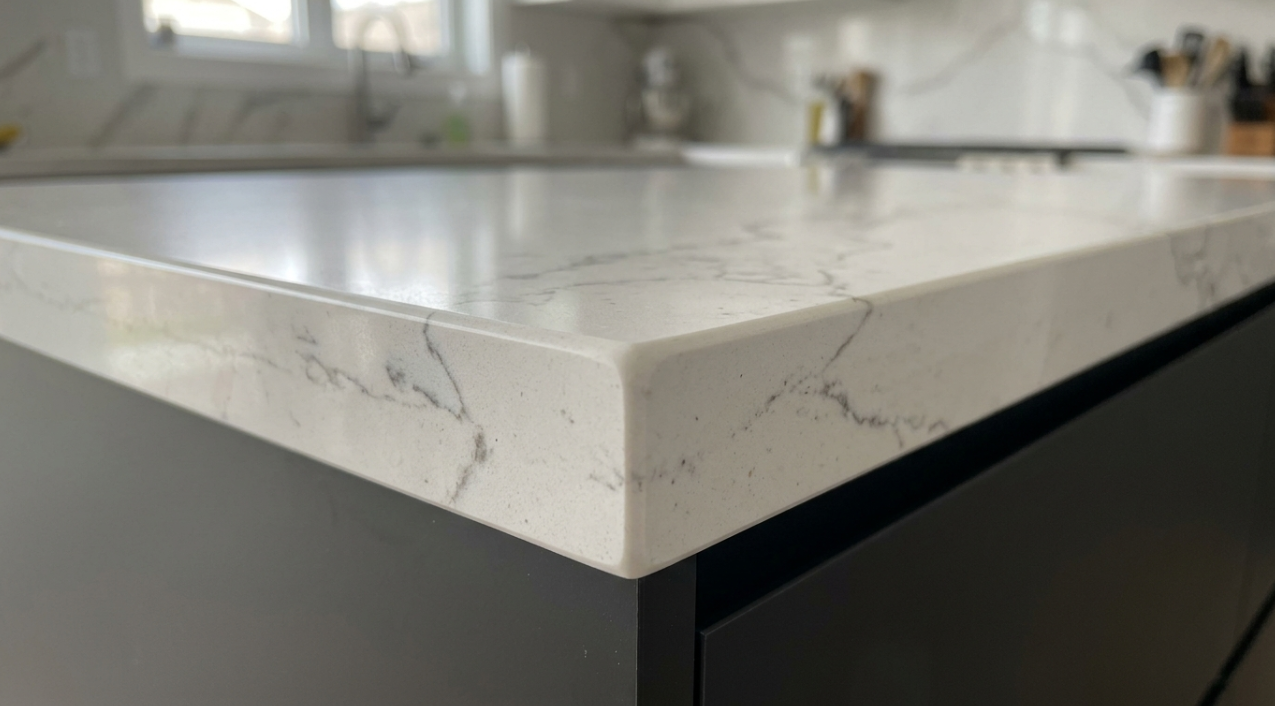
A beveled edge cuts the top corner at an angle, typically around 45 degrees. The angled cut catches light and creates subtle shadow lines, adding definition without curves or ornament.
Bevel width varies. A narrow bevel is nearly invisible. A wider bevel becomes more noticeable and can work as a design feature, especially on darker quartz where it creates contrast.
Bevel pairs well with Shaker doors and transitional kitchens. It also works alongside modern cabinet styles that have clean door profiles but benefit from a small edge detail.
Best for: Transitional kitchens, Shaker cabinetry, anyone who wants a subtle upgrade from eased.
Rounded Quartz Edge Profiles
Half Bullnose (Demi Bullnose)
The half bullnose rounds the top edge while keeping the bottom straighter or less rounded. It gives the softness of a rounded profile without the heaviness of a full bullnose.
This is the single best quartz countertop edge profile for families who want something softer than eased but more current than full bullnose. Kids bump into countertop edges constantly. A half bullnose absorbs minor impacts more gracefully than any sharp-cornered profile.
Half bullnose usually costs more than eased but less than decorative profiles. It is a practical upgrade, not a statement one.
Best for: Family homes, transitional design, anyone who wants comfort without a dated look.
Full Bullnose
A full bullnose rounds both the top and bottom edges completely, creating a smooth, pillow-like profile. It is the most forgiving edge for impacts and the safest for small children.
The trade-off is appearance. Full bullnose can read dated in modern kitchens, especially on white or marble-look quartz paired with flat-panel cabinets. It belongs in traditional spaces with raised-panel doors, crown molding, and more ornamentation.
Practitioners on GardenWeb forums stress that rounded edges are significantly less prone to chipping on any countertop material. If chip resistance is the top priority, full bullnose delivers.
Best for: Traditional kitchens, homes with toddlers, spaces where durability outweighs modern aesthetics.
Avoid when: The kitchen design is modern or minimalist. Consider half bullnose instead.
Decorative and Traditional Quartz Edge Profiles
Ogee
The ogee is an S-shaped curve (a concave arc flowing into a convex arc). It is the most recognized decorative quartz countertop edge profile, and it clearly signals “traditional” or “formal.”
Here is the honest take on ogee: it is not wrong, but it is often wrong for modern kitchens. In a genuinely traditional home with raised-panel cabinetry, furniture-style islands, and period architecture, ogee looks appropriate and intentional. In a modern open-concept kitchen with flat doors and waterfall islands, it looks out of place.
The concave section traps crumbs and dust. Houzz users have bluntly described it as a “crumb catcher.” Anyone who cooks heavily and hates cleaning should pass. Ogee also requires more shaping, polishing, and fabrication time, which means a higher per-foot charge.
For quartz countertops going into a rental property, ogee is almost never the right choice. Eased or half bullnose delivers better durability with less maintenance.
Best for: Formal traditional kitchens, period homes, ornate millwork.
Avoid when: The kitchen is modern, the homeowner prioritizes easy cleaning, or the remodel targets resale appeal.
Dupont (Cove Dupont)
The Dupont is a premium stepped profile combining a sharper top transition with a rounded lower curve. It reads as luxurious and complex, sitting firmly in the traditional/ornate category alongside ogee.
Dupont makes sense in luxury traditional bathrooms or formal kitchens where the cabinetry and millwork justify the detail. For most quartz kitchen projects, it is overkill.
Best for: Luxury traditional kitchens and vanities.
Cove Edge
A cove edge features a concave curved cut, sometimes paired with other details like a small roundover. Like ogee, the concave shape can collect dust and requires more attention to keep clean.
Best for: Custom traditional details, usually on bathroom vanities or specialty furniture-style cabinetry.
Architectural Quartz Edge Profiles: Mitered, Laminated, Waterfall, and Chiseled
These profiles change the structural appearance of the countertop, not just the edge shape. They cost more, require skilled fabrication, and should be treated as design features rather than defaults.
Mitered Edge
A mitered edge is not a solid thick slab. It is made by joining two pieces of quartz cut at 45-degree angles, glued, polished, and blended to create the illusion of a much thicker countertop. A standard 3 cm slab with a mitered edge can look 6 cm or thicker.
The quality of a mitered edge depends entirely on the fabricator’s skill. A good miter has a tight, nearly invisible seam with aligned surfaces. A bad miter shows a visible glue line, mismatched veins, or a rough joint.
Mitered edges cost more for reasons that go beyond simple labor. Reddit fabricators explain that mitering means cutting precise 45-degree strips, aligning and epoxying them, hand-finishing the corner, and sometimes rearranging the slab layout to accommodate extra material. On veined quartz, the fabricator may need to match vein direction across the seam, which can require more slab or even a second slab.
One homeowner on Reddit was quoted an extra $3,000 for mitered edges on a 7-foot veined quartz island. A fabricator in the thread confirmed their shop charges around $30 per linear foot for basic mitered work but noted that material waste and vein matching push the real cost much higher. If a mitered edge quote looks steep, ask whether it includes extra slab material, vein matching, waterfall panels, or builder markup. The answer usually clarifies the number.
Best for: Modern statement islands, waterfall sides, thick-edge aesthetics, vein continuation.
Avoid when: The budget is tight, the fabricator lacks miter experience, or the quartz has surface-print patterns that will not continue through a 45-degree cut.
Laminated Edge (Built-Up Edge)
A laminated or built-up edge bonds extra quartz material to the underside of the front edge to make it look thicker. A 2 cm slab with a 2 cm laminated strip can create the appearance of 4 cm stone.
The weakness is visible seam lines. If the lamination is not done carefully, a stacked line can show where the pieces join. Mitering avoids this problem but costs more.
Best for: Budget-conscious projects that want a thicker look without full mitering.
Waterfall Edge
A waterfall edge means the countertop material continues vertically down the side of an island or cabinet end, usually to the floor. The horizontal-to-vertical transition typically requires a mitered corner.
Waterfall edges are the most dramatic quartz countertop edge profile available. They use significantly more slab material, require careful mitering at the turn, and expose lower corners to foot traffic and vacuum bumps. The cost for a mitered waterfall island can add $3,000 to $5,000+ to a countertop quote.
Waterfall works best as a focal point on one island, not as a default for every run of countertop.
Best for: Modern statement islands, open-plan kitchens, design-forward remodels.
Avoid when: Budget is limited, or the island is against a wall where nobody sees the side.
Chiseled Edge (Rock Face, Broken Edge)
A chiseled edge mimics the rough, natural look of broken stone. It is uncommon for quartz. Confirm with your fabricator whether they can produce it on your chosen slab before building it into a design plan.
Best for: Rustic or organic stone-look designs.
How Much Do Quartz Countertop Edge Profiles Cost?
Edge pricing is one of the most misunderstood parts of a countertop quote. Here is how it works.
Edges are priced per linear foot of finished (exposed) edge. A countertop edge against a wall or backsplash is not finished and not charged. The quote should specify how many linear feet are being profiled and at what rate.
Cost Tier | Profiles | Typical Pricing |
|---|---|---|
Standard/included | Eased, sometimes pencil | Often built into the base slab price |
Simple upgrade | Bevel, half bullnose, double radius | Roughly $2 to $10 per linear foot |
Decorative upgrade | Full bullnose, ogee, cove, Dupont | Roughly $10 to $30 per linear foot |
Premium architectural | Mitered, laminated, waterfall, custom | $20 to $80+ per linear foot |
These ranges come from a 2025 fabricator pricing sheet and multiple national guides. Actual costs depend on your market, fabricator, slab material, and project complexity.
A simple example: if a kitchen has 35 linear feet of exposed edge and you choose a $10 per linear foot upgrade, you are adding about $350 before tax. That is often worth it for a profile you genuinely prefer. A mitered upgrade at $45 per linear foot on the same 35 feet adds over $1,575, which deserves more deliberation.
When budgeting the full project, plan cabinet and countertop costs together since edge upgrades are a small but real line item that adds up alongside other selections.
One more thing: radius corners are not the same as edge profiles. A radius corner rounds the plan-view corner of the countertop (turning a sharp 90-degree corner into a curve). This is typically priced per corner, not per linear foot, and is a separate line item on many quotes.
Quartz Countertop Edge Profile Costs
Quartz countertop edge costs depend on the profile, the number of linear feet being finished, the fabricator’s pricing structure, and the complexity of the design. Simple edges are often included in the base countertop quote, while decorative profiles and built-up edges may cost extra.
Edge Type | Typical Pricing Structure | What Affects the Cost |
|---|---|---|
Eased or standard edge | Often included in the base quote | Fabricator’s standard package |
Pencil or beveled edge | May be included or charged as an upgrade | Edge dimensions and local labor rates |
Half bullnose or full bullnose | Usually priced as a profile upgrade | Amount of shaping and polishing |
Ogee, Dupont, or cove | Typically a higher-cost profile upgrade | Complex shaping and finishing |
Laminated or built-up edge | Additional fabrication and material | Strip size, seams, and finishing |
Mitered edge | Additional fabrication, often priced per linear foot | Seam quality, edge height, material waste, and vein matching |
Waterfall edge | Usually quoted as a project-specific addition | Vertical panels, extra slab material, mitered joints, and installation |
How to Estimate Your Edge Upgrade
If your fabricator charges an additional $10 per linear foot and your project has 35 linear feet of finished edge, the edge upgrade would cost approximately $350 before taxes and any additional charges.
Formula:
Edge upgrade cost = finished linear feet × upgrade price per linear foot
Ask whether the quote includes the sink cutout, exposed island ends, mitered corners, and any required additional slab material. Waterfall sides and built-up edges may be quoted separately, so do not assume every component follows the same per-foot rate.
The most reliable comparison is to request itemized quotes from at least two fabricators using the same quartz product, measurements, edge profile, and installation requirements.
Which Quartz Countertop Edge Profile Is Best?
There is no universally best edge, but there is a best edge for each situation.
Situation | Best Edge | Why |
|---|---|---|
Most kitchens | Eased | Clean, current, included, easy to clean |
Modern kitchen | Eased, small bevel, or mitered | Straight lines match flat-panel cabinetry |
Traditional kitchen | Half bullnose, ogee, or Dupont | Decorative details match ornate millwork |
Family with kids | Half bullnose or generous eased | Fewer hard corners, more forgiving impacts |
Rental property | Eased or half bullnose | Durable, low-maintenance, cost-controlled |
Statement island | Mitered or waterfall | Creates a focal point with thick-slab drama |
Heavily veined quartz | Eased or well-planned miter | Avoids awkward pattern interruption at edges |
Resale-focused remodel | Eased or small bevel | Neutral, broadly acceptable to buyers |
Busy cook | Eased, pencil, or bevel | No grooves to catch food |
The cabinet door profile and the countertop edge should feel like they belong to the same design language. Coordinate quartz and cabinet selections before locking in the edge, especially in transitional kitchens where subtle mismatches stand out.
How to Choose a Quartz Countertop Edge for Your Kitchen
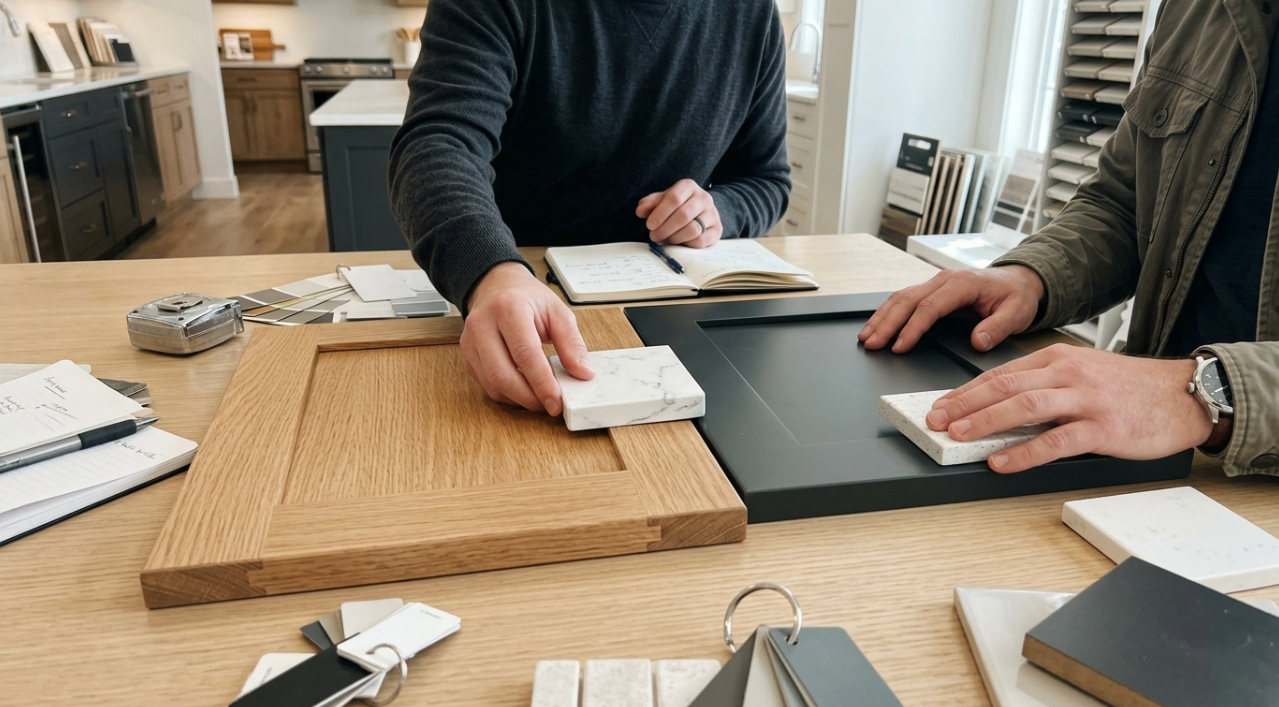
The right quartz countertop edge depends on more than appearance. Consider how often you cook, how much cleaning you want to do, where people walk, and whether the countertop is a design feature or a practical work surface.
For Busy Family Kitchens
An eased or half bullnose edge is a practical choice for a kitchen used by children and adults throughout the day. Both offer softened corners, while the half bullnose provides a more visibly rounded shape. Neither eliminates the risk of impact injuries or chipping, so corner design and countertop placement still matter.
For Modern and Minimalist Kitchens
Choose an eased, pencil, or subtly beveled edge for a clean finish. These profiles complement flat-panel cabinetry, simple hardware, and contemporary quartz patterns without introducing unnecessary decoration.
For Kitchens With Heavily Veined Quartz
Start by checking how the pattern looks at the edge of the actual slab. An eased edge provides a relatively simple finish, while a mitered edge may create a thicker appearance with a more deliberate transition. The best choice depends on whether the pattern continues through the material and how the fabricator plans the seams.
For Small Kitchens
A simple eased or pencil edge generally keeps the countertop visually understated. You do not need a waterfall or thick mitered edge to make a small kitchen look finished. Prioritize a cohesive cabinet-and-countertop combination over elaborate edge details.
For Traditional Kitchens
Half bullnose, full bullnose, ogee, and Dupont can complement traditional cabinetry and decorative millwork. Choose a more intricate profile when it supports the room’s overall design, rather than adding detail simply because it is available.
For Budget-Conscious Remodels
Start with the fabricator’s standard eased edge and ask which alternatives are included in the quote. If you want a visible design upgrade, compare the additional cost of a bevel or half bullnose before committing to a more expensive custom profile.
2 cm vs. 3 cm: How Slab Thickness Affects Edge Options
Quartz slabs come in two common thicknesses: 2 cm (roughly 3/4 inch) and 3 cm (roughly 1 1/4 inch).
A 3 cm slab is the standard for most kitchen countertops. At this thickness, even a simple eased edge looks substantial. Most quartz countertop edge profiles work well on 3 cm without modification.
A 2 cm slab looks thinner. Some homeowners use a laminated or mitered edge to create the appearance of 4 cm stone. But 2 cm slabs need more careful support planning and are more common in bathroom vanities, wall cladding, and prefab installations.
If you are considering a thinner slab, compare prefab and slab quartz to understand how thickness, edge options, and seam planning intersect. Prefab slabs often come with a pre-finished edge and limited profile choices.
How Quartz Patterns Affect the Finished Edge
Not every quartz countertop has the same appearance through its full thickness. Depending on the product, color and veining may continue through the material to varying degrees, or the visible surface pattern may contrast with the underlying body.
This matters when choosing a rounded, decorative, or mitered edge. A cut or shaped edge can reveal a different color or pattern from the top surface, while a mitered joint may make it possible to position the patterned surface on the visible face. The result depends on the specific quartz product and the fabricator’s technique.
Before approving an edge profile, ask your supplier or fabricator:
Does the pattern continue through the slab, or is the visual effect concentrated near the surface?
Can I see an edge sample made from this exact quartz product?
Will a rounded edge expose a contrasting core color?
If a miter is used, how will the pattern and veining align at the joint?
Can you show me a completed project using the same material and edge profile?
Do not rely on a generic quartz sample to judge the result. Check the actual product and discuss the intended fabrication with the shop before finalizing your selection.
Common Mistakes to Avoid
1. Approving a term without seeing a sample. Edge profile names are not standardized. What your fabricator calls “eased” may look different from what another shop calls “eased.” Always ask to see and touch a physical sample before signing off.
Visit a showroom where you can review countertop and cabinet selections together, rather than relying on online images alone.
2. Choosing ogee because it looks fancy in a photo. Ogee photographs well but lives poorly in busy kitchens. The concave curve collects crumbs, the ornate look clashes with modern cabinetry, and it costs more to fabricate.
3. Assuming mitered means solid thick quartz. A mitered edge is a joined assembly of two pieces. The countertop is not actually thicker. This matters for understanding both cost and quality, since the seam is where problems appear.
4. Ignoring vein direction at the edge. Surface-pattern or non-through-body quartz may look plain at decorative edges or undermount sink cutouts. Check a real edge sample from your specific material.
5. Forgetting the sink cutout edge. With undermount sinks, the stone edge around the opening is visible and needs a finished profile. This is a separate decision from the perimeter edge and may carry its own charge.
6. Using a thick-looking edge to skip proper support. A mitered edge makes the countertop look thicker, but it does not add structural support. Overhangs still need brackets or reinforcement per fabricator and industry standards. Edge shape is cosmetic, not structural.
Questions to Ask Before Approving Your Edge Profile
Use this checklist at your fabricator meeting or design approval:
Which edge profiles are included in the base quartz quote?
Which profiles are upgrade-priced, and how many linear feet are being charged?
Can I see the exact physical edge sample for my chosen profile?
Is this profile available on my quartz thickness (2 cm or 3 cm)?
Is my quartz through-body or surface-patterned? Will a decorative edge reveal a different base color?
If mitered, will the seam be visible? Is vein matching included?
Could the mitered edge require a second slab?
How will the undermount sink cutout edge be finished?
Are radius corners priced separately from the edge profile?
What overhang support does my layout require?
Can I see photos of similar installed edge work?
For a broader checklist that covers the full scope of a remodel project, review this kitchen remodel checklist.
A Note on Fabrication Safety
Quartz edges are shaped during fabrication, where cutting and polishing can generate respirable crystalline silica dust. OSHA identifies this as a worker-safety hazard during manufacturing, finishing, and installation. Finished countertops themselves are not the hazard. Homeowners and contractors should use qualified fabricators who follow proper dust-control practices and comply with current safety standards.
How to Choose: A Simple Path
If you are still unsure after reading every section above, follow three steps.
Step 1: Start with an eased edge. It is the safest, most versatile, and most cost-effective default for quartz countertop edge profiles in any kitchen style.
Step 2: Consider upgrading only when you have a specific reason. Half bullnose for a softer family feel. Bevel for subtle transitional detail. Mitered or waterfall for a statement island where the edge is the design feature.
Step 3: See a physical sample of your chosen edge on your chosen quartz material before giving final approval. Do not sign off based on a name, a drawing, or an online photo.
If the kitchen design is modern, keep the edge simple. If it is genuinely traditional, decorative profiles like ogee or Dupont can work, but only when the cabinetry, architecture, and overall room support them.
For Washington trade partners planning cabinets and quartz together, Krafter’s Land can help coordinate product selection, free design and quotes, 3D renderings, and showroom review through authorized retailers and licensed contractors.
Request a free design consultation to start planning your countertop and cabinet selections together.
Frequently Asked Questions
What is the most popular quartz countertop edge profile?
The eased (flat eased) edge is the most commonly chosen profile. It is simple, modern, easy to clean, and typically included in the base fabrication quote without an added per-foot charge.
Which quartz edge is least likely to chip?
Rounded profiles like bullnose and half bullnose are the most chip-resistant. Caesarstone recommends a rounded edge of at least 3 to 4 mm to reduce chipping risk. The general rule from fabricators: the more rounded the edge, the less likely it is to chip.
Is bullnose or eased better for quartz?
It depends on priorities. Eased looks more modern and usually costs less. Bullnose is softer, more child-friendly, and better at hiding minor chips, but it can look dated in contemporary kitchens. Half bullnose is a strong middle ground.
Is an ogee edge outdated?
Not inherently, but it is best reserved for traditional kitchens with ornate cabinetry and period architecture. In modern or transitional spaces, ogee tends to look out of place and adds cleaning difficulty because of its concave curves.
What is a mitered quartz edge?
A mitered edge is made by joining two quartz pieces at a 45-degree angle to create the appearance of a thicker slab. It is a fabrication technique, not a solid piece of thicker stone. Quality depends on seam alignment, polish, and installer skill.
How much does a mitered edge cost?
Mitered edges typically range from about $20 to $80 per linear foot depending on the fabricator, vein matching requirements, and additional slab material. A mitered waterfall island can add $3,000 to $5,000 or more to a project.
Can I change my countertop edge after installation?
Practically, no. The edge profile is cut and polished before the countertop is installed. Changing it after the fact means refabricating or replacing the affected pieces, which is costly and disruptive.
Do quartz countertop edges need sealing?
Quartz is an engineered surface that generally does not require sealing the way natural stone does. However, edge seams, sink joints, and backsplash caulk lines still need proper installation and periodic maintenance to prevent moisture issues.