
TL;DR
Calacatta quartz is an engineered stone (roughly 90–95% crushed quartz crystals, polymer resins, and pigments) that replicates the look of rare Italian Calacatta marble. For contractors, dealers, and designers in Washington, it remains one of the most requested countertop patterns, and sourcing it locally matters. Krafter’s Land stocks both prefab and jumbo Calacatta quartz slabs across its Tukwila, Tacoma, Lynnwood, and Spokane warehouses, with trade pricing available through authorized dealer and contractor accounts. Key specs: Mohs 7 hardness, non-porous, 15-year limited warranty on countertops, and no sealing required. The trade-critical limitation is heat sensitivity above 300°F, which should be part of every client handoff conversation.
Calacatta Quartz in Seattle: Quick Answer
Calacatta quartz is an engineered countertop surface designed to replicate the bold veining and bright white background of natural Calacatta marble. For Seattle-area kitchen and bathroom projects, it offers a marble-inspired appearance with a non-porous surface that does not require sealing. Key buying considerations include slab size, thickness, pattern consistency, fabrication costs, heat protection, and warranty coverage. Krafter’s Land offers quartz countertop products and prefab formats through its Washington locations, including Tukwila, Tacoma, Lynnwood, and Spokane. Confirm the exact pattern, dimensions, stock availability, and current pricing before ordering.
At a glance
Material: Engineered quartz with resin binders and pigments
Appearance: White background with bold gray, gold, or warm-toned veining
Maintenance: Routine cleaning; no sealing required
Heat protection: Use trivets and heat-resistant pads
Available formats: Product-dependent standard slabs, jumbo slabs, and prefab pieces
Best next step: Compare full slabs, confirm the product specifications, and request a project quote
Calacatta Quartz Specifications at a Glance
Calacatta quartz specifications vary by manufacturer, product line, slab format, and finish. Review the technical data for the exact SKU before finalizing a countertop order.
Specification | What Buyers Should Know |
|---|---|
Material | Engineered quartz containing mineral aggregates, resin binders, and pigments |
Appearance | White or off-white background with bold marble-inspired veining |
Porosity | Generally non-porous under normal use |
Sealing | Not normally required |
Scratch resistance | Hard quartz minerals provide good scratch resistance, but the surface is not scratch-proof |
Heat resistance | Thermal damage is possible; use trivets and follow the manufacturer’s temperature guidance |
UV exposure | Prolonged sunlight may discolor some resin-bound quartz products |
Thickness | Common options include 2 cm and 3 cm, depending on the product |
Slab dimensions | Vary by SKU; confirm actual dimensions before fabrication |
Warranty | Depends on the supplier, product, registration requirements, and applicable terms |
Before ordering: Confirm the manufacturer’s care instructions, fabrication requirements, warranty exclusions, and whether the selected product is suitable for its intended indoor or outdoor application.
What Is Calacatta Quartz?
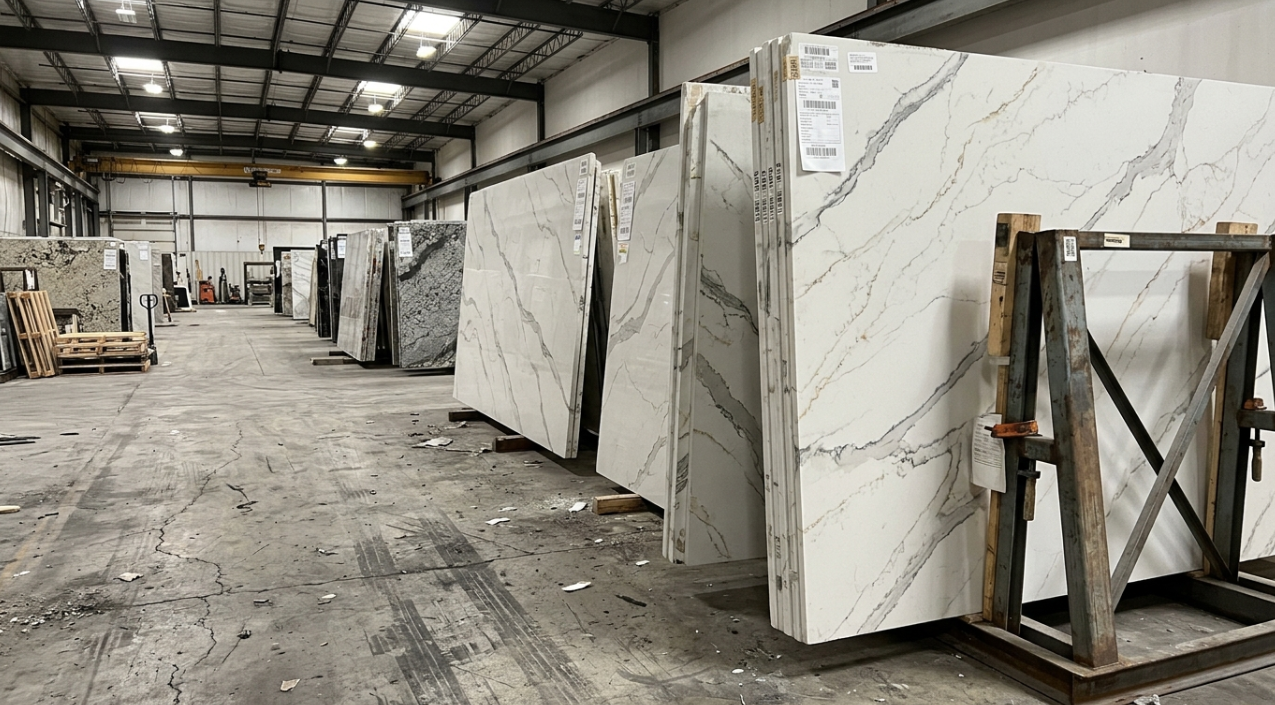
Calacatta quartz is an engineered countertop material designed to replicate the appearance of natural Calacatta marble, one of Italy’s most prized stones. It combines approximately 90–95% crushed natural quartz crystals with polymer resins and pigments, producing slabs that deliver the marble aesthetic with far better jobsite and long-term performance.
The name comes directly from the marble it imitates. Authentic Calacatta marble is quarried from the Apuan Alps near Carrara in Tuscany, from deposits that have been worked since Roman times. These quarries sit higher in the mountains than typical Carrara marble sources, making the stone significantly rarer and more expensive. Calacatta quartz gives your clients access to that same visual signature (a bright white background with bold, dramatic veining in gray, gold, or brown) without the fragility, lead times, or price tag of the imported natural stone.
If you’re helping clients through early project planning, our kitchen remodel checklist covers the full sequence from permits to material selection and can be shared directly with homeowners.
The visual hallmark is what sets Calacatta apart from other white quartz patterns. Where most engineered whites have subtle flecks or fine lines, Calacatta quartz features thick, sweeping veins that create a statement. Manufacturers use custom molds and, in many cases, hand-placed veining techniques to recreate the natural marble’s character. That extra manufacturing effort is one reason Calacatta patterns command higher margins than solid-color or simpler-patterned quartz, something worth factoring into project bids.
How Calacatta Quartz Is Made
The manufacturing process starts with raw quartz crystals, which are ground into granules and combined with polymer resin binders and color pigments. For Calacatta patterns specifically, the process is more involved than standard quartz production. Slabs require custom molds, and the veining is often crafted by hand to match specific design templates rather than relying on a random scatter approach used for simpler patterns.
This matters for trade partners quoting projects. A plain white or speckled quartz slab carries a lower material cost partly because the factory process is faster and more automated. Calacatta veining demands more labor and precision, which gets reflected in the wholesale price. Understanding this helps when explaining the price differential to clients who ask why Calacatta costs more than the solid white slab they saw online.
The finished product scores a 7 on the Mohs hardness scale, harder than most granite and highly resistant to scratches and chips. That hardness comes from the quartz crystal content, not the resin, which is the component responsible for most of the material’s limitations (and most warranty claims).
Calacatta Quartz vs. Calacatta Marble: What Trade Partners Should Know
This is the most common comparison your clients will raise. The two materials look similar but behave very differently on the jobsite and after handoff.
Feature | Calacatta Quartz | Calacatta Marble |
|---|---|---|
Composition | Engineered (quartz + resin + pigments) | Natural stone |
Porosity | Non-porous | Porous (absorbs liquids) |
Sealing required | Never | Yes, regularly |
Acid sensitivity | Not affected | Etches from lemon juice, vinegar, wine |
Slab consistency | Uniform across slabs | Every slab is unique |
Heat tolerance | Vulnerable above ~300°F | Handles heat better |
Callback risk | Lower (stain/etch complaints rare) | Higher (etching, staining, sealing neglect) |
Warranty | 15-year limited at Krafter’s Land | Varies; typically no manufacturer warranty |
For contractors and remodelers, quartz wins on reduced callbacks and easier client maintenance expectations. Marble wins on perceived prestige for high-end custom builds. Practitioners on Reddit and trade forums consistently note that quartz dramatically reduces post-install service calls compared to natural marble, especially in kitchen applications where acidic spills are inevitable.
For a broader material comparison to share with clients, see our guide on quartz vs. granite countertops.
Calacatta Quartz vs. Carrara Quartz
Both are named after Italian marbles and both come in white-background quartz versions. The difference is purely aesthetic (and partly financial), since the durability and fabrication requirements are identical. Knowing the distinction helps designers steer clients toward the right pattern during consultations.
Feature | Calacatta Quartz | Carrara Quartz |
|---|---|---|
Background color | Bright, warm white | Light gray or cooler white |
Veining | Bold, thick, dramatic | Fine, subtle, delicate |
Vein colors | Gray, gold, brown | Mostly gray |
Design impact | Statement piece | Understated elegance |
Wholesale cost | Higher (complex manufacturing) | Lower |
Both materials share the same scratch and stain resistance. When a client wants the countertop to anchor the room, Calacatta is the recommendation. For projects where the countertop should complement rather than dominate, Carrara works well. Stocking both gives dealers flexibility to upsell or match the design direction without switching suppliers.
Popular Calacatta Quartz Colors and Patterns
Calacatta quartz is available in several marble-inspired patterns, ranging from cool white backgrounds with crisp gray veining to warmer designs with gold or brown accents. The best choice depends on the room’s lighting, cabinet color, island dimensions, and desired visual impact.
When comparing Calacatta quartz at Krafter’s Land, start with the exact product name and SKU rather than relying on the general Calacatta label.
Product | What to Compare | Before Ordering |
|---|---|---|
Calacatta Icy | Background color and vein contrast | Confirm the available slab or prefab format |
Calacatta Golden | Warm-toned appearance and overall pattern | Review the full slab alongside cabinet samples |
Calacatta Pearl | Background tone and vein distribution | Confirm current dimensions and availability |
Calacatta Volcano | Pattern movement and color balance | Check the product specification and slab count |
Product appearance, available formats, and stock can vary. View the product photos and, where possible, inspect the actual slab before approving fabrication.
How to Compare Calacatta Patterns
For a bright, minimal kitchen: Look for a light background and a vein pattern that complements rather than overwhelms the cabinetry.
For a statement island: Examine larger sections of pronounced veining and plan the seam placement carefully.
For warm wood or cream cabinets: Compare the countertop’s undertones with physical cabinet samples.
For a coordinated backsplash: Confirm whether the fabricator can maintain the desired vein direction and pattern continuity across adjoining surfaces.
Calacatta Quartz Slab Sizes, Thicknesses, and Prefab Options
Choosing the right Calacatta quartz format affects material yield, seam placement, fabrication costs, and installation planning. Krafter’s Land lists both jumbo quartz slabs and narrower prefab formats, with sizes varying by product and SKU.
Standard and Jumbo Slabs
Larger slabs can be useful for kitchen islands, long countertop runs, and waterfall edges. They may reduce the number of seams, but the fabricator must confirm whether the slab dimensions and veining layout will accommodate the finished design.
For example, Krafter’s Land lists the following dimensions for its Calacatta Icy quartz:
Product Format | Published Dimensions | Thickness |
|---|---|---|
Prefab piece | 110 × 26 inches | 2 cm |
Prefab piece | 110 × 36 inches | 2 cm |
Prefab piece | 110 × 52 inches | 2 cm |
Jumbo slab | 126 × 63 inches | 3 cm |
Dimensions are product-specific, and actual measurements may vary. Verify the current SKU specifications before planning the countertop layout.
2 cm vs. 3 cm Quartz
2 cm quartz: A thinner option that may suit prefab countertop pieces, vanity tops, and selected applications when the fabricator’s installation requirements are met.
3 cm quartz: A thicker option commonly considered for kitchen countertops and islands. It changes the finished edge appearance and may affect handling, cabinet support, and fabrication requirements.
Neither thickness should be selected on appearance alone. Confirm support requirements, sink and cooktop cutouts, overhang limits, and the fabricator’s installation specifications.
When Should You Choose Prefab Quartz?
Prefab quartz can work well for standard-depth counters and some bathroom vanities because pieces are available in predefined dimensions. Full slabs provide more flexibility for unusual layouts, large islands, custom edges, and coordinated veining.
Before ordering, compare the usable dimensions, finished edge, backsplash requirements, seam locations, and expected offcuts. A prefab piece is not automatically cheaper once cutting, fitting, and installation are included.
Lead Times and Availability in Washington
Krafter’s Land maintains a large warehouse footprint (110,000+ sq ft across Washington locations) specifically to keep popular SKUs in stock and avoid the backorder delays that plague special-order-only suppliers. For trade partners, this means:
In-stock slabs can typically be picked up or scheduled for delivery within days, not weeks
Prefab pieces in standard dimensions are generally available for same-week pickup
Delivery terms: garage or first-floor drop, with clear scheduling so GCs can plan around it
For current inventory on specific Calacatta patterns, contact the showroom closest to your project area or reach out through your dealer account.
How to Choose Calacatta Quartz for a Seattle Kitchen Remodel
Choosing Calacatta quartz for a Seattle-area project involves more than selecting a white slab with attractive veining. The material must suit the cabinet layout, island dimensions, fabrication plan, budget, and expected use of the space.
1. Match the Veining to the Kitchen Layout
For a large island, examine the full slab to understand how the veins will travel across the finished surface. Ask the fabricator to explain seam placement and whether the design requires bookmatching or a specific vein direction.
For smaller kitchens, a pattern with more open white space may create a lighter visual effect, while pronounced veining can give an island greater visual emphasis.
2. Confirm the Slab Count Before Ordering
Provide the fabricator with the cabinet plan and approximate countertop measurements. Include islands, peninsula sections, backsplashes, and waterfall edges in the discussion.
The total countertop area does not always equal the amount of slab material required. Cutouts, vein direction, slab dimensions, and fabrication waste affect the final material calculation.
3. Coordinate the Countertop With Cabinets
Bring cabinet door samples, flooring samples, and paint colors when viewing quartz. Check the materials together under different lighting conditions, because a white countertop can appear warmer or cooler depending on surrounding finishes.
4. Check Delivery and Fabrication Timing
Before scheduling cabinet installation or demolition, confirm product availability, delivery arrangements, templating dates, and the fabricator’s estimated installation schedule. In-stock status does not necessarily mean a finished countertop can be installed immediately.
5. Review Care and Warranty Requirements
Ask for the written warranty and care instructions for the exact product. Confirm restrictions relating to heat, UV exposure, chemical cleaners, scratches, seams, and installation workmanship.
Seattle project checklist: Before approving the order, confirm the exact SKU, slab dimensions, thickness, slab count, pattern layout, seam locations, quote inclusions, delivery arrangements, and warranty terms.
Pros and Cons for Trade Applications
Advantages
Non-porous and zero maintenance. Unlike natural marble, Calacatta quartz does not absorb liquids and never needs sealing. This is the single biggest advantage for trade partners: fewer maintenance callbacks and simpler care instructions at client handoff.
Scratch and stain resistant. A Mohs hardness of 7 means everyday kitchen use won’t damage the surface under normal conditions. This protects your reputation after installation.
Consistent appearance across slabs. Because it’s manufactured, you can order multiple slabs and get a close visual match. This is critical for multi-phase projects or large installs where natural stone would require extensive slab matching at the quarry.
15-year limited warranty. Krafter’s Land backs its quartz countertops with a 15-year limited warranty, giving trade partners a concrete assurance to present during the sales process.
Compliance. Quartz countertops pair well with CARB Phase 2 and EPA TSCA Title VI compliant cabinetry (standard across Krafter’s Land cabinet lines), simplifying IAQ documentation for permitting.
Disadvantages
Heat vulnerability. The polymer resin binder starts to discolor or crack near 300°F (150°C). A pan straight from a hot oven easily exceeds that temperature on contact. Manufacturers universally exclude heat damage from warranties. MSI’s own troubleshooting documentation confirms that heat can discolor the resin in a way that looks like a stain but is actually thermal damage. This is the number one source of post-install complaints, so communicating trivet requirements during client handoff is essential.
UV yellowing. Extended sun exposure degrades the resin over time, causing white and off-white quartz to yellow. Most manufacturers don’t warrant quartz for outdoor use, and even indoor surfaces near large south-facing windows can show gradual color shift. Flag this during design consultations for homes with significant glazing.
Chemical sensitivity. Bleach, harsh alkaline cleaners (above pH 11), and strong solvents can cause irreversible “ghosting” on the surface. Include approved cleaner recommendations in your client care sheet.
Can look manufactured. Despite advances in veining technology, Calacatta quartz doesn’t have the depth and translucency of real marble. For ultra-high-end clients who have handled the natural stone, the difference can be noticeable. Setting expectations during the showroom visit prevents dissatisfaction after installation.
Care and Maintenance: What to Tell Your Clients
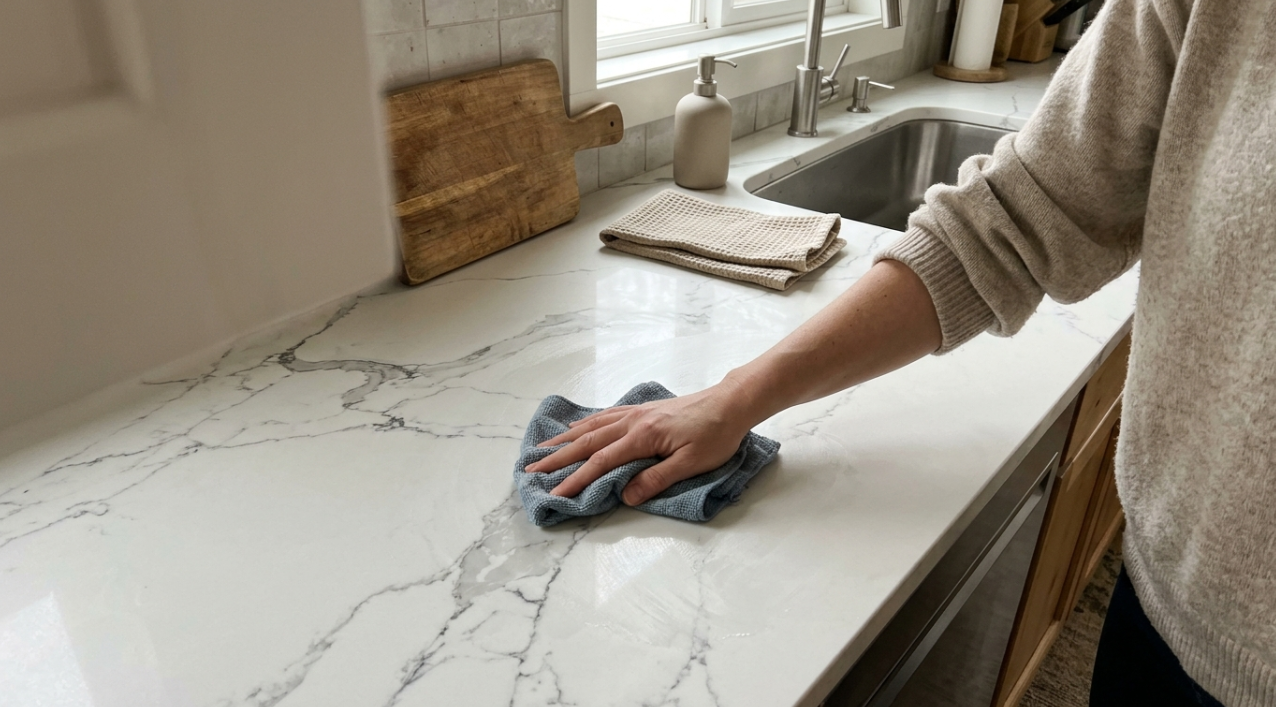
Calacatta quartz is relatively easy to maintain because it generally does not require sealing. Routine cleaning and sensible heat protection help preserve the surface and reduce the risk of damage.
Daily Cleaning
Use a soft cloth or non-abrasive sponge with warm water and a mild dish soap. Wipe away spills promptly, then rinse and dry the surface as needed.
For stubborn residue, use a cleaner approved by the countertop manufacturer. Test any unfamiliar cleaning product according to the manufacturer’s instructions before using it across the surface.
What to Avoid
Direct heat: Do not place hot pots, pans, or oven cookware directly on the countertop.
Abrasive materials: Avoid steel wool and harsh scouring pads that may damage the finish.
Harsh chemicals: Avoid strong solvents, concentrated bleach, and cleaners that are not approved for the specific quartz product.
Cutting directly on the surface: Use a cutting board to protect the finish and kitchen knives.
Prolonged direct sunlight: Follow the product’s restrictions on UV exposure, particularly near large windows or in outdoor applications.
Does Calacatta Quartz Need Sealing?
No. Quartz countertops generally do not require periodic sealing because their engineered surface is non-porous. Applying a stone sealer without manufacturer approval is unnecessary and may leave residue.
How Long Does Calacatta Quartz Last?
Service life depends on product quality, installation, usage, and maintenance. Rather than guaranteeing a specific lifespan, review the manufacturer’s documentation and warranty for the selected product. A warranty period is not a guarantee that the countertop will remain free of all damage throughout that period.
How Calacatta Quartz Pairs With Cabinets: Design Guidance for Specs
Understanding cabinet-countertop pairings helps designers and dealers close sales faster. Calacatta’s bold veining creates natural contrast and visual interest, which means the cabinetry choice significantly affects the overall result.
White and warm-white cabinets are the most popular pairing. Design surveys suggest that roughly 55% of kitchens with Calacatta countertops use white cabinetry. The key detail is matching undertones: gold-veined Calacatta looks best with warm whites and off-whites, while gray-veined Calacatta pairs better with cool whites or light gray tones. A stark, cool white cabinet next to warm gold veining can feel mismatched, something to catch during the design phase rather than after installation.
For a deeper look at specific cabinet styles available through Krafter’s Land, our comparison of white Shaker vs. Slim Shaker cabinets covers the two most common choices for this kind of pairing. Both the Shaker framed line and the Slim Shaker line are stocked locally.
Dark cabinets (navy, black, walnut) create a high-contrast, dramatic look that lets the countertop become the focal point. This combination works especially well on islands where the white surface stands out against a dark base.
Mid-tone cabinets (sage green, warm gray, natural wood) split the difference. The countertop still reads as a statement piece, but the overall palette feels softer.
For more detailed guidance, see our full guide on matching quartz countertops with cabinets. And for projects specifically using white cabinetry, the list of best quartz colors for white cabinets includes Calacatta options alongside alternatives.
Krafter’s Land provides free design and quotes with 2020 Design files and a project preview tool, which means trade partners can present clients with rendered kitchen visuals showing exact cabinet and countertop combinations before any material is ordered. This speeds up approvals and reduces change orders.
Calacatta Quartz Cost in Seattle: 2026 Budget Guide
The cost of Calacatta quartz countertops in Seattle depends on the product line, slab size, material thickness, countertop layout, fabrication requirements, and installation scope. Bold marble-look patterns may cost more than simpler quartz designs, but the final price depends on the specific product and supplier.
For initial budgeting, the following table illustrates how different installed-price assumptions affect a project. These are planning scenarios, not verified Krafter’s Land quotes or guaranteed Seattle market prices.
Countertop Area | At $60/sq. ft. | At $100/sq. ft. | At $140/sq. ft. |
|---|---|---|---|
25 sq. ft. | $1,500 | $2,500 | $3,500 |
40 sq. ft. | $2,400 | $4,000 | $5,600 |
50 sq. ft. | $3,000 | $5,000 | $7,000 |
60 sq. ft. | $3,600 | $6,000 | $8,400 |
Calculations multiply countertop area by an assumed installed rate. Confirm whether your quote includes material, templating, fabrication, edge finishing, sink and cooktop cutouts, delivery, installation, and applicable taxes.
What Affects Calacatta Quartz Countertop Pricing?
1. Slab selection and product tier
Different Calacatta patterns, finishes, and product lines can carry different material costs. Compare the actual SKUs rather than assuming that every Calacatta design has the same price.
2. Slab size and material yield
Large islands, full-height backsplashes, and waterfall edges may require additional material. A larger slab can reduce seams in some layouts, but it does not automatically reduce the total cost. Ask your fabricator to calculate the required slab count and expected offcuts.
3. Thickness and edge profile
A 2 cm slab and a 3 cm slab may differ in material cost, weight, fabrication requirements, and finished appearance. Mitered edges and other detailed profiles can also increase fabrication costs.
4. Cutouts and layout complexity
Undermount sinks, cooktops, corner details, curved edges, and complicated layouts can add fabrication time. The number and placement of seams also affect the finished result.
5. Delivery and installation
Confirm whether the quote includes transportation, handling, templating, installation, plumbing reconnection, backsplash work, and removal of existing countertops. These services may be priced separately.
How to Request a Comparable Seattle Countertop Quote
Before requesting a quote, prepare the approximate countertop measurements, cabinet layout, sink and cooktop specifications, preferred Calacatta pattern, and desired thickness. Ask each supplier to quote the same scope of work so you can compare total project costs rather than material prices alone.
For current product availability and trade pricing, contact Krafter’s Land directly. Homeowners can request assistance through a showroom, while licensed contractors can register for access to the company’s contractor resources.
Trade Pricing and Account Access
Krafter’s Land operates on a dealer and contractor purchasing model, not direct-to-consumer online sales. This protects channel pricing and trade margins. To access trade pricing on Calacatta quartz (and all other countertop, cabinet, and surface products):
Existing trade partners: Log in to your account or contact your showroom rep for current pricing on specific SKUs and quantities
New dealers and contractors: Visit any Krafter’s Land showroom (Tukwila, Tacoma, Lynnwood, or Spokane) or call to set up a trade account. Bring your contractor license or business credentials
Designers: Trade accounts are available for licensed interior designers working on residential and commercial projects
Consolidating countertop, cabinet, flooring, tile, and shower door orders through a single supplier reduces PO management and simplifies delivery coordination, a real advantage on full-kitchen and full-bath remodels.
If you’re evaluating countertop materials as part of a broader renovation budget for a client, our guide on kitchen updates that add home value puts countertop spending in context alongside cabinets, flooring, and appliances.
Krafter’s Land Quartz Countertop Warranty
Krafter’s Land publishes a 15-year limited warranty for eligible quartz countertop products used in qualifying residential installations. The warranty covers specified manufacturing defects in materials and workmanship, subject to the written policy’s conditions and exclusions.
Before presenting the warranty to a homeowner, confirm that the selected product and installation qualify.
Important points to review include:
Eligibility: The published policy applies to the original residential end-user purchaser and owner in the United States.
Authorized installation: Fabrication and installation must meet the warranty’s requirements.
Transferability: The warranty is non-transferable and applies to the original installation location.
Surface damage: Scratches, abrasion, and cutting directly on the countertop are excluded.
Environmental exposure: Outdoor use and damage associated with UV exposure and weather conditions are excluded.
Fabrication details: Seam appearance, certain accessories, and damage related to cutouts or edge profiles may fall outside coverage.
Review the complete Krafter’s Land Countertop Warranty Policy before purchasing. Warranty coverage depends on the written terms, so do not treat the 15-year period as protection against every type of damage.
For contractors, providing the homeowner with the warranty document and product-specific care instructions at handoff helps set clear expectations.
Showroom Locations for Slab Selection and Client Meetings
Viewing full slabs in person is the best way to help clients commit to a Calacatta pattern. Krafter’s Land operates showrooms across Washington State with quartz slabs, cabinets, flooring, and other surfaces on display:
Tukwila (Seattle metro)
Tacoma
Lynnwood
Spokane
These showrooms are designed for trade use. Bring clients in for slab selection, schedule design consultations, or pick up samples to bring to a jobsite or client’s home. Free design and 3D rendering services are available at all locations.
Frequently Asked Questions
Is Calacatta quartz the same as Calacatta marble?
No. They look similar but are fundamentally different materials. Calacatta marble is a natural stone quarried in Italy, porous, prone to etching, and requires regular sealing. Calacatta quartz is engineered from crushed quartz crystals and resin, is non-porous, and needs no sealing. For trade partners, the practical difference is significant: quartz generates far fewer maintenance-related callbacks.
Can clients put hot pans on Calacatta quartz?
They should not. The resin binder in quartz begins to discolor or crack at approximately 300°F, and a pan from a hot oven easily exceeds that. Always emphasize trivets during client handoff. Heat damage is not covered by any major quartz manufacturer’s warranty, including Krafter’s Land’s 15-year limited warranty.
Does Calacatta quartz yellow over time?
It can. UV exposure is the primary culprit, as extended sunlight breaks down the polymer resin and causes white surfaces to take on a yellow cast. During design consultations, note window placement and sun exposure in the kitchen. Recommending blinds or UV-filtering window film for south-facing installations is a proactive way to prevent this issue.
Is Calacatta quartz good for bathroom projects?
It’s excellent for bathrooms. The non-porous surface resists water, soap scum, and cosmetic stains without sealing. Vanity tops, shower niches, and tub surrounds are all common applications. The 2 cm thickness works well for vanity tops where weight matters. For more on specifying vanities, see our bathroom vanity guide.
What is the difference between Calacatta and Carrara quartz?
The difference is visual, not structural. Calacatta quartz has a bright white background with bold, thick veining in gray, gold, or brown. Carrara quartz has a softer gray or cool-white background with fine, subtle veining. Both are equally durable. Calacatta costs more at wholesale because the veining is harder to manufacture. Stocking both patterns gives dealers the flexibility to match a wider range of design directions.
How long does Calacatta quartz last?
With proper care (no direct heat, no harsh chemicals, regular cleaning), quartz countertops typically last 20 to 30 years or more under normal residential use. Krafter’s Land’s 15-year limited warranty covers manufacturing defects throughout that period.
How do I set up a trade account with Krafter’s Land?
Visit any showroom location (Tukwila, Tacoma, Lynnwood, or Spokane) with your contractor license, business license, or design credentials. Trade accounts provide access to dealer pricing, 2020 Design files, free design and quoting services, and priority inventory access. You can also call any showroom directly to start the process.