TL;DR
Shower doors cost more upfront ($400 to $3,000+ installed) but last 10 to 30 years, boost resale value, and contain water far better than curtains. Shower curtains cost $10 to $80, work great for renters and guest bathrooms, but need replacing every 6 to 18 months and can release harmful VOCs if made from PVC. The right choice depends on three things: your budget horizon, your bathroom layout, and who’s using the shower every day.
Why This Decision Matters More Than You Think
The shower doors vs curtains debate shows up in nearly every bathroom remodel. It seems simple on the surface, but the choice ripples into your project budget, your home’s resale value, your family’s health, and how much time you spend scrubbing mildew every weekend.
Most comparison guides toss out a generic pros and cons list and leave you to figure it out. This guide goes further. It defines every term you’ll encounter (tempered glass, ANSI Z97.1, bypass doors, PEVA liners), lays out real cost data, and gives you a clear decision framework based on your actual situation.
Whether you’re a homeowner weighing shower doors vs curtains for a renovation or a contractor speccing a bathroom for a client, this is the reference you’ll want bookmarked.
Browse our projects gallery to see how shower doors pair with wall panels in completed bath remodels.
Quick Answer
A shower door is the better long term choice for most homeowners because it lasts 10 to 30 years, contains water more effectively, improves bathroom appearance, and can increase resale value. A shower curtain is the better option for renters, guest bathrooms, tight budgets, and households with small children because it costs far less, installs in minutes, and is easy to replace. If you own your home and plan to stay for several years, a glass shower door usually delivers the better overall value despite the higher upfront cost.
Shower Curtains: What They Are and What You Need to Know
Definition
A shower curtain is a flexible, hangable panel mounted on a rod across a tub or shower opening. It relies on gravity and (usually) a separate waterproof liner to keep water inside the wet zone. Curtains are removable, replaceable, and require zero tools to install.
Curtain Materials Explained
Not all shower curtains are created equal, and the material matters more than most people realize.
PVC (Polyvinyl Chloride) is the cheap, plasticky material found in most budget liners. It’s the one that smells strongly when you first unroll it. That smell is not harmless. A study found that within just six hours of opening a new PVC shower curtain, a bathroom can be exposed to volatile organic compounds at 16 times the allowable indoor air quality levels. PVC curtains often contain phthalates, and some have been found to include added chemicals like lead and mercury that release more readily in hot, humid conditions.
PEVA and EVA are PVC free plastic alternatives. They’re chlorine free, produce far fewer VOCs, and cost only slightly more than PVC. If you’re buying a plastic liner, PEVA or EVA is the obvious choice.
Polyester fabric curtains look better than plastic, resist mildew better than cotton, and can go through the washing machine. They still need a waterproof liner behind them.
Cotton and linen curtains exist for aesthetics, but they absorb water, grow mold fast, and are impractical without a quality liner.
Shower Liner: The Unsung Hero
The liner is the actual waterproof barrier. It hangs inside the tub behind the decorative curtain and takes the brunt of water contact, soap scum, and mildew. Plan on replacing it every 6 to 18 months depending on your climate and how well you ventilate your bathroom.
Practitioners in humid regions like Florida report that liners rarely last more than 12 months before mildew, soap scum, and failing hooks force a replacement.
Curtain Pros
- Extremely affordable. A curtain, rod, and liner together run $10 to $80.
- Zero installation skill required. Hang it in five minutes.
- Renter friendly. No permanent changes to the bathroom. Remove it when you move out.
- Easy style changes. Swap the curtain to match a new paint color or season.
- Kid friendly access. Push the curtain fully aside to reach in and bathe a toddler, something glass doors make awkward.
Curtain Cons
- Short lifespan. Liners need replacing multiple times per year in humid climates. Even the curtain itself rarely lasts more than two years.
- Mold and mildew magnet. Experts recommend leaving the curtain spread open after every shower to let it dry completely, because closed folds trap moisture and accelerate mold growth.
- Weak water containment. Curtains billow, leave gaps at the edges, and let water escape onto your bathroom floor. Over time, this can damage flooring and subfloor materials. If water damage to adjacent surfaces concerns you, our guide on waterproof flooring options is worth reading.
- No resale value impact. A curtain in a master bathroom reads as “dated” to buyers. It doesn’t subtract value, but it adds nothing.
- Potential health risks. PVC liners can off gas harmful VOCs in the very room where you breathe deeply in steam.
- Limited privacy control. Lightweight curtains can shift or billow open during a shower, and translucent liners don’t always block visibility from the rest of the bathroom. Opaque fabric curtains solve this, but they require a separate waterproof liner and more frequent washing.
Shower Doors: What They Are and Key Terms Defined
Definition
A shower door is a rigid enclosure panel, typically tempered glass, installed around a shower or tub opening. Doors seal the wet zone far more completely than fabric alternatives and are available in multiple configurations to fit different bathroom layouts and budgets.
Types of Shower Doors
Sliding (Bypass) Door: Two or more glass panels that slide horizontally on a track. One panel glides in front of the other to open, so you never need clearance space in front of the shower for a swinging arc. This makes bypass doors ideal for tub shower combos and tight bathrooms where every inch counts.
Pivot Door: A door that swings on pivot points installed at the top and bottom of the panel itself, rather than on side mounted hinges. Pivot doors can swing both inward and outward, offering flexible access. They work well in larger bathrooms and walk in showers.
Hinged Door: Mounted on side hinges like a standard room door, swinging open in one direction. Requires clearance space for the swing arc, so it’s best suited for spacious bathrooms.
Barn Style Door: A sliding glass panel mounted on an exposed top track with visible rollers, mimicking the look of a barn door. No bottom rail means easier floor cleaning. This style is trending in both full length shower and half length tub top formats.
Fixed Panel: A stationary glass panel that doesn’t move, often paired with a door panel or used in curbless walk in showers as a splash guard.
Frame Types
The frame type is one of the biggest factors in both the look and cost of a shower door. If you’ve navigated the framed vs. frameless cabinets decision, the concept here is similar: structure versus sleekness.
Frameless Shower Door: Uses thick tempered glass (typically 3/8″ to 1/2″) held by minimal hardware, just clamps and hinges, without any surrounding metal frame. This creates a seamless, “floating glass” effect that’s become the defining feature of modern bathroom design. Premium look, premium price.
Semi Frameless Shower Door: A hybrid with partial framing along some edges (usually top and bottom rails) while the door panel itself remains unframed. Offers a cleaner look than fully framed at a lower cost than full frameless. It’s the middle ground many homeowners land on.
Framed Shower Door: An aluminum or stainless steel frame surrounds every glass panel. Budget friendly and durable, but visually heavier. Framed doors are the workhorse option for builder grade bathrooms and rental properties.
Glass Types and Safety Standards
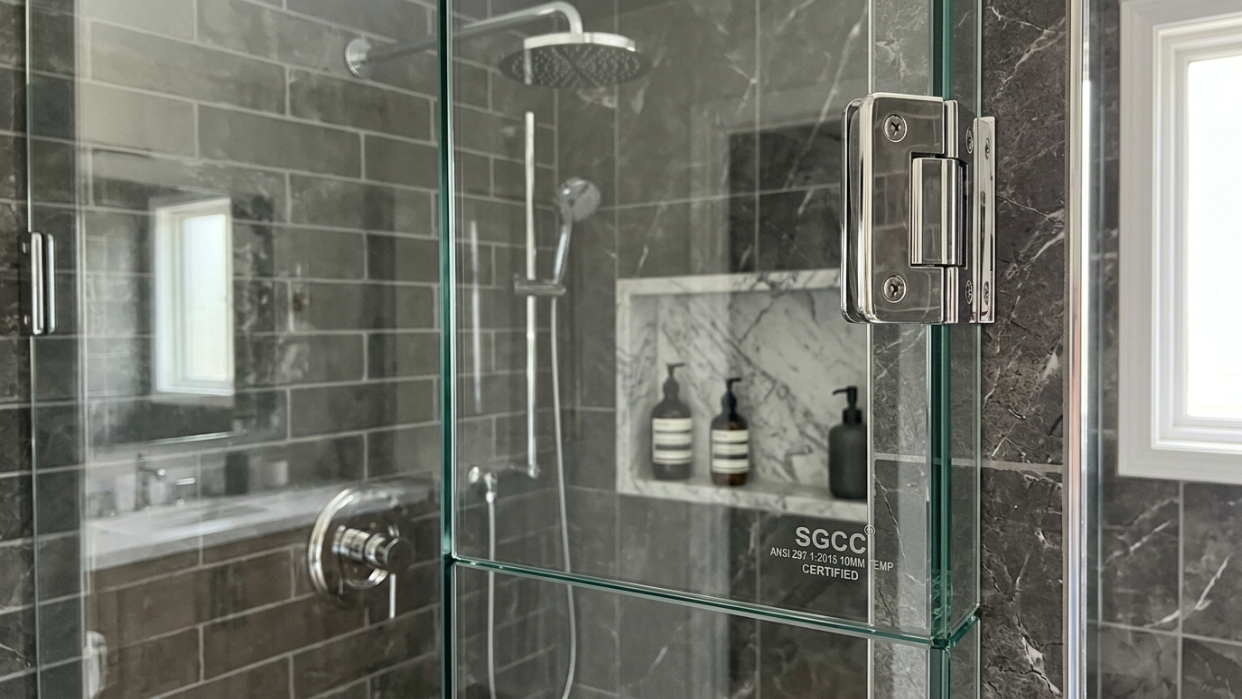
Tempered Glass (Safety Glass): Heat treated glass that’s about four times stronger than standard glass. It handles heat well, doesn’t harbor mold like fabric, and when it does break, it shatters into small, relatively dull pebbles rather than dangerous shards. U.S. building codes require tempered or laminated safety glass in all shower enclosures. This is not optional.
ANSI Z97.1: The American National Standards Institute safety glazing standard that governs shower door glass. It specifies performance requirements including impact resistance and fragmentation patterns. This standard has been adopted by the Consumer Product Safety Commission under 16 CFR 1201, making it federally enforceable.
SGCC (Safety Glazing Certification Council): The independent third party body that audits tempered glass manufacturers. SGCC performs unannounced audits twice a year at manufacturing plants, destroying sample glass to verify it meets both CPSC and ANSI standards. When sourcing shower doors, look for the SGCC label on the glass.
Glass finishes include clear (maximizes light and visual space), frosted (adds privacy), and textured or patterned (decorative while partially obscuring visibility).
Door Pros
- Exceptional durability. Quality tempered glass doors can last 10 to 30 years with basic maintenance.
- Superior water containment. Glass panels with proper seals keep water inside the shower far better than any curtain.
- Resale value boost. A frameless glass door signals “recently renovated” to buyers. Mid range bathroom remodels deliver 70% to 85% ROI, and shower doors are a visible part of that equation.
- Hygienic. Glass doesn’t harbor mold or mildew the way fabric and plastic do. A quick squeegee after each shower is all it takes.
- Modern aesthetics. Frameless glass opens sightlines and makes small bathrooms feel larger.
- Built in privacy. Frosted, rain textured, or patterned glass provides consistent privacy without any billowing, shifting, or gaps. The enclosure stays in place every time.
Door Cons
- Higher upfront cost. From $400 for a basic framed unit to $5,000 for a custom frameless enclosure.
- Professional installation usually required. Labor runs $150 to $600 depending on complexity and region.
- Hard water stain maintenance. Limescale buildup on glass is one of bathroom cleaning’s most persistent challenges. Those chalky white deposits form when minerals in hard water evaporate, and they’re stubborn to remove once established. A daily squeegee habit is the best prevention.
- Track cleaning (framed and bypass doors). Soap scum and grime accumulate in metal tracks and are tedious to clean. Frameless designs avoid this problem entirely.
- Less accessible for bathing small children. You can’t push a glass door fully out of the way like you can with a curtain.
- Repairs can be costly. When a seal fails or hardware loosens, replacement parts for frameless doors sometimes need to be ordered from the original manufacturer. A cracked tempered glass panel can’t be patched. It has to be replaced entirely, which can run $200 to $600 for the glass alone.
Shower Doors vs Curtains at a Glance
| Feature | Shower Door | Shower Curtain |
|---|---|---|
| Upfront Cost | High | Low |
| Lifespan | 10 to 30 years | 1 to 3 years |
| Water Containment | Excellent | Fair |
| Cleaning | Easy with squeegee | Frequent washing |
| Mold Resistance | High | Low |
| DIY Installation | Usually No | Yes |
| Resale Value | High | None |
| Privacy | Excellent (frosted/textured) | Variable |
| Ease of Repair | Moderate to difficult | Very easy |
| Best For | Homeowners | Renters |
| Style | Modern | Flexible |
| Maintenance Cost | Low | Moderate |
Head to Head Comparison: Shower Doors vs Curtains
This is the side by side breakdown covering every major factor in the shower doors vs curtains decision. Every data point is sourced from installer cost guides and industry research.
Cost: Upfront and Over 10 Years
| Factor | Shower Curtain | Shower Door |
|---|---|---|
| Upfront cost | $10 to $80 (curtain + rod + liner) | $400 to $3,000+ installed |
| Framed door installed | n/a | $400 to $1,200 |
| Frameless door installed | n/a | $600 to $1,900 |
| Custom frameless | n/a | Up to $5,000 |
| Installation labor | DIY, 5 minutes | $150 to $600 professional |
| 10 year amortized cost | $250 to $640 (replacing liner 7 to 8 times, curtain 3 to 4 times) | $400 to $1,900 (one time install, no replacement) |
The average shower door installation costs about $959, with most projects landing between $530 and $1,390. On the West Coast, where labor rates tend to run higher, professional installation averages $75 to $125 per hour, which is especially relevant if you’re remodeling in Washington State.
Here’s what many homeowners miss: a glass installer (Henderson’s Glass & Mirror) published an amortized cost analysis showing that over 10 years, the gap between curtains and doors narrows dramatically. A curtain setup replaced at realistic intervals in a humid climate costs $250 to $640 over a decade. A mid range framed door costs $400 to $1,200 once and never needs replacing.
The “curtains are cheaper” argument is only true in year one.
Durability and Lifespan
| Curtain | Door | |
|---|---|---|
| Liner life | 6 to 18 months | n/a |
| Curtain/door life | 1 to 3 years | 10 to 30 years |
| Replacement frequency | Multiple times | Rarely or never |
Shower curtains simply don’t stand the test of time. Even with diligent drying after each use, liners degrade, hooks corrode, and fabric stains. Glass doors, by contrast, can serve daily use for a decade or more without losing their clarity.
Maintenance and Ease of Repair
Curtains need regular washing (machine wash for fabric, wipe down for plastic) and vigilant drying. You’ll also replace the liner regularly and deal with mildew at the bottom hem. On the plus side, repairs are a non issue. A torn curtain or cracked ring costs a few dollars to fix, and any homeowner can do it in minutes. Several practitioners on Reddit note that this simplicity is exactly why curtains still dominate in rental properties and college apartments.
Doors need a daily squeegee to prevent hard water stains, plus periodic cleaning of hardware and seals. If you have framed or bypass doors, the tracks require attention too. Frameless doors are the easiest to maintain since there are no tracks or frames where grime can hide.
Where doors fall short is repair complexity. A worn rubber sweep or failing seal might seem minor, but finding the exact replacement part for a specific brand and model can take time. Frameless door hardware is not standardized across manufacturers, so you can’t always grab a universal replacement at a hardware store. And if a tempered glass panel cracks (rare, but it happens), the entire panel must be replaced. You cannot patch tempered glass. Practitioners on home improvement forums regularly point out that a cracked frameless panel replacement can cost $200 to $600 for the glass alone, not counting labor.
A survey by the Home Improvement Research Institute found that 78% of homeowners prioritize easy to clean features when choosing shower enclosures. That stat alone explains the market shift toward frameless glass, despite the trickier repair situation.
Privacy: Shower Doors vs Curtains
Privacy matters more than most comparison guides acknowledge. In shared households, multi generational homes, or bathrooms without a separate toilet closet, the shower enclosure is a real privacy boundary.
Shower curtains offer variable privacy. An opaque fabric curtain blocks visibility well, but a cheap translucent liner on its own doesn’t do much. And curtains can shift during use. The “shower curtain cling” effect (where the curtain billows inward and sticks to you) is annoying, but the opposite problem, where water pressure creates gaps at the edges, can compromise privacy if the bathroom door is open or another person is in the room.
Shower doors provide more reliable privacy, but it depends on the glass finish. Clear glass hides nothing. Frosted glass, rain glass, and textured patterns offer strong privacy while still letting light through. One designer on a YouTube bathroom walkthrough noted that rain glass has become the most requested privacy finish because it obscures the body effectively while maintaining the modern look of a glass enclosure.
For bathrooms shared by roommates or family members, frosted or textured glass doors are the better privacy solution. They stay in place, don’t shift, and provide consistent coverage. If a curtain is the only option, pairing an opaque fabric outer curtain with a PEVA liner gives the best combination of privacy and water protection.
Water Containment
Glass doors win this category decisively. A properly installed door with sweeps and seals keeps water inside the shower. Curtains billow inward from the shower spray, leave gaps at the sides and bottom, and allow water to escape onto the floor. Over time, repeated floor splash can damage bathroom flooring and the subfloor beneath it.
If you’re planning bathroom flooring alongside your shower enclosure, consider how your shower doors vs curtains choice affects moisture exposure. Our SPC flooring guide covers waterproof rigid core options that handle bathroom moisture well.
Aesthetics and Design Flexibility
Curtains offer unlimited pattern and color options. You can change them seasonally or whenever you redecorate. They suit eclectic, bohemian, or casual bathroom styles.
Doors, particularly frameless glass, create a clean, open, spa like aesthetic. They make small bathrooms feel larger by allowing sightlines to pass through uninterrupted. Contemporary homes are increasingly implementing frameless glass doors, with shower curtains declining in primary bathrooms.
When coordinating a full bathroom remodel, the shower enclosure needs to work with the vanity too. Our guide on choosing a bathroom vanity covers how to match these elements.
Home Resale Value
This is where the shower doors vs curtains debate gets financially interesting.
A bathroom remodel is considered one of the strongest investments for homeowners, delivering around 80% ROI. Midrange updates, including modern vanities, walk in showers, and updated fixtures, average 70% to 85% return.
A curtain in a master bathroom signals “hasn’t been updated.” A framed door reads as “original to the home.” A frameless door reads as “recently renovated” and meaningfully lifts the perceived value of the entire bathroom. If you’re renovating before selling, the door pays for itself in buyer perception alone.
For contractors coordinating full bathroom remodels, matching shower doors with the right countertop and cabinet selections creates a cohesive result. Our guide on matching quartz with cabinets covers that coordination process.
Health and Safety
Curtain health risks are underreported. PVC shower liners contain polyvinyl chloride and phthalates, materials linked to indoor air pollution. These chemicals release more readily when exposed to the high heat and humidity of a running shower, which is exactly when and where you’re breathing most deeply. Switching to a PEVA or EVA liner eliminates most of this concern at minimal extra cost.
Door safety is well regulated. All shower glass sold in the U.S. must be tempered or laminated safety glass per building code. Tempered glass undergoes a fragmentation test confirming it breaks into small, dull pieces that minimize injury risk. The SGCC certification label on the glass confirms third party verification of these standards.
Accessibility
For families with small children, a curtain is often more practical. You can push it fully out of the way to reach in and scrub a toddler. Practitioners who write about family bathroom design point out that glass doors, even wide opening ones, create a barrier that makes bathing small kids more awkward.
On the flip side, for households with elderly family members or anyone with mobility issues, a frameless glass door with a wide opening can actually be safer than a curtain. A curtain rod can pull down if someone grabs it for balance. A properly mounted glass panel won’t move.
How to Replace a Shower Curtain with a Glass Door
Switching from a curtain to a glass door is one of the most common bathroom upgrades, and one of the most searched questions in the shower doors vs curtains debate. The process is straightforward for a professional but has a few steps that homeowners should understand before committing.
Step 1: Measure the Opening
Measure the width and height of the shower or tub opening in at least three places (top, middle, bottom for width; left, center, right for height). Walls are rarely perfectly plumb or level, and even 1/4″ of variance matters for a glass door. Framed doors are more forgiving of slight irregularities. Frameless doors require near perfect alignment, and if walls are significantly out of plumb, shims or wall prep may be needed before installation.
Step 2: Choose the Door Type
For a standard tub shower combo, a sliding bypass door is usually the simplest and most cost effective replacement. It requires no swing clearance and fits the existing opening without structural changes. For a walk in shower, a pivot or hinged door offers a wider opening, but you’ll need to confirm there’s enough floor space for the swing arc.
Step 3: Check Wall Structure
This step gets overlooked constantly. Frameless doors with 3/8″ to 1/2″ glass are heavy. The hardware that holds them (clamps, hinges, header bars) needs to anchor into solid blocking or studs, not just drywall. If the existing walls are tile over drywall with no blocking behind them, additional wall prep may be required. A contractor can assess this quickly during a site visit.
Step 4: Remove the Curtain Hardware
Take down the tension rod or mounted rod, patch any screw holes, and clean the area. If the rod was a tension fit, there’s nothing to patch. If it was wall mounted, fill the holes with spackle and touch up the paint or tile grout.
Step 5: Professional Installation
Most homeowners hire a professional for this step. Installation for a basic framed bypass door on a standard tub takes two to four hours. A custom frameless enclosure may require a templating visit first, with the actual installation happening on a return visit one to two weeks later. Expect to pay $150 to $600 for labor depending on the door type and your region.
Practitioners on Reddit’s home improvement forums frequently advise getting at least three quotes, noting that pricing varies widely between glass shops, big box store installers, and independent contractors. One commenter in a popular thread noted a $700 spread between the lowest and highest quote for the same frameless door in a mid sized city.
What About Going the Other Direction?
Replacing a glass door with a curtain is far simpler. Remove the door and hardware, patch and waterproof any holes left in the tile or walls, install a tension rod, and hang a curtain with liner. The whole job takes under an hour. This sometimes makes sense when converting a primary bathroom to a kid friendly bathroom, or when staging a rental between tenants.
For broader bathroom renovation planning, our bathroom remodel checklist walks through every phase of the project.
Which Option Is Best for Different Types of Bathrooms?
Choosing between shower doors vs curtains depends heavily on the specific bathroom and how it’s used. Here’s how the decision breaks down by room type.
Primary Bathroom
Frameless or semi frameless doors are the strongest choice here. This is the bathroom that gets daily use, that buyers evaluate first, and that sets the tone for the entire home’s perceived quality. A glass door makes the space feel finished and modern.
Guest Bathroom
A curtain often offers the best value. Guest bathrooms see light use, and spending $1,500 on a frameless door for a space used twice a year is hard to justify. A quality polyester curtain with a PEVA liner looks clean and costs under $50.
Rental Property
Curtains are usually the practical option because tenants can replace them inexpensively. Glass doors in rentals carry the risk of damage, and replacement costs fall on the landlord. That said, some landlords of higher end rentals install framed bypass doors to elevate the unit’s appeal. Our guide on cabinets for rental properties applies similar logic to other fixture decisions in investment properties.
Luxury Remodel
Frameless glass almost always wins. It’s the expected standard in high end bathrooms, and anything less can feel like a compromise in an otherwise premium space.
Family Bathroom
Depends on children’s age. With toddlers, a curtain makes bath time easier. Once kids are old enough to shower independently (usually around age 6 to 8), a glass door becomes the better long term investment.
When to Choose a Curtain vs. a Door: The Decision Framework
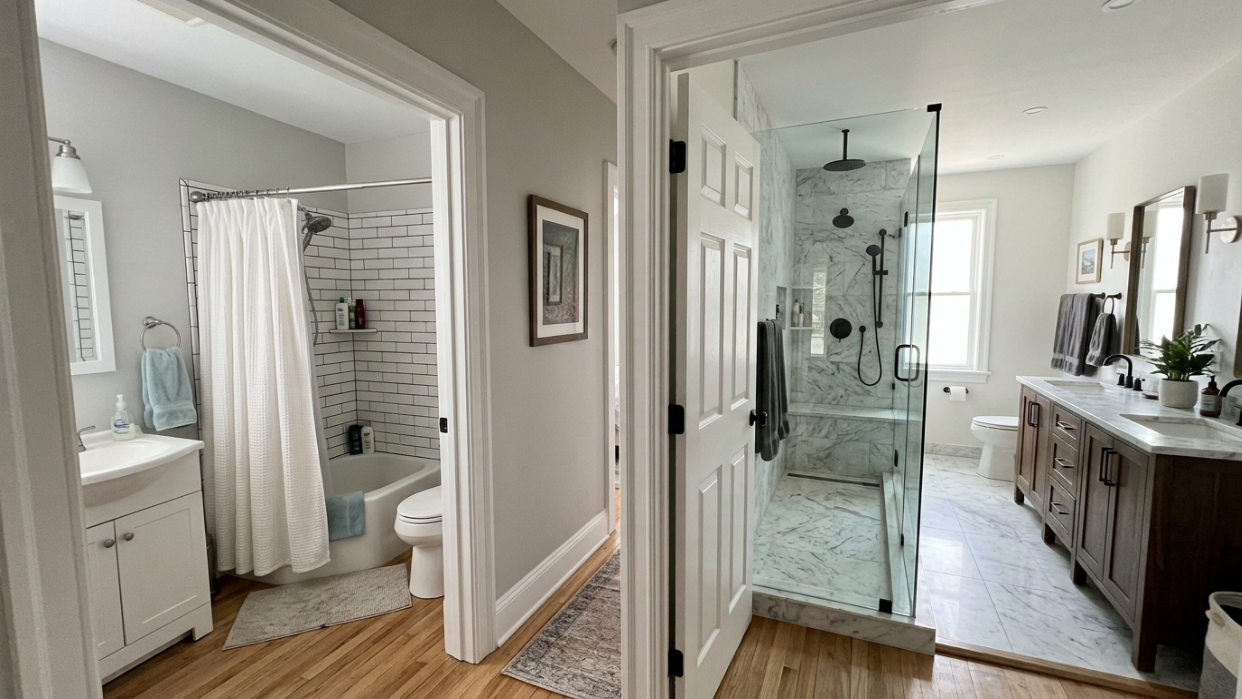
Rather than leaving you with “it depends,” here’s a clear matrix for resolving the shower doors vs curtains question based on your specific situation.
Choose a Shower Curtain If:
- You’re renting. Installing a shower door counts as a permanent modification. Curtains are removable and leave no trace. This is the clearest case for curtains, and it’s barely discussed on most comparison sites.
- Budget is the top priority right now. If spending $400+ on a shower enclosure isn’t feasible this year, a quality PEVA lined curtain keeps your bathroom functional for under $50.
- You have a tub shower combo with small kids. The ability to push the curtain completely aside for bath time is a real practical advantage.
- It’s a guest bathroom. Secondary bathrooms get light use. Spending $1,500 on a frameless door for a bathroom guests use twice a year is hard to justify.
- You enjoy frequent style changes. A new curtain is the cheapest way to refresh a bathroom’s look.
Choose a Shower Door If:
- You own the home. Doors are a long term investment that pays back in durability, aesthetics, and resale value.
- It’s the primary bathroom. This is the bathroom buyers look at first. Glass doors signal quality.
- You’re planning to sell within five years. The resale value bump from a modern shower door, especially frameless, is one of the highest ROI bathroom upgrades available. For more on how updates affect home value, see our guide on kitchen updates and home value.
- Your bathroom is small. Counterintuitively, a clear glass enclosure makes a small bathroom look bigger by keeping sightlines open. A curtain visually divides the room.
- Hygiene and water containment matter. If you’re tired of mopping up water outside the tub or scrubbing mildew off a liner, glass solves both problems.
- Privacy is a concern. Frosted or textured glass provides reliable, consistent privacy that a shifting curtain can’t match.
- You want to avoid common remodel mistakes. Over investing in aesthetics while ignoring function (or vice versa) is a frequent pitfall. Our guide on remodel mistakes to avoid covers this thinking more broadly.
Consider Using Both
Many homes benefit from a mixed approach: glass doors in the primary bathroom where they boost value and daily experience, curtains in secondary or guest bathrooms where budget efficiency makes more sense.
What Contractors and Designers Should Know
If you’re a trade professional speccing shower enclosures for clients, a few practical considerations go beyond the homeowner facing comparison.
Door type affects project scope and timeline. A framed bypass door on a standard tub is a half day install. A custom frameless enclosure on a neo angle shower might require templating, a return visit for installation, and coordination with tile work. Build this into your project timeline and client expectations.
Material coordination matters. The shower enclosure doesn’t exist in isolation. It needs to work visually and functionally with the tile, flooring, vanity, and countertop selections. A frameless glass door paired with large format porcelain tile and a quartz countertop creates a cohesive modern look. Mixing a barn style door with traditional framed cabinets can create visual tension unless handled deliberately. Our guide on quartz vs. granite countertops helps with surface material decisions in these coordinated remodels.
Glass thickness dictates hardware and wall prep. Frameless doors use 3/8″ to 1/2″ glass that’s significantly heavier than the 1/4″ glass in framed doors. The wall structure and blocking need to support the weight of heavy duty clamps and hinges. Confirm wall conditions before committing to frameless for a client.
West Coast labor rates are above national averages. If you’re working in the Seattle metro, Tacoma, or Spokane areas, factor $75 to $125 per hour for installation labor when quoting shower door projects.
Repair planning matters for client satisfaction. Inform clients upfront that frameless door hardware is often manufacturer specific. Keeping a record of the door brand, model, and hardware specs in a project binder saves headaches years later when a seal or sweep needs replacing.
For trade professionals sourcing shower doors alongside cabinets, countertops, and flooring for a complete bathroom remodel, consolidating suppliers saves time and coordination headaches.
Contact Krafter’s Land for trade pricing on shower doors and coordinated bath remodel materials across our Washington State showrooms.
Common Mistakes People Make When Choosing Shower Doors or Curtains
People often focus only on the purchase price and ignore replacement costs over the next decade. Others choose frameless glass without checking whether their walls are sufficiently plumb, or buy inexpensive PVC liners without realizing they can off gas VOCs.
Another common mistake is installing a swinging shower door in a small bathroom where it interferes with the toilet or vanity. Measuring carefully and considering long term maintenance usually leads to a better investment.
Skipping the privacy question is another frequent oversight. Homeowners install clear glass doors, then realize they need a solution for shared bathroom situations. Choosing the glass finish at the time of purchase is far simpler (and cheaper) than trying to add a privacy film after the fact.
Finally, failing to document the door’s make and model creates problems down the road. When a seal or hinge needs replacing five years later, knowing the exact specifications makes the difference between a $30 part swap and a $500 guessing game. Our bathroom remodel checklist includes a documentation phase that covers exactly this.
Quick Reference Glossary Index
ANSI Z97.1: The U.S. safety glazing standard governing shower door glass, adopted by the CPSC under federal regulation 16 CFR 1201.
Barn Style Door: A sliding glass shower panel on an exposed top track with visible rollers and no bottom rail.
Bypass Door: See Sliding Door.
EVA: Ethylene vinyl acetate, a PVC free plastic used in non toxic shower curtain liners. Often marketed interchangeably with PEVA.
Frameless Shower Door: A door using thick tempered glass (3/8″ to 1/2″) held by clamps and hinges only, without a surrounding metal frame.
Framed Shower Door: A door with aluminum or stainless steel framing surrounding all glass panels.
Hinged Shower Door: A door mounted on side hinges that swings open in one direction, like a standard room door.
PEVA: Polyethylene vinyl acetate, a chlorine free alternative to PVC used in safer shower curtain liners.
Pivot Shower Door: A door that swings on pivot points at the top and bottom of the panel, capable of opening both inward and outward.
PVC (Polyvinyl Chloride): A plastic commonly used in budget shower curtain liners, associated with VOC off gassing and potential health risks.
Semi Frameless Shower Door: A hybrid with partial framing along some edges while the door panel remains unframed.
SGCC: Safety Glazing Certification Council, the third party body that audits manufacturers to verify tempered glass meets safety standards.
Shower Liner: A waterproof inner curtain (typically plastic or EVA) hung behind a decorative curtain to block water.
Sliding (Bypass) Door: Two or more glass panels that slide horizontally on a track, ideal for tub shower combos.
Tempered Glass: Heat treated safety glass required by code for shower enclosures, approximately four times stronger than standard glass.
Frequently Asked Questions
Are shower doors better than curtains for small bathrooms?
Yes. Clear glass doors allow your eye to travel through the entire room, making the space feel larger. A curtain, especially a dark or patterned one, visually cuts the room in half. Sliding bypass doors are particularly good for small bathrooms because they don’t need swing clearance.
How much does it cost to replace a shower curtain with a glass door?
Expect to spend $400 to $1,900 for most installations. A basic framed door runs $400 to $1,200 installed, while a frameless door costs $600 to $1,900. Custom frameless enclosures can reach $5,000. The national average for shower door installation is about $959. The process involves measuring the opening, choosing a door type, checking wall structure, removing old hardware, and hiring a professional installer.
Do shower doors increase home value?
They do. Bathroom renovations deliver among the highest ROI of any home improvement, averaging 70% to 85% for midrange updates. A frameless glass door in a primary bathroom is one of the most visible signals of a modern, well maintained home. Curtains in a master bath, by contrast, suggest the space hasn’t been updated.
Are PVC shower curtains toxic?
PVC curtain liners can release volatile organic compounds, especially when new and when exposed to steam and heat. Research has shown VOC levels reaching 16 times allowable indoor air quality thresholds within six hours of unwrapping a new PVC liner. Switching to a PEVA or EVA liner avoids most of these concerns.
How long do glass shower doors last?
With proper maintenance, quality tempered glass shower doors last 10 to 30 years. The glass itself doesn’t degrade. The components most likely to need attention are the seals, sweeps, and hardware, which can be replaced individually without replacing the entire door.
Can I install a shower door myself?
It depends on the type. A simple framed sliding door on a standard tub is a manageable DIY project for someone comfortable with a drill and level. Frameless doors are a different story: the glass is heavy (3/8″ to 1/2″ thick), precise measurements are critical, and improper installation can compromise both safety and water containment. Professional installation is strongly recommended for frameless enclosures.
What type of glass is required for shower doors?
U.S. building codes require tempered or laminated safety glass in all shower enclosures. Tempered glass is the standard choice. It meets ANSI Z97.1 requirements and is verified by the SGCC through unannounced factory audits. When shopping for shower doors, check for the SGCC certification label on the glass.
Should I choose frameless or framed shower doors?
Frameless doors look sleeker, are easier to clean (no tracks), and add more resale value. Framed doors cost 30% to 50% less and are more forgiving of slightly out of plumb walls. Semi frameless splits the difference. Your budget and the bathroom’s aesthetic direction should drive the decision. For a deeper look at how framed vs. frameless thinking applies across remodeling decisions, see our framed vs. frameless guide.
Which option offers better privacy, shower doors vs curtains?
Frosted or textured glass shower doors provide the most reliable privacy because they don’t shift, billow, or leave gaps. An opaque fabric curtain can work well too, but it needs a separate waterproof liner and tends to move during use. Clear glass doors offer no privacy at all. If privacy matters, choose frosted or rain glass at the time of purchase rather than trying to add film later.
How hard is it to repair a shower door vs a curtain?
Curtains are the clear winner on repair simplicity. A torn curtain or broken ring costs a few dollars and takes minutes to fix. Shower door repairs are more involved. Worn seals and sweeps are relatively inexpensive but can be hard to source for specific models. A cracked tempered glass panel cannot be repaired and must be fully replaced, typically costing $200 to $600 for the glass plus installation labor.